Likes
Comments
Share
10/10 smoke if you don’t mind that minty taste
Likes
93
Share
Hi guys, What's up? Welcome back to Queen Peaky's Flower Gardens we immediately got busy repotting our autoflowers before giving them some heavy stress!
Likes
47
Share
@ElNass
Follow
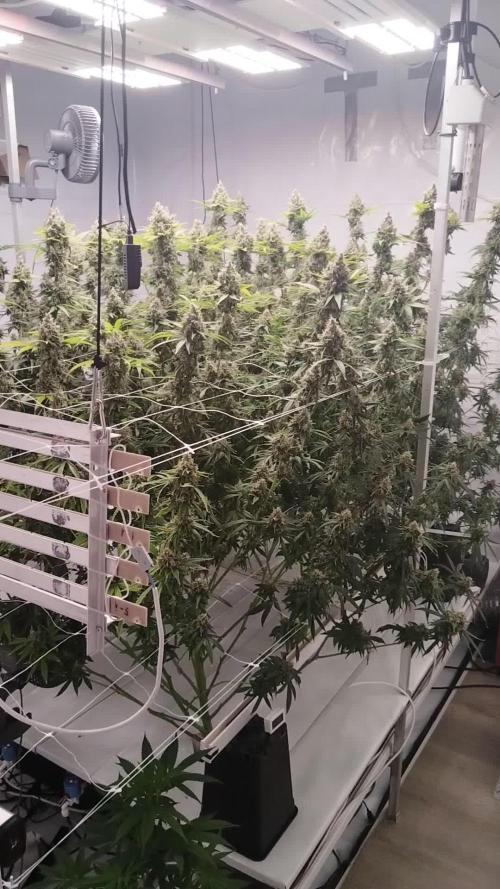
🌱 General Development White Russian had a more eventful week. She reacted to light intensity and showed first signs of top bleaching, so I raised the lamp slightly, which immediately helped. Buds are chunkier than Bubblegum and stacking more aggressively, with a classic frosty look. 🌿 What I Did This Week • Raised the light to prevent bleaching and heat stress on top colas. • Enzyme tea (light) to boost microbial activity and help the plant handle the mid-flower nutrient demand. • Adjusted irrigation to 5–6 L, keeping the soil evenly moist. • Checked worms under the avocado → great activity, soil thriving. ⚠️ Issues Noticed • Some upper sugar leaves slightly yellowing → normal light stress + high metabolism in mid-flower. • A few lower leaves yellow → absolutely normal for Week 5–6 flower in living soil. Nothing alarming, the plant is stable and responding well. 📈 This Week’s Progress • Buds thickened significantly. • Aroma stronger; more citrus/spice notes coming through. • Resin production clearly increasing. • Structure tightened after the light adjustment. ✨ Closing Note White Russian is definitely the more vigorous one this cycle. After raising the light she bounced back instantly. Buds are swelling, resin is coming, and the canopy looks incredibly uniform. Next week should be her “sparkle moment.” ❄️🔥 #livingsoil #organic #scrog #season2 #seriousseeds #ledgrow #nemessis200w #elnassgrow
Likes
5
Share
Here we grow! These are clones of Mandarin Cookies, rooted in peat plugs, under low light T5 Sunblaster 24w, inside a dome, keeping humidity levels high.
Likes
11
Share
bueno hemos iniciado el dia de hoy con un transplante final de cada de estas niñas las he transplantado a un sustrato propio hecho por mi con los suficientes minerales y propiedades para qeu este cultivo sea una locura , solamente estoy con pulverixador
Likes
1
Share
13/08/2025 19:30 Sun came back strong with super harsh climate,so the plants are suffering a bit because of underwatering Gorilla z had a bit of defoliation with some leaves yellowing the buds are bumping nice Frostbanger needs some defoliation too but i think it's gonna be next week ,altough buds are becoming frostier and frostier Apricot and Coco milk handled well the bad transporting and transplanting Having some problem with insects as you can see Hope i can fight them with no problems 16/08/2025 19:35 Good moisture level the pot had some water when i came,the gorilla Z Is the only one Who drinks a lot maybe because of the 20l pot Finally gorilla Z Is frosting ,the buds are becoming densier and the smell now Is noticeable,straight tropical Candy z terps unbelievable for a guerrilla grow Frostbanger seems to have not the best buds to leaf ratio,but the quality is dank The buds are like an indoor photoperiodic weed and i think It has at least a month to go🤯 Smell Is very citrusy with a creamy gassy undertone Apricot auto now into the flowering stage ,the plant Is small but i think Is going to be good as It Is sativa dominant Coco milk developing good seems like i did lst but the plant did this all herself ,maybe 5 days and will start to produce flowers 2 Coco fresh just transplanted in the same pot,not the best transplantation i have to say,hope they handle well like the others Neem oil sprayed all around the more i can except on the weed plants Next week it's gonna be rainy maybe i will get no update
Likes
28
Share
Growing pretty well so far. I'm excited for this to be a good daytime strain to keep me motivated, in a good mood and hopefully not anxious. She'll be going outside so I'm strengthening her stem so she'll be able to handle outdoor stresses.
Likes
9
Share
J attend de voir combien je vais trouver sur la.balance . A savoir que j avais réalisé une croissance plus courte que les autres filles . Mais elle m a donné des buds super denses et super givrée elle sent magnifiquement bon . Je ferais une Maj apres l avoir manucuré et
Likes
4
Share
Likes
18
Share
@djghost
Follow
So alles schön getrocknet ergebniss auf der wage ist ok aber nicht das beste aber die qualität ist 1a 2 von 3 phenos waren rot 1 ganz normal grün und schmeckt eher nach Skunk die anderen 2 sehr fruchtig halt wie beschrieben. 1g pro 1 watt trocken gewicht ......
Likes
4
Share
Buenas a tod@s... Vamos llegando al final de este cultivo, es verdad q al principio hubo algunas carencias pero de a poco fuimos solucionando todo, hoy en día están grandes, fuertes y absorben muy bien los nutrientes, en resumida cuenta están espectaculares... En 2 semanas aproximadamente ya estarán listas... Buenos humos para tod@s... 💨💨🤗😱 🇦🇷😎💀
Likes
14
Share
Day 21. Looking good, been giving her general Hydroponics maxigro. Best all in one fertilizer on the market. Day 22. Lst and hst, removing 1 or 2 leafs per day to open her up. Day 27. Supercropped main cola. Looking good.
Likes
55
Share
@w33dhawk
Follow
03.05.21 hab heute morgen die Pflanzen alle einmal durch gespült mit klarem Wasser ohne irgendwas natürlich Ph eingestellt auf 6,5 hoffe das das mein Problem behebt mal sehen wie sich die Ladys die Woche so schlagen. Werde dann wenn alles gut läuft mit halber dosis green sensation weiter fahren sowie ca halber dosis sugar royal, blüte dünger fällt erstmal weg bis aufs erste...... 04.05.21 heut stand nix an ausser beobachten der Ladys Töpfe sind noch gut feucht vom spülen hab fast 65% rh im Zelt In der Nacht ist nicht so toll aber muss ich durch Wetter ist auch beschissen was dem ganzen auch noch zu steuert zum kotzen...... 05.05.21 die Pflanze scheinen sich einigermaßen von der überdüngung zu erholen, ich hab das gefühl das die blüte weiter an schwillt auf der linken Seite. Gelato # 1,2 und 3 sind jetzt auch seid gestern dabei ihre stigmas in caramel zu verwandeln. Kann es kaum noch erwarten zu spülen und dann in den Endspurt zu kommen aber bis dahin sind noch ein paar Wochen..... 06.05.21 heute stand mal wieder nix an ausser mich an meinem Ergebnis bis jetzt zu erfreuen hab mir auch heute schon mal Gedanken für die nächste Runde gemacht werde wohl beim nächsten Grow mal nur mainlaining machen ohne netzt ach ja und es wird auf den Wunsch meiner Frau 4x purps og die Kaffee caramel lady.... 07.05.21 heute stand mal Die erste terp Kontrolle bei gelato 41 #2 an und siehe da es sind schon einige milchig dazwischen aber noch nix bernstein würde schätzen das ca 60% milchig sind und 40% noch durchsichtig also noch zeit bis zur Spülung hab mir heute gedacht ich zeige mal die Höhe der buds im Durchschnitt linke Seite ca 20 cm rechte Seite ca 10 cm der Geruch der Ladys ist eigendlich garnicht so typisch stechen nach Cannabis solange ich die Ladys nicht bewege sprich gegen die röhre vom Netz komme das bisschen wackeln am netzt lässt sie sofort stinken wie ein stinktier als würde sie versuchen mich zu vertreiben oder meine Aufmerksamkeit auf sich ziehen...... 08.05.21 heute stand auch wieder mal nur das beobachten und begutachten der buds an ich kontrolliere fast täglich auf schimmel und dieser Geruch ist einfach traumhaft heute hat er mich dazu verleitet zum Eis laden zu gehen und mir erstmal Haus gemachtes Eis zu kaufen ich werd noch fett wegen der Sorte dieser Duft macht hungrig auf süßes....... 09.05.21 endlich wieder eine Woche rum kann es kaum noch erwarten zur Spülung zu kommen dann kann ich endlich einen genauen Zeitpunkt für den cut festlegen und mich neu sortieren für die nächste Runde gibt so eine schöne Aussage die ich in meinem grow Buch gelesen habe "kiffen macht nicht süchtig, growen aber schon" ich persönlich empfinde es ganau so. Ich bin schon richtig Heiss darauf neu zu beginnen, während meine Frau einfach nur Heiss aufs Endprodukt ist.....
Likes
14
Share
Vamos familia primera semana de estás Punch pie de RoyalQueenSeeds. Que ganas tengo de ver el progreso de esta variedad, las plantulas están sanas, se ven con buen color. La cantidad de agua cada 48h entre riegos. Esta primera semana ya añadimos nutrientes, estas próximas semanas veremos cómo avanzan. Mars hydro: Code discount: EL420 https://www.mars-hydro.com/ Agrobeta: https://www.agrobeta.com/agrobetatiendaonline/36-abonos-canamo Hasta aquí todo, Buenos humos 💨💨💨
Likes
2
Share
67 days since April 16th, 2026 We become aware at such times of man's wonderful ability to bring seemingly unrelated elements into harmonic balance, and receive a glimpse into a world where everything exists in conscious sympathetic attunement to everything else. When we listen to a piece of music that seems to strike a beautiful chord somewhere inside us, or view a painting that simply glows with harmonic awareness well executed, we probably do not spare much time to contemplate the wonderfully intricate combination of vibrations that our sensors make it possible for us to perceive. We tend to appreciate the relationship between the parts of something by an awareness of the harmony or dissonance of the whole. This ability enables us to say "what a beautiful house!" instead of "analysis has proven that this collection of building materials exhibits certain elements of harmonic proportion." While this ability to instinctively appreciate the beauty of true harmony has an important role to play in evolution, a more analytical understanding of the laws involved can be most useful. This is especially so if we wish to create works of art where each part exists in true harmony, not only with the other part of that particular whole, but with the universe within which the creator and the created exist. Everything vibrates. From the most dense matter to the most subtle cosmic rays, everything which our senses allow our thoughts to become aware of, can be specified in terms of wavelength or frequency of vibration. These two terms define the same thing, but from different points of view. The following are the approximate wavelengths of various energy carriers: Cosmic rays 0.000,000,001 mm Gamma rays 0.000,000,1 mm X rays 0.000,500 mm Ultraviolet rays 0.003 mm Visible light 0.006 mm Infrared 0.01 mm Sound waves 1 meter Radio waves 300 meters Violet light 400 nm to 450 nm Blue light 450 nm to 500 nm Green light 500 nm to 570 nm Yellow light 570 nm to 590 nm Orange light 590 nm to 610 nm Red light 610 to 700 nm 1 nanometer (nm) = 0.000,000,1 cm = 1/10,000,000 cm If a guitar string is plucked and we hear a sound, it is not too difficult for the human mind to associate this sound with the vibration of the guitar string. With color it is quite different. It is difficult for us to conceive that the color of a substance is not an inherent property of the substance itself, but an indication picked up by our senses of that substance's ability to absorb or reflect the light which happens to be shining on it at that moment. Neither the matter nor the light is colored. What happens is that the brain learns to differentiate between the frequencies reflected or transmitted by the substance the eyes are focused on. The same thing happens with sound. When we say "Oh! Listen, they're playing my favorite song," what we really mean is: "My brain has stored within it a particular pattern of frequencies. I have compared the new information being received with this stored pattern and have deduced the answer that the two patterns are similar within certain specified tolerances." The 'pleasure' involved could have something to do with our running the pre-recorded pattern at the same time, in 'sympathy' with the new pattern as it is received. The word sympathy describes very well our ability to appreciate color and sound. It also describes the reason behind certain elements of harmony. For instance, if a substance vibrating at 100 cycles per second (tone 1) is in the proximity of another substance vibrating at 200 cycles per second (tone 2), we could perceive, if we had the right equipment, a certain sympathetic relationship between the two. We will see from this that there is a uniform doubling of the first tone seen in the second. At various points along the waves, the two are the same in amplitude. At other points, they are at opposite poles to each other. This doubled frequency has more points of similarity to the original than any other frequency except the original itself. If the equipment we had available for measuring these two frequencies was a soundboard amplifier and a pair of ears, then we would hear what would sound to us like one tone. If we had the opportunity to hear one at a time, we would hear that although they sound the same, one is higher in pitch than the other. This characteristic of 'the same but different in pitch', musicians have called the octave. Any two tones produced where one has exactly doubled the frequency of the other is called an octave. Speaking in ratios, an octave would appear then as the ratio 2:1 or 1:2, depending on whether we are talking of an octave up or down. A single note produced by almost any instrument will contain more than one wavelength or frequency. It will have a dominant frequency, the wavelength of which we would call the note's 'fundamental' or 1st harmonic. It will also have a varying number of upper harmonics, gradually fading in intensity into infinity or silence. Natural harmonics always have the same pattern of intervals between them. The interval between the 1st and 2nd harmonic is a perfect octave; between the 2nd and 3rd a perfect fifth; between the 3rd and 4th a perfect 4th; and so on, the intervals becoming smaller and smaller until they lose any relationship with the western 12 tone scale as it exists at the moment. Just as an octave has certain elements of sympathy with its fundamental, so some intervals have been noted to be more perfectly in sympathy with the fundamental than others. The ratio of the 'perfect 5th' or interval of 7 semitones, as it occurs in the harmonic series, is 3:2 or 2:3, while that of the 'perfect fourth" is 4:3 or 3:4. All the tones in the western 12 tone scale can be expressed in terms of the ratio between the upper tone and its fundamental. This would seem to be an ideal way of generating a scale from any given fundamental and several attempts have been made to do this, the Pythagorean system being probably the most well known. Although when working with a single tone instrument playing on its own, the Pythagorean formula works wonderfully well, if we had several instruments tuned this way together and asked them to play almost any western music, we would find that at times they sounded quite out of tune to each other. The lack of flexibility of the various scale systems based on the harmonic series has led to what is known as the 'tempered' scale. This uses as its primary unit of interval the ratio of the octave or 2:1. It then proceeds to divide the interval between any fundamental and its upper octave into 12 smaller intervals by applying the ratio: two to the one-twelfth power, to one (21/12:1). This equals 1.059463094, so by multiplying any frequency by this number, we will obtain the tempered semitone next up from our fundamental. We will also find that any tone twelve semitones up from any other tone, in a scale generated in this way, will have exactly double the frequency. If we took the note middle C on a piano and halved the wavelength, we would have the note C one octave above. If we halved this, we would have the C above, and so on. However, within about 6 octaves, we would find that although a 'sound' was being produced, no human ear could perceive it. If we kept on going, halving and producing upper octaves of our fundamental C, we would proceed through the infrared band, into the visible light spectrum. If we happened to be outside during the day, we would, for one octave only, see the note C with our eyes. The next octave above would already be in the ultraviolet band, and outside the eye's sensitivity range. If we can think of color as being an indication of a substance's vibratory rate or wavelength, we may begin to see a relationship that could exist between the color and sound spectrums. The logical extension of what has so far been said is that there exists a scale in the color spectrum that corresponds exactly to the scale in the sound spectrum, each color tone being an octave of the equivalent note in the sound range. This is not the end of the story but only the beginning. If we can for the moment accept that any wavelength in one band has upper and lower octave stretching out to infinity, then the next question is 'fine, but what shall we use as our fundamental? A particular color? A particular sound frequency?' The musicians among us will probably say 'A 440'. This means that the note A should vibrate at 440 Hertz, or 440 times per second. They would tell us that this is standard pitch has been adopted by most orchestras around the world; pianos are tuned to it, instruments are constructed to formulas based on it, and so to them it would probably seem the most appropriate place to begin. Some of these musicians may know of the battle that is still raging with regards to this being the standard, but few would know why A = 440 Hz was chosen except that it worked when it was set to be a suitable compromise between the many different pitches in use at the time. 432 Hz is said to be mathematically consistent with the patterns of the universe. Studies reveal that 432 Hz tuning vibrates with the universe’s golden mean PHI and unifies the properties of light, time, space, matter, gravity, and magnetism with biology, the DNA code, and consciousness. When our atoms and DNA start to resonate in harmony with the spiraling pattern of nature, our sense of connection to nature is said to be magnified. Another interesting factor to consider is that the A=432 Hz tuning correlates with the color spectrum, while the A=440 Hz is off. Audiophiles have also stated that A = 432 Hz music seems to be non-local and can fill an entire room, whereas A=440 Hz can be perceived as directional or linear in sound propagation. Once you adopt the idea that sound (or vibration in general) can have an equalizing and harmonizing effect (as well as a disturbing effect), the science of harmony can be applied to bring greater harmony into one's life or tune to specific energies. There is a form of absolute and relative harmony. Absolute harmony can, for example, be determined by the tuning of an instrument. The ancients tuned their instruments at an A of 432 Hz instead of 440 Hz - and for a good reason. There are plenty of music examples on the internet that you can listen to in order to establish the difference for yourself. Attuning the instrument to 432 Hz results in a more relaxing sound, while 440 Hz slightly tenses up the body. This is because 440 Hz is out of tune with both macro and micro cosmos. On the contrary, 432 Hz is in tune. To give an example of how this is manifested microcosmically: our breath (0,3 Hz) and our pulse (1,2 Hz) relate to the frequency of the lower octave of an A of 432 Hz (108 Hz) as 1:360 and 1:90. It is interesting to note that 432 Hz was the standard pitch of many old instruments and that it was only recently (19th and 20th century) the standard pitch was increased. This was done in order to be able to play for bigger audiences. Bigger audiences (more bodies) absorb more of the lower frequencies, so the higher pitch was more likely to “cut through”. One of the oldest instruments of the world is the bell ensemble of Yi Zeng (dated 423 BC), tuned to a standard F4 of 345 Hz, which gives an A= 432 Hz. The frequency of 345 Hz is that of the platonic year! Similarly, many old organs are tuned in A=432 as well; for example, St. Peter’s Capella Gregoriana, St. Peter’s Capella Giulia, S. Maria Maggiore in Rome. Maria Renold’s book “Intervals Scales Tones and the Concert Pitch C=128 Hz” claims conclusive evidence that 440 Hz and raising concert pitch above scientific “C” Prime=128 Hz (Concert A=432 Hz) disassociates the connection of consciousness to the body and creates anti-social conditions in humanity. The difference between concert pitch A=440 Hz and Concert A=432 Hz is only 8 cycles per second, but it is a perceptible difference of awareness in the human consciousness experience of the dream we share called existence.
Likes
10
Share
*** update, 7/23. Girls are very happy today. Another day with no afternoon sun. Thank goodness I hung a light above them or I would be dealing with some light starved ladies but as it is they are chugging right along. Another day that I won’t have to worry about watering them thanks to the Roots Organic Formula 707 soil, stuff is making me a believer. Really healthy plants on their way into flower by the next weeks update I’m sure. Strong well pronounced female organs I hope mean big buds later on down the line. The Harvey Wallbanger is coming on strong, now the second tallest. She still has not produced a fan leaf with more than five points on it, all 5’s or 3’s. The Vanilla Fizz I still think will enter flower first as the other two are still producing opposite nodes and are not staggered yet. The 91 Grapes stinks!! Not even in flower yet but stinks, very chemmy.
Likes
13
Share
@Droot
Follow
have had some temperature problems with the change of the season but i think im dialed in now. this first run really has been trial and error. but so far the buds are swelling nicely. zkittles has more bud sites, and is taller and bushier. blue dream buds are already bigger than zkittles
Likes
2
Share
Morning of day 14- tops look dry but it’s just the very surface. They took a little longer than I wanted to dry out. The weather has been cold windy and rainy, not much sun lately, and we are still about a month away from our potential last frost date. Farmer’s Almanac says last frost date is May 30th or something crazy, even though the days are normally rather warm by now. I haven’t fed as of Day 14 because they are not dry enough, there is plenty of amendments in the pot, especially towards the bottom, except I will still spoon feed a little bit. I just rehydrated the tops as they were really dry at least 1-2 inches of the tops were dry, but the bottoms are still plenty wet, so with clean water in a spray bottle, I just lightly rehydrated the top a lil, so I might be feeding tomorrow for day 15, but I don’t know yet. Keeping the tent around 80 degrees Fahrenheit, and only about 25-30% RH. This helps me compensate for the lack of heat provided by the LEDs and help the plants adapt to a higher water demand. I haven’t seen the low humidity effect the seedlings, intact all the plants that grow outside in the hot bone dry climate LOVE IT! They were praising all last year. So to help keep me away from damping issues and to better prepare the little ones for the outdoors, I’m trying to match a hot and dry environment in the tent. With VPD levels way up in the red, I have yet to experience a negative impact. I have damped off enough plants in my life, it’s a lot harder for me in 60-70%RH to water the plants and get them to dry out fast enough in the tent with cold LEDs.
Likes
11
Share
@cadur
Follow
Very cold here 10oC, not much I can do as maxed out on the heating. Plant not the happiest but in we go
Likes
10
Share
@GrowerGaz
Follow
Just water this week and wait patiently.