


Likes
Comments
Share


@Ultraviolet
Follow
Lacewings seemed to have mostly killed themselves by flying into hot light fixtures. I may have left the UV on which was smart of me :) Done very little to combat if anything but make a sea of carcasses, on the bright side its good nutrition for the soil.
Made a concoction of ethanol 70%, equal parts water, and cayenne pepper with a couple of squirts of dish soap.
Took around an hour of good scrubbing the entire canopy.
Worked a lot more effectively and way cheaper.
Scorched earth right now, but it seems to have wiped them out almost entirely very pleased.
Attempted a "Fudge I Missed" for the topping. So just time to wait and see how it goes.
Question?
If I attached a plant to two separate pots but it was connected by rootzone, one has a pH of 7.5 ish the other has 4.5. Would the Intelligence of the plant able to dictate each pot separately to uptake the nutrients best suited to pH or would it still try to draw nitrogen from a pot with a pH where nitrogen struggles to uptake?
Food for stoner thought experiments!
Another was on my mind.
What happens when a plant gets too much light?
Well, it burns and curls up leaves.
That's the heat radiation, let's remove excess heat, now what?
I've always read it's just bad, or not good, but when I look for an explanation on a deeper level it's just bad and you shouldn't do it.
So I did.
How much can a cannabis plant absorb, 40 moles in a day, ok I'll give it 60 moles. 80 nothing bad ever happened.
The answer, finally. Oh great........more questions........
Reactive oxygen species (ROS) are molecules capable of independent existence, containing at least one oxygen atom and one or more unpaired electrons.
"Sunlight is the essential source of energy for most photosynthetic organisms, yet sunlight in excess of the organism’s photosynthetic capacity can generate reactive oxygen species (ROS) that lead to cellular damage. To avoid damage, plants respond to high light (HL) by activating photophysical pathways that safely convert excess energy to heat, which is known as nonphotochemical quenching (NPQ) (Rochaix, 2014). While NPQ allows for healthy growth, it also limits the overall photosynthetic efficiency under many conditions. If NPQ were optimized for biomass, yields would improve dramatically, potentially by up to 30% (Kromdijk et al., 2016; Zhu et al., 2010). However, critical information to guide optimization is still lacking, including the molecular origin of NPQ and the mechanism of regulation."
What I found most interesting was research pointing out that pH is linked to this defense mechanism. The organism can better facilitate "quenching" when oversaturated with light in a low pH. Now I Know during photosynthesis plants naturally produce exudates (chemicals that are secreted through their roots). Do they have the ability to alter pH themselves using these excretions? Or is that done by the beneficial bacteria?
If I can prevent reactive oxygen species from causing damage by "too much light".
The extra water needed to keep this level of burn cooled though, I must learn to crawl before I can run.
Reactive oxygen species (ROS) are key signaling molecules that enable cells to rapidly respond to different stimuli. In plants, ROS plays a crucial role in abiotic and biotic stress sensing, integration of different environmental signals, and activation of stress-response networks, thus contributing to the establishment of defense mechanisms and plant resilience. Recent advances in the study of ROS signaling in plants include the identification of ROS receptors and key regulatory hubs that connect ROS signaling with other important stress-response signal transduction pathways and hormones, as well as new roles for ROS in organelle-to-organelle and cell-to-cell signaling. Our understanding of how ROS are regulated in cells by balancing production, scavenging, and transport has also increased. In this Review, we discuss these promising developments and how they might be used to increase plant resilience to environmental stress.
Temperature stress is one of the major abiotic stresses that adversely affect agricultural productivity worldwide. Temperatures beyond a plant's physiological optimum can trigger significant physiological and biochemical perturbations, reducing plant growth and tolerance to stress. Improving a plant's tolerance to these temperature fluctuations requires a deep understanding of its responses to environmental change. To adapt to temperature fluctuations, plants tailor their acclimatory signal transduction events, specifically, cellular redox state, that are governed by plant hormones, reactive oxygen species (ROS) regulatory systems, and other molecular components. The role of ROS in plants as important signaling molecules during stress acclimation has recently been established. Here, hormone-triggered ROS produced by NADPH oxidases, feedback regulation, and integrated signaling events during temperature stress activate stress-response pathways and induce acclimation or defense mechanisms. At the other extreme, excess ROS accumulation, following temperature-induced oxidative stress, can have negative consequences on plant growth and stress acclimation. The excessive ROS is regulated by the ROS scavenging system, which subsequently promotes plant tolerance. All these signaling events, including crosstalk between hormones and ROS, modify the plant's transcriptomic, metabolomic, and biochemical states and promote plant acclimation, tolerance, and survival. Here, we provide a comprehensive review of the ROS, hormones, and their joint role in shaping a plant's responses to high and low temperatures, and we conclude by outlining hormone/ROS-regulated plant-responsive strategies for developing stress-tolerant crops to combat temperature changes.
Onward upward for now.
Next!
Adenosine triphosphate
(ATP) is an energy-carrying molecule known as "the energy currency of life" or "the fuel of life," because it's the universal energy source for all living cells.1
Every living organism consists of cells that rely on ATP for their energy needs. ATP is made by converting the food we eat into energy. It's an essential building block for all life forms. Without ATP, cells wouldn't have the fuel or power to perform functions necessary to stay alive, and they would eventually die. All forms of life rely on ATP to do the things they must do to survive.2
ATP is made of a nitrogen base (adenine) and a sugar molecule (ribose), which create adenosine, plus three phosphate molecules. If adenosine only has one phosphate molecule, it’s called adenosine monophosphate (AMP). If it has two phosphates, it’s called adenosine diphosphate (ADP).
Although adenosine is a fundamental part of ATP, when it comes to providing energy to a cell and fueling cellular processes, the phosphate molecules are what really matter. The most energy-loaded composition for adenosine is ATP, which has three phosphates.3
ATP was first discovered in the 1920s. In 1929, Karl Lohmann—a German chemist studying muscle contractions—isolated what we now call adenosine triphosphate in a laboratory. At the time, Lohmann called ATP by a different name. It wasn't until a decade later, in 1939, that Nobel Prize–-winner Fritz Lipmann established that ATP is the universal carrier of energy in all living cells and coined the term "energy-rich phosphate bonds."45
Lipmann focused on phosphate bonds as the key to ATP being the universal energy source for all living cells, because adenosine triphosphate releases energy when one of its three phosphate bonds breaks off to form ADP. ATP is a high-energy molecule with three phosphate bonds; ADP is low-energy with only two phosphate bonds.
The Twos and Threes of ATP and ADP
Adenosine triphosphate (ATP) becomes adenosine diphosphate (ADP) when one of its three phosphate molecules breaks free and releases energy (“tri” means “three,” while “di” means “two”). Conversely, ADP becomes ATP when a phosphate molecule is added. As part of an ongoing energy cycle, ADP is constantly recycled back into ATP.3
Much like a rechargeable battery with a fluctuating state of charge, ATP represents a fully charged battery, and ADP represents a "low-power mode." Every time a fully charged ATP molecule loses a phosphate bond, it becomes ADP; energy is released via the process of ATP becoming ADP.
On the flip side, when a phosphate bond is added, ADP becomes ATP. When ADP becomes ATP, what was previously a low-charged energy adenosine molecule (ADP) becomes fully charged ATP. This energy-creation and energy-depletion cycle happens time and time again, much like your smartphone battery can be recharged countless times during its lifespan.
The human body uses molecules held in the fats, proteins, and carbohydrates we eat or drink as sources of energy to make ATP. This happens through a process called hydrolysis
.
After food is digested, it's synthesized into glucose, which is a form of sugar. Glucose is the main source of fuel that our cells' mitochondria
use to convert caloric energy from food into ATP, which is an energy form that can be used by cells.
ATP is made via a process called cellular respiration that occurs in the mitochondria of a cell. Mitochondria are tiny subunits within a cell that specialize in extracting energy from the foods we eat and converting it into ATP.
Mitochondria can convert glucose into ATP via two different types of cellular respiration:
Aerobic (with oxygen)
Anaerobic (without oxygen)
Aerobic cellular respiration transforms glucose into ATP in a three-step process, as follows:
Step 1: Glycolysis
Step 2: The Krebs cycle (also called the citric acid cycle)
Step 3: Electron transport chain
During glycolysis, glucose (i.e., sugar) from food sources is broken down into pyruvate
molecules. This is followed by the Krebs cycle, which is an aerobic process that uses oxygen to finish breaking down sugar and harnesses energy into electron carriers that fuel the synthesis of ATP. Lastly, the electron transport chain (ETC) pumps positively charged protons that drive ATP production throughout the mitochondria’s inner membrane.2
ATP can also be produced without oxygen (i.e., anaerobic), which is something plants, algae, and some bacteria do by converting the energy held in sunlight into energy that can be used by a cell via photosynthesis.
Anaerobic exercise means that your body is working out "without oxygen." Anaerobic glycolysis occurs in human cells when there isn't enough oxygen available during an anaerobic workout. If no oxygen is present during cellular respiration, pyruvate can't enter the Krebs cycle and is oxidized into lactic acid. In the absence of oxygen, lactic acid fermentation makes ATP anaerobically.
The burning sensation you feel in your muscles when you're huffing and puffing during anaerobic high-intensity interval training (HIIT) that maxes out your aerobic capacity or during a strenuous weight-lifting workout is lactic acid, which is used to make ATP via anaerobic glycolysis.
During aerobic exercise, mitochondria have enough oxygen to make ATP aerobically. However, when you're out of breath and your cells don’t have enough oxygen to perform cellular respiration aerobically, the process can still happen anaerobically, but it creates a temporary burning sensation in your skeletal muscles.
Why ATP Is So Important?
ATP is essential for life and makes it possible for us to do the things we do. Without ATP, cells wouldn't be able to use the energy held in food to fuel cellular processes, and an organism couldn't stay alive.
As a real-world example, when a car runs out of gas and is parked on the side of the road, the only thing that will make the car drivable again is putting some gasoline back in the tank. For all living cells, ATP is like the gas in a car's fuel tank. Without ATP, cells wouldn't have a source of usable energy, and the organism would die.
Eating a well-balanced diet and staying hydrated should give your body all the resources it needs to produce plenty of ATP. Although some athletes may slightly improve their performance by taking supplements or ergonomic aids designed to increase ATP production, it's debatable that oral adenosine triphosphate supplementation actually increases energy.
An average cell in the human body uses about 10 million ATP molecules per second and can recycle all of its ATP in less than a minute. Over 24 hours, the human body turns over its weight in ATP.
You can last weeks without food.
You can last days without water.
You can last minutes without oxygen.
You can last 16 seconds at most without ATP.
Food amounts to one-third of ATP production within the human body.

Likes
18
Share


@DeadJoke
Follow
i think pistills are changing more oranger this week..
but i guess buds are not growing fat this week ..
something isn't right...

Likes
37
Share


@Haoss
Follow
The plant has removed all the leaves, the buds should be dried in the dark, at 21 degrees at 50% humidity

Likes
3
Share


@TheGanjaGrower
Follow
Started with LST and did extreme defoliation. Plants were pretty healthy so they will recover soon.

Likes
3
Share


@Mr_nugs_lover_David
Follow
Big tops! She's got a lot of rocket colas thanks to the training techniques that were applied, she smells exactly like her sisters, very sweet and floral, I'm starting to feel the cherry 🍒 notes on the smell of the buds, very good strain to grow, only 2 of the 5 phenos are 100% percent purple but tje other ones show purple on the leafs like this one because of the cold temperatures

Likes
7
Share


@Greenfingers666
Follow
6 weeks old C/Mass clone mum we took about 5 cuttings from her so she's going to be fat already she has lots of branches growing off her short internode spacing so tight bud formation.
As you can see we have opened her up without damaging her so no recovery or time wasted.
We have pulled down all the main branches with soil clamps (fantastic) Its like a rib cage pull down and secure branches then all the small what would have been not much will now become much, much more.
she has 3 weeks now to transform into a tree.
The 3 girl scout cookies are the little supporters put in the 3 corners their autos from weed seed express{big up dem} for the freebies, the other 3 are for different projects.
so here we are.. I know now not to overwater dem because my self contained unit contains the moisture hence da reader always in the soil to give me the correct reading.
ph, ppm, and temp simple get a reader😇😇


Likes
10
Share

@Todzilla
Follow
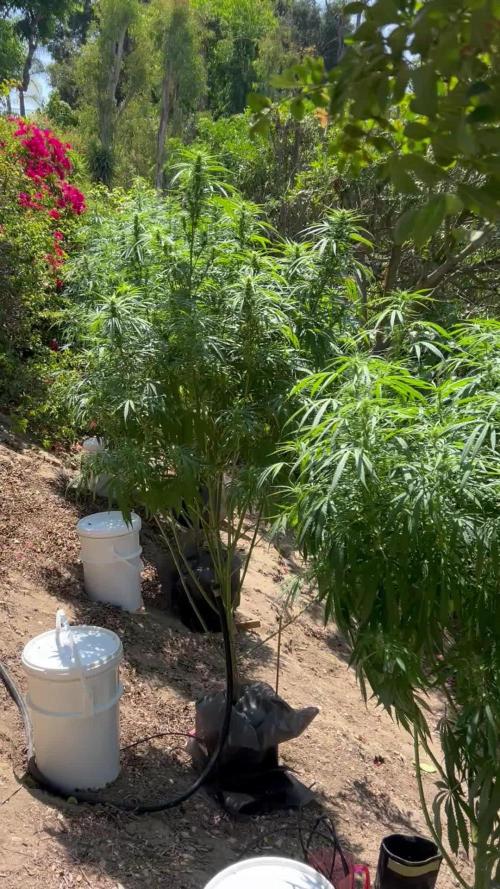
This week we moved the plants to a more secluded location, which was easier with small autopots. Leveling and terracing the equipment was a pain. I put individual 6 gallon reservoirs for each plant. This allows me about three days before filling up the reservoirs.
The biggest problem again was the plants falling over because of wind.
They have hit the ground over 20 times, maybe thirty. Each time this dumps the reservoir, so I had to make a ton of water this week. But they keep chugging along.
I staked and wired them down and so far so good for three days.
The plants are big, with my biggest being 7 1/2 to 8 feet tall. They have mostly recovered from falling over so many times. The branches have hardened so I can’t really stretch out the branches anymore. They’re tighter than I planned….
Flowering has started and should start stacking up on one or two of the plants next week. I’m just running Jack’s RO for weeks 4 to 8. I may start with some fulvic and humic acid soon.
Best of luck on your grow.

Likes
7
Share


@HeavyHead
Follow
Starting to really be thirsty. Soon as I started the nutrients they started drinking almost twice as much water.
Did some low stress training this week and probably continue tying back and levelling through the next two weeks.
Since it’s an empty tent right now really letting them stretch out ;p


Processing
Likes
18
Share


@eldruida_lamota
Follow
La primera semana de floración les sentó bien la echaron su sexo, hembras, ahora ya queda ir viendo cómo se forman las flores.
La temperatura no pasa a los 30 nunca.

Likes
19
Share


@RDWCGrowing
Follow
7/27/2023- Prep
Tent and system are cleaned and ready to go from my last grow. I have submitted my Journa for the Diary of the Month Competition here is to hopeing for good resutls.
7/28/2023- Germination Day 0- Seed initiation
Well lets get this new Grow started.. So My Dad Sent me a custom Landrace Strain that he wanted me to grow out and Breed for him. The Strain is Called Black African Magic:
Black African Magic, Alson known as BAM, is a Sativa pure land race strain, It's classified under the Cannabis Sative species and its genetics come from Africa-the Ituri Forest in the Dmocratic Repoublic of Congo. The Effects are said to be Very Psychedelic, used for Stress managment and for better sleep and rest. This is my frist Land Race so we, will see how this goes together..
RO Water Used
Added Hydrogen Peroxided
8/1/2023- Germination Achieved G-Day1
Popped her head above the root riot today to say hello.. Woot first challenge when dealing with an unknown seed and a new Strain is getting the seed to pop and the lady to show life.
8/2/2023- Germination Day 2
Took the root riot out today and it was soaked not good plant drowing again. I am still having a hard time finding the right blance for where the water should be to keep the root riot moist and not soaked. I had to drain some of the water out of the root riot plug to help give a little oxygen. I also removed some of the water.
8/3/2023- Germination Day 3
Looking good stretching her leaves out to let in the lights
8/4/2023- Germination Day 4
Looking good a few days until I put them into the RDWC System and get this thing rocking and rolling.
8/5/2023- Germinaiton Day 5
Looking good will probably plant tomorrow if the roots are still looking good.
8/6/2023- Plant Day- Germination Day 6
Planted into the RDWC System today. Joy when they go into the system as long as we dial that in right this will now be a great grow.. Survived the hard part..
8/7/2023- Germination Day 7
Everything looks like it is going good, she is showing some damage on the lower leaves from the over watering in the cloning machine but right now I don't see any new damage.
8/8/2023- Germination Day 8
Added the first Nutes today, to help support root growth and to help give there first jump to growth.
TPS SILICA GOLD-.5mil/Gal
Root Drip- 1mil/Gal
GH FLoraMicro-1mil/Gal
GH FlroaGro-1mil/Gal
GH FLroaBloom-1Mil/Gal
ORCA-.5mil/Gal
8/9/2023 - Germination Day 9
Everything is looking good new growth looks like it is praying and they are looking happy. I will take off the damage leaves probably tomorrow.
8/10/2023- Germination Day 10
She looks like she is on track the roots are starting to come out of the basket very small but starting.
8/11/2023- Germination Day 11
Cleaned up the dead leaves... Day 1 VEG tomorrow.. Water Change Day and first real meal...
Likes
17
Share


@Hashy
Follow
Week 1
Light cycle=24/0
Light Power=73w 30%
Extractor controller settings
High temp= 23c
Low temp= c
Temp step=0c
High Rh= 70%
Low Rh= %
Rh step=0%
Speed max=5
Speed min=1
Smart controller settings (during lights on).
Lights on=am
Radiator on= not in use.
Radiator off= not in use.
Humidifier on= below 63%
Humidifier off= above 68%
Dehumidifier on= not in use.
Dehumidifier off= not in use.
Smart controller settings (during lights off).
Lights off=pm
Radiator on= not in use.
Radiator off= not in use.
Humidifier on= not in use.
Humidifier off= not in use.
Dehumidifier on= not in use.
Dehumidifier off= not in use.
VPD aim=0.4-0.8
DLI aim=15-18
EC aim=0.4
PH aim=6.2
Fri 22/12/23
#1 (Day 1)
📋 5.00pm Leaves open and working on its 1st set of true leaves.
💧💧💧💧💧💧💧💧💧💧💧💧💧💧💧💧
Method= manual
Neutralise=0.1ml/L
Roots=5ml/L
Feed=nutes
Volume=100ml
Easy Ph down=0 drops/L
Ec=0.36PH=6.3/6.0
Time=10.00pm
Runoff.
Total runoff=10ml
Ec=2.85 PH=5.7
💧💧💧💧💧💧💧💧💧💧💧💧💧💧💧💧
📋 Calibrated ph pens in ph 4/7 solution.
Older pen read 6.8
Newer pen read 7.1
Sat 23/12/23
#1 (Day 2)
📋 Looks ok. Root has hit the bottom of the pot.
H=5cm D=82cm DLI=15.8
Sun 24/12/23 (Christmas eve)
#1 (Day 3)
📋 Still working on its 1st set of true leaves.
Mon 25/12/23 (Christmas Day)
#1 (Day 4)
📋 Merry Christmas everyone. 10.30pm This tester looks good, 1st true set of leaves are developing fine. Started developing 2nd set of leaves.
Tue 26/12/23 (Boxing Day)
#1 (Day 5)
📋
💧💧💧💧💧💧💧💧💧💧💧💧💧💧💧💧
Method= manual
Neutralise=0.1ml/L
Roots=5ml/L
Feed=nutes
Volume=150ml
Easy Ph down=0 drops/L
Ec=0.28PH=6.2/6.2
Time=7.00pm
Runoff.
Total runoff=20ml
Ec=2.91 PH=5.6
💧💧💧💧💧💧💧💧💧💧💧💧💧💧💧💧
Wednesday 27/12/23
#1 (Day 6)
📋 She has got a massive lean on her, probably through watering yesterday.
9.30pm decided to stake her as she's nearly touching the soil.
Before changes.
H=8cm D=80cmDLI=14.8
After changes.
H=8cm D=77cm DLI=18.3
10.00pm
Light cycle=22/2
Light power was=73w=30%
Light power now=86w=36%
Lowered light by 3cm.
Extractor controller settings
High temp= 24c
Low temp= c
Temp step=0c
High Rh= 70%
Low Rh= %
Rh step=0%
Speed max=5
Speed min=1
Smart controller settings (during lights on).
Lights on= 02.00am
Radiator on= below 19c
Radiator off= above 20c
Humidifier on= below 64%
Humidifier off= above 67%
Dehumidifier on= not in use.
Dehumidifier off= not in use.
Smart controller settings (during lights off).
Lights off=00.00am
Radiator on= below 16c
Radiator off= above 18c
Humidifier on= not in use.
Humidifier off= not in use.
Dehumidifier on= not in use.
Dehumidifier off= not in use.
Thursday 28/12/23
#1 (Day 7)
📋 H=8cm D=77cm DLI=18.3
She will probably only need the support for a few more days, the lean was from over watering. So this week she has developed her single fingered true leaves and is working on the next set of 3 fingered leaves.
Conditions for the week have been good.
Back soon.
Take it easy.

Processing
Likes
10
Share


@CanadianFillmore
Follow
Start of week 3! All three plants have had great bud site development during the last 2 weeks. The Super Lemon Haze is a bit thirstier than the Blueberries, so the Slh got and extra 2 liters of feed during week 2. The Slh is also showing deficiency, hopefully with the addition of B52 to the feed cycle, she'll come around. On th blueberries, there has been some rust spots appearing on the largest leaves, I removed the worst one's and will monitor more closely this week, if that issue continues or not. These babies are very bushy, they take up 80% of my grow room space, very excited about this grow and these plants.

Likes
1
Share


@zenderman
Follow
14.10.26
day 57 from germination,beginning week 9.This beauty 🐒 amazes me, she wants to show that she is worthy of being called a gorilla🦍
Processing
Likes
4
Share


@Grownewgenetics
Follow
These is a project in the we try (test) tge products of our sponsors to see how good they genetics are, for example we have know 6 seeds banks on these round.
Sweetseeds with the dark devil auto have break the time record for seed on the ground , 20 hours , only these tine have the seeds from sweetseeds on the soil and they just jump out to 2 cm , simple amazing
Likes
2
Share


@CannaIGrow
Follow
Topped this girl this week, she’s growing pretty good. Very nice looking plant to my eye.
Processing
Likes
Comments
Share


@MG2009
Follow
08/13/2019
Another rainy day. Recovering from topping and,fimming.
Looking good for start of flower, soon.
08/18/2019
Did a little training.

Processing
Likes
18
Share


@Bread_n_Buds
Follow
What a trip with these Monster Zkittlez. We have almost reached the end, going through many fears we are reaching excellent results for real. I have three young ladies planted one before and two more after 10 days to test the right vegetative times. The first was worked with very aggressive LST and now I dominate many weeks of flowering is fantastic. They are putting all of them very much but they are filling up really well except one that seems lost and is not bad. In fact, the two smaller ones were also low stressed and treated with an aggressive pruning to keep only a big main cola and something lateral. One has filled very well another is filling less and very slowly but still with dignity, I gave it up for lost but even the ugliest is not bad. The big has some scary banana. The frozen speaks for itself sugar dripping from everywhere early harverst next weekend

Likes
1
Share


@Therbalist
Follow
Other two have caught up and overtaken the one I aggressively bent.
All three have shown females thank god 🙏
Likes
Comments
Share

@Growmigos
Follow
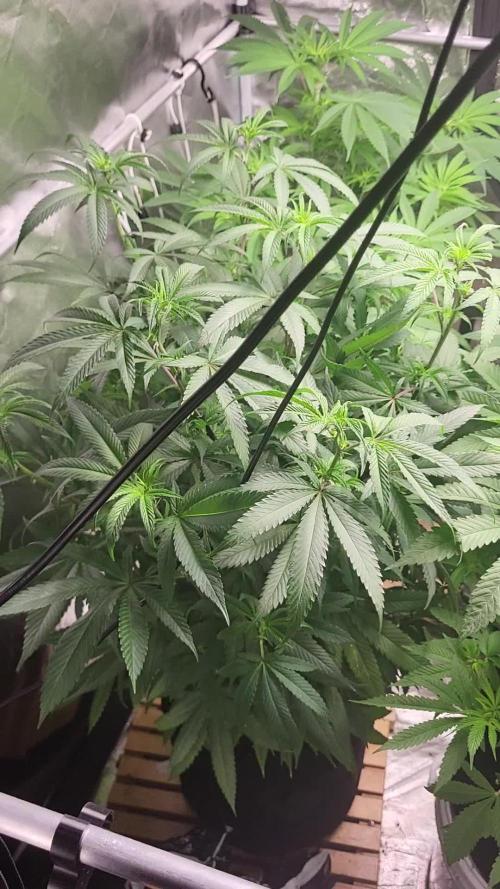
Sie explodiert förmlich Aus der Pflanze mit extremer stau Nässe ist eine super schöne grape milchshake geworden,sie strotzt wieder vor Vitalität. Ich werde wenn die drain master da sind die gute nochmals auseinander binden,sie ist größer geworden aber durch das runterbinden hat sie eigentlich kaum höhe gemacht,sie reagiert auf licht und nährstoffe gut ,keine überdüngung,ich kann die ersten mini pisillen sehen
Likes
15
Share


@BigDripFelgo
Follow
Pink Certz is another amazing strain she looks pretty and smells delicious like Fruity Pebbles, Skittles and Starbursts very fruity sweet candy! Colors on her have darkened looking very appealing along with her bright orange pistils. Been flushing for a week now, waiting for trichomes to ripen some more on the calyxes as of course the leaves are being trimmed off.