


Likes
Comments
Share


@Stacy_smokez
Follow
Went into this week just using mute from fox farm ocean then began nutrients due to deficiencies, getting in under control but overall doing well also started 3 new plants going to start a diary for them soon


Likes
18
Share


@Coopmc
Follow
In the Voice of Little Michale won’t you climb my lemon tree with me Who m-Hoo chugging bo wa!!
Hey Lemon Tree your Sativa is showing sit down!
Processing
Likes
1
Share


@Ganjagrandaddy
Follow
FLIP DAY 1: it is here finally. I had hoped to her them a lot bigger before the flip but other plants are forcing the issue so I am going with them.
C Banana is smallest of them both but her thick stems give an idea of how she wants to bud up for flowering. She is very thick and has a lot of growth spread out well. Each head has a few smaller nodes below already so should start the stacked fat colas early on hopefully.
Monster zkittelz is a lot wider by comparison and certainly very productive too. bending her out and getting her to stay put has been an endeavor but also given me faith in this hybrid. She will be a productive girl I think. Nice work Zamnesia. let the fun begin.

Likes
11
Share


@Lazuli
Follow
I think 12 liter airpot was too small, i opened the pot and was one rootball
Likes
26
Share


@Ukfarmer420
Follow
So guys today is day 49 entering week 8, so 1 more week on the bio bizz heaven, top max and bloom.
The weather in the UK is mad at the minute 28°c my grow room is the same with lights off and causing my a lot of humidity, thank god for the dehumidifier but I'm emptying it twice a day now.
Buds are getting fatter and the fade is coming on.
Just got to go in there and check on them, temp has dropped now even tho light is on. Humidity is sitting at 50%.
I hope you like the video, happy growing peoples😊💚 ignore the ozzie man review voice at the beginning 🤣🤣🤣
Day 52 flower, buds are fat sticky and ready to harvest, im waiting for more of a fade as I reckon they will swell more, I think another week and its time for the chop.
Any questions or advice please feel free to hit me up.
Day 54, done a slight defoliation at there was a lot of leaf on leaf, I should of used cropguard for piece of mind 😅 next run I will trust me.
I have started the ripener 5ml to a litre I will be running this for the next 7-10 days and then rinsing with there rinse aid for 4 days so aiming for harvest on the 24th-25th latest 😀.
Happy growing famalam 💚

Likes
11
Share
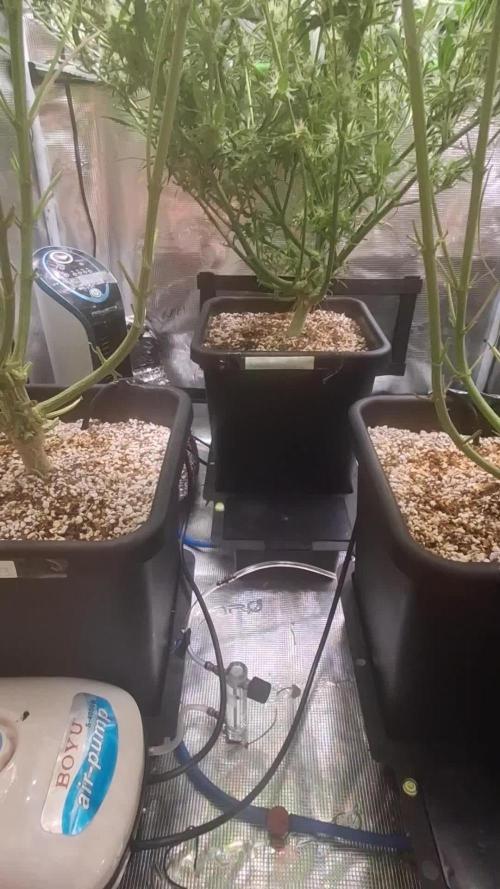

@Thomas86
Follow
Plants at the back look very green and overfed so I dropped the Ec a little, Had to defoliate again to try combat the high humidity, hoping it drops a bit, probably stunted the growth a little but hoping I didnt stress them too bad, My lights are max height so hoping they stop growing vertically, they got a little taller this week and some leaves are getting bleached.
Likes
4
Share


@Orchard
Follow
&&&&&&&&&&& Week 1 -FLOWER- / TRANSITION &&&&&&&&&&
+++ 03.15.2021 +++
<---NOTES--->Started transition and changed light schedule on 3.15.2021 to 12/12 time @ 26" Light spectrums are set to max on all. First nutes applied 3.18.21. Took Pictures confirmed settings.
(((((((((((((((((((((((( CONDITIONS )))))))))))))))))))))))
*Nutes: CaliMagic GHE 1.75ml / Gal, FloraFlex B1 3g - 0.75 tsp/gal, FloraFlex B2 3g - 0.75 tsp/ gal, pH Down 1ml/ gal, RapidStart 0.5ml/ gal, ArmorSi 0.5ml/ gal (((((((APPLIED 3.18))))))
*Ph: 6.0
*Ec: 2.06
*Light: Mieemclux 1500W LED Veg+Bloom@ 26" 12/12; Mieemclux1500W LED Veg+Bloom@ 26" 12/12; Parfactworks RA1000W LED@ 22" 12/12
*Rh: 70%
*Temp: 78F
<-------- END -------->
+++ 03.18.2021 +++
<---NOTES--->Started Bloom nutes 3.18.21.
Started nutes durring transition as looking at FloraFlex feed charts it does not have a transition. I mixed and transplanted with only 1 week of nutes @ week 4 so I figured there would be little buildup. Started RapidStart. Roots should be all the way stretched out. ADD a little silicate for plant vigor. TOOK VIDEO.
(((((((((((((((((((((((( CONDITIONS )))))))))))))))))))))))
*Nutes: CaliMagic GHE 1.75ml / Gal, FloraFlex B1 3g - 0.75 tsp/gal, FloraFlex B2 3g - 0.75 tsp/ gal, pH Down 1ml/ gal, RapidStart 0.5ml/ gal, ArmorSi 0.5ml/ gal
*Ph: 6.0
*Ec: 2.06
*Light: Mieemclux 1500W LED Veg+Bloom@ 26" 12/12; Mieemclux1500W LED Veg+Bloom@ 26" 12/12; Parfactworks RA1000W LED@ 22" 12/12
*Rh: 70%
*Temp: 78F
<-------- END -------->


Likes
6
Share


@Ninjabuds
Follow
Man, it's been a crazy week. These past few days have been brutal – seriously cold with this crazy humidity. I don't know about you, but I'm sick of the chills and the way my skin feels all sticky. It's been a struggle, but I'm finally getting on top of things. I think I've figured out a good routine to dry things out around here, so hopefully, I'll be feeling a lot more comfortable soon.
It's been interesting watching these permanent marker plants grow. One of them is still kinda lagging behind, but I think I've got the other one figured out. It's stacked so perfectly, and it's starting to look super sparkly, almost like it's got little crystals on it. I'm curious to see if the other plant will catch up.

Processing
Likes
Comments
Share


@Hampoop35
Follow
This week it seems like they are starting to flower or getting ready to. Day 42 and they are smelling great. I’m super excited to see the difference in plant A and plant B. The runt seems to be bouncing back. After I did some LST it really started to take off.
Likes
147
Share


@MrJones
Follow
MrJones Black Berry OG
🔹🔹🔹🔹🔹🔹GOALS🔹🔹🔹🔹🔹🔹
🌞Flowering Environment - 75/80℉ and 50% Humidity
💧 Feeding - Advanced Nutrients Bloom Regiment - Great APP!
🍃Training / 1 Trellis in place, looking to install a second, may have to do more defoliation..
🕷️ IPM - Will be using Green Cleaner" 1 OZ per Gallon, and CannControl from Mammoth alternating between product each month for Integrated Pest Management.
💡Mars Hydro LED / Veg TS-1000 / Flower 480W FC 4800, this light is just performing very well!
🔹🔹🔹🔹🔹🔹🔹🔹🔹🔹🔹🔹🔹🔹🔹🔹🔹🔹
📜 Rambling - With week 11 here, the ladies are about 3 of 8 weeks into flower, they continue to stretch nicely, and starting to stack on some buds!
🔹🔹🔹🔹🔹🔹🔹🔹🔹🔹🔹🔹🔹🔹🔹🔹🔹🔹
▶️ Friday - 03.26.21/Feeding 40 OZ of Advanced Nutrients
▶️ Saturday - 03.27.21/Feeding 40 OZ of Advanced Nutrients
▶️ Sunday - 03.28.21/ Feeding 40 OZ of Advanced Nutrients
▶️ Monday - 03.29.21/ Feeding 40 OZ of Advanced Nutrients
▶️ Tuesday - 03.30.21/Feeding 40 OZ of Advanced Nutrients
▶️ Wednesday - 03.31.21/Feeding 40 OZ of Advanced Nutrients
▶️ Thursday - 04.01.21/Feeding 40 OZ of Advanced Nutrients
🔹🔹🔹🔹🔹🔹🔹🔹🔹🔹🔹🔹🔹🔹🔹🔹🔹🔹
📜 Cultivar Information - We have created this strain by crossing the best Black Domina available with Very Berry and our own Lost Coast OG Kush, this plant produces large colas with a super intense sweet berry flavor with a sweet-smelling aroma that varies from fruit and berries to sweet candy. This lady offers tight internal stacking giving a perfect structure for those super heavy colas, which is perfect for growth both indoors and out, if grown outside she is fairly resistant to mold and powdery mildew which is a real bonus with such large colas.
🔹🔹🔹🔹🔹🔹🔹🔹🔹🔹🔹🔹🔹🔹🔹🔹🔹🔹

Likes
23
Share


@Canadian
Follow
Day 50 the plant has been growing at an incredible speed and has a very very large flowering stretch in fact I only have left 5 inches to raise up my light and then I'm going to have to do something to keep an eye on those branches so they don't stretch anymore or at least they can have enough light to proper development.
From all the plants I have grow indoors this one is the only one that has make my light stretched to the top of the tent I guess it's a good problem to have.
Other than the incredible stretch the plan seems to be healthy and doing pretty well the flower is development and I'm looking forward to see how this is going to turn out.
Day 52 I have rise my light to the top as high as I can and she still grow past the light towards the exhaust system I had to tie her down in order to create an arch and in that way make her receive enough light instead of growing over the top of the light where there is actually no sufficient light if this problem persist I will have no choice but to do super cropping on the tallest branches and see how they react to that I decide to take some cuttings I'm trying to clone this one to see if I can get her outside in the summer in another buddy house and see how she reacts to challenging Ontario weather.
Day 53 I have to Super crop several branches Unfortunately they were growing straight into the light becoming burned by the intense light I hope the plant doesn't react to bad to HST and still deliver awesome buds
thank you for reading I will continue to update have a happy grow.

Likes
25
Share
@GrowBro1981
Follow
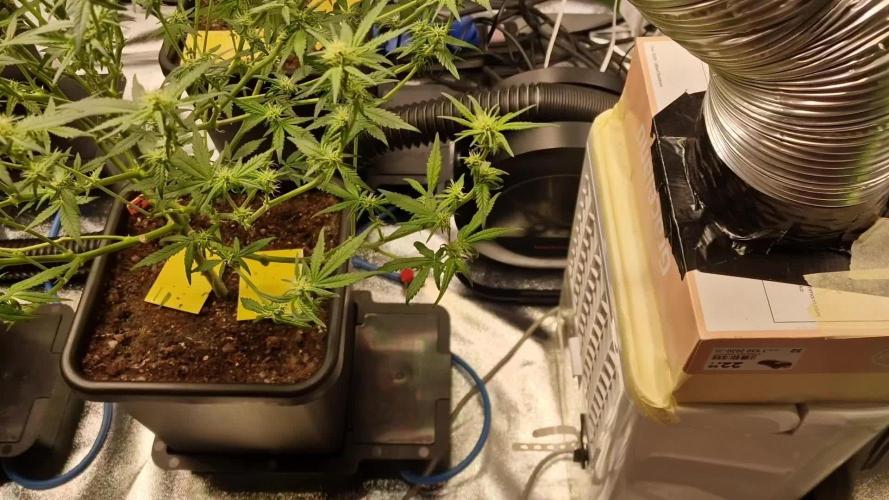
Sooo liebe Growfreunde, wir sind wieder zurück für einen kurzen Wochenbericht.
Heute ist BT 25 am Dienstag endet somit Woche 4. Leider blüht die Gorilla Zkittlez immernoch nicht, keine Ahnung was sie hat. Aber alle anderen 5 machen sich prächtig😎💪👌🤗. Extrem viele Blütenstände. Hab nochmal richtig entlaubt, alle großen Blätter weg. Ich weis das viele von euch dass anders gemacht hätten, für mich war der Hintergrund die Lichtausbeute, deshalb so radikal.
Hab fast nicht gelollipoppt weil überall Licht hinkommt. Was meint ihr dazu? Übrigens danke an alle die meinem Grow folgen,liked und kommentieren👍

Likes
11
Share


Likes
Comments
Share

@DogDoctorOfficial
Follow
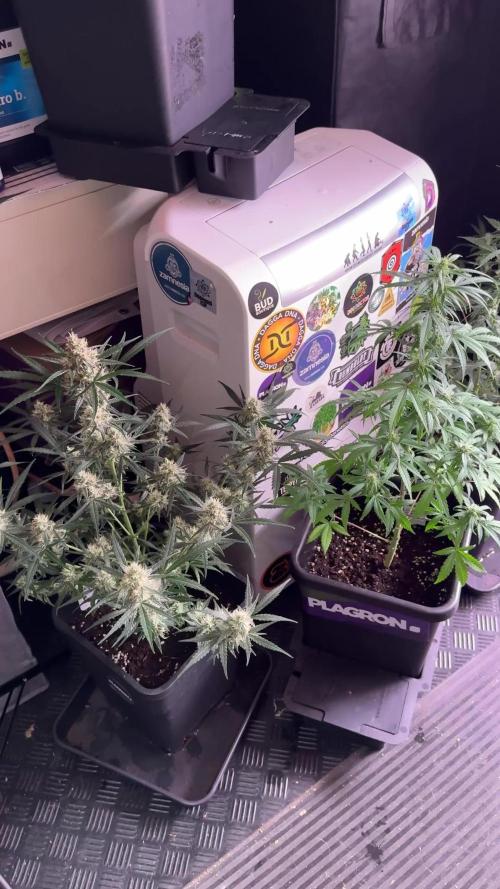
🌿 Frosted Guava Auto by Zamnesia | Pheno B | Week 8 (Flower Week 5) 🌿
Small Plant. Big Personality. And Now… A Little Less Green.
There are plants that follow the plan.
And then there are plants that write their own story.
Frosted Guava Pheno B has been doing the latter from the beginning.
She has never been the biggest plant in the room. She hasn't chased height, hasn't tried to dominate the canopy, and hasn't demanded much intervention.
Instead, she has quietly developed her own personality.
Compact.
Elegant.
Beautifully structured.
And increasingly covered in flowers.
Now, entering her fifth week of flowering, she has reached another important moment in her journey.
This week, she joined the group receiving a selective flowering defoliation.
Not because she was struggling.
Not because she was unhealthy.
And certainly not because every plant needs to be defoliated.
Quite the opposite.
She was looking fantastic.
But after looking carefully at her structure, her development, and the way light and airflow were moving through the plant, I felt that removing some unnecessary foliage was the right decision.
So we went in.
We cleaned her up.
And now we're going to see what she does with the extra space.
🌸 Week 5 Flower – Her Own Story
Frosted Guava Pheno B is currently around 108 cm tall.
That still makes her one of the more compact plants in the room.
But honestly?
I don't think she cares.
😂
She has found her own architecture and she's sticking with it.
The flowers continue developing beautifully, with increasingly visible frost and those characteristic white pistils reaching outward from the developing buds.
Her foliage has remained lush and healthy, with that beautiful deep green colour we've been following since the beginning.
The plant looks comfortable.
The flowers are developing.
And now we're starting to see more definition between the different parts of the plant.
This is exactly the kind of moment where stepping back and looking at the whole plant becomes important.
Because sometimes the question isn't:
"Can I remove this leaf?"
The better question is:
"Does this leaf still have a useful job to do here?"
And that's where this week's defoliation came from.
✂️ Defoliation – What We Actually Did
This wasn't a complete strip.
It wasn't a race to make the plant look naked.
And it wasn't about removing leaves simply because they were large.
The approach was selective.
I removed most of the fan leaves carrying their own petioles, particularly where they were contributing to unnecessary shading or creating congestion inside the plant.
I also cleaned the lower and interior portions of the plant where some flowering sites were positioned so far below the productive canopy that I didn't expect them to develop into meaningful flowers.
Those areas are what I would consider the true bottoms on a compact plant like Frosted Guava.
And that's an important distinction.
Because this plant is small.
Her lower sites really are lower.
Even with the Lumiflora under-canopy lighting helping bring additional photons into the lower canopy, the primary productive zone of the plant remains higher up.
So rather than allowing the plant to spend resources maintaining foliage and very low sites that are unlikely to contribute much, I decided to clean those areas selectively.
But I didn't remove everything.
Some lower flowering sites remain.
I want to see what they can actually do.
That's part of the experiment.
🌿 What Is Defoliation?
For anyone new to growing:
Defoliation is the intentional removal of selected leaves from a plant to alter the structure of the canopy.
The goal isn't simply to have fewer leaves.
The goal is to create a better balance between:
light penetration + airflow + canopy structure + productive flowering sites.
Leaves are extremely valuable.
They're the plant's solar panels.
So removing them should never be treated as something automatically beneficial.
Every leaf removed is a piece of photosynthetic machinery removed.
That's why I don't approach defoliation as:
"Flower started. Time to strip the plant."
Instead, I look at the plant in front of me.
Is the canopy becoming too dense?
Are leaves heavily shading developing flowers?
Are there congested areas where airflow is poor?
Are there leaves that are doing very little because they're buried underneath several layers of foliage?
Are there lower sites that realistically have very little opportunity to develop?
If the answer is yes, then selective defoliation can make sense.
If the answer is no...
Leave the plant alone.
🚫 What Defoliation Is NOT
This is probably even more important.
Defoliation is not:
❌ Removing every fan leaf
❌ Trying to expose every single flower to direct light
❌ A substitute for good plant structure
❌ A guaranteed way to increase yield
❌ Something every plant needs at the same time
❌ An excuse to strip a healthy plant simply because you can
The objective isn't to make the plant look clean for the sake of appearance.
The objective is to improve the functional canopy.
And there's a big difference.
A beautiful green leaf isn't a problem simply because it's a beautiful green leaf.
If it's healthy, receiving light, contributing to photosynthesis and helping the plant, I have no reason to remove it.
But when the canopy becomes crowded and certain leaves are contributing more obstruction than productivity, that's when selective removal becomes interesting.
✂️ How I Approach It
My approach is simple:
I observe first.
I don't start with a predetermined number of leaves that must disappear.
I start by looking at the structure.
Then I work from the outside toward the interior and from the top toward the lower portions, looking for unnecessary congestion.
Leaves that are heavily shading productive flowering sites can be candidates.
Leaves buried underneath several other leaves can be candidates.
Leaves occupying congested interior areas can be candidates.
And lower growth that is so far beneath the productive canopy that it has little realistic opportunity to develop can also be considered.
But I always keep the plant's overall health in mind.
The goal is balance, not maximum removal.
That's why Pheno B still has plenty of green.
She's not naked.
She's simply better organized.
💡 The Under-Canopy Question
This is particularly interesting with Frosted Guava Pheno B because we're running Lumiflora under-canopy lighting.
Someone might reasonably ask:
"If you have light underneath, why remove the lower growth?"
That's a very fair question.
And the answer is that under-canopy lighting doesn't magically make every lower flower equal to a top flower.
On a compact plant like this, the very lowest parts are still extremely low relative to the main productive canopy.
The under-canopy lighting is helping reinforce the lower and interior areas, but I still want to observe where the plant naturally allocates its energy.
That's why I deliberately left some lower flowering sites behind.
I don't want to assume.
I want to watch.
Will those remaining lower sites develop?
Will the extra light make a noticeable difference?
Will the upper flowers continue dominating?
That's exactly the kind of question this project allows us to explore.
And the harvest will eventually give us the answer.
☀️ More Light Where It Matters
The Future of Grow Black Series LED continues providing the primary light from above, with approximately 1,000 PPFD across the upper canopy.
Frosted Guava may be compact, but she certainly isn't short on photons.
She's been sitting underneath that light throughout flowering, converting those photons into leaves, flowers, structure and now increasingly visible resin.
And with the selective defoliation, we're changing how some of those photons move through her architecture.
We're not creating more photons.
We're simply trying to make better use of the ones already available.
That's the idea.
Don't waste energy chasing light.
Build a canopy where the available light can actually do its job.
❄️ And The Frost Is Getting Serious
The name Frosted Guava continues becoming more appropriate every week.
The flowers are developing beautifully, and the resin production is becoming increasingly visible.
Those white pistils are still everywhere, creating an incredible contrast against the deep green foliage.
And underneath all those hairs, the flowers are beginning to gain more structure and density.
This is the stage where I love looking at the same plant from week to week.
Because the change isn't always dramatic overnight.
But compare the plant to where she was a few weeks ago...
And suddenly you realize:
She's building.
She's filling out.
She's gaining flower volume.
She's becoming increasingly defined.
She's becoming Frosted Guava.
🌿 Small Plant. Big Character.
I've said this about her before, but this week makes it even more obvious.
Frosted Guava Pheno B doesn't need to be the tallest plant in the room.
She's already found something more interesting.
Character.
Her sister Pheno A has followed a different path.
And that's one of the beautiful things about running phenotypes together.
Same genetics.
Same room.
Same light.
Same nutrition.
Same philosophy.
Different personalities.
Pheno B has chosen to remain compact and elegant.
And now, as flowering progresses, she's showing us exactly what that compact structure can become.
💧 Nutrition & Hand Watering
We're continuing with hand watering throughout the room.
Current feeding remains centered around the Plagron flowering program:
Terra Bloom — 2.2 ml/L
Power Buds — 1 ml/L
Sugar Royal — 1 ml/L
Green Sensation — 1 ml/L
Lemon Kick — 0.03 ml/L
Current recorded parameters are around:
pH: 6.0
EC: approximately 2.0 mS/cm
Solution temperature: 21°C
Root-zone temperature: 21°C
Watering: approximately 1.2 L per 24 hours
Hand watering has also given me another opportunity to observe this plant closely.
Every time I water her, I get another chance to look at the flowers, inspect the leaves, check the structure and notice those tiny changes that are easy to miss when everything is automated.
It takes more work.
But it also brings you closer to the plants.
And sometimes that's where the best observations happen.
🌡️ Environment
The room continues running under stable conditions:
Day temperature: 29°C
Night temperature: 25°C
Relative humidity: approximately 72%
Solution temperature: 21°C
Root-zone temperature: 21°C
CO₂: approximately 639 ppm
With the canopy becoming increasingly dense, airflow and humidity management become even more important.
That's another reason selective defoliation can be useful at this stage.
Not because leaves are inherently bad.
But because a dense flowering canopy can create small pockets where air movement becomes less effective.
Opening selected areas gives the room a little more breathing space.
And that's particularly valuable as the flowers continue developing.
🔭 Looking Ahead
Now comes the interesting part.
We've changed the architecture.
We've removed some unnecessary foliage.
We've cleaned the lower sections.
We've opened some of the interior.
And now...
we wait and observe.
I want to see how quickly she responds.
I want to see how the flowers develop with the improved canopy structure.
I want to see what happens to those lower sites we deliberately left behind.
And most importantly, I want to see how Frosted Guava Pheno B continues writing her own story.
Because she's already made one thing very clear:
She doesn't need to follow anybody else's timetable.
❤️ Final Thoughts – Let Her Shine
Frosted Guava Pheno B has been one of those plants that quietly earns your attention.
She didn't arrive in the room demanding the spotlight.
She didn't become the tallest.
She didn't become the biggest.
She simply kept growing.
And week after week, she became more beautiful.
Now she's entered another chapter.
A little less foliage.
A little more breathing room.
A little more light moving through the canopy.
And plenty of flowers left behind to show us what she's capable of.
The important thing about this week's defoliation isn't how many leaves we removed.
It's why we removed them.
Because good cultivation isn't about following a recipe blindly.
It's about looking at the plant in front of you and making decisions based on what she's actually telling you.
And Frosted Guava Pheno B was telling me:
"I'm ready."
So we listened.
Now let's see what she does.
A huge thank you once again to Zamnesia for these beautiful genetics, Plagron for the nutrition, Future of Grow for the Black Series lighting, Lumiflora for helping illuminate the lower canopy, TrolMaster for environmental control and of course to everyone following this 8×8 Adventure on GrowDiaries.
Every week, every phenotype tells us something different.
And that's exactly why I love this project.
Until next week...
Let her shine. She has earned her spotlight. ✨🌿❄️
Growers love and happy growing! 🌱💚
Likes
119
Share


@DogDoctorOfficial
Follow
Time to give this P2000 a secont run, and in it i will run a single clone that i took from my previous run, i took one from each phenotype and from them i chose the one i like the most in terms of plant structure , terpene profile and in the end smoke test also, that one is the most important one lol and the one with the most value on my decision, saying this dont judge me on this hahahaha i kind a forget it in the corner and now its time to bring her up to her full potential.
I started by transplanting her from her tinny pot to a 25 L one , had to the soil 100g of All in one Pellets, a touch of microbial life and some Mycor to the roots and ready she is, gave them a foliar feeding with APTUS HOLLAND nutrispray and gave them a full feeding with the on the water sine the pallets will take a couple days minimum to start breaking and becoming available for the plants to take, i will let her adapt to it all for now and then i will star training her to became a tiny ginormous beautiful lady best, covered in trichomes and smelling like pines falling out of pine trees in the middle of the woods.
As for the PAR department for now i am giving them 600 PPFD and running my VIPARSPECTRA P2000 @ 69%
Looking at them an i decided that it was a good idea to start some training going on in this girl, so i gave her a new look and lets see how she goes from here, i spray them again with APTUS HOLLAND Nutrispray to help thing move faster .
And they are coming back to life , in just a couple of days i can notice that they love the fact that im giving them my love and attention
Is it just me or they are bouncing back fast af ? Not complaining at all hehehe , did some more training today, if they keep evolving like this i will be able soon to start taking leafs and selecting what to keep and what have to go.
Just recently started collaborating with APTUS HOLAND and i have to give a big shoutout to them ,Thank you Aptus Holland for believing in my love for growing , fells amazing wen you already believe and buy a product and they come and start supporting your love for it all 🙏🙏🙏💚💚💚🙌🙌🙌✊✊✊
As always thank you guys for your love , your time, your support and it all, i fell blessed and i am truly thankful 💚💚💚🙏🙏🙏🙌🙌🙌
Let the games begin hihihihi
All i grow is medicine for myself, for me and for my best friend with is me 😆 nothing to sell, so don’t even ask 😅💚💚💚
All info and full product details can be find in can find @
https://viparspectra.eu/collections/grow-lights DISCOUNT CODE 5% - DOGDOCTOR ( all store )
https://www.zamnesia.com DISCOUNT CODE 10% - GROWITGD ( just for seeds )
https://aptus-holland.com/
#aptus #aptusplantteck #aptusgang #aptusfamily #aptustrueplantscience #inbalancewithnature #trueplantscience #viparspectra #zamnesiaseeds #growerslove
With true love comes happiness 💚🙏 Always believe in your self and always do things expecting nothing and with an open heart , be a giver and the universe will give back to you in ways you could not even imagine so 💚💚💚
More info and updates @
https://growdiaries.com/grower/dogdoctor
https://instagram.com/dogdoctorofficial
https://youtube.com/channel/UCR7ta4DKLFMg2xxTMr2cpIg
💚💚💚Growers love to you all 💚💚💚
Likes
19
Share


@Canadian_Growology
Follow
This week growth has been exceptional!
They are all stretching nicely and setting flowers.
I foliar sprayed Soluable Kelp, ChitoSal and Rubicon Marinis to help transition to flower. All 2 days apart.
Added this months top up of Gaia at 1.5 cups of 4-4-4 and 1.5 cups of 2-8-4 as top dressing. They responded very well to this application. Might start adding a few tbsps of each every week from now on.
Still adding compost tea once a week. This compost tea I added 2 tbsp of Gaia 2-8-4.
Ran out of fish shit.
-------------------------------------------------------------------
Roughly 30 gallons of soil inside cages wrapped in plastic about a foot and a half high amended with 3 cups Gaia 4-4-4 and 2 cups Gaia 2-8-4 and 2 cups Gaia Feather Meal 13-0-0.
Topped up each month with a cup of each as well as worm casting/soluble kelp/molasses compost tea once a week. Also Fish Shit amendment added at recommended doses.
Orange Kush Cake, Cherry Gar-See-Ya, Mac 'n Jack, Crescendo Rbx1 are all Ethos genetics at 25-35% THC
Blue Afghan is from Jordan Of The Islands.
Recieved clones in the mail in early May.
Happy Growing 😌


Processing
Likes
17
Share


@StoneyMelony
Follow
Overview of my grow:
Tent: Secret Jardin DS120 4 x 4 (120 cm by 120 cm)
Lights: 2 x 120 Watt CTlite c4 clusterled
Climat: Trotec Dehumidifyer 240 watt- 10L/24h
Filter: Prima Klima carbon filter PK2600
fan: 2 x Secret Jardin 20watt osc. fan
Pots: Gronest 4 x 11 liter airpots
Water : automated water system
PH: bluelab
Nutrients: Plagron cocos A + B
Plagron PK 13/14
ATA cal/mag
Epsom salt
Week 8 She has now a lot more room because the pineapple is gone. she is doing good , i have give a PK boost last week . She is not as big as the gelato i did before.
Likes
16
Share


@Ginger_gnome
Follow
Damn has the buds started to fatten up. The Kmintz plants are really starting to get some beautiful bud production going on. Thw Tarantula Genetics Platinum OG Punch Breath is starting to get some gorgeous color in the buds and lots of frosting on the buds. End of week 5 and the plants are starting to look top notch.
Plant size
Kmintz #1 - 37"
Kmintz #2 - 32"
Platinum OG Punch Breath - 42"
Apple Punch-? - 37"
Well that's all so far. Happy growing everyone!!!

Likes
69
Share


@Mimi420
Follow
Hi growers!
The tent is geting preaty full with that indicas.In the last week I toped al of them ,and removed the lowes coals.With the coals I removed I try to make clones,and root them with honey directly in soil.not sure what I gonna do with them,I'am just experimenting with them 😀In the coming days I'am gonna do some LST on them,and start to floower them.
All of them growin fast.Blue Kush have some wired leaf deformaition from the start,but its growing fast.Two or thre of them have some brown spots on the leafs,but thats becouse I droped some watter drops on them.
Sorry for my bad English 😀

