


Likes
Comments
Share


@GrapevineGrower2
Follow
Week 4 flower went fine with all three humming along nicely in living soil. Watered to saturation after applying a 1" top dressing of worm castings, compost, and Langbeinite from Down to Earth. No need for further plant training, defoliation, or pruning. Now, just sit back and let these girls finish their run.


Likes
14
Share


@Pblc_10
Follow
So stehen jetzt alle in töpfe im Zelt aber ich habe das Problem das es super warm ist (29°C in der Wohnung) im Zelt. Da ich schon meine Abluft ziemlich hoch gedreht habe und ein lüfter schon auf höchster Stufe ist werde ich wohl noch ein zweiten Ventilator mit rein hängen und dann hoffen das ich nicht weiter andauernd bei 30 Grad ankomme🙈 vielleicht hat ja jemand Tipps wie ich die Temperatur runter bekommen kann und einen riesen Aufwand zu haben🙈😅

Likes
6
Share


Likes
18
Share


@VI_Cannabis
Follow
June 21st - they are doing great with the newa ac unit. temps are saying around 25-26. They are just growing away. I decided this week I would swap there nutrients for transition to flower. I watered them today with the first mix of the recommended transition to flower.
June 22nd - Still growing away, they seem to be picking up growth quite a bit now!
June 23rd - Starting to explode with growth! Everything looks healthy. I have turned the lights up to about 85% now. Gave them a feeding today, again with the transition to flower recommendation.
June 24th - Still growing like crazy. They are on a 12/12 schedule and it looks like they're on there way to flower!
Junes 25th - Lots of growth in the last 5 days. They have perked up a ton, grown a ton of fan leafs and its almost time to do some more lst or defoliation. Gave them another feeding today. I have decided to just feed with every watering as it is the manufactures recommendation.
June 26th - Took the girls out and did some LST on them again as they were starting to become pretty uneven. Unfortunately I only took pictures/videos of the one plant. You can definitely see the growth since the start of this week. They seem to be getting pretty dry by the morning so I have been feeding roughly every 24-36 hours making sure not to overwater.
June 27th -They popped back up overnight and are just growing away. Another watering today. Roughly 3L per plant. Again making sure not to overwater.
Likes
3
Share

@Nillenium
Follow
WOCHE 8
Der Stretch hat zum Glück aufgehört.
Ich habe den unteren Bereich noch mal ziemlich stark entlaubt und dort auch alle Blütenstände entfernt.
Sie pusht jetzt alles in die Blüten.
Diese Woche gibt es leider nur ein paar Fotos vom Anfang der Woche und die Timelapse, da ich mal wieder unterwegs bin.

Likes
32
Share


@Juschiln420
Follow
Well unfortunately mistakes were made. I didn't release the lst tie downs over time as she grew. So I end up finding the stress spilt the main stem in half right down middle so I used the ties down ties and tied it together and undid all lst tie downs.
When I resumed lst training I used lst clips and don't use tie downs anymore.
6/25
Raised light from 18 to 20
Added water, Ph
Found main stalk was splitting so undid all lst tie downs and taped together
6/26 Added water, ph
6/27
Lst with lst clips instead
Raised light to 24"
Turned light intensity to 100%
Added 5ml cal mag
6/28
6/29
Added 1.6L, 3ml cal mag, 8ml hydroguard
6/30
7/1 nutrients
3/4 Bloom 3gal = 11.3L
Micro 0.75/L=6.4ml
Gro 0.75/L=6.4ml
Bloom 1/L=8.5ml
Cal mag 1.5/L=17ml
Bud candy 1.5L=17ml
Big bud 1.5/L=17ml
Hydroguard 2/gal =6ml
Raised light
7/2 lst, added water
Likes
5
Share


Processing
Likes
7
Share


@Kushizlez
Follow
Day 70-77
(Day 71) Not exactly sure why but node spacing on bbb 6&7 is super tight still. Their stems are also harder and less bendy, almost like they’re root bound.
Bbb #5 in my veg tent is looking bizarre and I’m at a loss for what to do. I’ve been looking up and asking around about the leaf crinkle and no one seems to know what’s wrong. Trashing a pheno of this would hurt. It could be a keeper too as I don’t think the problem is genetic. It’s definitely root bound but that doesn’t cause contorted new growth like that. I’ve concluded that it’s my dense soil coupled with root bound issues, overwatering and high RH.
(Day 72) Later tonight I’m going to give bbb 5 a bath tub flush until it’s reading 200ppms, drain it well and then transplant into a 3g pot with lightly amended soil. I’m also going to give it a light defoliation. I don’t mind stressing the shit out of this plant right now because I won’t be flipping for another week at least. With the small container it will run out of amended nutes mid flower so I will hit it with a few synthetic feedings around then to test out the smokabilty and taste compared to organic nutrients.
I might as well give the rest a good defoliation on the rest of the plants too. I will try to get most of what is under the trellis.
(Day 73) I definitely defoliated #7 waaay too much. Since it’s tucked away in the corner and a really bushy plant I can’t train it as well as the others. I cut most of the sucker branches and the majority of the lower fans. This should prevent the need to defoliate at all until week 3 of flower.
(Day 74) I’ve been reading that higher temperatures with a high RH can affect growth big time. It could be what’s causing all the crinkling and twisting. And now that the plants are in very late veg they could probably benefit from a lower RH. When I was running my temps around 74-78F and 70% RH I was in the perfect range. Now that I’m around 82-86F with the same 70% RH that could be what’s causing it. Hotter air holds more moisture than cooler air and proper vpd at 84F is around 75-80%. I’m going to turn up the speed on my carbon filter and set my controller to 75%. If I don’t see a difference or it gets worse I will drop to 65 and go from there.
(Day 76) I finally got the lights raised up another 4 inches or so. It’s not much but it should help reduce the intensity and stretch the nodes more.
I’m starting to think the super tight node spacing and droopy/contorted growth has more to do with something I’ve been reading about called ‘soil compaction’. Apparently farmers often deal with compacted soil in fields from running tractors over it all day. When I potted the plants I gave them a good little jiggle to compact the soil down further so I could fit a bit more in the container. I think this could be the culprit as they don’t seem to be drying out evenly. Even the plants in my other room are not drying out like they should and it’s probably from compacting too. With the addition of rock dust and dry amendments the soil can become sandy/clay like and retain a lot more moisture. Wish I would have added a few more liters of perlite and packed the soil a bit looser. Either way I need to get this problem sorted ASAP before I get root rot.
Earlier in the season when I overwatered, I stuck a fish tank air pump into the soil and it aerated the soil enough to prevent overwatering. The only reason I discontinued it is because it didn’t have much effect in the 1.7g pots. I just ordered a 36w 6 way fish tank pump that is way more powerful. It was 50 bucks and I’m willing to take a gamble on it. It seems to be my only option at the moment because I can’t just repot. Worst case scenario I can use it for brewing compost teas if it doesn’t work. I’m not sure how well this will work in a giant fabric pot but it’s worth a shot. I’ve heard of people supplementing additional air into raised garden beds with great results.
I’m picking off some of the new auxiliary branches to try and widen the node spacing. Growth is definitely slow and stunted but no signs of deficiencies.
I just thought of another theory on the node spacing... and the more I think about it, the more I think it’s the mystery problem. I’ve been foliar spraying with 1-1-1 VeloKelp at pretty high concentrations 2-3 times per week. I have heard in passing that kelp and seaweed can somehow reduce stretch. A quick google search reveals that Ascophyllum Nodosum Seaweed and other marine algae extracts contain large amounts of hormones and auxins that reduce plant height and stretch. *facepalm*
Guess I’ll stop that for the rest of the cycle. As far as I know there is nothing I can really do but wait for the plant to use up all those excess hormones and nutes. The recent 0-0-15 seaweed extract and 1-0-3 kelp meal I bought is derived from the same kind as the velokelp. I guess I won’t use it again until week 3 or 4 in flower. Tight nodes are very useful in flower but aren’t desirable at all in when trying to scrog in veg. Especially when they’re like a half inch apart. It slows the shit out of a grow. Vietnamese and biker gangs in my area used to grow SOG style and use a synthetic PGR hormone (meant for bonsai trees) called ‘paclobutrazol’ that would make the weed rock hard dense so they wouldn’t have to pay people as much to trim it. I’ve heard that in recent years they have made the switch to using kelp extracts because paclo is getting harder find and is not meant for food crops let alone smokeable crops. I’m ashamed of it but I have smoked pounds of PGR weed long before I knew what a PGR was. 🤷♂️
(Day 77) One more theory. Ever since raising up the plants up onto that shelf the root zone is probably significantly warmer and the bottom of the pot (where most of the roots are) drys out way quicker. It’s possible that the warmer root zone could not be holding dissolved oxygen at the proper rate resulting in that over/underwatered look. Or it could be that I’m not watering enough at once to reach the bottom of the pot where the roots are and it’s indeed under watered. I’m going to water in a gallon when I get my new air pump and see if that makes any positive change. If I see the new air pump making a difference, I will flip on the 21st of April. If I don’t see a difference, I will carefully untangle the plants from the scrog net and remove the shelf. That extra foot should make a massive difference with ppfd and will cool down the roots significantly too. I’m thinking about grabbing a simple soil/compost thermometer to check the temp of the medium. Better safe than sorry.
Rough week. Hopefully everything get smoothed out in the next little while before I flip.
Processing
Likes
27
Share


@CanadianFillmore
Follow
Week 8 begins, the final feed! Mandarin dreams 1&2 are both looking good, MD2 I find is the bigger of the two and smells like a chemical cleaner with a lime zest. MD1 is the only one of these two plants with any purple in her leafs.
Thanks for stopping by, tune in next week for the flush 👽🌳🔥
Processing
Likes
18
Share


@Juggalo420
Follow
Shes my baby she's doing real good getting lot of Bud formations real wide plant I'm happy with her very happy tell next time happy growing
Likes
2
Share


@LoganatorDude
Follow
I absolutely love to watch them grow! Especially that moment they hit their first growth spurt.
I started with RO water that is remineralized for drinking purposes. The ppm is only 18! My tap is 156! So considering they don’t need much water, I’ve been stealing some of our drinking water. The RO water starts at pH of 7. After I add the nutrients, ppm of 249 @ pH of 5.8 while soil is still sweet @ pH of 7
I think my days are off as a new week begins on the last day of the previous week. I am going to leave that for consistency.
04/21 - Noticing some possible nutrient issues with the Fruity Pebbles for several days now. Going to see what she needs. Up front I’m thinking maybe just a super small amount of Amino Acids with a little Epsom Salt. Maybe she is struggling to access the nitrates from the neem cake. IF it’s a issues with nitrogen. We will see. Maybe she would benefit from some extra calcium?… Any ideas are greatly appreciated.
Day 22 and I am noticing how these girls have been burning up a lot of potassium lately, dealing with the wind and sun 💨 ☀️, getting pushed around all day.
I plant to top dress with some Kelp Meal pretty soon.
Day 24 -> 4/22/22- a quote from the weather on today’s red flag warning and dust storm warning.
“ HAZARD...Less than a quarter mile visibility with damaging wind in excess of 60 mph. SOURCE...Satellite imagery. IMPACT...Dangerous life-threatening travel.”
I’m keeping the girls inside today.
Day 26, I was planning to check the runoff on some of these girls, especially the fruity pebbles, however I messed that up as I also top dressed WAY too much of the seaweed bliss. So I flushed with plain RO water at pH of 7 until there was only slight coloration in the runoff. I didn’t check the runoff as a lot has changed with all that flushing. So next watering/feeding I will make sure I check the runoff on multiple plants.
So the seaweed bliss with its 17 on potassium, seems to be the most likely culprit for why there is a bronze-ish color on the inside of the new growth. Hopefully a foliar feed of Epsom salts can correct the problem. Inside tent, lights on LOW. Noticing similar pattern in all of them to a degree, most noticeable in the fruity pebbles.


Processing
Likes
16
Share


@Jazzvet
Follow
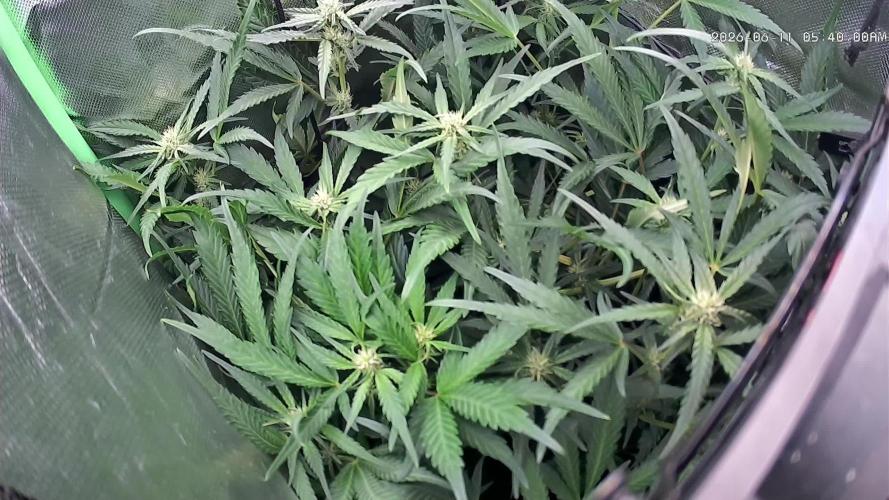
4th week of vegetation. The girl has grown healthy and entered in the blooming phase, and the first pistils are starting to appear. I've increased the dose of bio grow to 0.7 ml per 3 L and I'll continue for 2 more weeks. See you next week happy growing

Likes
21
Share

@Nedizzle
Follow
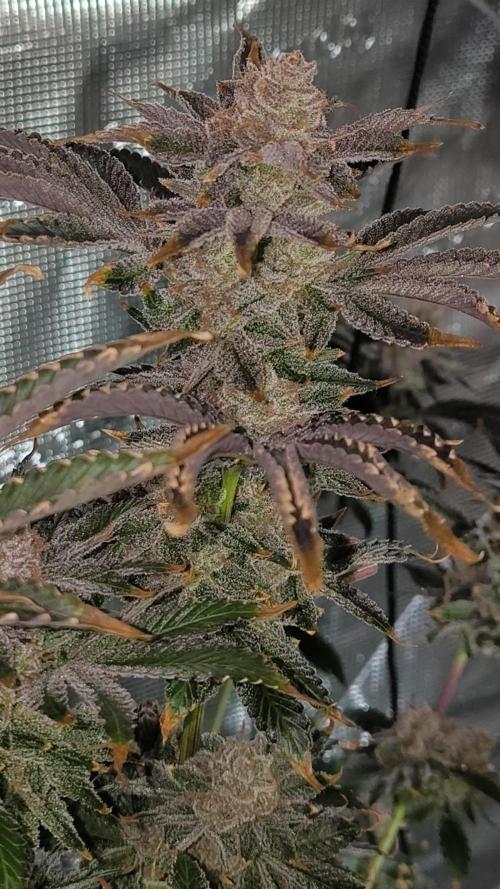
Harvest day on day 66. She's a big gyal. I gave her Flawless Finish for 5 days.
Jealousy was harvested a week before, because she stopped drinking and was "done".
I already tested one J and it was pretty strong.
Not much more to say, enjoy the pictures and videos. I'm hyped for the next run, but i will start somewhere in July.
I will return with the harvest reports in two weeks.
Cya 🌌🍁

Likes
42
Share


@Jackweed77
Follow
beginning of the fourth week🌻 everything is going well. made another small defoliation🍁 where it was needed. girls 🌱keep eating all the nutrition that my diet is good for them!👍 I'm waiting for the flowers to explode!💚👽
Day 25👍🌻👊
Likes
9
Share


@Pot_Portraits
Follow
Grandaddy Purple is also ready for flower, shape came along perfect thanks to the defoliation of fan leaves, now the lowers caught up and we are ready to produce some nice flowers.
Super healthy plant, excited to see what she will produce !
Likes
6
Share


Likes
37
Share


@PapaNugs
Follow
SO, the girls were doing so well into their second week I decided to do the unthinkable... I topped autos! 😳😳🤯🤯
I figured they were doing so well and hadn't entered flower yet; let's do our best to keep them small and get multiple good buds instead of just one. This will also give me the best opportunity to lst them down using ties. Stayed tuned for that!
This girl is doing well. She's in second place right now out of the group. She should easily fill out over the next few weeks and is already entering flower.
Dimmed to 40% but increased it today to 60%
Here are the lights details:
Medic Grow Mini Sun-2 150W LED
Model: MN150-022
Spectrum mode: V1
Efficacy: 2.8 umol/J
Thanks for stopping by!
You can find the light on Grow Diaries:
https://growdiaries.com/grow-lights/medic-grow/mini-sun-2-150-watts
You can find the light on Medic Grow's website:
https://medicgrow.com/
Likes
10
Share


@GuniGugu
Follow
D67 removed ScrOG and repeated LST on left plant so lower buds will get more light. There is not enough space in tent to do the same with the right plant.
Likes
98
Share


@Tropicannibis_Todd
Follow
💩Holy Crap We Are Back💩
Well i took the summer off to do some outdoor but thats all done so , we are back indoors and at it again 😁
So super happy to be trying this one out , can't wait😝 ..... it's been awhile since I've grown some BubbleGum so looking forward to it ..👍
We are 7 Days in and everything is going great 👌
Lights being readjusted and chart updated .........👍rain water to be used entire growth👈
👉I used NutriNPK for nutrients for my grows and welcome anyone to give them a try .👈
👉 www.nutrinpk.com 👈
NutriNPK Cal MAG 14-0-14
NutriNPK Grow 28-14-14
NutriNPK Bloom 8-20-30
NutriNPK Bloom Booster 0-52-34
I GOT MULTIPLE DIARIES ON THE GO 😱 please check them out 😎
👉THANKS FOR TAKING THE TIME TO GO OVER MY DIARIES 👈
Likes
27
Share


@LockDownGrow
Follow
ok so everything has gone fantastic , no nutrient burns at all , and have been slowly creeping up the base nutrients , i have stopped the cal mag and now adding house and gardens bud XL at full strength these girls are now in full swing of flower and i bought a new ph stick this week ,
i have found when PHing the feed bucket that its best too have air stones in the bucket , add all nuts and then ph but do not use the feed that day as if you check the next day the ph is off again so i left it 24 hours after i add more ph down , and it seems too make the measurements alot easier and stable , i have bent down the main stems " without damaging them onto my netting too A keep the canopy all the same high so my lighting is covering all plants at the same distance and also it allowed the side stems too reach up too ,
i also was sponsored another new led light by kingbo this week so have added another 600watt led too the grow , so now have two 600's and one 900watt , and temps are still fine sitting at 24c lights on and 19-20 off , so am pleased with that , this lady is nice and compact and tight lots of leaves that I had too remove too open up her bud sites , stretch was also minimal ,