


Likes
Comments
Share


@bioaccessory
Follow
Hello colleagues! ✋
Somehow this time the cycle ended quickly, perhaps because the plants performed very well.
At the beginning of the week I washed it with Clean, and throughout the week I gave it clean water.
Visually, the harvest looks good, the buds are as dense as stones. After about ten days of drying, I invite everyone to evaluate the results 😎
Thank you for stopping by, and be healthy! 🙏
To be continued... 😶

Processing
Likes
1
Share


@Esebees
Follow
Cambiamos de fotoperiodo y las plantas rápido han pegado el cambio y ya sacan los primeros pelitos
Likes
16
Share


@DeepRootsGrowTrees
Follow
GORILLA MELON / 420FASTBUDS
WEEK #13 OVERALL
Week #3 FLOWER
This week she doing good 👍 she's continued to grow her buds and she's getting good trichome coverage she's looking frosty. Stay Growing!!
Thank you for stopping by and taking a look it's much appreciated!!
BUDTRAINER.COM
BUD CLIPS/BUD CUPS
GORILLA MELON / 420FASTBUDS

Likes
7
Share


@Nw4117
Follow
I reduced nutrients. Powdery mildew is continuing and getting slightly worse. I sprayed it with an apple cider vinegar mix. Hopefully that helps.
The smell on the flower is really incredible. Smells berry like, and clean.
I opened all vents in tent and have been leaving the window slightly open as well. Heater is keeping up ok. Even in the cold nights it’s keeping it at 66F with everything open.
The leaves went crazy refilling the canopy. I’ve been pinching off some of the longer leaves and some that had mildew. The buds look good. Trichomes are cloudy enough yet, but it’s getting close. I’m gonna err on an earlier harvest, if the powdery mildew continues.
I’m making some LAB from KNF, along with other natural fertilizers. If the vinegar solution doesn’t help, I’ll try that when it’s ready. Excited to try KNF on my outdoor garden and lawn. Planning on growing a couple canna plants outside this year. Gonna keep my outdoor as organic and natural as I can.
The clone is doing well. The areas that I knuckled are strong now. Looks like biceps. Powdery mildew seemed to get this plant worse than the other. I’ve been wiping it off with my fingers as I see it, and finally treated with the vinegar solution too. I increased its feed to week two of medium gh feed chart. Expecting a lot of growth this week even with little light.
Getting my dry closet ready as well. Got another humidity controller and an upgraded temp controller with Wi-Fi. Gonna dry one more time inside my house. It’s dry enough inside that I should only need a humidifier to keep it right. Need to get another one before I harvest and then should have everything. I used grove bags last time to cure and will never use anything else.
Ordered another cheap TDS meter. The one I had got dropped in the solution.
Update: 2/11
The apple cider vinegar definitely cleared the powdery mildew up, but I found a few spots I think I missed directly in the middle of the large plant. I don’t see anything on the clone. I’ll reapply in a few days and pay closer attention to the middle of the plant.


Likes
55
Share


@Ultraviolet
Follow
What's in the soil? What's not in the soil would be an easier question to answer. 16-18 DLI @ the minute. +++ as she grows.
Probably not recommended, but to get to where it needs to be, I need to start now.
Vegetative @1400ppm 0.8–1.2 kPa 80–86°F (26.7–30°C) 65–75%, LST Day 10, Fim'd Day 11
CEC (Cation Exchange Capacity):
This is a measure of a soil's ability to hold and exchange positively charged nutrients, like calcium, magnesium, and potassium. Soils with high CEC (more clay and organic matter) have more negative charges that attract and hold these essential nutrients, preventing them from leaching away.
Biochar is highly efficient at increasing cation exchange capacity (CEC) compared to many other amendments. Biochar's high CEC potential stems from its negatively charged functional groups, and studies show it can increase CEC by over 90%. Amendments like compost also increase CEC but are often more prone to rapid biodegradation, which can make biochar's effect more long-lasting. biochar acts as a long-lasting Cation Exchange Capacity (CEC) enhancer because its porous, carbon-rich structure provides sites for nutrients to bind to, effectively improving nutrient retention in soil without relying on the short-term benefits of fresh organic matter like compost or manure. Biochar's stability means these benefits last much longer than those from traditional organic amendments, making it a sustainable way to improve soil fertility, water retention, and structure over time. Needs to be charged first, similar to Coco, or it will immobilize cations, but at a much higher ratio.
a high cation exchange capacity (CEC) results in a high buffer protection, meaning the soil can better resist changes in pH and nutrient availability. This is because a high CEC soil has more negatively charged sites to hold onto essential positively charged nutrients, like calcium and magnesium, and to buffer against acid ions, such as hydrogen.
EC (Electrical Conductivity):
This measures the amount of soluble salts in the soil. High EC levels indicate a high concentration of dissolved salts and can be a sign of potential salinity issues that can harm plants.
The stored cations associated with a medium's cation exchange capacity (CEC) do not directly contribute to a real-time electrical conductivity (EC) reading. A real-time EC measurement reflects only the concentration of free, dissolved salt ions in the water solution within the medium.
98% of a plants nutrients comes directly from the water solution.
2% come directly from soil particles.
CEC is a mediums storage capacity for cations. These stored cations do not contribute to a mediums EC directly.
Electrical Conductivity (EC) does not measure salt ions adsorbed (stored) onto a Cation Exchange Capacity (CEC) site, as EC measures the conductivity of ions in solution within a soil or water sample, not those held on soil particles.
A medium releases stored cations to water by ion exchange, where a new, more desirable ion from the water solution temporarily displaces the stored cation from the medium's surface, a process also seen in plants absorbing nutrients via mass flow. For example, in water softeners, sodium ions are released from resin beads to bond with the medium's surface, displacing calcium and magnesium ions which then enter the water. This same principle applies when plants take up nutrients from the soil solution: the cations are released from the soil particles into the water in response to a concentration equilibrium, and then moved to the root surface via mass flow.
An example of ion exchange within the context of Cation Exchange Capacity (CEC) is a soil particle with a negative charge attracting and holding positively charged nutrient ions, like potassium (K+) or calcium (Ca2+), and then exchanging them for other positive ions present in the soil solution. For instance, a negatively charged clay particle in soil can hold a K+ ion and later release it to a plant's roots when a different cation, such as calcium (Ca2+), is abundant and replaces the potassium. This process of holding and swapping positively charged ions is fundamental to soil fertility, as it provides plants with essential nutrients.
Negative charges on soil particles: Soil particles, particularly clay and organic matter, have negatively charged surfaces due to their chemical structure.
Attraction of cations: These negative charges attract and hold positively charged ions, or cations, such as:
Potassium (K+)
Calcium (Ca2+)
Magnesium (Mg2+)
Sodium (Na+)
Ammonium (NH4+)
Plant roots excrete hydrogen ions (H+) through the action of proton pumps embedded in the root cell membranes, which use ATP (energy) to actively transport H+ ions from inside the root cell into the surrounding soil. This process lowers the pH of the soil, which helps to make certain mineral nutrients, such as iron, more available for uptake by the plant.
Mechanism of H+ Excretion
Proton Pumps: Root cells contain specialized proteins called proton pumps (H+-ATPases) in their cell membranes.
Active Transport: These proton pumps use energy from ATP to actively move H+ ions from the cytoplasm of the root cell into the soil, against their concentration gradient.
Role in pH Regulation: This active excretion of H+ is a major way plants regulate their internal cytoplasmic pH.
Nutrient Availability: The resulting decrease in soil pH makes certain essential mineral nutrients, like iron, more soluble and available for the root cells to absorb.
Ion Exchange: The H+ ions also displace positively charged mineral cations from the soil particles, making them available for uptake.
Iron Uptake: In response to iron deficiency stress, plants enhance H+ excretion and reductant release to lower the pH and convert Fe3+ to the more available form Fe2+. The altered pH can influence the activity and composition of beneficial microbes in the soil. The H+ gradient created by the proton pumps can also be used for other vital cell functions, such as ATP synthesis and the transport of other solutes. The hydrogen ions (H+) excreted during photosynthesis come from the splitting of water molecules. This splitting, called photolysis, occurs in Photosystem II to replace the electrons used in the light-dependent reactions. The released hydrogen ions are then pumped into the thylakoid lumen, creating a proton gradient that drives ATP synthesis.
Plants release hydrogen ions (H+) from their roots into the soil, a process that occurs in conjunction with nutrient uptake and photosynthesis. These H+ ions compete with mineral cations for the negatively charged sites on soil particles, a phenomenon known as cation exchange. By displacing beneficial mineral cations, the excreted H+ ions make these nutrients available for the plant to absorb, which can also lower the soil pH and indirectly affect its Cation Exchange Capacity (CEC) by altering the pool of exchangeable cations in the soil solution.
Plants use proton (H+) exudation, driven by the H+-ATPase enzyme, to release H+ ions into the soil, creating a more acidic rhizosphere, which enhances nutrient availability and influences nutrient cycling processes. This acidification mobilizes insoluble nutrients like iron (Fe) by breaking them down, while also facilitating the activity of beneficial microbes involved in the nutrient cycle. Therefore, H+ exudation is a critical plant strategy for nutrient acquisition and management, allowing plants to improve their access to essential elements from the soil.
A lack of water splitting during photosynthesis can affect iron uptake because the resulting energy imbalance disrupts the plant's ability to produce ATP and NADPH, which are crucial for overall photosynthetic energy conversion and can trigger a deficiency in iron homeostasis pathways. While photosynthesis uses hydrogen ions produced from water splitting for the Calvin cycle, not to create a hydrogen gas deficiency, the overall process is sensitive to nutrient availability, and iron is essential for chloroplast function.
In photosynthesis, water is split to provide electrons to replace those lost in Photosystem II, which is triggered by light absorption. These electrons then travel along a transport chain to generate ATP (energy currency) and NADPH (reducing power). Carbon Fixation: The generated ATP and NADPH are then used to convert carbon dioxide into carbohydrates in the Calvin cycle. Impaired water splitting (via water in or out) breaks the chain reaction of photosynthesis. This leads to an imbalance in ATP and NADPH levels, which disrupts the Calvin cycle and overall energy production in the plant. Plants require a sufficient supply of essential mineral elements like iron for photosynthesis. Iron is vital for chlorophyll formation and plays a crucial role in electron transport within the chloroplasts. The complex relationship between nutrient status and photosynthesis is evident when iron deficiency can be reverted by depleting other micronutrients like manganese. This highlights how nutrient homeostasis influences photosynthetic function. A lack of adequate energy and reducing power from photosynthesis, which is directly linked to water splitting, can trigger complex adaptive responses in the plant's iron uptake and distribution systems.
Plants possess receptors called transceptors that can directly detect specific nutrient concentrations in the soil or within the plant's tissues. These receptors trigger signaling pathways, sometimes involving calcium influx or changes in protein complex activity, that then influence nutrient uptake by the roots. Plants use this information to make long-term adjustments, such as Increasing root biomass to explore more soil for nutrients. Modifying metabolic pathways to make better use of available resources. Adjusting the rate of nutrient transport into the roots. That's why I keep a high EC. Abundance resonates Abundance.
Likes
13
Share
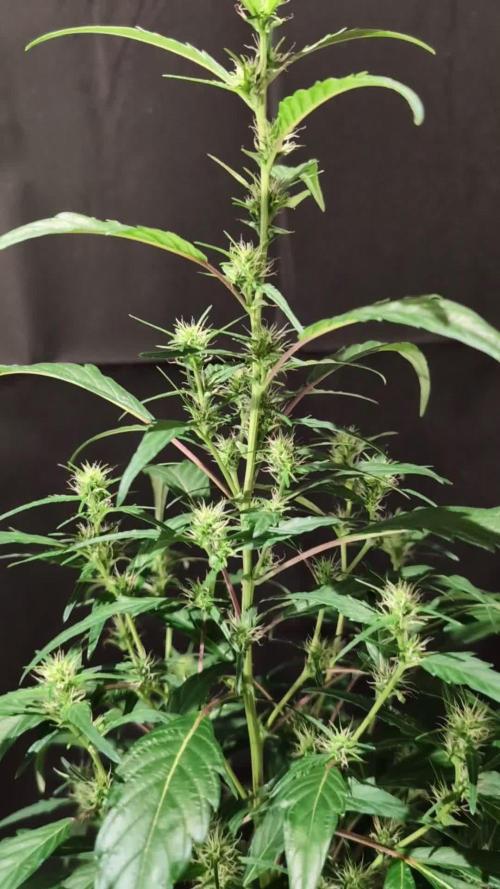

@GoodTimesOrganics
Follow
Hi liebe Community and Welcome Back! 💚
Nach der zweiten Blütewoche entwickelt sich die Orange Bud weiterhin top. Im Stretch kommen nun die Sativa Gene stark zum Ausdruck und die Pflanze hat noch Mal einen starken Wachstumsschub hingelegt.
Außerdem hat sie eine richtig schöne Weihnachtsbaum Form 😁
Dadurch, dass sich jetzt nur einzelne Blätter ausgebildet haben kann das Blütenbild nun wunderbar ausgeläuchtet werden.
Oldschool Baby! 💚
Die Pflanze wurde nicht getoppt.
Die Seittriebe beginnen nun in die Breite zu gehen und kommen allmählich gut hervor.
Die unteren Triebe wurden rausgeschnitten, damit die Pflanze nun ihr Potential nach oben entfalten kann.
Die Umgebungsgegebenheiten sind aktuell gut:
—————
🌞 Temp: 26°C
🌚 Temp: 18°C bis 19°C
💨 RH: 58%
VPD: 1,10 kPa
💡ppfd: 830 mpm
—————
Viele Grüße 👋

Likes
119
Share


@PEAKYPLANTERS
Follow
Ok ,let's GOOO!
These buds are eager to gain weight and develop under this phenomenal light and seem to enjoy excellent health thanks to these excellent nutrients😋🤗🤗🤗

Likes
1
Share


@Unkraut
Follow
everything's looking good 😀
check www.sr-organics.com for some topnotch 5 in 1 fertilizer!
root, growth, bloom, micro-organisms, enzymes & vitamins all in one!
CODE: "Unkraut10" for 10% Discount! 😊

Likes
2
Share


@Stiggy
Follow
19 Oct: Tied the main stem down, took off some leaves and cleared the lower nodes. Light raised to 50 cm. 30 cm tall.
20 Oct: More LST clips, tied some leaves back and took off a few more lower nodes. Dehumidifier is in now as well.
21 Oct: Watered 2.5 L with Bio-Bloom 2 ml/L and Bio-Grow 2 ml/L. Removed more lower nodes. Light went to 60 cm and 90 %, around 660 PPFD at the canopy.
22 Oct: didn't do much today, she's still a bit short, but catching up
23 Oct: First pistils are out, so she has started to flower. Lollipopped the bottom, a lot of lower nodes sat fully in the dark. Watered 2.5 L with Bio-Bloom 3 ml/L + Bio-Grow 2 ml/L and she drank all of it. Lamp at 40 cm now, 846 PPFD on average over the tent.
Week 5 totals (19–25 Oct): 7.5 L of water. Bio-Bloom total: 20 ml. Bio-Grow total: 12.5 ml.
24 Oct: Bent a few branches down to level the canopy and raised her pot so her tops sit at the same height as the others.
25 Oct: Watered 2.5 L with Bio-Bloom 3 ml/L + Bio-Grow 1 ml/L.
Likes
5
Share


Likes
15
Share


@SirBudAlotts
Follow
This week was a blessing...
Everything went smoothly, except..I had my grow light a little too close to her...
**Tips Burnt abit**
But, I corrected the mistake that should not have happened in the first place if I payed attention to the setup 🤣😫..
Other than that she is doing quite well as you can see 👀 😉
Likes
39
Share


@KitaKush
Follow
A white christmas for me after all! 😂
Week 13 harvest! Plant 1 = 67 grams/2.3 oz Plant 2= 55 grams/1.9 oz overall= 4.2 oz
(5-7 day dry)
The Gorilla Cookies are soooo damn frosty and stinky…i’ll be drooling at them for a month until I can taste them!!!!
Photos mostly of plant 2..1 was coated in resin but plant 2..the frostiness can be seen from far away! My first top shelf grow 😈…hopefully more to come!
My glove was literally sticking to the stems and getting stuck with plant #2
The stench reminds me of thanksgiving dinner LOL..sausage stuffing and gas is what comes to mind..very savory aroma!
One plant flushed partially the other not flushed and I can tell you that the flushed plant has much more flavorrrr..if this didn’t prove to me that flushing is absolutely essential IDK what would! LOL
Likes
9
Share


@Irshaads
Follow
2 weeks and 3 days into flower.
Improved air ventilation by moving oscillating fan to the top of the tent, moved extractor fan to the bottom of tent and reversed polarity for more air circulation.
LST scrog net applied.
AFGOO strain seems to be flowering much quicker than GC strain.
Processing
Likes
25
Share


@parachute
Follow
The buds are fattening and getting covered with trichomes very well, most of them are healthy and flowering at the same stage, orange pistols are already popping out, thinking about harvesting in a week or some.

Likes
11
Share


@Kirsten
Follow
🧡 ACAPULCO GOLD 🧡
This is becoming a very interesting pheno!
She has developed 3 tops, and growing really well, nice and healthy, and is looking so far 👌
I have a full tent, so I'm considering letting the plants in this grow, grow up as I've got plenty of head space but very little horizontal space.
This one is a Sativa, and so I am preparing for a tall plant.
This was what I did this week:
23.6.25:
I watered with 2L of dechlorinated water PH'd to 6.6 and containing no nutrients.
PH: 6.6
PPM: 307
26.6.25
I gave 2l of dechlorinated water PH'd to 6.2 with no nutrients;
PPM: 333
PH: 6.4
27.6.25:
I top dressed the plant today, I watered yesterday.
Top dress:
♡ 2 cups Worm Castings
♡ 1 TBSP Ecothrive Life Cycle
♡ 1/2 TBSP Ecothrive Charge
♡ 1 TBSP Cinnamon
29.6.25:
I watered with 1L of dechlorinated water PH'd to 6.0-6.2 and containing the following nutrients per 5 litres;
♡ 1 Tsp Cal-Mag by Greenleaf Nutrients
PH: 6.0-6.2
PPM: 1300
Thanks for checking out my diary 💚✌️🍃😊🌱

Likes
4
Share


Likes
4
Share


@cadaver420
Follow
Alga vera biobizz once more. NEXT TIME go with Bloom.
Smell sttrong.
buds hard as a rock.
Royal critical, royal gorilla, amnesia haze in the front smaller plants.
One week more for Bubble kush (in video) then harvest. More space i will have than.




Likes
24
Share


@Grey_Wolf
Follow
Eva Seeds High Level 2nd Feb 2020
Im updating a day early because Ive had a major fuckup!! I sprayed my girls with potassium bicarbonate and it's scorched some leaves pretty badly 😱😓
I'm hoping they recover because they are just starting to flower FFS 😒 But its my bad and I'm pretty pissed at myself for doing it .
Im gonna post up a grow question regarding the burnt foliage . Cheers for checking in
Update 4th feb Ive done the soil ph test thankfully it's still well within optimum range so one less thing to worry about for now.
I only removed the leaves that were completely burnt and dried out any with burns just on the fringes got left alone , Gave a misted spray with distilled water
and added a big ass Fan to the greenhouse. This should create all the air movement needed to help keep it cool and not humid.
We have 5 days in a row forecast ahead with temps that are expected to reach 40 celcius during the day. Whilst the greenhouse provides shade , the inside temps can reach
50 on a 40 degree day not good without plenty of air. movement
