Likes
Comments
Share
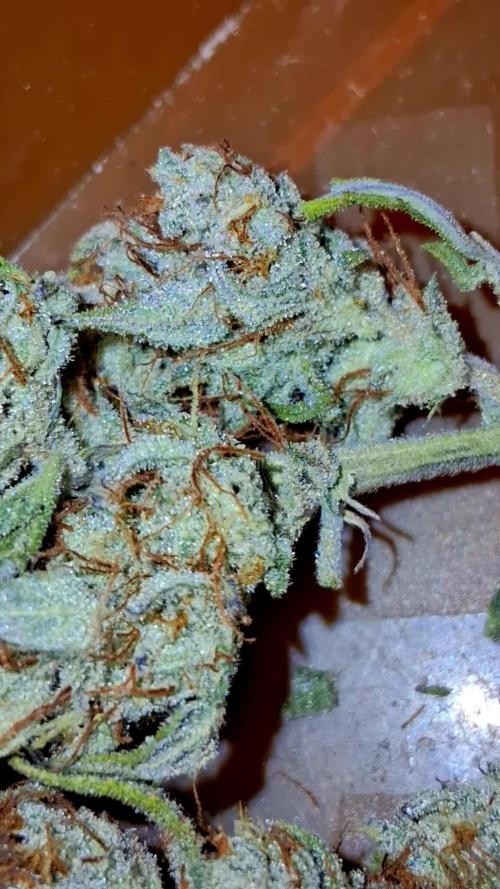
Bueno familia ya finalizamos con el proyecto de las Runtz de seedstockers, son una cepa bestial. La verdad que el secado muy bien 9 días en Malla y a los botes, 40% humedad y 21 grados es la temperatura ambiental que han tenido en el secado, aparte deshumidificador enchufado 24 horas al día. En resumen la cepa es muy fácil de cultivar, el germinado se me resistió igual es complicado el germinado pero el resto es simple resistente fácil de alimentar pienso que es rápida los tricomas ya estaban hechos y se me hecho el tiempo encima. Por lo demás de miedo os la recomiendo. Gracias a Seedstockers, Agrobeta y Mars hydro, sin ellos este proyecto no sería igual 🙏. Agrobeta: https://www.agrobeta.com/agrobetatiendaonline/36-abonos-canamo Mars hydro: Code discount: EL420 https://www.mars-hydro.com/ Buenos humos 💨💨💨
Likes
7
Share
Processing
Likes
27
Share
Nothing much to say about my grow this week. Gave he a flush with pH 6.0 to kick off the week. Day 86..... Gave her a feeding today a whole gallon. Ive been doing some research and maybe I'm feeding my plants a little too much nutrients. So from now on I will be feeding a lot less and the next day I will feed just plain water. So my plants will get nutrients every 3 or 4 days. I also bought a few advanced nutrients supplements which I'll be experimenting with. Day 87... Gave her a feeding today of advanced nutrients Nirvana and voodoo juice and pH to 5.9. Day 88.....gave her a 2l feeding today of nutrients. Also defoliated some of her big fan leaves.
Processing
Likes
31
Share
day 35: finally they are flowering, they are drinking 1 liter every 2 days today i broke the main cola of the TM im still crying, use duct tape to repair, will try to update the recovering
Likes
1
Share
@c1note
Follow
11.11 die Lady nimmt 2L pro Tag auf. Solution 4L mit 12 ml COCO A+B, 8ml Rhizo, 10 ml Cannazym, 3.0 -3.5 ml CalMag, 14ml Boost. EC 1.918 Ph 5.83. Eine Handvoll Laub muss pro Tag raus. Braucht viel Pflege und Nahrung aber bei diesem Wachstum sehr gerne. 09.11 24.7 °C 68 % RL VPD 1.0. Gehe jeden Tag 0.5 ml mit dem Bosster hoch. Schaut sehr gesund aus und verträgt das tägliche Entlauben ohne Probleme. 08.11 neu organisiert, einiges an Blattmaterial rausgenommen. Dieser Busch frisst 1.5 L mit 1.8Ec pro Tag. 650-700 PPFD DLI 1.18 VPD 1.2. 07.11 4 L Solution mit 1.8 Ec. ca.1.6L bis es unten raustropft. Dli 30-32 VPD 1 06.11 Woche 6 Blüte Tag1 Umstellung auf 12/12 nach 24 Stunden Dunkelheit. Dli 28- 30. 2L mit Ec1.72 5.8 ph so wie immer. VPD 1.1
Likes
179
Share
@StarLorr
Follow
Welcome to my Øpium Diary. 🚨 Officially outdoor plant as of Saturday 18-May-24.🚨 ___________________________ Feeding: Wed 15May: 1.3L nutrients pH'd 6.5 Fri 17May: 650ml water pH'd 6.5 Sat 18May: 4L after transplant in 7 gallon bucket pH @7.2 Mon 20May: 4L water pH'd 6.5 ___________________________ Finally got her out of the tent and transplanted her into a 7 gallon container on Saturday the 18 of May. Weather has been abnormally warm for this time of the year.... smooth transition from the indoor to the outdoor. Did some light defoliation on lower branches and fan leaves on Mon 20-May-24. ___________________________ Thanks for stopping by, likes and comments are appreciated!👊🏻😎 Keep on growin! Keep on tokin!!! 😙💨💨💨💨💨
Likes
12
Share
@FreakShow
Follow
Buds Getting bigger and full off trichoms 😍😍 And smells fantastic 🤤🤤🤤
Likes
1
Share
@Wenz004
Follow
In der vergangenen Woche der Abwesenheit ist die Pflanze fast eingegabgen. EC drain war nicht mehr Messbar. Mein EC Gerät gibt bei über 6 auf. Wohl totale Übersalzung. Fast alle Blattränder sind kaputt und viele Blätter komplett. Weiß nicht ob es nicht an den aqua flores liegt - evtl. für sowas nicht geeignet oder weil zuwenig drain vorhanden war. Hab jetzt mehrmals gespüllt mit ta flash clean und den ec drain auf 1 runtergebracht. Ab jetzt wieder Handbewässerung mit Aptus - da gabs solche Probleme nie. Vermerk - bei nochmaligen Düngerwechsel - ordentlich vorher spülen. Auf zur zur Rettung.
Likes
53
Share
@Pr3m_85
Follow
We approach the late friends !!! Peace to all ✌️🏻✌️🏼✌️🏿✌️🏾✌️✌️🏽
Likes
1
Share
@PapaTerps
Follow
Blue Zushi - Dutch Passion Day 74 - Watered with 3 litres of RO tap water, with defined nutrients, pH'd to 6.3. She had a massive growth spurt this week and was stretching so fast, I had began plan's to bend her main stem, but thankfully she finished that and is now focusing on developing her bud sites 💪 This week, I removed a few leaves, but other than that, I've just let her do her thing.🙏
Likes
6
Share
@BoooBooo
Follow
Plant started really good. unfortunatelly, humidity and temperature is very low, but she is good for that stresses I guess )) i’m working on both problems, hope all conditions will be perfect soon and she will be a monster ))
Likes
8
Share
Very boring but very good week lots of stretching. got a new hood wi th cool tube it's huge 3x3 and my tent is 4x4 I love it will make a second video to show it off. Today I will feed with gaia green bloom ,bat guano and a small amount of worm castings as she lpves her nitrogen and dont want her to fade early. Blimburn seeds are great so far growing GDP by them as well both r fast growing and very forgiving. With the new cool tube i can keep my tent closed now without overheating tent stays between 70-72 degrees now getting all of the light none wasted can't wait for next week's update as I was able to drop the light a foot closer to my plants so growth should be big your gonna wanna see this guys. It's my second grow ever and I'm getting better at growing everyday thanks to everyone's diaries I'm reading so ty everyone and ty to the genius who came up with this web site
Likes
19
Share
🌸 White Widow — Week 7 Flower (Week 11 from seed) Status: Full flower, bulking rapidly. Vibe: Dark foliage, compact form, heavy frost, 90s aroma profile. Feeding: Aptus + Plagron lineup (Power Buds, Sugar Royal, Green Sensation, Regulator, CalMag, All-in-One) Photos: Sony a6000 — loyal workhorse for studio shots. 📷 ⸻ 🧠 Deep dive — Why 12/12-from-seed makes a plant “go hard” Plants evolved to reproduce. Their primary biological drive is to make seeds. Photoperiod (day length) is one of the most reliable seasonal cues plants use to decide: is it time to flower? Mechanisms at play (simple → nerdy): • Photoperiod sensing: Leaves detect day length via phytochrome systems (Pr Pfr). Short days (or the 11/13 rhythm) flip the hormonal cascade toward flowering. • Florigen & flowering hormones: When the plant senses “short days,” it produces mobile signals (florigen) that travel to the shoot apex and shift gene expression from vegetative growth to reproductive development. • Carbohydrate reallocation: Energy stops making more leaves/branches and is directed into calyxes, resin synthesis, terpene pathways, and seed/flower tissues. • Result: A plant that thinks “the season’s ending — reproduce now!” goes all-in: denser flowers, rapid calyx swelling, intense trichome production. Important point: they don’t know about pollination. The plant can’t tell you whether pollinators exist or whether pollen will land — it simply invests in attractive, resinous flowers to maximize reproductive success. As growers, we exploit that drive to produce potent sensimilla (unpollinated) flowers. ⸻ 🔬 Why your White Widow is exploding in quality right now • Immediate reproductive programming: Starting floral signals early (12/12 from seed) forces the plant to prioritize flower formation rather than vegetative mass. That yields compact, dense colas. • High PPFD + short day = strong DLI in less time: With fewer hours of light, your lamp intensity is higher in those hours → powerful photosynthesis during the window the plant has chosen. • Nutrition tuned to flower: the Aptus + Plagron stack feeds the metabolic surge — PK + biostimulators for bulking, sugar stimulators for terpene pathways, Ca/Mg for structural health. • Genetics: White Widow is resin-happy; give it the right cues and it will frost up like a sugar cookie. ⸻ 🌈 Why her colors are going dark (and why that’s beautiful) Leaf & bud color comes from a balance of chlorophyll + accessory pigments (anthocyanins, carotenoids) and is influenced by: • Genetic propensity (some phenos are naturally darker) • Temperature swings (cooler nights often increase anthocyanin expression) • pH / nutrient balance (some deficits/ratios nudge color pathways) • Light spectrum intensity (strong red/far-red influence can shift pigment expression) Dark phenos often correlate with high terpene and anthocyanin expression — visually stunning and often highly aromatic. ⸻ 🔁 Quick timeline recap (for newcomers) • Germination & early mistakes: initial heat-mat loss → restarted, one strong survivor. • Veg: compact, short internodes under the 11/13/12-12 shuttle → stacked nodes. • Early flower: slow to show, but once she flipped she committed. • Now – Week 7 flower (Week 11 from seed): heavy bulking, thick trichomes, deepening color, classic White Widow aroma emerging. ⸻ 🔭 What to expect next (this week → next week) Expect: • Continued bulking of calyxes and cola weight. • Explosion of trichome coverage — white, cloudy glands multiply. • Stronger terpene smell (earthy, spicy, resinous 90s profile). • Possible color intensification — deeper greens, potential purples depending on phenotype & nights. Do not expect: • Major new stretch — she’s committed to flower and will remain compact. • Immediate harvest — typical White Widow still wants its weeks; plan for patience (mid-late flower bulking happens over several more weeks). ⸻ ⚖️ Should you run all seeds 12/12 next cycle? (pros & cons) You asked if you might run every seed 12/12 — here’s the honest rabbit-hole: Pros • Much faster cycle → less time to harvest. • Compact plants → ideal for small spaces or stealth grows. • Often denser single-plant yields; less training needed. • Great for experimentation, multi-strain rapid rotation. Cons • Generally lower total biomass per plant vs. long veg runs. • Some genetics need veg time to express full canopy & branching; yields may be lower for those strains. • Root systems can remain smaller → may stress under high PPFD if not supported. • Less flexible for heavy-topping/lst/manipulation strategies. Bottom line: for strains with good genetics for flowers (like White Widow), 12/12-from-seed can be very rewarding. For sativa-dominant, tall strains you might lose yield without long veg. ⸻ 📷 Gear love — Sony a6000 shoutout I’ve got to echo it: that camera is a workhorse for growers. Compact, responsive, great color fidelity, and perfect for low-light studio shots when paired with proper exposure. The a6000 captures the leaf texture, color depth, and bud gloss in a way phones struggle to match. Long live the loyal shooter. 📸✨ ⸻ 🙏 Gratitude — the usual and the real Thank you to: • Zamnesia — for the genetics & the nostalgia. • Aptus & Plagron — the chemical & biological push that lets the plant sing. • ThinkGrow / Future of Grow / TrolMaster — lighting, control, and environment orchestration. • You — the makers, lovers, critics, curious readers — your energy fuels this diary. And to our White Widow — for showing up, forgiving mistakes, and giving back in beauty. 💚 ⸻ Week 7 flower — Week 11 from seed. Darker colors, heavy frost, the classic 90s scent, and a compact structure that proves 12/12-from-seed can produce absolute fire. We went full-in on Aptus + Plagron, kept the Emerson red-lead sunrise/sunset, and trusted the genetics. Watching her build is pure joy. Come see the series in 4K on YouTube — every detail, every shimmer. 🌿🔥📷 #WhiteWidow #Zamnesia #GrowDiaries #12fromSeed #EmersonEffect #Aptus #Plagron 📲 Don’t forget to Subscribe and follow me on Instagram and YouTube @DogDoctorOfficial for exclusive content, real-time updates, and behind-the-scenes magic. We’ve got so much more coming. You won’t want to miss it. • GrowDiaries Journal: https://growdiaries.com/grower/dogdoctorofficial • Instagram: https://www.instagram.com/dogdoctorofficial/ • YouTube: https://www.youtube.com/@dogdoctorofficial ⸻ Explore the Gear that Powers My Grow If you’re curious about the tech I’m using, check out these links: • Genetics, gear, nutrients, and more – Zamnesia: https://www.zamnesia.com/ • Environmental control & automation – TrolMaster: https://www.trolmaster.eu/ • Advanced LED lighting – Future of Grow: https://www.futureofgrow.com/ • Root and growth nutrition – Aptus Holland: https://aptus-holland.com/ • Nutrient systems & boosters – Plagron: https://plagron.com/en/ • Soil & substrate excellence – PRO-MIX BX: https://www.pthorticulture.com/en-us/products/pro-mix-bx-mycorrhizae • Curing and storage – Grove Bags: https://grovebags.com/ ⸻ We’ve got much more coming as we move through the grow cycles. Trust me, you won’t want to miss the next steps, let’s push the boundaries of indoor horticulture together! As always, this is shared for educational purposes, aiming to spread understanding and appreciation for this plant. Let’s celebrate it responsibly and continue to learn and grow together. Friendly reminder all you see here is pure research and for educational purposes only, With true love comes happiness. Always believe in yourself, and always do things expecting nothing and with an open heart. Be a giver, and the universe will give back in ways you could never imagine. 💚 Growers love to all P.S. — Deep dive on DLI (Daily Light Integral) — short, clear, and a little nerdy (in the best way). 🌞🌿 1) What is DLI, simply? DLI = the total amount of photosynthetic light (photons) a plant receives over one day. It’s expressed in moles of photons per square metre per day (mol·m⁻²·day⁻¹). While PPFD (μmol·m⁻²·s⁻¹) tells you instantaneous light intensity, DLI tells you how much light the plant actually used that day. ⸻ 2) The formula (how to calculate it) Use this exact formula: text{DLI (mol·m}^{-2}text{·day}^{-1}) = frac{text{PPFD (μmol·m}^{-2}text{·s}^{-1}) times text{seconds of light per day}}{1{,}000{,}000} Where seconds of light per day = hours of light × 3600. I’ll show worked examples so it’s easy to follow. ⸻ 3) Worked examples (digit-by-digit so it’s crystal clear) Example A — your reported PPFD ≈ 766 μmol·m⁻²·s⁻¹ and 11 hours light • seconds of light = 11 × 3600 = 39,600 s • photons per day = 766 × 39,600 = 30,333,600 μmol·m⁻²·day⁻¹ • convert to moles: 30,333,600 ÷ 1,000,000 = 30.3336 mol·m⁻²·day⁻¹ So: 766 μmol·m⁻²·s⁻¹ × 11 h → DLI ≈ 30.3 mol·m⁻²·day⁻¹ Example B — same PPFD but 12 hours • seconds = 12 × 3600 = 43,200 • photons = 766 × 43,200 = 33,091,200 • DLI = 33,091,200 ÷ 1,000,000 = 33.0912 mol·m⁻²·day⁻¹ Example C — other quick refs • 700 μmol × 11 h → DLI ≈ 27.72 • 800 μmol × 11 h → DLI ≈ 31.68 • 400 μmol × 11 h → DLI ≈ 15.84 • 1000 μmol × 12 h → DLI ≈ 43.2 (You can plug any PPFD and hours into the formula — those are ready-made reference points.) ⸻ 4) What DLI targets are useful for cannabis? • Vegetative (gentle): ~12–25 mol·m⁻²·day⁻¹ • Flower (typical good range): ~25–40 mol·m⁻²·day⁻¹ — most home/pro growers aim here • High-intensity/CO₂-enriched commercial: 40–60+ mol·m⁻²·day⁻¹ (needs CO₂, stronger conditioning) So your example (≈30 mol·m⁻²·day⁻¹ at ~766 PPFD × 11h) sits very nicely in the flower range. That explains the dense bulking + heavy resin you’re seeing — our DLI is right where White Widow loves to convert energy into flowers. ⸻ 5) Practical implications — what DLI affects and what to watch • Higher DLI → higher photosynthesis → more carbohydrate to drive bud bulking and terpene/trichome production. • Higher DLI requires more water and nutrients. Plants transpire more and pull more minerals; be ready to feed and irrigate appropriately. • Leaf temperature / heat stress: pushing PPFD up increases canopy energy/heat — keep airflow, VPD, and room temps under control. • CO₂ matters: if aiming beyond ~40 mol/day, elevated CO₂ (e.g., 800–1200 ppm) becomes productive; otherwise additional light won’t be used efficiently. • Distribution matters: DLI is an average over the canopy. Hotspots or shaded pockets mean some flowers get too much or too little — even light spread (and PAR mapping) matters. ⸻ 6) Actionable tips for your run (based on your 11/13 / 12/12 experiment) • We’re hitting excellent flower DLI (≈30 mol/day at 766 μmol × 11 h). That’s why buds are dense/frosty — keep the rhythm. • If you shorten hours (e.g., 11 h) keep PPFD high to maintain target DLI. If you lengthen hours (12 h) you can reduce peak PPFD slightly and still hit the same DLI. • If you raise PPFD to chase more DLI, ramp slowly (a few μmol/sec per day) to let stomata and roots acclimate — avoid sudden bleaching. • Watch watering & EC — higher DLI → faster uptake → more frequent but measured feeding. • If you ever push DLI 40 mol/day consider CO₂ enrichment and perfect VPD control to have that extra light used efficiently. ⸻ 7) Quick rules of thumb • Want to hit ~30 mol/day with 11 hours on the clock → aim for roughly 700–800 μmol·m⁻²·s⁻¹. • Want ~33 mol/day at 12 hours → ~766 μmol·m⁻²·s⁻¹ matches that nicely. • If you see leaf cupping/bleaching, you’ve likely exceeded safe PPFD for that canopy or temps are too high — back off, check VPD.
Processing
Likes
6
Share
@Deeganja
Follow
this girl is further ahead than the rest of the girls so I believe she will be finished a couple of weeks before the rest of them, looking stunning 😍
Processing
Likes
61
Share
@Dunk_Junk
Follow
She's over doubled her height this week!!!!!!!!!! Looks like she's going great! An educated guess says she is just about to enter flowering in the coming week.
Likes
3
Share
@FrostyB
Follow
Again this strain was a pleasure to grow and very resistant to any changes or nutrients. I just wish I had more at the time but it was a feee seed and I only had one. Would be a decent harvest of some juicy tasty pineapple goodness 🍍💚
Likes
2
Share
It was good its my first grow ever so I can say that it came out good. I watered them with spray bottle and kept the ph at 5.7 til they got bigger. As you can see I kept them in a humidity dome with a heat may and they loved that environment!
Likes
38
Share
@Aedaone
Follow
I dropped these in a glass of water and let sit until they sank, then transfered to paper towel. I placed the paper towel in a ziplock bad but did not zip it. That was the afternoon of the 9th of June. I'm planting today the 11th June directly into 30 gallon pots. The taps are slightly longer than the seed, but we've got overcast rainy/misty weather forecast all day. That should give them moisture to keep them alive until roots establish. I've added the nutes to this week. These nutrients are all dry fertilizer that are premixed into the soil and numbers are ml of fertilizer per gallon of soil/perlite.
Likes
62
Share
@Hou_Stone
Follow
it grows so fast. The lower leaves are shaded and away from the light. So I cut them as the plant gets taller I really don't have a good setup to be able to clean my roots. I tried this week anyway. I watered each pot with 2L (not enough I think :/) of water at 450PPM PH: 7 then after I gave 1L of water at 900PM PH: 5.5. There was a big puddle in the room afterwards. But it wasn't that hard to clean up after all. In 5 minutes with a rag and a bucket ------------------------------------------------ -Daytime temperature: 24-29°C -Night temperature: 22-27°C -Humidity: 50-75% ( Too high but it's hard to lower it... I need advice please contact me if you have :) ) -Lamp: Mars Hydro FC3000. intensity 80% at 40cm from the top leaves -Room: Mars Hydro 100x100x180cm -Extractor: Mars hydro 402 CFM Max. power 3/10 -Substrate : 70% coco, 25% perlite, 5% vermiculite. My instagram : https://www.instagram.com/p/CuMhQ_BsjRP/?utm_source=ig_web_copy_link&igshid=MzRlODBiNWFlZA==
Likes
2
Share
@ChiTaN
Follow
These are the last moments of veg, soon switching to flowering 💪