


Likes
Comments
Share


Likes
120
Share


@DogDoctorOfficial
Follow
Welcome back to another thrilling chapter of our Tropical Tangie's journey, now in Week 5 of flowering.
This week, our lovely lady continues to enchant with her graceful growth and mesmerizing beauty. The trichomes have developed into a spectacular sight, glistening like tiny diamonds under the grow lights. These little crystal-like structures hold the essence of her strength and character, and they are, without a doubt, a testament to the diligent care we've provided.
I want to take a moment to apologize for the missing videos. Unfortunately, I'm currently experiencing some technical difficulties with Grow Diaries that are preventing me from uploading them. Rest assured, I'll rectify this as soon as the situation is resolved. The videos are an essential part of this journey, and I'm excited to share them with you.
As always, your support and enthusiasm are deeply appreciated. Our quest for botanical knowledge continues, and we'll explore every facet of this captivating journey together.
Stay tuned for the next chapter in our research, and in the meantime, I wish you all a blessed and beautiful week.
GD Still playing hard on me, ASAP i will upload the videos but for now is not allowing me to do it, and to upload photos it takes me hours i will upload all missing wen possible <3 <3 <3

Likes
13
Share


@rkomaaa
Follow
A lot of problems with run off PH
It drove me crazy, and i gave up
Now is aprox 6.5 and i will see how it will go

Likes
120
Share

@DogDoctorOfficial
Follow
The Harvest Prelude:
After a patient wait and 48 hours of darkness, the moment arrived. The Tropical Tangie Lego Ninja, standing proudly like a silent guardian, was ready for the grand harvest. The sound of each cut echoed through the grow space, reminiscent of felling a mighty tree. The compact structure of the buds was awe-inspiring, a testament to the ninja's disciplined growth.
The Lego Ninja, like a stoic warrior, was then hung upside down, beginning a two-week drying ritual. Maintaining an ambient temperature of around 21°C and a relative humidity of 60%, this slow-drying process allowed the buds to retain their essence, preserving the symphony of terpenes and cannabinoids.
The trimming phase unfolded like a fragrant masterpiece. Each bud, adorned with a glistening layer of resin, transformed the trimming process into a sensory delight. The zesty aroma of oranges enveloped the room, a tangible expression of the tropical lineage. The compact buds made every snip a careful dance, revealing an abundance of frosty trichomes.
The moment of reckoning arrived with the scale's unveiling. The Tropical Tangie Lego Ninja, from a single plant, bestowed upon me 309 grams of dried medicine. Each gram was a treasure trove of cannabinoids, a promise of euphoria and relief. The sheer compactness of the buds translated into a concentrated potency that left me in awe.
In parallel, the clones, nurtured with equal care, showcased a fascinating divergence. A twist in the tale unfolded as the intense oranges of the mother transitioned into vibrant tangerines. This unique expression, I believe, was a testament to the clones weathering a summer heatwave differently, bringing forth a distinct personality.
The clones, resilient and generous, gifted me a bountiful 549 grams of pure joy. This now my keeper of the garden, an embodiment of the Lego Ninja's legacy. The harvest dance, though familiar, carried the nuances of tangerine zest, a refreshing twist that left me eager to explore its intricacies.
Both harvests shared a common thread—their resinous abundance. The trim bin, akin to a treasure chest, gleamed with golden trichomes and fragrant joy. Sticky fingers became a badge of honor, a tangible connection to the resinous richness that filled the room.
Shout Outs:
No harvest report is complete without expressions of gratitude. A special nod to @DutchPassion_Official for crafting the genetic marvel that is the Tropical Tangie Lego Ninja. Their expertise paved the way for this epic journey, and I tip my hat in acknowledgment.
In conclusion:
As the dust settles on this epic harvest saga, my heart brims with happiness and excitement. The Tropical Tangie Lego Ninja has proven itself not just as a plant but as a living masterpiece. Stay tuned for the smoke report, where we delve into the true essence of this botanical ninja's legacy. Until then, fellow cultivators, may your gardens flourish, and your harvests be as bountiful as the joy they bring.
As always thank you all for stopping by, for the love and for it all , this journey of mine wold just not be the same without you guys, the love and support is very much appreciated and i fell honored and blessed with you all in my life<3 <3 <3
#aptus #aptusplanttech #aptusgang #aptusfamily #aptustrueplantscience #inbalancewithnature #trueplantscience
With true love comes happiness <3 <3 <3 Always believe in your self and always do things expecting nothing and with an open heart , be a giver and the universe will give back to you in ways you could not even imagine so <3 <3 <3
Friendly reminder all you see here is pure research and for educational purposes only
<3 <3 <3 Growers Love To you All <3 <3 <3
P.S- I must extend my sincerest apologies for the missing video reports. Regrettably, Grow Diaries is still facing some technical issues that are preventing me from uploading them. Rest assured, as soon as the situation is resolved, I'll share those videos to give you an even closer look at this fascinating journey. or in my case apparently GD dont let me do uploads over 100mb with is super small file if you working and editing videos , doing my best here to upload them all but GD is not making my life easy on this <3 <3 <3
Likes
3
Share


@Willy_Balls
Follow
This Ice cream cake #2 is a true beast. It grows like crazy. Pythium has nothing on her. Cuttings in a glass of water had roots in a week 😳
Let's see how she turns up in a couple of weeks. Aroma is lovely.

Likes
7
Share


@ToRuL88
Follow
Después de 1 semana sin bichos y sin carencias de calcio y magnesio. He pensado en transplantar para la semana que viene, tengo que quitar 2 plantas para que quede todo cuadrado a 5x5 plantas. Una de ellas tengo claro cuál será, una que está más amarilla desde el principio y supongo que otra de las que están con muchas copas desde el principio también. Transplantare de 4l a 11l. Que opináis ? Cuanta altura como mucho deberían crecer Antes de pasarlas a floración teniendo en cuenta que son 25 plantas en 1.50m x 1.50m.
Muchas gracias

Likes
14
Share


@Killabeez
Follow
Today is Day 62 and this strain finishes in 75 days, so it says on the back of the pack. Anyone recommend When should I start to flush? Only the bottom of the canopy is yellow at the mo!
Cheers

Processing
Likes
17
Share


@JustKeepGrowing
Follow
Well we are on to week 7, and what a start. I have nicknamed the first one Hulk. It will not stop growing. I defoliate at the end of every week now. I looks like a giant pile of fan leaves when I'm done, but the plants still look full and lush. I was hoping to see some actual flowers by now but nothing as of yet. Maybe by the end of this week they will start to poke out. I did not anticipate such a stretch. This is my first time using this system and it seems to be working rather while. I am trying to go without changing the water now. I want to keep them at this ec for a few weeks so I have been topping up with nutrient water and so far they seem to like it. As long as they stay green and the water stays clear I will continue like this. They are drinking about 2 gallons a day now and eating just as fast. Growing is a true art and I find myself really starting to enjoy the training. I want to make it bigger and better. Already making plans for the next grow. Well I posted up some cool videos and pictures, at least I thought they were, so let me know what you all think. Everyone is so quiet here. Well I will update later on. Keep it growing ya'll.




Likes
32
Share


@AsNoriu
Follow
Day 50. Selective defoliation, constant spraying ( I said never in flower, but it goes well, so I will keep up for few more days ).
All good, nothing special except missing space as always ;))))
Day 54. I repositioned them a bit, think too intense air was making both big Mimosas - a real sl@tty DIVAS ;)) Hope they will feel better aside.
Happy Growing !!!
Likes
13
Share


@HIAZ_urbanbudfarmer
Follow
Saturday 16-11-24 , Flowering day # 53 week 8. Harvest day!
Cut branches off plants & hung the 2 front plants off the light.
Put scrog net back in with a large flyscreen laying on top, & spread branches from the back plant over it. This allows complete air flow around the buds. Running a single oscillating fan beneath pointing to the bottom.
Temperature is around 24°C & RH is 55%
Likes
12
Share


@Tommy716
Follow
Wow! I literally put these ladies in 10 days ago. Seeds in Rockwell with a little clone x cloning gel on it seems to make them all pop. This is Royal Queen's seed sponsored. These are also top tao seeds I won from Grow diaries. These things are jumping off. Love the cloneck solution. Working great. Like the new arrow pot ceiling station works great. It was 50 bucks too winning. I added an extra pump. Super stoked to see how it comes up. Going in good old HTG Aero parts after this. Stay tuned

Likes
11
Share


@High_And_Hydro
Follow
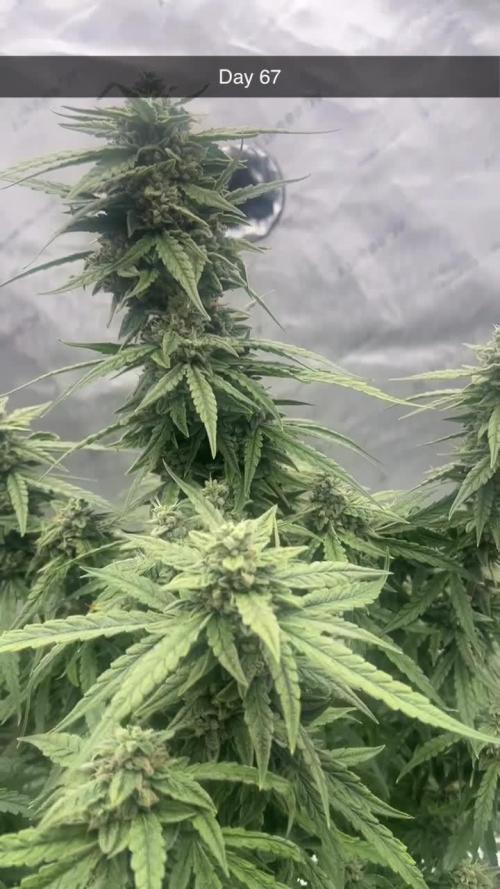
- Ich hab die erste Woche des Biobizz Allmix Düngeschemas gestartet und gebe wie immer erstmal vorsichtige 100%, da meine Erde an sich durch den Kompost recht potent sein sollte.
- Außerdem hab ich mit meinem Calmag-Rechner mein Leitungswasser angepasst. Die Werte könnt ihr auf den Bildern sehen.
- Den PH-Wert passe ich ebenfalls auf 6,5 an.#
- Die Lampe bringt zur Zeit etwa einen PPFD-Wert von 350 - 360 µmol/s/m² bei 18 Stunden Beleuchtungszeit (DLI von 22 - 23 mol/d/m²). Sie wird aber nur eingesetzt bis es warm genug draußen bleibt. Tagsüber stehen sie jetzt schon draußen, sofern es nicht regnet oder stürmt.
Die Tropicana Cookies macht sich hervorragend und sie ist sehr uniform mit den anderen Fastbuds Strains bis jetzt. Sieht gut aus finde ich 💪😁👍
YT: www.youtube.com/@High-And-Hydro

Likes
21
Share


@DeeDeeKushner
Follow
Day 57 of flower, we’re on the home stretch now. I’ve been flushing them out for the past week or so now. I like to flush for 21 days. IMO, I think the buds taste better and smoke smoother when you flush longer than usually but that’s just me! No specific pics/vids of the white widow but I thought I share my entire garden with you guys. I said I would harvest on day 70 but I might harvest on day 63-65 because I’m seeing more amber trichomes every day. My next update will either be harvesting or I’ll be letting them go for another week. Until next update! 🙏🏾

Likes
64
Share


@SmokingTiki
Follow
The 6 plants came out of the ground and look good 😎 In my 2 previous growths, I had better result with 24h of light on the first week compared to 18h, so I tried this schedule again and it seems to work. The plants are stretching as usual, maybe due to my soil being too rich in nitrogen. I added a wet towel to increase the humidity. 2 out of 3 of the extra seeds developped nicely. Great seeds, especially after one year in the fridge👍
Plants heights at the end of the week :
-------------------------------------------
Gorilla Cookies 1 : 10.5cm
Gorilla Cookies 2 : 11.5cm
Purple Lemonade 1 : 8.5cm
Purple Lemonade 2 : 10cm
Wedding Cheesecake 1 : 8.5cm
Wedding Cheesecake 2 : 9.5cm
Likes
16
Share


@Mopish
Follow
17 Jan - 23 Jan
19 Jan
Kush del Arriero: Looking good in color and size, planning to flush next week, hope those possible nanners don't develop enough, not removing due to harvest time being so close and this one being the one that will probably give me the best yield. Some buds and leaves getting purple colors.
Choco Cookie: Still very small, hope they grow a little more before harvest. Some buds and leaves getting purple colors.
Banana Cake: Small buds, decent trichomes.
I hope that KDA won't cause much trouble to the other two plants, I hope I'm wrong about the nanners... Keeping my plans, finish with nutrients this Sunday and flushing for 7-14 days after that.
I'll add a few more pics later today.
Sat 22
Yesterday a friend with more experience in these things took a look at my plants, he seemed impressed by what I've accomplished on my first grow so far. He also confirmed that the weird things on the KDA buds aren't nanners... phew !
He also confirmed my plans for flushing tomorrow are good.
Likes
18
Share


@Mr_Dior21
Follow
This week has been all about shaping the plant. I’ve learned from last that the colas weren’t the same height, because I let the plant do it’s things with just a bit of training. Now I know what to look for so I’m trying my hardest.
I top dressed this week with crab meal, Gaia green all purpose 4-4-4, insect frass, kelp meal, bone meal, azomite, and covered it with a healthy serving of worm castings (about an inch to 2 inches). All of which was sprinkled on all the chopped and dropped leaves/branches. I believe in adding biomass to soil, especially for an indoor growing who is money conscious. Doing that can help save me money going back to the store for more soil.
Likes
32
Share


@Ganjagrandaddy
Follow
Day 42 flowering: What a start to this update with the #3 Mango cream being ready for harvest NOW!!!. She has been maturing very quickly during the last few weeks and I have been concerned that she was somehow going towards a toxicity issue. Her buds began darkening really early in flower and I thought it looked very different to the others. As the last week has passed I have been looking at her trichrones with the microscope as they oustils had all gone majority brown too. They had mostly clouded and a couple of odd amber spheres were visible too. as the week went on I saw more begin to amber so took her out a day ago too have a dark period before trimmed for drying . She is the first I have ever had this quick in decades of growing !. The video shows her colours off well and her maturity to harvest too. @exoticseeds have a winner here. lol she smells amazing too with a really nice icky sticky feel . I will update her progress once trimmed.
#1 is the smaller of the 3 remaining ladies now ansneven with the #4 beingna week behind her she is still the smallest in height. Her buds are nice and chunky and just as we hit the budswell period too , so shebshould finish with some nice sized colas.
#2 Mango is a beast of a plant and by far the largest. Her main is a beast of a cola already with the side branching really picking up some size now too. A brilliant example of the strain I think. Her main is really tacky to touch and the nice smell it leaves all over my fingers is mouth-watering now. She should yield very well.
#4Mango at day 35 looks very like the #3 plant for her bud appearance. slightly different pheno i think. More like a wedding cake strain but still very nice and colourful. She has been using pellets in the soil mix and just waterings but they are not good in my opinion and I have had to add megacrop to keepnher growing well now I waited as long as I dare to see if the pellets helped in flower but even using the second part of the feed has not helped. The megacrop has already begun to colour them back up to a more healthy green so i am hoping I can keep her happy until harvest now. She is pushing out a very nice fruity smell now too.
I am looking forward to trying the photoperiod strains I have from exotic now and will be germinating Herz Og and Quick sherbet in a couple of weeks time for the summer run.
Top genetics from a great breeder . Thank you Exotic.
###UPDATE###UPDATE###UPDATE###
The Mango cream #3 has been in the dark for the past 48hrs and has now been trimmed and is hanging to dry. She will be dried low and slow now for approx 10-14 days at around 15-17°C in a large cardboard box with a steady air exchange. She has a surprising size and weight to her for such a short time from seed and is as finished as any plant i have harvested before . What an amazing little lady she has been to grow She looked a little stunted initially and soon filled the pot she was in. 20L was way too small for these genetics to flourish and at least a 30L would be my advice. Happy days , let's see what she yields dried while we wait for her sisters to join her. Be well Growmies

Likes
5
Share


@420keef
Follow
Had to pull this one out of the tent because i had to make room for the bigger outdoor plants🤷♂️🏻
