Processing
Likes
17
Share
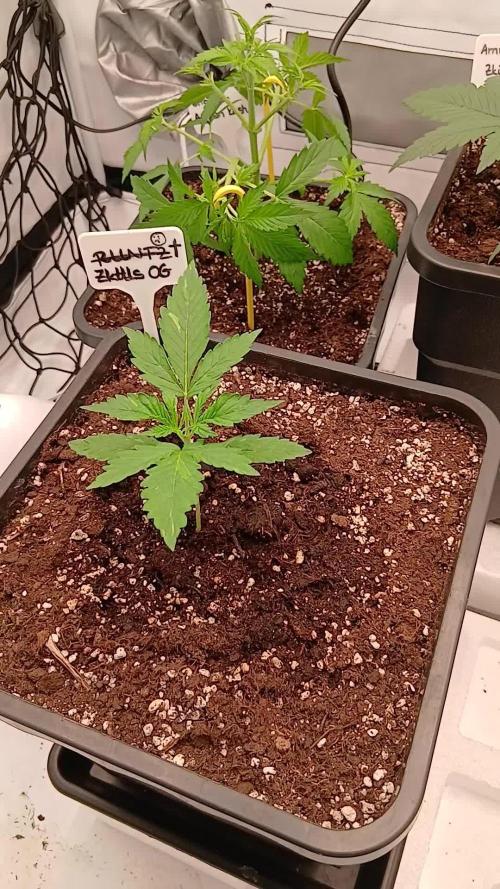
Nothing to report this week. Plants are growing on in the greenhouse as I wait for some extra supplies before setting them up inside. I hve to do this before they outgrow their pots but that still gives me a little while. There is one Frankenstein seedling that seems to have no ‘center’ is the only way I can describe it really! I should probably pinch it out but I’m curious to see what will happen?! Anyone ever had this before? I have been growing a few years now and never saw this!
Likes
13
Share
@Rob691
Follow
D-104 : Last week, I noticed a problem related to the calcium OR to the Ph. I didn't know if it was a deficiency or an excess. So I tried to just wetered girls with the right Ph and A bit more of CalMag 0.8 > 1.2/L. We'll see this week if It was the good choice. fingers corssed ! D-110 : As Chocolate Haze 1/4 start to show nanners and her trichomes are mostly mature, I desicided today to remove her from the main room to settle her in the small room for 48h of black out. For her, the harvest and the drying process will start in 48h from now.
Processing
Likes
15
Share
July 7, 2020 update... Houston... We have lift off!!! Flowering has officially begun with all four ladies. The actual heights of the 4 ladies is as follows 24" & 26" (indoors) and 21" & 24" (outdoors). The indoor plants are also much bushier and have more nodes. The outdoor plants are looking more like old school autos just focusing on a main central cola. I gave all of the ladies a LST bend and tied them down at a 45 degree angle. This is to allow better light penetration to the lower bud sites and usually results in several branches producing fat colas, not just the top. I am starting to see some bug damage on the outdoor girls. I have been trying to use companion planting of Basil, Chives, Spearmint, and Oregano as natural bug deterrents, but that's not working as well as I had hoped. I also sprayed them once with Safer End-All. Its OMRI listed and recommended by 'The Rev' of Skunk Magazine and True Living Organic fame. I'd prefer not to spray them again, especially as they get farther into flower. Any suggestions for keeping bugs away from my girls would be appreciated - hit me up in the comments. 👍
Likes
25
Share
@Luna91
Follow
HEY Guys , I've been in a crazy & exciting week really, these contests motivate me to work on my photography and make delicious edibles 😋. after tasting that brownie/muffin everything change!! You guys Can't imagine the damn taste of it. ( I was high about 4hrs after eating a Muffin and there was nothing I could do to chill down a bit Maybe I should pay attention to it's dosage next time.😀 Also Taking Close shots of my buds and my homemade Extraction was really amazing, I enjoyed every minute of it and really worked on them for hours, when I find sth worth it, I always go all in. I put lot of time and effort to the point where I was finally satisfied, with both growing and taking memorable photos of my first grow. All and all, I loved every minute of my time here, made me pay more attention to my ladies, learn from you guys, share sth and have fun. Good Luck to you all & Happy HalloweeD 👻😎
Likes
20
Share
Not particularly growing for speed or any dedicated reason this time round, just adding water and a abundande of positivity, gotta admit I do like the autoseed logo. Off we go again into the magical forest. (Arthrospira platensis) cultivated in high-alkaline, mineral-rich water in Kailua-Kona, Hawaii. It is renowned for having a higher nutrient content, including more carotenoids and essential fats, compared to other spirulina brands. It is frequently cited as a "complete food" due to its dense concentration of proteins, vitamins, minerals, and pigments. The nutritional profile of standard dried Spirulina platensis biomass. 3kg of spirulina powder has an approximate NPK ratio of 10-2-1 (or 10% Nitrogen, 2% Phosphorus, and 1% Potassium). Here is the breakdown of the nutrient content for 3kg of powder: Nitrogen (N): ~300g (10% of total mass) Phosphorus (P): ~60g (roughly 2% of total mass) Potassium (K): ~30g (roughly 1% of total mass) 3kg of spirulina powder is more than enough nitrogen for 4 cannabis plants in a 100-gallon pot—in fact, it is likely excessive and could cause severe nutrient burn or toxicity if not properly managed. Spirulina has a very high protein content (46% to 63% dry weight), which translates to a significant nitrogen source. It is often described as a 5-1-1 NPK fertilizer. 3kg (3000g) of powder in 100 gallons means 30g per gallon. General organic recommendations for potent amendments (like frass) are often around 1–3 tablespoons per gallon. 30g of powder is roughly 2-3 tablespoons, making this a very high-strength application rate if added all at once. Balance this with calcium/magnesium, and organic nutrient delivery in soil growing can lead to deficiencies in these nutrients. Not all of that 100 gallon is used, so figuring out precise measurements was ballpark, but there is about 10kg of engineered biochar in that pot. Mostly in the top half. Ideally, I'd have 25kg in a full active 100-gallon, but......... don't mess with something that is not broken. Roots do not utilize the entire 100 gallons. This has been a couple of years of trial and error, mostly error. The amount of cations you can add in grams depends entirely on the specific cation exchange capacity (CEC) of your biochar and the type of cation being added. Biochar CEC values vary widely, typically ranging from 4 to over 300cmolc/kg. Multiple Biochars in use, ranging upwards of 100cmolc/km. Different cations have different atomic weights Potassium K+ 39.1g/mol. Calcium Ca2+ 40.1g/mol. Magnesium Mg2+ 24.3g/mol. Nitrogen NH4+ 18.04g/mol. You get more nitrogen bang for your buck. It all depends on the CEC of the biochar you use, but brrrrrrrrrr roughly I'm looking at 500-600 grams worth of elemental cation exchange capacity, give or take. That's just for the biochar alone. Elemental cation exchange capacity refers to the ability of materials—such as soil, minerals, and biochar to adsorb, hold, and release positively charged ions Ca2+, Mg2+, K+, Na+, Al3+, and Zn2+. This capacity is a critical measure of nutrient availability in soil and energy density in electrochemical systems. Added calmag 2:1 to complement spirulina. Calcium (Ca): Approximately 150g - 300g of elemental calcium. Magnesium (Mg): Approximately 75g - 150g of elemental magnesium. So long as pH stays in 6.3 to 6.7 ish, the plant will unlock hydrogen. Plants will be able to cycle CEC for their own needs. Hydrogen ion pumping (proton pumping) is a fundamental mechanism used by plant roots to facilitate the cycling of nutrients within a medium's Cation Exchange Capacity (CEC), directly increasing nutrient availability. A growing medium's Cation Exchange Capacity (CEC) does not contribute directly to Electrical Conductivity (EC). CEC represents potential nutrient storage, while EC represents active nutrients in the water/soil solution. A medium with a high CEC can hold many nutrients, but if there is no water present, the EC will be low. 98% of plant nutrient uptake comes directly from the soil solution. 2% of nutrient uptake is directly from soil particles. Nutrients held on exchange sites (CEC) are not directly measured by EC until they are released into the soil solution through exchange with other ions (e.g., hydrogen ions from roots or fertilizer). Plants source the H+ ions (protons) used in cation exchange primarily by exuding carbon sugars into the rhizosphere, then microorganisms perform root respiration, which reacts with soil water to form carbonic acid H2CO3 that dissociates into H+ and bicarbonate. Roots also actively pump out H+ ions directly to acidify the rhizosphere, plants trade hydrogen produced through metabolism for essential nutrients held by the soil. In plant cells, the H+ (protons) used in proton pumping across the plasma membrane come primarily from the cytoplasm (cytosol). The protons are derived from internal cellular sources, including metabolic processes that release H+, and the regulation of intracellular pH homeostasis. Distilled water is highly useful in managing the electrical conductivity (EC) of a growing medium by allowing for precise control over nutrient concentration and assisting in the mobilization of nutrients from the cation exchange capacity (CEC) into the active, plant-available nutrient solution. Just add water & positive energy. Potential hydrogen. pH. + - , potential charge balance for hydrogen. So long as there is adequate oxygen in the soil and air and water moves at a decent interval, its practically impossible for the pH to skew in a soil that is taking in oxygen and releasing CO2 and nitrogen, I say practically, but meh, even with plenty of oxygen, the process of converting ammonium NH4+ to nitrate NO3- by bacteria releases hydrogen ions H+, which directly causes acidification (lowering pH). While water movement is necessary, consistent water moving through the soil can leach away basic cations Ca2+, Mg2+, K+, Na+, leaving behind acidic hydrogen and aluminum ions, causing pH to drop, especially in humid regions. High levels of CO2 in the soil (from intense respiration) dissolve in soil water to create carbonic acid, H2CO3, which lowers the pH. (barometric pumping removes that possibility) The pH in a cannabis cultivation environment, particularly in hydroponic or soilless setups, will often naturally drift towards acidic (lower pH) over time. Understand how to know when to lime the pH back up. Complex but critical. Once I understood this it helped ease the pain of understanding pH. Base saturation directly reflects the percentage of CEC occupied by base cations. Generally, as base saturation increases, soil pH increases because fewer acidic cations, H+ and Al3,+ are present on the soil colloid surfaces. At a pH of 7 or higher, the soil colloids are saturated with base cations, resulting in a base saturation of 90+%. While many sources include Sodium Na+ as a base cation, some calculations focused specifically on plant nutrients (like in some nutrient management contexts) may focus solely on the "Big 3": Ca2+, Mg2+, and K+. However, in soil science and CEC (Cation Exchange Capacity) measurements, sodium is usually included in the definition of total base cations, making it the "Big 4" base cations. At a pH around 5.5, soils often have a 45–55% base saturation, while a soil with a pH between 6.5 and 6.8 generally has an 80–90% base saturation. Base saturation is considered a reliable, albeit complex, indicator of soil fertility and the degree of soil weathering, acting as a crucial metric in soil classification and management. Once you take full control of the pH, so long as there is oxygen, and one keeps tabs on base saturation levels. Its near impossible for anything to go wrong. All you are essentially doing is adding water and waiting for any sign of deficiency. Not so much growing as eliminating the possibilities of things going sideways. Can't over or under water, can't skew pH, can't go anaerobic. Everything runs in optimal cycles, watering every 2 to 3 days or as required, depending on the rate of combined ET. A little warmer, a little drier, but never short on water. All the nutrients are already there in the medium, we still focus on the water, just not adding salts, but to mobilize nutrients held in the Cation Exchange Capacity (CEC) and move them into the active soil solution for plant uptake, the best supplements to add to water are fulvic acid, humic acid, or seaweed/kelp extract. Liquid solutions with high concentrations of essential trace elements. Distilled water has no alkalinity or minerals to help buffer or release nutrients. Adding these supplements turns the "empty" water into an active agent that forces nutrients off the CEC colloids into the solution for plant uptake. When to water? When Electrical Conductivity of soil gets low. No water, no conductivity.
Likes
4
Share
Best week yet still shoot white straight pistols hoping they fill out more in the next two weeks plan on letting them flower for the full nine weeks thricomes are starting to turn milky
Likes
Comments
Share
@cowstick
Follow
Last day of week 5 today. Got a great start to some frosty tops. Seeing some.purple leaves coming in. My wife's shower music played a key roll in this video. These 2 Minnesota strains from Mad Shark Genetix , Taste of Minnesota on left, Blueberry Winter on the right, are doing very well and I have enjoyed growing these 2. 4 more weeks ish to go. Added a P boost and Recharge to this weeks feeding. Let's put on some weight baby!!! NFSOT
Likes
Comments
Share
@BIYEI
Follow
Plantula 12-11-2024 a 21-11-2024 Semana 1 12-11-2024 Se mantiene en rehidratacion constante y vigilancia ya que son los dias mas vulnerables de la plantula. 15-11-2024 Se coloca por la tarde en el recipiente hidroponico ya que la plantula ya tiene la madurez necesaria, y se colocan nutrientes en dosis muy baja. 16-11-2024 Primer Contacto de raizes en agua. 18-11-2024 Se nota la evolucion radicular de la planta y se observa mejoria. Parametros Utilizados Temperatura del ambiente 24 C° Extraccion de aire 4 pulgadas Humedad 75% a 90% Potencia de la lampara 50% Ec Original 0.4 Ec Nutriente 1.0 Ph 6.5
Likes
17
Share
Really suffered in the summer with heat waves. Temps in the tent when the lights were on was going as high as 93⁰f (33.88⁰c). The buds have foxtailed as a result and I beleive I had pheno #1 hermy in its final days. 0 seeds found in both phenos so I got lucky. It flew through the veg stage, growing faster than the runtz muffin it was sharing the tent with. Flower period felt fast too, it was looking stacked already in week 5.
Likes
19
Share
@Qerss
Follow
Critical Orange is almost ready. Melonade Runtz looks amazing. It is completely covered with resin. The scent is slightly sweet
Likes
9
Share
Throwing pistils out like crazy and definitely thickening up which is nice. They had seemed to stall out for a bit there
Likes
57
Share
Well guys! home stretch! as you can see in the photo, harvest day is not far away)) Both plants look amazing! the structure of the Buds, trichomes, smell, stickiness and oiliness, all this is in excess!)) Buds are very solid and elastic .. very happy ..
Likes
4
Share
She is smelling so strong and stacking nicely, the buds are dense and super shiny and covered in tricombs. So far there’s more cloudy than clear but no Amber yet will keep y’all updated :)
Likes
35
Share
🍼Greenhouse Feeding BioGrow & Bio Bloom ⛺️MARSHYDRO The ⛺️ has a small door 🚪 on the sides which is useful for mid section groom room work. 🤩 ☀️ by VIPARSPECTRA (models: P2000 & XS 2000)
Likes
19
Share
Hi everyone :-) This week it has developed really well 😍. it was also topped for the first time. Like the Cup, I will not do an LST here either, just top it a few times 😃. I wish you all a nice week, stay healthy 🙏🏻 and let it grow 🌱
Likes
4
Share
Right so basically, a week ago today marked a month for these ladies and because I had a broken phone it was very hard to keep up to date with the journal but hopefully now I can keep on top of this grow for you guys. It's been 35 days since germination for the Rhino Ryder and Afghan Kush. I'm using soil from the back garden and now that there is a bit of foliage, with the watering etc. The humidity has risen to a level I'm not happy with to which I'm going to invest in a portable dehumidifier to bring down the moisture in the air. I had to defoliate as it was getting really bushy and the fan was struggling to get air through the fan leaves. I cannot believe the RR, started off as the most finicky plant from germination and now it's the tallest f***er of the 4. She has shot up! I looked at the yellow tips on the leaves and apparently it's a lack of Iron. I read that Iron deficiency can be left to work itself out typically if it's not severe. Usually after a few days after the leaves are left to expand the yellow disappears and they turn a nice fresh green colour. The smell in here is fantastic! Until next time! ;) Happy growing and much love from the Shire!
Likes
3
Share
So i popped one of this beautifull strain and she germanted just great, steady and strong so really happy with this strain and bix tnx again to @fast_buds 🤙🏻🌱🙏🏻
Likes
53
Share
Hello, my amazing green-thumbed friends! Welcome to the Week 1 flower report for our beloved P.C.R.s. The transition from veg to flower is a magical time, and our plants are already showing signs of their future glory. Let’s dive into the exciting details of this week! Entering the Flower Stage Our P.C.R.s have officially entered the flowering stage, and the transformation is already visible. The stretch has begun, and you can see the plants reaching up, preparing to produce those beautiful buds we’re all waiting for. This stage is all about supporting their growth and ensuring they have everything they need to thrive. NutriSpray Magic This week, we’ve been diligently spraying Aptus Holland NutriSpray, and the results are phenomenal. NutriSpray is like a spa treatment for our plants, providing essential micronutrients directly to the leaves. It helps with nutrient uptake, reduces stress, and boosts overall plant health. Our P.C.R.s are absolutely loving it, standing tall and proud with their leaves praying to the light. Nutrient Transition With the start of the flowering stage, we’ve made some important adjustments to our nutrient regimen. We’ve stopped using StartBooster and replaced it with TopBooster, which promotes flowering and bud formation. Additionally, we’ve introduced P-Boost, a phosphorus booster that enhances root development and flower production. TopBooster: Encourages larger and more abundant flowers. P-Boost: Provides essential phosphorus for robust root and flower development. NutriSpray: Continues to support overall plant health and stress reduction. Optimal Conditions Maintaining the perfect environment is crucial as we move into the flowering stage. Our TDS is now at 360, with a pH of 5.9 and a temperature of 21°C for watering. These conditions are optimal for nutrient uptake and overall plant health, ensuring our P.C.R.s have everything they need to produce those beautiful, resinous buds. Care and Attention Paying close attention to our plants during this stage is key. Regularly inspecting for any signs of stress or nutrient deficiencies and adjusting care as needed ensures our plants stay happy and healthy. The love and care we put into this process are reflected in the vibrant health of our plants. In Conclusion Week 1 of flowering has been all about setting the stage for a bountiful harvest. With the help of Aptus Holland NutriSpray, TopBooster, and P-Boost, along with our careful attention, our P.C.R.s are off to a fantastic start. The excitement is building, and I can’t wait to see how they develop in the coming weeks. Shout Outs A huge shout out to @aptusholland, our main sponsor, for their incredible products that keep our plants thriving. Another big thank you to @artgenetix for creating the phenomenal P.C.R. strain. And to the wonderful community at Grow Diaries and all our followers, your support and enthusiasm keep us going. Let's continue to grow together! Until next time, happy growing, and may your gardens be full with love and green! Genetics - P.C.R. @Art_Genetix_Team https://artgenetix.world/ Nutricion @aptusholland https://aptus-holland.com/ LED Power @Lumatek and @viparspectra As always thank you all for stopping by , for the love and for it all, i fell blessed to have you all with me for one more love journey Thank you Thank you Thank you , you guys are great and have been amazing , thank you for everything ! #aptus #aptusplanttech #aptusgang #aptusfamily #aptustrueplantscience #inbalancewithnature #trueplantscience #dogdoctorofficial #growerslove
 With true love comes happiness , Always believe in your self and always do things expecting nothing and with an open heart , be a giver and the universe will give back to you in ways you could not even imagine so ! Growers love to you all
Likes
70
Share
@MrJones
Follow
Sky Walker ~~~~~INDOOR~~~~~ DAY 77 Above Dirt 💬SATURDAY - 11.11.23 These ladies continue to blow up, I moved them into a 4x4 space under the Mars Hydro FC-6500 I am going to look at some defoliation and pruning, they will be moved over into 7-gallon pots, then some final tie-downs added into the training, also started a compost tea today, see recipe below. 💬SUNDAY - 11.12.23 - The ladies like their new space, today I defoliated, topped, and pruned out the lowers, and insides, once these girls are moved over into their new pots, will be flipping these massive bushes! ~~~~~~~~~~~~~~~ 🌱Sky Walker 👨‍🌾🏽Sativa Jones 🌤️@Medicgrow420 SeedBank Seeds 📝@gaiagreenorganics 📝Bokashi Biochar ~~~~~~~~~~~~~~~ 📝 Skywalker OG Strain is a top-shelf Indica dominant hybrid. It is a cross of Original Amsterdam Blueberry, OG Kush, and the indica strain Mazar from Afghanistan, and is best known for its super potent effects and sky-high THC levels. ~~~~~~~~~~~~~~~ 📝 Compost Tea 3 Gallons of Dechlorinated H20 3 Cups Malibu Compost 2T Molasses 2 T Alfalfa Meal (DTE) 2 T Kelp Meal (DTE) 1 T Bat Guano (DTE) 1 teaspoon Rootwise Bio Elixir 1)- I used a small paint strainer to hold my composts, placing an air stone right in the bag and zip-tie it nice and tight - this allows air bubbles to really agitate the micro matter off of the compost and into your tea 2)- I like to mix in the molasses (microbe food) and start my main air stone, the dry amendments and Rootwise can be just measured in the bubbles 3) - Keep the temp of the water warm to 75F/85F - too cool and the microbes reproduce too slowly and too hot will kill them. I do not delete my teas and let the plant pots dry out slightly before feeding.
Likes
9
Share
Día 14 comenzando la 3ra semana de vida, todas tienen un buen desarrollo, solo hay 1 que presenta una coloración distinta y una morfología diferente a las demás, probablemente sea solo un fenotipo distinto, además plante una nueva semilla en la maceta que estaba vacía