


Likes
Comments
Share


Processing
Likes
15
Share


@Race91
Follow
For the first time I have finally found my way. This whole endeavor has been a great learning experience going from growing clones to trying seeds. I have three strains all purple fruity strains so I’m in heaven. 100% success by soaking seeds for an extended period of time and leaving them in the paper towel in a warm place until they had completely sprouted leafs and all. They were yellow but the next day after planting them they were perkey and green. I’m finally happy with my grow and feel like iv learned a lot but I paid dearly in lost seeds that’s for sure


Likes
46
Share


@Roberts
Follow
Drunken Bitch Slap has gotten pretty big. She is bulking now under the Hortibloom Solux 350. Her colas are looking dense at the moment. Everything is looking strong are the moment. I may do a solution change tomorrow for last bit of bulking. Thank you Hortibloom, and Aeque genetics. 🤜🏻🤛🏻🌱🌱🌱
Thank you grow diaries community for the 👇likes👇, follows, comments, and subscriptions on my YouTube channel👇. ❄️🌱🍻
Happy Growing 🌱🌱🌱
https://youtube.com/channel/UCAhN7yRzWLpcaRHhMIQ7X4g

Processing
Likes
12
Share


@Therbalist
Follow
#3 has beautiful pink buds very happy with these girls, hopefully the other two show some colour as the Temperature comes down.
Have swapped the 250 red CFL for a 150 blue. May turn it off for the last week to get every last bit of pink possible! Pots have a nice wet dry cycle, have tried to hold back and not over water so I've been watering with a spray bottle. I use a 1L hand spray bottle and fill it up three to four times depending on the weather. Although it seems impossible to overeater with the breathable fabric pots. Which are awesome if I haven't said already. Perfectly fit 11 in my small cupboard which is lucky as I ordered ten as soon as he free one arrived without measuring them! Stoners eyes never lie! 👁️
Buds should be huge if they keep going at this speed! Haven't topped them for the natural look, been a few years since I've done it can't wait to see a big fat cola bud at the end!

Likes
Comments
Share


@DaddyPrime2
Follow
7/4 she's taking well to the training
7/5 its so hot out here its 105F and 19%
7/7 5ml grow 5ml

Likes
4
Share
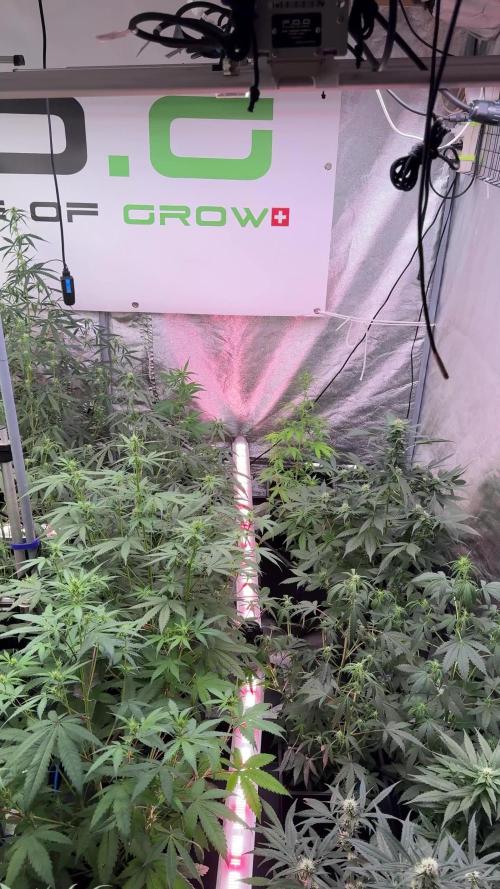

@DogDoctorOfficial
Follow
🍑 Passion Fruitz by Zamnesia
Week 7 | Finally Whispering That Flower Is Coming
Welcome back to another chapter of the 8×8 Adventure!
If you've been following this diary, you'll know that Passion Fruitz has become one of the most fascinating plants in this entire project.
Not because she's the biggest.
Not because she's flowering the fastest.
Quite the opposite.
She's teaching us that sometimes the most interesting plants are the ones that refuse to follow the schedule we expected.
Every other lady in the room has already settled into flowering.
Meanwhile, Passion Fruitz has continued building herself, almost completely ignoring the fact that she's been growing under a 12/12 light schedule since the day she broke through the soil.
This week, however...
Something finally changed.
🌱 Why We're Calling This Week One of Flower
Technically, she's still only in pre-flower.
The first signs are there.
Tiny white pistils are beginning to appear.
The growing tips are changing shape.
The plant is slowly transitioning from producing leaves into producing flowers.
Is she fully flowering yet?
Not really.
But every flowering journey has to begin somewhere, and this week feels like the true beginning of that transition.
So for the sake of documenting this phenotype consistently, I'm officially calling this her Week One of Flower.
She's finally telling us she's ready.
She's just doing it in her own time.
And honestly...
That's exactly what makes this phenotype so interesting.
🌿 The Bush That Never Stopped Growing
Standing at approximately 66 cm tall, Passion Fruitz remains one of the shortest ladies inside the tent.
But don't mistake short for small.
She's become an incredibly dense, wide, and vigorous bush.
Large fan leaves.
Thick stems.
Strong side branches.
Beautiful spacing throughout the canopy.
Instead of stretching vertically, she's invested her energy into building a broad, healthy framework.
Looking at her now, I can't help wondering just how enormous she might have become if I had given her several weeks of vegetative growth before flowering.
Considering she's been under 12/12 from seed, her ability to keep producing vegetative growth for so long has been remarkable.
🍃 Healthy, Lush & Full of Life
Every time I look at this plant, one thing immediately stands out.
The colour.
Her foliage is rich, vibrant, and beautifully healthy.
The large fan leaves almost glow under the lighting, while fresh new growth continues emerging from nearly every branch.
She may be taking her time to flower, but she's certainly not wasting that time.
Every day she seems to become stronger.
Healthier.
More prepared for what's ahead.
Sometimes patience really does reward the grower.
🌱 Low Stress Training — Guiding, Never Forcing
Low Stress Training has continued playing an important role throughout her development.
Rather than forcing the plant into an unnatural shape, LST simply encourages branches to spread out, exposing more growing tips to light while maintaining a level canopy.
Combined with occasional leaf tucking, it allows airflow to improve naturally while opening the plant without causing unnecessary stress.
It's one of my favourite techniques because it works with the plant instead of against her.
Passion Fruitz has responded beautifully.
Her canopy is open.
Balanced.
Healthy.
And ready for flowering whenever she decides it's time.
💧 Feeding & Consistency
This week's feeding remained exactly in line with the rest of the flowering room:
• Terra Bloom – 2 ml/L
• Pure Zym – 1 ml/L
• Green Sensation – 1 ml/L
• Sugar Royal – 1 ml/L
• Power Buds – 1 ml/L
• pH adjustments using Lemon Kick and pH Plus when required.
Even though she's only just entering pre-flower, consistency remains the priority.
The goal isn't to force development.
It's to provide everything she needs so she can continue progressing naturally.
💡 Under Canopy Lighting From Day One
One thing I'm particularly curious about with this phenotype is how she'll respond to the Lumiflora under canopy lighting.
Unlike most of the other ladies, which received the additional light after flowering had already begun, Passion Fruitz has been benefiting from it while still building her structure.
Although she doesn't yet need extra support for developing buds, those lower branches have been receiving additional light from a very early stage.
Will that help her build stronger lower flower sites later?
Will the lower canopy develop differently compared to the other phenotypes?
Only time will tell.
That's one of the reasons I love documenting projects like this.
Sometimes the biggest discoveries are the ones you never planned to make.
🌡️ Environmental Conditions
The environment continues providing the stable conditions shared by every plant in this project:
• Day temperature: 29°C
• Night temperature: 25°C
• Relative humidity: 60%
• pH: 5.8
• EC: 1.95 mS/cm
• Solution temperature: 25°C
• Root zone: 21°C
• CO₂ concentration: 636 ppm
Keeping these variables consistent allows the genetics—not environmental changes—to tell the story.
📸 This Week's Gallery
This week's photographs perfectly capture the personality of this incredible plant.
The full plant images reveal an impressively dense canopy despite her relatively modest height.
The close-ups showcase beautifully healthy foliage, rich green colour, vigorous new growth, and those very first hints that flowering is finally beginning.
Every picture tells the same story.
She's been slow.
But she's never stopped growing.
And now she's finally preparing for the next chapter.
🔮 Looking Ahead
Over the coming week, I'm hoping to see more white pistils appearing across every growing tip as pre-flower gradually develops into true flowering.
I'm not expecting explosive bud formation just yet.
Knowing this phenotype, she'll probably continue doing everything at her own pace.
The stretch may begin slowly.
The first clusters of calyxes should become more noticeable.
And I'm especially curious to see how the Lumiflora under canopy lighting influences those lower branches as flowering finally gets underway.
One thing is certain.
Whatever she decides to do...
She'll do it on her own schedule.
And after watching her these past weeks, I've learned not to rush her.
💚 Thank You
Thank you so much for following another chapter of this 8×8 Adventure.
Passion Fruitz has reminded me that growing isn't about trying to force every plant into the same timeline.
It's about understanding that every phenotype carries its own personality, its own rhythm, and its own way of expressing its genetics.
A huge thank you to:
💚 GrowDiaries for providing an incredible platform where growers from around the world can learn, share, and inspire one another.
🌱 Zamnesia for providing the fantastic genetics that make this phenotype hunt possible.
💜 Plagron for supplying the nutrition supporting every stage of this journey.
💡 Future of Grow LED for delivering the light powering this entire project.
🌿 TrolMaster for helping maintain a stable environment every single day.
✨ Lumiflora for providing the under canopy lighting that's helping every branch receive the best possible opportunity to perform.
And finally...
Thank you to everyone following these diaries, leaving comments, asking questions, sharing knowledge, or simply enjoying this adventure with me.
The first flowers may only just be arriving...
But sometimes the slowest journeys become the most memorable ones.
I'll see you all next week as Passion Fruitz continues writing her own unique story, one leaf, one pistil, and one flower at a time.
Growers Love, and happy growing everyone! 🌱🍑💚
Likes
2
Share


@KrudBuddysExotics
Follow
welcome to week 6 of the peanutbutter breath and gorilla cookies
I must say their fillin up nice I hit them witha heavy dose of nutes today
thinking bout giving them the full 10 weeks instead of 8-9 and start flush next week in week 7
Likes
23
Share


@Kynareth
Follow
week 11- this is the last week until harvest- i have made root cleaning and the leaves are now more yellow due to it. ill harvest probably tomorrow so lets see the final result


Likes
7
Share


@Sabac
Follow
Fin de mis plantitas.
Recomiendo el banco greenhouseseeds primera Vez que cultivo ese banco y salieron excelentes...


Likes
12
Share


@Metamorph
Follow
Hello again, dear growers! 🌱👋
We’ve officially stepped into Week 10 of this wild and fragrant journey! Last week ended with a little makeover for the girls—I defoliated about 30-40% of the leaves again. ✂️ The Gorilla decided to keep me on my toes by showing some nutrient deficiencies on her leaves—guess she didn’t get enough food after the flush. 🍌🌿 (Lesson learned: don’t keep a Gorilla hungry!)
Now, let’s talk about Runtz! 😍 She’s an absolute queen—so photogenic that even my struggling phone can’t capture her real beauty. 📸✨ She’s forming into one giant, luscious bud, and her fragrance is something else entirely! 🕵️♂️ The carbon filter is fighting the good fight, but if the room isn’t aired out every 8-9 hours, a little aroma starts sneaking through.
But opening the tent… oh, my friends, that’s where the magic happens! 🌬️💫 The aroma is intoxicating—imagine diving headfirst into a field of flowers while bees whisper secrets in your ears. 🌺🐝 I just sit there, enchanted, savoring the smell, and staring at these beauties like a hypnotized gardener. Honestly, it’s hard to walk away. 😂
Here’s their menu for the week:
🍵 Feed: A+B 4ml/L, Micro Chum 1ml/L, Big Bud 2ml/L
📊 PPM: 1050 | pH: 5.8
💧 Runoff: PPM 1000 | pH 6.0-6.3
Now, for the not-so-great news…
I’m struggling with humidity levels—daytime sits around 65-77%, and at night, it can climb to a stubborn 80%. 🌫️ Temperature-wise, it’s 23-25°C during the day and drops to a cool 16-18°C at night. ❄️🔥
Despite the challenges, the endgame is near, and I’m savoring every moment of this grow! 🌟 🙌 Happy growing, everyone! 🌱🔥


Likes
8
Share


@Kaotic_Herb
Follow
What's happening. There is a light midst in the atmosphere this morning. I set WISDOM up to the drip system and it worked out perfectly.
WISDOM was planted this past winter. She actually grew up in a window seal most of here life.
It was a slow progression but she still came out on top.

Likes
4
Share


@Yuriboyka9
Follow
this week we topped the 5th knot, lst and gave a dose of delta 1 root. See you lateeeerrrr💪


Likes
97
Share

@Roberts
Follow
Northern lights grew great in the Pro-mix medium size hp bag. She had a struggle through the grow. She really wanted more space to root. I did have a salt build up towards the end of vegging. A few minor issues beside that. She did fill the little Spider Farmer tent. She turned out great. Thanks again Pro-mix, Medic Grow, Spider Farmer, and Divine Seeds. This wasca slightly different style grow compared to my usual methods using the Pro-mix. I really enjoyed it. 🤜🏻🤛🏻🌱❄️
Thank you grow diaries community for the 👇likes👇, follows, comments, and subscriptions on my YouTube channel👇.
❄️🌱🍻 Happy Growing 🌱🌱🌱
https://youtube.com/channel/UCAhN7yRzWLpcaRHhMIQ7X4g.

Likes
27
Share


@GuerillaGorilla
Follow
Sept 16th,
Finally found some time to work with her again. She nearly got blown over last week. Time to thin her out a bit.
She has braches growing into eachother and lot of popcorn sprouts in the center. I removed rhos to focus energy on outer buds and max out airflow.
Weather has been really damp and cold but she doesnt seem to bother. Hoping for some more sun to see this one finish
Likes
39
Share

@Roberts
Follow
Bubba OG Gum auto is doing good. I think I have a pest problem. It was starting to move its way to her. So I sprayed her down with neem oil mix and rinsed her off after about a half hour. Hopefully it eliminates them all over the course of the week treating her. It is last minute, but I want to get it done so the neem oil don't effect the taste of the bud. I also lollipopped the canopy today. Thank you Ganja Farmer, Spider Farmer, and Athena. 🤜🏻🤛🏻🌱🌱🌱
Thank you grow diaries community for the 👇likes👇, follows, comments, and subscriptions on my YouTube channel👇. ❄️🌱🍻
Happy Growing 🌱🌱🌱
https://youtube.com/channel/UCAhN7yRzWLpcaRHhMIQ7X4g

Likes
12
Share


@Jays_Not_Here_Man
Follow
Transplanted the ladies this week! Moved them into a 4 gallon pot, I plan on letting them get settled and flipping to flower soon.
Temps were good this week, RH was steady at about 60%. No big surprises with the transplant, however it did take them a day or two longer than my typical recovery time.

Likes
8
Share


@Shellshocked
Follow
It's chop down day she has 25% ambers now I would like 50%+ but she has had a rough life and it will most likely go to concentrates so less ambers the nicer the colour I find so I made the decision to chop her and I got no room in my tents for her as the website said 9-10 weeks and she's 11 and a half now and I try to have perpetual grows.

Likes
5
Share


@Ninjabuds
Follow
Obama runtz x gas tax sad to say both seedlings are super crappy so far. If it was not for the gas tax parent being the best flower ever then I wld just toss these but sometimes the crappy slow growing plants end up being super dank
It's looking like a good start to a week the plants are strong they are getting to the point I can let the dried dry out completely. I'm thinking by the end of this week the plants will be starting to be sold.
Last week I put all the plants into my bigger 2x4 tent with my medicgrow mini sun 2 the 500w version. Only a few of the plants were ready for that light. Seems like the only plants that really have good resistance and have a strong start are the weedseedsexpress.com seeds. Shout out to weedseedsexpress.com for the strong plants.
I ended up putting all the plants back into my 2x2 tent with the 55w amazon light it has alot more blue light in its spectrum. It's kinda weird b4 I switched the plants to the 2x4 tent they were getting 220umol under my amazon 55w led then when I put them under the 500w light 25% strength about 50in from plants and they were getting only about 195umol in that tent but it was stressing most the plants. I assume a larger light has more side lighting hitting the plants. I think when useing larger lights it's good to measure umols from the top but also coming from the sides. I think durring seedling stage they only need about 50% the umols coming from the side the plants as the top is receiving.
When I put the plants back in the small tent about the same umols as they were getting b4 the switch and they were still a little stressed. So for a few days I put the small light at the top the tent giving them 100umols for a few hrs then 130umols the rest the day.