Likes
Comments
Share
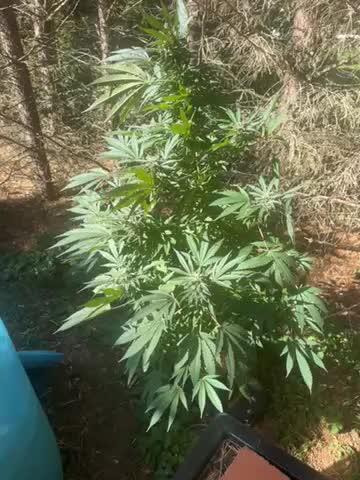
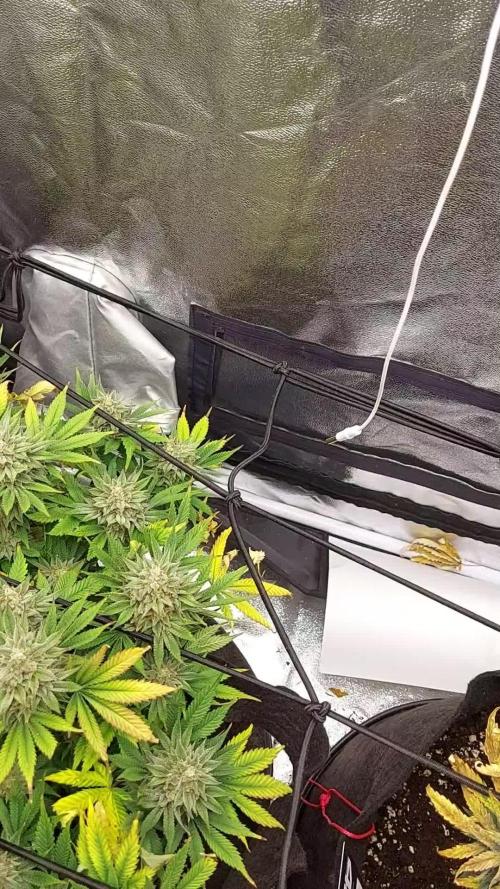
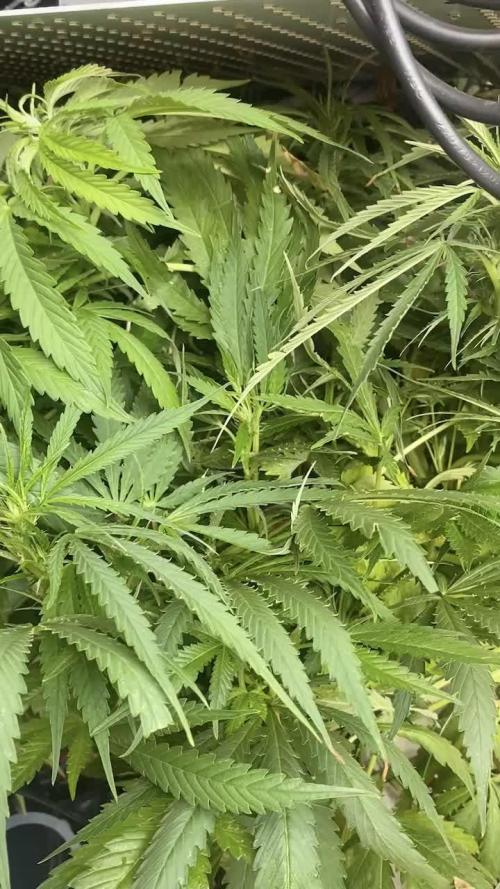
Week 7 for the Caramel 🍯 from Ganja farmers 👨‍🌾 Awesome results for now, the buds are looking great and getting bigger every week, more and more trichomes are visible. Not much left so we continue with water for now. A slight excess of nutrients is visible but nothing to worry about as we are flushing now anyway
Likes
3
Share
No extra nutrients given in the last week or so, but no flushing as such. Harvested this week, since the smell was discernible from outside the house ;-) Now drying, in a remote shed.
Likes
78
Share
@Nebula420
Follow
This out grow for me is extreme, cause daylight time less than 12 hours, Just awful weather, and at night temperature is 15 degrees. Despite all the difficulties Blackberry grows very vigorously and healthy. I am sure this strain will grow in any conditions.Nice genetics. Plant have already started flowering, so fast, and easy strain. For now buds r green, maybe just got the green pheno, or still early and i will see purple colors, color is not important to me. Still weak smells like berries, very tasty. Thanks Fast Buds, nice genetics, and thank to everyone who follow my grow report, Peace!😇
Likes
55
Share
2nd net is up. Early bud formations are promising. holding up to the extremes pretty well, some leaves taking minor damage, but overall, she is holding up, gave her 1 night at 50F see how she would react, stressful. Not advised as it messes with her metabolism, but I want to see if it triggers any anthocyanin response. Love to see her purp up but no signs yet. Remember, For every molecule of glucose produced during photosynthesis, a plant needs to split six molecules of water. This process provides the hydrogen needed for synthesizing glucose and other organic compounds, while oxygen is released as a byproduct. Homework. If Rubisco activity is impaired and it cannot properly function or regenerate its substrate, the plant's leaves are likely to turn a pale green or lime green, a condition known as chlorosis. Essentially, Rubisco activity is highly regulated and susceptible to various environmental and metabolic factors that can cause it to become inhibited, leading to an apparent failure in RuBP regeneration due to a lack of consumption. Rubisco regeneration is intrinsically linked to nitrogen supply because Rubisco is a major sink for nitrogen in plants, typically accounting for 15% to over 25% of total leaf nitrogen. The regeneration phase itself consumes nitrogen through the synthesis of the Rubisco enzyme and associated proteins (like Rubisco activase), and overall nitrogen status heavily influences the efficiency of RuBP regeneration. RuBisCO is a very large enzyme that constitutes a significant proportion (up to 50%) of leaf soluble protein and requires large investments in nitrogen. Insufficient nitrogen supply limits the plant's ability to produce adequate amounts of RuBisCO, thereby limiting the overall capacity for photosynthesis and carbon fixation. Maintaining the optimal, slightly alkaline pH is crucial for the proper function and regeneration of Rubisco. Deviations in either direction (too high or too low) disrupt the enzyme's structure, activation state, and interaction with its substrates, leading to decreased activity and impaired RuBP regeneration. (Lime/yellowing) Structural Component: Nitrogen is an essential building block for all proteins, and the sheer abundance of the Rubisco protein makes it the single largest storage of nitrogen in the leaf. Synthesis and Activity: Adequate nitrogen supply is crucial for the synthesis and maintenance of sufficient Rubisco enzyme and Rubisco activase (Rca), the regulatory protein responsible for maintaining Rubisco's active state. Nitrogen deficiency leads to a decrease in the content and activity of both Rubisco and Rca, which in turn limits the maximum carboxylation rate, Vmax, and the rate of RuBP regeneration Jmax, thus reducing overall photosynthetic capacity. Nitrogen Storage and Remobilization: Rubisco can act as a temporary nitrogen storage protein, which is degraded to remobilize nitrogen to other growing parts of the plant, especially under conditions of nitrogen deficiency or senescence. Nitrogen Use Efficiency (NUE): The allocation of nitrogen to Rubisco is a key determinant of a plant's photosynthetic nitrogen use efficiency (PNUE). In high-nitrogen conditions, plants may accumulate a surplus of Rubisco, which may not be fully activated, leading to a lower PNUE. Optimizing the amount and activity of Rubisco relative to nitrogen availability is a target for improving crop NUE. Photorespiration and Nitrogen Metabolism: Nitrogen metabolism is also linked to the photorespiration pathway (which competes with carboxylation at the Rubisco active site), particularly in the reassimilation of ammonia released during the process. To increase RuBisCO regeneration, which refers to the process of forming the CO2 acceptor molecule Ribulose-1,5-bisphosphate (RuBP) during photosynthesis, the primary methods involve optimizing the levels and activity of Rubisco activase (Rca) and enhancing the performance of other Calvin-Benson-Bassham (CBB) cycle enzymes. Biochemical and Environmental Approaches: Optimize Rubisco Activase (Rca) activity: Rca is a crucial chaperone protein that removes inhibitory sugar phosphates, such as CA1P (2-carboxy-D-arabinitol 1-phosphate), from the Rubisco active site, thus maintaining its catalytic competence. •Ensure optimal light conditions: Rca is light-activated via the chloroplast's redox status. Adequate light intensity ensures Rca can effectively maintain Rubisco in its active, carbamylated state. •Maintain optimal temperature: Rca is highly temperature-sensitive and can become unstable at moderately high temperatures (e.g., above 35°C/95F° in many C3 plants), which decreases its ability to activate Rubisco. Maintaining temperatures within the optimal range for a specific plant species is important. •Optimize Mg2+ concentration: Mg2+ is a key cofactor for both Rubisco carbamylation and Rca activity. In the light, Mg2+ concentration in the chloroplast stroma increases, promoting activation. •Manage ATP/ADP ratio: Rca activity depends on ATP hydrolysis and is inhibited by ADP. Conditions that maintain a high ATP/ADP ratio in the chloroplast stroma favor Rca activity. Enhance Calvin-Benson-Bassham (CBB) cycle enzyme activity: The overall rate of RuBP regeneration can be limited by other enzymes in the cycle. •Increase SBPase activity: Sedoheptulose-1,7-bisphosphatase (SBPase) is a key regulatory enzyme in the regeneration pathway, and increasing its activity can enhance RuBP regeneration and overall photosynthesis. •Optimize other enzymes: Overexpression of other CBB cycle enzymes such as fructose-1,6-bisphosphate aldolase (FBA) and triose phosphate isomerase (TPI) can also help to balance the metabolic flux and improve RuBP regeneration capacity. Magnesium ions, Mg2+, are specifically required for Rubisco activation because the cation plays a critical structural and chemical role in forming the active site: A specific lysine residue in the active site must be carbamylated by a CO2 molecule to activate the enzyme. The resulting negatively charged carbamyl group then facilitates the binding of the positively charged Mg2+ion. While other divalent metal ions like Mn2+ can bind to Rubisco, they alter the enzyme's substrate specificity and lead to dramatically lower activity or a higher rate of the non-productive oxygenation reaction compared to Mg2+, making them biologically unfavorable in the context of efficient carbon fixation. The concentration of Mg2+ in the chloroplast stroma naturally increases in the light due to ion potential balancing during ATP synthesis, providing a physiological mechanism to ensure the enzyme is activated when photosynthesis is possible. At the center of the porphyrin ring, nestled within its nitrogen atoms, is a Magnesium ion (Mg2+). This magnesium ion is crucial for the function of chlorophyll, and without it, the pigment cannot effectively capture and transfer light energy. Mg acts as a cofactor: Mg2+ binds to Rubisco after an activator CO2 molecule, forming a catalytically competent complex (Enzyme-CO2-Mg2+). High light + CO2) increases demand: Under high light (60 DLI is a very high intensity, potentially saturating) and high CO2, the plant's capacity for photosynthesis is high, and thus the demand for activated Rubisco and the necessary Mg2+ cofactor increases. Mg deficiency becomes limiting: If Mg2+ is deficient under these conditions, the higher levels of Rubisco and Rubisco activase produced cannot be fully activated, leading to lower photosynthetic rates and potential photo-oxidative damage. Optimal range: Studies show that adequate Mg2+ application can enhance Rubisco activation and stabilize net photosynthetic rates under stress conditions, but the required concentration is specific to the experimental setup. Monitoring is key: The most effective approach in a controlled environment is to monitor the plant's physiological responses e.g., leaf Mg2+ concentration, photosynthetic rate, Rubisco activation state, and adjust the nutrient solution/fertilizer to maintain adequate levels, rather than supplementing a fixed "extra" amount. In practice, this means ensuring that Mg2+ is not a limiting factor in the plant's standard nutrient solution when pushing the limits with high light and CO2. Applying Mg2+ through foliar spray is beneficial to Rubisco regeneration, particularly in alleviating the negative effects of magnesium (Mg) deficiency and high-temperature stress (HTS). While Mg can be leached from soil, within the plant it is considered a mobile nutrient, particularly in the phloem. Foliar-applied Mg is quickly absorbed by the leaves and can be translocate to other plant parts, including new growth and sink organs. Foliar application of: NATURES VERY OWN MgSO4 @ 15.0g L-1 in a spray bottle. For those high-intensity workouts when 1 meal a day is just not enough! Foliar sprays are often recommended as a rapid rescue measure for existing deficiencies or as a supplement during critical growth stages, when demand for Mg is high. Application in the early morning or late evening can improve absorption and prevent leaf burn. The plant was getting a little limey yellow in the centre. Shortly thereafter, she was back in business, green mostly regenerated. The starting point [of creativity] is curiosity: pondering why the default exists in the first place. We’re driven to question defaults when we experience vuja de, the opposite of déjà vu. Déjà vu occurs when we encounter something new, but it feels as if we’ve seen it before. Vuja de is the reverse—we face something familiar, but we see it with a fresh perspective that enables us to gain new insights into old problems. Confidence is evidence... nothing more. You are confident because you have driven 10,000 times, you are confident because you have spoken 10,000 times. People think confidence is a feeling, but it's not. If you want more confidence, then you need to create evidence, take more shots, collect more data, build more experiences, take more risks; fail, confidence doesn't come first; it is the reward you get for doing the work. no one else wants to do.
Likes
15
Share
Likes
24
Share
@Crawlndog
Follow
What a journey! These girls were so awesome to watch grow. I made some real true newbie mistakes right from the start... 😳 Packed the soil way too tight, did not germinate in wet paper towel first, and of course over-watered. The one I call yellow monster actually had its root above ground and it turned brown. I did fix it up laughing all the time. But in the end with only a dry weight of 21.7 g , watching it turn yellow then purple was well worth it. 😍 The one I wanted to main-line was the very first to sprout but the very last to grow... the end up being the tallest at 38 inches. She stayed green the whole time. She had a weight of 34.2 g 😜 My LST was fantastic... I could only imagine what she would have turned out like with no to little mistakes. She was a cool mixture of green and purple. Her weight was 43.6 g 😳😍😜 Total weight = 99.5 grams or 3.55 oz Kryptonite soil "living soil", just added water the whole time... (with a little bit of molasses mixed in once in a while). 315w CMH Lights with an extra 600w LED for 3 or 4 week near the end... thanks to a friend! Had temp average around 24-25 Celsius with night temps between 16-19 Celsius. Used 5 Gallon Smart pots. Only vaped a little... waiting for full cure. 3-4 weeks! Will update! Thank you @Sweet_Seeds! Thanks for watching! 😵 Update June 17th: Smell has changed from curing. Alot more pungent. I tried a taste from each but I'm going to wait another week before my final comment. Final Update June 26th... The curing process is pretty much done, I believe. The taste has changed a little... has more of earthy taste to it now. Since I cured at 3 different times, each pheno has it's own nice little buzzzz😵 It has been a blast!!! 😛
Likes
21
Share
@BLAZED
Follow
Week 15 (9-6 t/m 15-6) 9-6 Temperatuur: 30.8 graden (licht aan) 22.2 graden (licht uit) Luchtvochtigheid: 66% (hoogste) 40% (laagste) De toppen beginnen al wat dikker te worden, en de geur is nu ook erg aanwezig, het gaat de goede kant op! Watergift: 1000 ml, met 0.2 ml Silica Power per liter, 0.3 ml CalMag per liter en 1.3 gr Calcium PowderFeeding per liter. EC: 0.7 PH: 6.5 10-6 Temperatuur: 32.2 graden (licht aan) 23.2 graden (licht uit) Luchtvochtigheid: 62% (hoogste) 44% (laagste) Vandaag de lamp op 95% sterkte gezet. Watergift: 1500 ml, met 0.2 ml Silica Power per liter, 0.3 ml CalMag per liter en 1.3 gr Calcium PowderFeeding per liter. EC: 0.7 PH: 6.4 11-6 Temperatuur: 31.4 graden (licht aan) 24 graden (licht uit) Luchtvochtigheid: 70% (hoogste) 45% (laagste) Watergift: 1500 ml, met 0.2 ml Silica Power per liter, 0.3 ml CalMag per liter en 1.3 gr Calcium, 0.5 gr Hybrids en 0.5 gr PK+ PowderFeeding per liter. EC: 1.7 PH: 6.4 12-6 Temperatuur: 31.7 graden (licht aan) 24.5 graden (licht uit) Luchtvochtigheid: 62% (hoogste) 39% (laagste) Watergift: Geen. 13-6 Temperatuur: 31.7 graden (licht aan) 24.4 graden (licht uit) Luchtvochtigheid: 50% (hoogste) 35% (laagste) Watergift: 1250 ml, met 0.2 ml Silica Power per liter, 0.3 ml CalMag per liter en 1.3 gr Calcium PowderFeeding per liter. EC: 0.7 PH: 6.4 14-6 Temperatuur: 32.3 graden (licht aan) 23.7 graden (licht uit) Luchtvochtigheid: 50% (hoogste) 35% (laagste) Watergift: 1100 ml, met 0.2 ml Silica Power per liter, 0.3 ml CalMag per liter en 1.3 gr Calcium en 0.25 gr PK+ PowderFeeding per liter. EC: 1.0 PH: 6.4 15-6 Temperatuur: 31.6 graden (licht aan) 23.4 graden (licht uit) Luchtvochtigheid: 54% (hoogste) 37% (laagste) Nu nog 2 weken te gaan! 😁 Watergift: 1100 ml, met 0.2 ml Silica Power per liter, 0.3 ml CalMag per liter en 1.3 gr Calcium PowderFeeding per liter. EC: 0.8 PH: 6.4
Likes
3
Share
I took David Robinson's tip a little late " dont grow small flowers" So I took anything that was taking away from the main coals. Of that works out in my favour I will have to find out !! There is a large story behind there fine ladies . But for now let's just say f*ck cancer.
Likes
24
Share
Plants started getting real bushy a couple of days after topping. Low Stress Trained all the plants at the end of the week by tying them down using rubber coated garden wire to spread out the newly grown tops. Also spaced out each plant evenly on the tray and turned on the other 2 PB2000 LED lights I had ready to go.
Likes
12
Share
Likes
7
Share
She’s growing and stretching every day.. bud sites are starting I take shape.. look overall very healthy. I’m blown away by this Bruce Banner, it is about 10 to 14 days younger than the Durban’s I’m growing in the same tent yet the banner is taller and bigger. Week 3 flower major defoliation coming up within the next week.
Processing
Likes
4
Share
Excellent progress so far. Grower exclaimed his enthusiasm for the progress made in only after a week of nutrient program. See Grower commentary in video.
Likes
53
Share
@AutoCrazy
Follow
Another week has brought loads of new healthy grow with it. This plant is an absolute Queen!! It is just a little maintenance from here on out. 😎🍿🍻
Likes
17
Share
Blütetag 16 🌺 1,5 l Osmosewasser bei PH 6,3 mit Calmag, Bio-Heaven, Fish-Mix, Bio-Grow, Top-Max, ALG A MIC und Bio-Bloom. Blütetag 19 🌺 1,5 l Osmosewasser bei PH 6,3 mit Calmag, ALG A MIC und Eisen-Dünger F06. Blütetag 20 🌺 Lollipopping Sunlight Evo 3-60 60% 55cm Abstand (ca. 625 PPFD) 22-25 Grad Celsius bei 50-55% Luftfeuchtigkeit. VPD 0,8 - 1,0 kPa
Likes
13
Share
@Oyziphar
Follow
Mother Gorilla is a new and improved version of Royal Madre. The strain is a cross between Reina Madre (Queen Mother) and Gorilla Glue (GG # 4). As with any cross, the offspring have pronounced Reina Madre as Gorilla types and everything in between. Reine Madre has a complex terpene profile with sweet, sour and spicy aromas. However, the buds are rarely pronounced sweet or sour. The vast majority of the plants are rather spicy. However, it is difficult to give a specific description of this spicy aroma. When smoking, you can recognize it by its specific taste. The Gorilla specifications are also there: high in THC and the fantastic aromas of pine, chocolate and diesel. Mother Gorilla has a stimulating sativa-dominant effect. Energy and excitement without being overwhelming. A stimulating and creative effect. Euphoric at higher doses. The strain is great for small gatherings and parties and puts you in a social mood. It is also ideal to enjoy at home, if you are looking for some inspiration and introspection. The taste is rather spicy. With some plants, this gives a pronounced taste that may not please everyone. Sweet and sour is always well balanced, but never pronounced. The effect is mild and rather social. Larger doses really create a strong euphoric mood. The plant is fairly easy to grow. Her branches are fairly sturdy for a sativa, but also flexible enough for just about all pruning and bending techniques. Flowering time is at least 9 weeks. I am very satisfied with the autopots. You can leave for a few days without worrying. I wouldn't use them if you live on a floor. Occasionally they leak sometimes .... The pots are wet and heavy, but strangely enough you don't have problems with budrot. Here is a list of all 16 plants: # 1 89cm 13.9gr Small Plant, Small yielder. Incredibly soft aroma, with a very subtle Reine Madre taste. Delicious! # 2 144cm 53.0gr Beautiful large plant with a high yield. Beautiful buds. Sativa. Hazey. Excellent! # 3 144cm 33.0gr Pronounced foxtail sativa buds. Lower yield. Softer aroma than # 2. # 4 129cm 28.7gr Perfect mix between sweet and sour aromas. What a beauty! # 5 117cm 37.6gr Surprising yield for this smaller plant. Balanced sour / sweet. Great! # 6 92cm 21.2gr Beautiful plant. Seems a bit like the small version of plant # 13. But here too the aroma is less pleasant. # 7 123cm 29.0gr Hazey taste due to the many sativa influences. But also surprisingly sweet. Sugared with trichomes. Superb! # 8 124cm 38.0gr Good hard bud yield. With a pronounced strong spicy Reina Madre aroma. Don't stick your nose in the jar for too long. Splendid ! # 9 102cm 24,7gr Most beautiful Sativa-style buds, swollen, hard and ripe. Magnificent! A lust for the eye. And that taste ... incredible! # 10 65cm 16.3gr Small plant, low yield. Small tops with beautiful brown pistils. Subtle slightly spicy sweet Reine Madre fragrance. # 11 71cm 15.6gr Too bad about the low yield, but what a wonderfully soft and sweet aroma! The tops smell like super soft shortcrust with a very light touch of vanilla. Fantastic! # 12 111cm 24.0gr Less pleasant odor. Catpiss ... # 13 113cm 54.0gr Very different plant. Looks a bit like Critical 47 from Positronics that I once grew. Plant # 6 is also such a phenotype. Probably stray seeds…. Large yield of skunky buds with many orange-brown pistils. However, the fragrance is not skunky, but unpleasantly sour. # 14 92cm 21.4gr Top quality. Firm hard ripe swollen buds. Beautiful brown pistils. Many trichomes. Fantastic aroma. Splendid ! # 15 126cm 67.1gr Extreme heavy yielder. Rocket-shaped mega top. The weed is less beautiful and has less trichomes, but does have the typical Reine Madre smell and taste. Topper! # 16 88cm 16.4gr Small plant with small buds and relatively much leaves. Low yield. A lot of trichomes.
Processing
Likes
16
Share
@HisHope
Follow
3/11 Week 11 a day early due to visitors day 28 of Flower Her buds building and coning as any proud female would like. No signs of any deficiencies and the tips are ok so leaving all nuets as is. Halfway to projected harvest date according to Fast Buds, we believe them. Having some humidity issues due to our funky weather. Humidity running higher than is safe on lights out , 60-70%, so installed one small dehumidifier but getting a larger one today to add to it. That is pretty much it, hope for better pics later! Good growing out there! 3/12 Vid and Pics of her We fouled up and miscalculated days in flower today should be 29 as she obviously into flower on 2/12. Hubby just looked at the calendar wrong 😏 Fix what I can sorry folks thought it looked further along than that. pics
Likes
1
Share
@tterpy
Follow
Seeds broke surface 8/3/26
Likes
20
Share
This lady tends to stay small, but the she has quite a explosive veg time. She will not grow tall but she will produce many side branches that will continue side branches. There for the plants can be very leafy, and will produce unnecessary shadow that will block the canopy. Due to blocking of the canopy after the 5 first CM high chance useless pop corn bud will develop. So with this strain it is very important to train her wel and make sure the light can penetrate the lower branches aswel, if you want to have enjoyable sweet dense buds all of the plant and branches. Have a good grow!