


Likes
Comments
Share


@GrownwithLED
Follow
The plants keep to continue to grow FANTASTICALLY with the BIO-TABs nutrients and fill out the tent quickly. I therefore decide it is time to defoliate the plants. I cut off all lower branches (lowest two to three internodes) and take the biggest fan-leaves off the plant. This ensures a better air circulation and better light penetration. The two SANlight EVO4-120 LED-lamps continue to be 75 cm above the plants and run on full-power (=not dimmed). The development of new buds each day is outstanding, all is going well.


Likes
5
Share


@Ninjabuds
Follow
My Rainbow Melon plant has been a powerhouse from day one! It's always been one of the fastest and strongest growers in the tent. For a while, it was the undisputed champion in terms of size, and it's still neck and neck for second place. This plant is just bursting with vigor, and I'm super excited to see what kind of yield I get from it. It's got that classic Rainbow Melon aroma – sweet and fruity with a hint of earthiness. It's gonna be a good one!
This past week has been a whirlwind of work, leaving little time for anything else. My phone's camera roll is sadly neglected, with only a few snapshots to show for it. But finally, I'm finding a moment to catch up on my grow diaries. It's been exciting to see the progress, even if it's just through photos. I'm looking forward to documenting the next stage!


Likes
31
Share


@XperencdGmanXG
Follow
well this littler creeper weed is the smoothest i have ever tasted, this pheno expressed as a hint of citrus and very smooth very white ash. Nice and relaxing couch lock.

Processing
Likes
22
Share


@Psicultivo
Follow
Buenos humos! ya pasaron a la segunda semana de floración, sigo aun con el foco de haluro metálico, se ven bastante bien en realidad para no estar con un foco adecuado para su ciclo actual. (el foco de sodio viene en camino)
Los nutrientes los he ido dosificando según el desarrollo de las plantas, esta semana use la siguiente dosificación por riego:
Riego 1: Acti Vera (1ml) - Alg A Mic (1ml) - Bio Grow (1ml)
Riego 2: Root Force (1ml) - Big One (2ml)
Riego 3: Rhino Skin (2ml) - Bio Bloom (2ml)
Agua usada: Agua de llave + Agua purificada, mezcla de agua reposada 2 a 3 días según requerimientos nutricionales de las plantas.
Ventilación: 2 ventiladores (1 giratorio) + 1 extractor de aire + 3 ventanillas rectangulares pequeñas de ventilación pasiva propias de la carpa indoor.
Posiciones de las plantas:
Royal Gorilla: Inferior izquierdo.
OG Kush: Inferior derecho.
Critical Orange Pounch: Superior izquierdo.
Purple Afghan Kush: Superior derecho.


Likes
18
Share


@ADHDselfmedication
Follow
3 seeds from barneys farm : zkittlez Og auto.
Diary :
Day 1:
I dug a pit and cleaned my dirt with metal grid and a wheelbarrow & Installed the greenhouse.
Day 2 : I rotated my dirt and added universal soil. 4 x 70l to area of 6m2 . I also planted seeds in universal soil without sprouting first.
Day 3 :
I gave water and checked for sprouts. Bought moist meter and dripping hose.
Installed those and making the greenhouse more moisty now.
Putted seeds in small sprout basket for now.
Feeling : Verry happy for my first time. Lots to learn.. . Excited

Likes
13
Share


@Firstautos
Follow
Really struggling this week I've stopped using bio bloom today 17/9 and swapped to plain water shes not taking as much water now and the humidity is off the charts i may fix it before I have a problem she looks good in general tho I don't think I've done too much harm
Likes
6
Share


@victortripp
Follow
Plants are now what appears in Week 4 of flower, even though the natural light cycle is still above 14 hours per day. It’s likely that the streak of cloudy mornings over the past couple of weeks has contributed to the transition by simulating shorter effective light periods.. that in addition to going from indoor to outdoor
Nutrient Activity:
• Started the week with a cap mag-only feeding to address ongoing signs of magnesium deficiency.
• Later in the week, applied a strict Epsom salt feeding at 1 tsp per gallon, one dose per plant.
I also moved my watering schedule from late in the evenings too early morning and midday to address a potential cold shock.
Observations:
• Minor yellowing remains present, particularly in the older leaves. Still leaning toward a magnesium deficiency as the primary cause.
• Toward the end of the week, tip burn began to appear, likely due to nutrient buildup from trying to aggressively correct the deficiency.
It’s a delicate line right now between resolving deficiencies and avoiding overfeeding.
⸻
Next Steps / Adjustments:
• Reduce feedings to no more than twice per week going forward to minimize the risk of nutrient burn.
• Monitor new growth and bud development closely for any signs of stress or improvement.
• If tip burn continues or worsens, consider a mild flush to rebalance the root zone.
If the yellowing stabilizes and tip burn is contained, I’ll resume light feeding adjustments in the following week.


Likes
47
Share


@terpproducer
Follow
👇 This week:
---
Watered again as usual with the standard Plagron scheme + Calmag (last feeding with Alga Grow) (PLEASE CHECK YOUR WATER BEFORE USING CALMAG)
Phosphorus foliar spray - red stems pretty much gone now
PPFD at canopy height approximately 350-400, VPD ~1
Performed a major defoliation again
Ordered more Autopots 😂
---
Happy growing and thanks for checking out my report! I really appreciate you! 😁💪🙏
Likes
6
Share

@DogDoctorOfficial
Follow
🚂 8×8 Adventure – Week 11
Cash Express – Pheno B
A Taller Girl, A Brighter Stage, And Still Completely Herself 🌿🌸💡
Hello everyone, and welcome back to another chapter of the 8×8 Adventure! 🌱💚
And here we are again...
Cash Express Pheno B.
If you've been following this girl from the beginning, you already know that she has never really tried to be the same plant as her sister.
Same genetics.
Same room.
Same environment.
Same nutrition.
Same irrigation.
Same lighting.
And yet...
Pheno B has always had her own way of doing things.
She's taller.
She's more extended.
She's got her own architecture.
And she's carrying that beautiful, deep green foliage and those increasingly defined flowering sites that have been becoming her signature.
And this week?
We're not changing her.
We're not reshaping her.
We're not trying to make her something else.
We're simply giving her everything she needs...
and letting her shine.
🚂🌿🌸💡
────────────────────────
🌸 Week 11 – Let Her Continue
Cash Express Pheno B is currently around 93 cm tall.
And that still makes her one of the taller expressions we've been following in this part of the 8×8 Adventure.
But height isn't really the important part anymore.
The structure is established.
The flowering sites are developing.
The plant has already done the major work of building herself.
Now we're entering the stage where patience becomes increasingly important.
There's a temptation during flowering to constantly reach into the canopy.
Move something.
Remove something.
Change something.
Adjust something.
But sometimes...
there simply isn't anything that needs changing.
Pheno B is healthy.
She's growing.
She's flowering.
She's maintaining beautiful foliage.
So we're letting her do exactly that.
She's already shown us what kind of plant she wants to be.
Our job now is to support her rather than fight her.
────────────────────────
🌿 Taller Than Her Sister – And That's Okay
One of the most interesting things about having two Cash Express phenotypes in the same room is seeing how differently they can express themselves.
Pheno A has her own structure.
Pheno B has hers.
And Pheno B has clearly chosen the taller route.
She's occupying more vertical space.
Her branches extend further through the canopy.
Her flowers are distributed across a larger structure.
But neither plant needs to become the other.
That's one of the reasons I love this project.
We're not trying to prove that one phenotype is better than another.
We're documenting the differences.
Same genetic family.
Different expression.
And Pheno B is making her own expression increasingly obvious with every week.
She's the taller Cash Express.
The more extended Cash Express.
The one that decided there was nothing wrong with reaching a little higher.
😂🌿
And honestly...
I like her exactly that way.
────────────────────────
🌸 The Flowers Are Becoming The Main Story
At this point, the height is becoming less interesting to me than what's happening at the flowering sites.
And those are looking beautiful.
The buds are becoming increasingly defined.
The pistils are continuing to develop.
The individual flowering sites are becoming easier to distinguish.
And when you compare the photographs with the earlier weeks...
the transformation is obvious.
What started as little flowering points is becoming a much more recognizable flowering structure.
That's the part I love about documenting the same plant week after week.
You don't just see the final result.
You see the transition.
You see the plant building herself.
And Pheno B is certainly building.
Slowly.
Steadily.
And very much in her own style.
────────────────────────
💡 The 8×8 Just Got A Lot Brighter
While we haven't been doing much to the plant herself, something significant has changed above her.
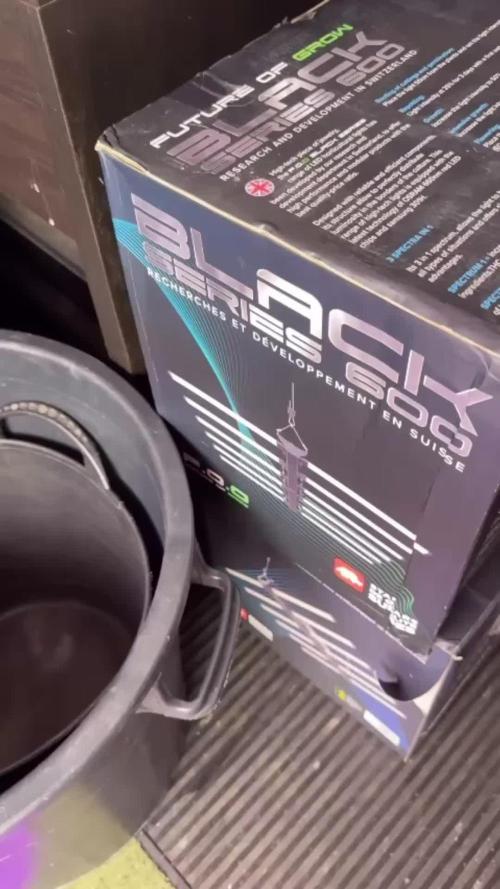
We've added two additional Future of Grow Black Series 600W fixtures to the room.
And yes...
we definitely noticed the difference.
😂💡
The available light increased substantially.
In fact, it initially went a little higher than I wanted.
So rather than simply running everything at maximum output, we reduced the power.
We're currently running at approximately:
🔌 59% power from the plug.
And with that setting, we're seeing approximately:
☀️ 1,500 PPFD across the upper canopy.
That's a very strong light environment.
And I'm much happier controlling it at this level rather than simply chasing the highest possible number.
We have the lighting capability.
We have the headroom.
And now we can choose how much of that capability we actually want to use.
────────────────────────
☀️ Around 1,500 PPFD – But The Plant Isn't Flat
One important detail when talking about that 1,500 PPFD number:
That's across the upper canopy.
Cash Express Pheno B is not a perfectly flat surface.
She's a three-dimensional plant.
Some flowers sit higher.
Some branches sit lower.
Some leaves face directly toward the fixtures.
Others are naturally more shaded.
So the amount of light changes throughout the structure.
And that's perfectly normal.
We're not trying to make every individual flower receive exactly the same intensity.
We're trying to create a strong overall light environment while allowing the plant to use those photons effectively.
And with Pheno B's taller architecture, this becomes particularly interesting.
She's creating several different levels within the canopy.
Upper.
Middle.
Inner.
Lower.
And every level has a different relationship with the light.
────────────────────────
💚 A Big Thank You To Future Of Grow
I want to give Future of Grow another big shout-out this week.
They provided the two additional Black Series 600W fixtures for us to test here in the 8×8 Adventure.
And we're not simply installing them and calling it a day.
We're actually testing them.
We increased the available light.
We measured the response.
The PPFD went higher than my preferred target.
So we reduced the power.
Now we're running around 59% and seeing approximately 1,500 PPFD across the upper canopy.
And there's another benefit I really appreciate.
We're not only controlling the light intensity...
we're also reducing electricity consumption.
There's no reason to run equipment harder than necessary when we can achieve the light level we're looking for at a lower output.
So we're testing the fixtures, learning what they can do, finding a practical operating level and allowing the plants to show us the results.
That's exactly what I wanted from this addition to the project.
Thank you, Future of Grow, for giving us the opportunity to put these fixtures to work.
────────────────────────
💡 More Capability Doesn't Mean More Power
This is something I think is worth emphasizing.
Having a 600W fixture doesn't mean I need to run it at 100%.
Having two additional fixtures doesn't mean I need to use every watt they can produce.
The important thing is control.
We added the lighting capability.
We saw what happened.
We adjusted.
And now we're sitting at a level that I'm very comfortable with.
Approximately 59% power.
Approximately 1,500 PPFD across the upper canopy.
And less electricity being consumed than if we simply pushed everything to maximum output.
For me...
that's much more interesting than chasing a number.
We want useful photons.
Not simply more watts.
And Cash Express Pheno B is getting plenty of photons right now.
😂💡🌿
────────────────────────
⚗️ Nutrition – Another Small Step
The nutrition has also moved forward slightly.
Again...
nothing dramatic.
We're making a small increase to Terra Bloom.
Current feeding:
• Terra Bloom — 2.3 ml/L
• Pure Zym — 1 ml/L
• Power Buds — 1 ml/L
• Sugar Royal — 1 ml/L
• pH Plus — 0.03 ml/L
• Lemon Kick — 0.03 ml/L
That small increase brought the EC up just slightly.
We're now around:
⚡ EC — 2.14 mS/cm
And that's exactly where I want the adjustment to be.
Small.
Measured.
Controlled.
The plant is already healthy.
The flowers are developing.
The foliage is looking beautiful.
So there's no reason to make a dramatic nutritional change.
We're simply giving the flowering programme a little progression and watching how she responds.
────────────────────────
💧 Irrigation – Consistency Is Still King
The irrigation remains consistent as well.
We're currently around:
💧 1.45 L per plant / 24 hours
The nutrient solution is around:
🌡️ 25°C
with the substrate also around:
🌡️ 25°C.
And this is becoming increasingly important as flowering progresses.
The plant doesn't need us constantly changing things.
She needs consistency.
Light.
Water.
Nutrition.
Root-zone stability.
Environment.
And time.
The system provides the consistency.
Cash Express provides the growth.
And I get to stand there taking photographs.
😂📸
Honestly...
I'm quite happy with that arrangement.
────────────────────────
🌡️ Week 11 – Current Conditions
This week's recorded conditions are approximately:
• 🌡️ Day Temperature: 26.5°C
• 🌙 Night Temperature: 26°C
• 💧 Relative Humidity: 61%
• 🥥 Substrate Temperature: 25°C
• 💦 Nutrient Solution Temperature: 25°C
• ⚗️ pH: 6.02
• ⚡ EC: 2.14 mS/cm
• 💨 CO₂: approximately 693 ppm
• 💡 Light Schedule: 12/12
• 💧 Irrigation: approximately 1.45 L/plant/24h
• ? Pot Size: 15 L
• 📏 Plant Height: approximately 93 cm
The environment remains very consistent across the room.
Summer still likes to remind us that plants don't live inside a mathematical spreadsheet.
😂☀️
Temperatures move.
Humidity moves.
The outside world changes.
What matters is keeping those fluctuations controlled and maintaining stability where we can.
And most importantly...
the plants look happy.
That's still the final check.
────────────────────────
🌿 Why We're Doing Less To Her Now
This is probably the biggest change in our approach compared with the earlier stages of the grow.
We're doing less.
Not because we're paying less attention.
Quite the opposite.
We're watching more closely.
But there's a difference between observing a plant and constantly manipulating it.
Earlier in the grow, we had reasons to train.
Reasons to shape.
Reasons to remove foliage.
Reasons to manage structure.
Now?
The structure is there.
The flowers are developing.
The canopy is established.
And Cash Express Pheno B is healthy.
So we're allowing her to continue.
No unnecessary intervention.
No trying to make her shorter.
No trying to make her look like Pheno A.
No trying to force her into a different architecture.
She's already telling us what she wants to be.
We're listening.
────────────────────────
🌸 The Beautiful Green Still Tells A Story
That deep, lush green remains one of the first things I notice when I look at her.
And it's something I don't take for granted.
Those leaves are the working machinery behind everything we're seeing.
They're capturing the light.
They're processing photons.
They're supporting photosynthesis.
They're helping provide the energy required for continued development.
And now that we're giving the room access to significantly more light, healthy foliage becomes even more important.
The plant has more photons available.
And she has the biological machinery to make use of them.
That's the relationship we're watching.
Light comes in.
The plant responds.
And the flowers continue developing.
Simple...
but absolutely fascinating.
────────────────────────
💡 A Three-Dimensional Garden
With Pheno B being one of the taller plants, the three-dimensional aspect of the lighting becomes especially interesting.
She's not just occupying a flat plane.
She's creating layers.
Upper branches.
Middle branches.
Interior growth.
Lower flowering sites.
And as the plant develops, the way light travels through that structure changes.
That's why our lighting strategy isn't simply about what happens directly above the plant.
The Future of Grow fixtures provide the primary artificial sun.
And Lumiflora continues helping bring additional light into areas that naturally receive less direct illumination.
We're trying to make better use of the plant's three-dimensional structure.
Not simply:
"More light."
But:
"Better opportunities for useful photons throughout the plant."
And Pheno B gives us a particularly interesting example because of her height and architecture.
────────────────────────
📸 The Camera Keeps Revealing More
This is another week where the photographs really tell the story.
The wide shots show the architecture.
The height.
The branches.
The overall flowering structure.
But the closer photographs reveal something completely different.
The pistils.
The developing flowers.
The texture.
The tiny details appearing throughout the buds.
And this is why I love keeping individual diaries.
From across the room, Cash Express Pheno B is simply one plant among twelve.
But when we isolate her...
we can appreciate her.
We can follow her.
We can see her changes.
And we can actually document her individual expression.
That's the whole point.
────────────────────────
Same Genetics – Different Expression
Her sister is still there.
Same cultivar.
Same room.
Same general conditions.
But look at them.
Different architecture.
Different height.
Different way of occupying the space.
Different expression.
And that's exactly why I don't want to force one phenotype to behave like another.
If I did that, we'd lose the very thing we're trying to document.
The whole point of the 8×8 Adventure is to give these plants a comparable environment and then let their genetics speak.
Cash Express Pheno B is speaking clearly.
She's taller.
She's lush.
She's vigorous.
She's flowering beautifully.
And she's doing it her way.
────────────────────────
🌸 We're Moving Deeper Into Flower
The stage we're entering now is becoming increasingly interesting.
The plant has already transitioned.
The flowering sites are established.
The structure is visible.
Now we're watching those flowers continue developing and becoming increasingly substantial.
This is where patience becomes extremely important.
We can't photograph a dramatic transformation every single day.
But week after week...
the difference becomes obvious.
And that's what these reports capture.
One week.
One photograph.
One observation.
One little piece of the story.
Eventually, all those little pieces become the complete picture.
And Pheno B is giving us a beautiful one.
────────────────────────
🔬 The 8×8 Adventure – Twelve Plants, One Experiment
This week is another reminder of what makes this project so much fun.
Twelve different genetics.
One room.
A shared environment.
Shared irrigation.
Shared nutrition strategy.
Shared lighting philosophy.
And now an upgraded lighting system capable of delivering significantly more photons.
We're not trying to make all twelve plants identical.
We're trying to give them comparable opportunities.
Then we observe.
Some will stretch.
Some won't.
Some will develop compact flowers.
Some will build more elongated structures.
Some will mature differently.
And that's the information we're collecting.
Cash Express Pheno B is simply one of those twelve stories.
And she's a particularly beautiful one.
────────────────────────
🔮 Looking Ahead
From here, we're keeping the plan simple.
Continue observing.
Continue monitoring the flowers.
Continue maintaining the environment.
Continue providing consistent irrigation.
Continue with the flowering nutrition.
Continue monitoring the new lighting setup.
And let Cash Express Pheno B continue doing what she does.
We're not looking for reasons to interfere.
We're looking for reasons to understand.
Over the coming weeks, I'll be watching:
🌸 Continued flower development
🌿 Healthy foliage
💎 Increasing resin production
☀️ Response to the stronger lighting environment
💧 Consistent water demand
🌡️ Environmental stability
🌬️ Good airflow throughout the canopy
📈 Increasing flower definition and density
And most importantly...
we'll let the plant set the pace.
────────────────────────
🚂 Final Thoughts – Let This Girl Shine
There are some weeks where the grower does a lot.
And there are other weeks where the most important thing the grower can do is step back.
This is one of those weeks.
We added two Future of Grow Black Series 600W fixtures.
We tested the increased lighting capability.
The PPFD climbed higher than I wanted.
So we reduced the output.
We're now running around 59% power from the plug and seeing approximately 1,500 PPFD across the upper canopy.
We made a small increase to Terra Bloom.
The EC moved slightly higher to around 2.14 mS/cm.
And then...
we stepped back.
Because Cash Express Pheno B doesn't need us constantly reaching into her canopy.
She needs consistency.
She needs photons.
She needs water.
She needs nutrition.
And she needs time.
And she's getting all of those things.
She's still the taller Cash Express.
She's still lush.
She's still beautiful.
She's still developing those flowers and those unmistakable white pistils.
And she's still writing her own story.
I don't want to change that.
I want to document it.
So keep doing what you're doing, girl.
Keep growing.
Keep flowering.
Keep showing us what this phenotype can become.
The lights are ready.
The environment is steady.
The nutrition is supporting you.
And we're watching.
🚂🌸💚💡
Let's make her shine.
────────────────────────
🙏 Thank You
As always, a massive thank you to everyone following the 8×8 Adventure and taking the time to follow these twelve individual stories.
Thank you to Zamnesia for giving us the opportunity to explore these genetics and discover how differently individual phenotypes can express themselves.
Thank you to Plagron for supporting the garden throughout this flowering journey with the nutrition helping these girls continue developing.
And a huge thank you to Future of Grow for providing the Black Series LEDs powering our artificial sun and, especially this week, for providing the two additional 600W fixtures for us to test here in the 8×8 Adventure.
Being able to increase the lighting capability, measure the response, adjust the output and find a practical operating level has been a fantastic part of this experiment.
We're currently running around 59% power and seeing approximately 1,500 PPFD across the upper canopy while also reducing unnecessary electricity consumption.
That's exactly the kind of real-world testing I love.
Thank you as well to Lumiflora for continuing to help bring additional light deeper into the canopy and allowing us to explore lighting as a three-dimensional environment.
And of course...
thank you to everyone following along on GrowDiaries.
Every comment.
Every question.
Every observation.
Every person stopping by to see how the girls are doing.
You're all part of this adventure.
Twelve plants.
One room.
One shared environment.
And twelve completely different stories.
And this particular story?
It's Cash Express Pheno B.
She's taller.
She's lush.
She's beautiful.
She's flowering.
She's developing.
And she's doing it her own way.
The lights are stronger.
The nutrition has moved slightly.
The environment remains stable.
And now...
we let her continue.
🚂🌿🌸💡
Sometimes the best thing a grower can do is provide the conditions, pay attention, and step back.
Cash Express Pheno B doesn't need us to force the story.
She's already writing it.
So let's keep watching.
Let's keep photographing.
Let's keep those photons flying.
And let's see what this beautiful girl shows us next.
Until next week...
Growers Love, happy growing, and take care everyone! 🌱💚
See you next week in the 8×8 jungle. 🌿🚂🔥

Processing
Likes
28
Share


@GaiaGreenGiant
Follow
New weekly video uploads and more! See what’s happening in the Cabbage Patch! Day 14 Flower! Plants looking very h@ppy. Can’t wait to get in there and give it’s last defoliation.
Day 16 - She’s stacking up nice! Just need to water when dry. She’s on cruise control!
Day 20 - Defoliation video for ya! Cheers 🍻
Likes
17
Share


@eldruida_lamota
Follow
Que pasa familia, actualizamos ya la quinta semana de crecimiento de las Purple OG Kush de Dutchfem.
El crecimiento fluye sin parones el color que tiene es bastante correcto las 3 en general se ven muy similares, misma altura misma formación.
Ya vamos viendo cómo progresan quiero pasarlas a floración ya.
Spannabis 2023 a sido increíble ya tengo ganas de que se haga el año que viene porque la de 2020 me quede con muchísimas ganas, conocí a muchas gente del sector que ya conocía por redes pero por fin nos ponemos caras, y lo dicho increíble la innovación de los productos , las genéticas que se llegan a ver, y los stands pfffff, de 10.
Agrobeta:
https://www.agrobeta.com/agrobetatiendaonline/36-abonos-canamo
Mars hydro:
Code discount: EL420
https://www.mars-hydro.com/
Las maximas de temperatura no superan los 25 grados y las mínimas no bajan 19, así que no me puedo quejar.
Los niveles de humedad también son los correctos van entre 50%/65% de humedad relativa.
Por supuesto el Ph lo estamos dejando alrededor de 6.
Hasta aquí es todo, buenos humos 💨💨💨

Likes
10
Share


@iLoveGoodWeed
Follow
The buds are really getting fat on this little CBD monster did not expect that. She will be small but heavy
Likes
38
Share


@Miss_Greenthumbs_Garden
Follow
So I'm very happy with how this Purple Ghost 👻 Candy 🍬 turned out she's just beautiful . Had no problems growing her and she took multiple topping like a pro !! she's produced some lovely flowers

Likes
52
Share


@Ultraviolet
Follow
Once again she passes my expectations, late to the show with trichome production. I'm surprised there is purple on the bud, maybe Purpinator does work. I thought I could see hints under the grow lights and thought my eyes were deceiving me, I was just being hopeful. But nah 2 of the 3(under the UV) have developed a beautiful tone of purple. I was never going to bother with a deep freeze but maybe the whole bud will change given conditions, that would be something, fingers crossed. 🤔 was a little skeptical that reducing temps humidity would change density, but it does, buds are solid something I've not been able to achieve before.
Rule of thumb is never to surpass 60% RH in the flowering phase and try to progressively reduce it down to 40% in the last 2–3 weeks before harvest. The plant will react as it seeks to protect its flowers, responding by producing denser buds and a higher concentration of resin. Cannabis plants are sensitive to sudden temperature changes, especially in the flowering stage. Extreme heat or cold can impact bud density and overall yields. In nature as a defense mechanism from cold, the plant sensing sudden dips in temperature will attempt to remove the pockets of air within the bud, it achieves this by compacting itself in doing so to better protect itself from cold snaps which are normally indicators in nature that worse weather is on the way.
Terpene levels are the highest just before the sun comes out. Ideally, you want as many terpenes present in your plants as possible when you harvest. Cannabis plants soak up the sun during the day and produce resin and other goodies at night. The plant is at its emptiest from "harvest undesirables" so to speak right before the lights on. Boiling cannabis roots during harvesting slows down the drying process. When you boil cannabis roots, it shocks the plant, closing the stomata on the leaves. This prevents massive moisture loss through the leaves, leaving only the floral clusters actively losing moisture at a reduced pace. I've always run a strict 60/60 and it took almost twice as long to dry to a snap than previous grows where I didn't boil for what it's worth.
Chlorophyll is good for the plant but not for you. When you harvest the buds, even after you flush them, if you flush them, they’re still filled with chlorophyll. Freshly cut buds are greener than dried buds because they still contain loads of chlorophyll. However, when rushed through the drying process, the buds dry but retain some chlorophyll, and when you smoke it, you will taste it. Chlorophyll-filled buds are smokable, but they aren’t clean. Slow drying gives the buds enough time and favorable conditions to lose the chlorophyll and sugars, giving you a smoother smoke. How the plant disposes of the chlorophyll and sugars by a process of chemically breaking them down and attaching the decomposed matter once small enough to water molecules which then evaporate back into the ether. Time must be given to the process to break down the chlorophyll and sugars. Think of it like optimizing the environment for decay.
All the nutrients it could ever need are in abundance, it eats nutrients based on its demand for growth, which is dictated primarily by available light.
Plant growth and geographic distribution (where the plant can grow) are greatly affected by the environment. If any environmental factor is less than ideal, it limits a plant's growth and/or distribution. For example, only plants adapted to limited amounts of water can live in deserts. Either directly or indirectly, most plant problems are caused by environmental stress. In some cases, poor environmental conditions (e.g., too little water) damage a plant directly. In other cases, environmental stress weakens a plant and makes it more susceptible to disease or insect attack. Environmental factors that affect plant growth include light, temperature, water, humidity, and nutrition. It's important to understand how these factors affect plant growth and development. With a basic understanding of these factors, you may be able to manipulate plants to meet your needs, whether for increased leaf, flower, or fruit production. By recognizing the roles of these factors, you'll also be better able to diagnose plant problems caused by environmental stress.
Water and humidity
*Most growing plants contain about 90 percent water. Water plays many roles in plants. It is:*
A primary component in photosynthesis and respiration
Responsible for turgor pressure in cells (Like the air in an inflated balloon, water is responsible for the fullness and firmness of plant tissue. Turgor is needed to maintain cell shape and ensure cell growth.)
A solvent for minerals and carbohydrates moving through the plant
Responsible for cooling leaves as it evaporates from leaf tissue during transpiration
A regulator of stomatal opening and closing, thus controlling transpiration and, to some degree, photosynthesis
The source of pressure to move roots through the soil
The medium in which most biochemical reactions take place
Relative humidity is the ratio of water vapor in the air to the amount of water the air could hold at the current temperature and pressure. Warm air can hold more water vapor than cold air. Relative humidity (RH) is expressed by the following equation:
RH = water in air ÷ water air could hold (at constant temperature and pressure)
The relative humidity is given as a percent. For example, if a pound of air at 75°F could hold 4 grams of water vapor, and there are only 3 grams of water in the air, then the relative humidity (RH) is:
3 ÷ 4 = 0.75 = 75%
Water vapor moves from an area of high relative humidity to one of low relative humidity. The greater the difference in humidity, the faster water moves. This factor is important because the rate of water movement directly affects a plant's transpiration rate.
The relative humidity in the air spaces between leaf cells approaches 100 percent. When a stoma opens, water vapor inside the leaf rushes out into the surrounding air (Figure 2), and a bubble of high humidity forms around the stoma. By saturating this small area of air, the bubble reduces the difference in relative humidity between the air spaces within the leaf and the air adjacent to the leaf. As a result, transpiration slows down.
If the wind blows the humidity bubble away, however, transpiration increases. Thus, transpiration usually is at its peak on hot, dry, windy days. On the other hand, transpiration generally is quite slow when temperatures are cool, humidity is high, and there is no wind.
Hot, dry conditions generally occur during the summer, which partially explains why plants wilt quickly in the summer. If a constant supply of water is not available to be absorbed by the roots and moved to the leaves, turgor pressure is lost and leaves go limp.
Plant Nutrition
Plant nutrition often is confused with fertilization. Plant nutrition refers to a plant's need for and use of basic chemical elements. Fertilization is the term used when these materials are added to the environment around a plant. A lot must happen before a chemical element in a fertilizer can be used by a plant.
Plants need 17 elements for normal growth. Three of them--carbon, hydrogen, and oxygen--are found in air and water. The rest are found in the soil.
Six soil elements are called macronutrients because they are used in relatively large amounts by plants. They are nitrogen, potassium, magnesium, calcium, phosphorus, and sulfur.
Eight other soil elements are used in much smaller amounts and are called micronutrients or trace elements. They are iron, zinc, molybdenum, manganese, boron, copper, cobalt, and chlorine. They make up less than 1% of total but are none the less vital.
Most of the nutrients a plant needs are dissolved in water and then absorbed by its roots. In fact, 98 percent are absorbed from the soil-water solution, and only about 2 percent are actually extracted from soil particles.
Fertilizers
Fertilizers are materials containing plant nutrients that are added to the environment around a plant. Generally, they are added to the water or soil, but some can be sprayed on leaves. This method is called foliar fertilization. It should be done carefully with a dilute solution because a high fertilizer concentration can injure leaf cells. The nutrient, however, does need to pass through the thin layer of wax (cutin) on the leaf surface.
It is to be noted applying a immobile nutrient via foliar application it will remain immobile within the leaf it was absorbed through.
Fertilizers are not plant food! Plants produce their own food from water, carbon dioxide, and solar energy through photosynthesis. This food (sugars and carbohydrates) is combined with plant nutrients to produce proteins, enzymes, vitamins, and other elements essential to growth.
Nutrient absorption
Anything that reduces or stops sugar production in leaves can lower nutrient absorption. Thus, if a plant is under stress because of low light or extreme temperatures, nutrient deficiency may develop.
A plant's developmental stage or rate of growth also may affect the amount of nutrients absorbed. Many plants have a rest (dormant) period during part of the year. During this time, few nutrients are absorbed. Plants also may absorb different nutrients as flower buds begin to develop than they do during periods of rapid vegetative growth.
432 Hz is said to be mathematically consistent with the patterns of the universe. Studies reveal that 432 Hz tuning vibrates with the universe’s golden mean PHI and unifies the properties of light, time, space, matter, gravity and magnetism with biology, the DNA code and consciousness. When our atoms and DNA start to resonate in harmony with the spiraling pattern of nature, our sense of connection to nature is said to be magnified.
Another interesting factor to consider is that the A=432 Hz tuning correlates with the color spectrum while the A=440 Hz is off.
Audiophiles have also stated that A = 432 Hz music seems to be non-local and can fill an entire room, whereas A=440 Hz can be perceived as directional or linear in sound propagation.
Once you adopt the idea that sound (or vibration in general) can have an equalizing and harmonizing effect (as well as a disturbing effect), the science of harmony can be applied to bring greater harmony into ones life or a tune to specific energies. There is a form of absolute and of relative harmony. Absolute harmony can for example be determined by the tuning of an instrument. The ancients tuned their instruments at an A of 432 Hz instead of 440 Hz - and for a good reason. There are plenty of music examples on the internet that you can listen to in order to establish the difference for yourself. Attuning the instrument to 432 Hz results in a more relaxing sound, while 440 Hz slightly tenses up to body. This is because 440 Hz is out of tune with both macro and micro cosmos. On the contrary, 432 Hz is in tune. To give an example of how this is manifested micro cosmically: our breath (0,3 Hz) and our pulse (1,2 Hz) relate to the frequency of the lower octave of an A of 432 Hz (108 Hz) as 1:360 and 1:90.
It is interesting to note that 432 Hz was the standard pitch of many old instruments, and that it was only recently (19th and 20th century) the standard pitch was increased. This was done in order to be able to play for bigger audiences. Bigger audiences (more bodies) absorb more of the lower frequencies, so the higher pitch was more likely to “cut through”. One of the oldest instruments of the world is the bell ensemble of Yi Zeng (dated 423 BC), tuned to a standard F4 of 345 Hz which gives an A= 432 Hz. The frequency of 345 Hz is that of the platonic year! Similarly many old organs are tuned in an A=432 as well; for example: St. Peter’s Capella Gregoriana, St. Peter’s Capella Giulia, S. Maria Maggiore in Rome.
Maria Renold’s book “Intervals Scales Tones and the Concert Pitch C=128 Hz” claims conclusive evidence that 440 Hz and raising concert pitch above scientific “C” Prime=128 Hz (Concert A=432 Hz) disassociates the connection of consciousness to the body and creates anti-social conditions in humanity.
The difference between concert pitch A=440 Hz and Concert A=432 Hz is only 8 cycles per second, but it is a perceptible difference of awareness in the human consciousness experience of the dream we share called existence.

Likes
11
Share


@GodZilla_Owner
Follow
Week 3 – Day 22 (VT22)
RedPure#4 was transplanted into a 15L fabric pot this week and received 💧 2.5L of water.
She’s showing the first signs of preflower 🌸 and is staying nice and compact – just as expected.
Looks like she’s going to turn a beautiful purple 💜 soon!
She reacted well to the transplant and shows no signs of stress.
The overall light intensity (DLI) was reduced to 27 to keep stress low, but RedPure handled it like a champ 💪.
📅 Looking ahead:
🔹 Watering volume will increase to 4–5L depending on demand.
🔹 Root growth looks promising – they’ve started exploring the new pot.
🔹 Light LST will continue, and I might remove a few bigger leaves 🍃 if needed.

Likes
37
Share


@rhodes68
Follow
This strain has a good amount of trimming to be done on medium sized leaves so takes a few minutes.. or more.
Just the easiest plant to grow... hands down period end of line
Here is our guess for yield - 300-350 grams - yeah she still gonna kick my butt hers was almost a pound
Heh I was long by an oz or two and yep she kicked my butt as expected
Likes
51
Share


@WeedManiacLove
Follow
Super bien, están creciendo con mucho vigor. La alimentación se mantiene igual. No he tenido ningún contratiempo.
Armario completamente cubierto.
Cambiamos el ciclo de luz a 12-12. 👌
Likes
16
Share



Likes
12
Share

@XperencdGmanXG
Follow
gonna run these runt bottoms for another week. Turned on the heat mat and growth has exploded. So gonna leave it and see what happens as I have not pending rush for the room to be cleared.