Likes
12
Share
@Kirsten
Follow
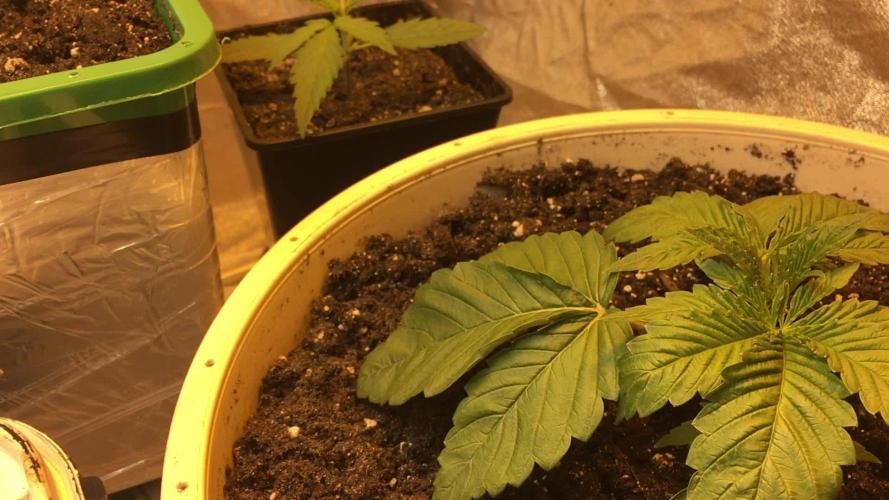
31.12.24: I have been readjusting the LST pegs and wire daily. Sometimes, twice a day! (I know, too much time on my hands)! 😆 The plants have responded fantastically! I'm so glad I gave it a go. Some plants have been a bit too tall, and I snapped Do-sì-dos P3, pulling the stem down. Audibly snapped 😬I let it be, though. It seems to have healed mostly, in only 2 days. I have increased the lighting to 70%. They're getting watered a few times a week, with 1 litre of Dechlorinated water, containing the following nutrients and additives; 1ml of Biobizz Bio-Grow, 1ml Biobizz Top Max, 1ml of Biobizz Bloom, 2ml of cal-mag, 1g of Ecothrive Biosys. The plants are responding well to this concoction, so it's all good so far. The leaves are looking greener and are getting darker. Will be monitoring to continue readjusting the LST ties. Also, to monitor the increased lighting level, to make sure they can handle that yet. 1.1.25: Happy New Year! I have continued to readjust the LST wire and plant pegs. Several times a day. Coincidence would have it, I have a 6ft tropical aquarium which was time for cleaning! I always water my Acer tree in the front yard with this water, with beautiful results 😍 👌 🍁 I decided to try it out in my indoor garden. I'll post photos of before and after to see the difference, good or bad 😅 3.1.25: Plants are doing very well, except for PPP3 I'm quite disappointed in that one, as I feel like it's wasting a space. I guess I'll have to keep it, along with the Do-sì-dos that I snapped twice, which refuses to die 😅 I started to lightly defoliate, which is difficult because I always get carried away with it. I'm going to water again with the nutrients in description of this week. Overall Pink Mist P3 is looking a little sparse, and training is difficult as the stem is harder and thicker than the other plants in the tent. Hoping to see some more growth this week! 4.1.25: Continuing to defoliate and adjust the LST pegs and wire. Watered today with 1ltr of dechlorinated water PH'd to 6.0. With the following nutrients;- 2ml Biobizz Bloom, 4ml Biobizz Bio-Grow, 2ml Cal-Mag, 2ml Ecothrive Flourish, 0.2 g/ltr of Ecothrive Biosys. I've increased the Nitrogen by adding double the amount of Biobizz Bio-Grow. I'm trying to keep them growing for as long as possible! I really want to keep the strength up and keep the leaves nice and lush green! 💚 Will update here with more photos and videos. Thanks for checking out my diary 🍃 ✌️
Processing
Likes
16
Share
@Stinkfox
Follow
i didn’t defoliate this week on this girl. I don’t think she needs it, and I don’t want to risk stunting her. The structure is open enough that it shouldn’t be an issue.
Likes
44
Share
Yes guys lot of arguing n disbelief and negitive vibes on ma chat do you know a was Fukin rajin ready tae head over tae Texas n open a can of whoop ass on old @silverback guerilla aye herd him gettin tooled up for war so the Mack tenz n rocket 🚀 launchers on stand by everyone has there own opinion true rite ok I think mutation because I know I haven’t potted stray seed highly unlikely
Likes
12
Share
@Terpyboyz
Follow
This grow should be coming to an end next 2 weeks or so some are looking to be in the last stages, only issue is having multiple strains is strains finishing at diff times. There’s one exodus cheese that looks like she’s going to go 10/11 weeks but she’ll be cut well before that to start a new batch. There’s 3 clones that were taken 1 being a big Buddha blue cheese that absolutely reeks of tangie/Clementine terps with a slight sour cheesey smell. This is getting revegged and cloned for the next run. Ripper seeds - this is another strain I’m going to try to reveg as this is another keeper I should have taken cuts. Platinum x harachata - 2 different pheno / one with rock solid nugs other is more Sativa.
Likes
30
Share
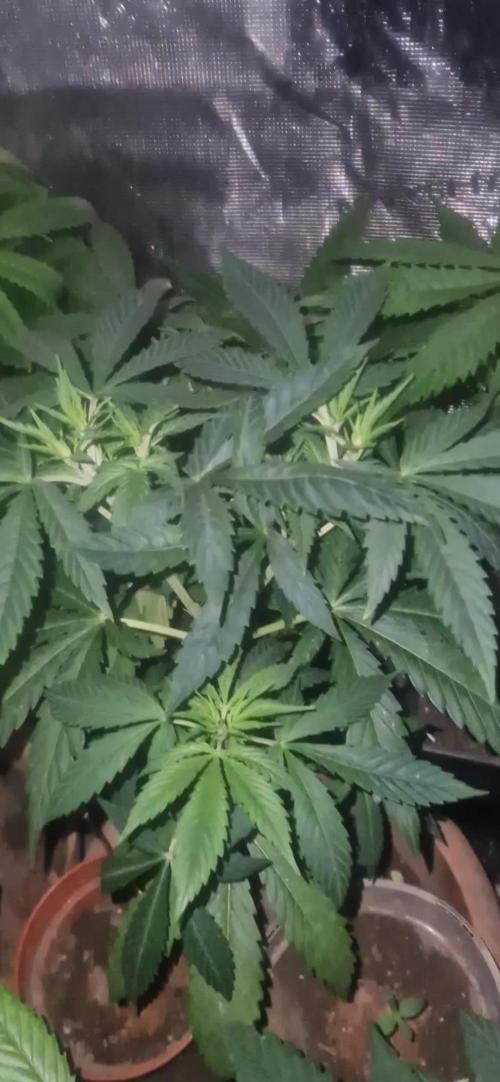
Cette semaine les plantes ont très bien poussé, je suis très content !! Je me rends compte que j'aurai dû faire une plus grosse défoliation 1 semaine avant de passer les plantes en floraison. Là les plantes sont très touffues et les plantes utilisent de l'énergie pour des feuilles qui n'arrivent pas à obtenir de lumière malgré le palissage. La prochaine fois, je couperai bien plus pour privilégier les têtes supérieures. J'ai augmenté l'intensité lumineuse et j'ai rapproché la lampe et rajouter de l'alga bloom. Je reste très satisfait de ce résultat avec tous les problèmes que j'ai eus lors de cette culture. J'ai perdu plusieurs sondes à ph ce qui a provoqué des problèmes d'absorption, mais j'ai bien rattrapé le coup. Plus qu'à attendre les nouveaux bourgeons 😎
Likes
35
Share
@SooSan
Follow
90x60x140 (Mars Hydro) FC-E4800 (Mars Hydro) Easy2go Aquavalve5 (Autopot) Living Soil (Demetearth) Bruce Banner (PEV Seed) Gorilla GG4 (Ganja Farmer) Cream Caramel (Sweet Seed) Gorilla Gelato (Ganja Farmer) Blueberry (00 Seed) Kalini Asia (Zamnezia) Biscotti Mintz (Barney's Farm) Blackberry Cake (Sensi Seed) Amsterdam Amnesia (Dutch Passion) Gelato Cookie (Ganja Farmer) Purple OG Punch (Ganja Farmer) Sweet ZZ (RQS) Rainbow Road (Paradise Seed) Substrat ~50L: 30L Super Light Mix Biotechnologie 18L coco 2L perlite 1,7kg lombricompost 350g guano de chauve-souris 350g Zéolithe 350g Basalte 170g guano vers de farine 170g biochar 0,7g Endomychorise glomus intraradices 0,7g Bacillus Amyloliquefaciens Paillage de luzerne alfalfa Arrosage avec 2ml/L de mélasse de canne 1x par semaine Pulvérisation avec 1% d’huile de neem
Likes
2
Share
Welcome to Flower Week 4-5 of Divine Seeds Auto Black Opium I'm excited to share my grow journey with you all as part of the Divine Seeds Autoflowering Competition 2025. It's going to be an incredible ride, full of learning, growing, and connecting with fellow growers from all around the world! For this competition, I’ve chosen the Feminized Automatic strain: Auto Black Opium Here’s what I’m working with: • 🌱 Tent: 120x60x80 • 🧑‍🌾 Breeder Company: Divine Seeds • 💧 Humidity Range: 50 • ⏳ Flowering Time: 60-63 Days • Strain Info: 25%THC • 🌡️ Temperature: 26 • 🍵 Pot Size: 3 • Nutrient Brand: Narcos • ⚡ Lights : 200W x 2 A huge thank you to Divine Seeds for allowing me to be a part of this amazing competition and Sponsoring the Strains. Big thanks for supporting the grower community worldwide! Your genetics and passion speak for themselves! I would truly appreciate every bit of feedback, help, questions, or discussions – and of course, your likes and interactions mean the world to me as I try to stand out in this exciting competition! Let’s grow together – and don’t forget to stop by again to see the latest updates! Happy growing! Stay lifted and stay curious! Peace & Buds!
Likes
25
Share
@Weedbadk
Follow
Me sorprende como van engordando súper rápido y la formación de resina es sorprendente. Están demostrando unos tonos muy hermosos ,se puede apreciar que van a ser cogollos grandes y compactos .
Likes
6
Share
@Naujas
Follow
That's how I know the crop was harvested too early:( ..... but only because someone started visiting my place of cultivation and took my two girls, and left two, so that he wouldn't come back a second time and take them, I decided to cut her down earlier:( that's it such news awaited me when I returned from vacation, but overall the girl looked very beautiful, although she got a lot of stress when the snails ate her, but she endured it and recovered very well:) I will dry the bigger flowers and make bubble hash from the rest, good luck to everyone be careful in nature :).
Likes
70
Share
So this is how things are looking for the ladies at the end of Week 6 of Veg guys, I have uploaded a video with more information, any questions just ask in the comments 👍🏾🌱💚 HAPPY GROWING
Likes
10
Share
🔥🔥🔥🔥 en attente de l'explosion florale. Leq branche commence a ce givré d'une couverture de trichome fantastique.
Likes
2
Share
The nighttime VPD does not need to mirror the daytime VPD. Daytime VPD dictates the pull of water and nutrients, while nighttime VPD acts mostly as a prevention tool. A high nighttime VPD increases the risk of the leaf temperature dropping below the dew point, which can trigger bud rot and powdery mildew. Switched down to 12's hours of light mid-week, changed spectrum, increased light intensity from 840umol up to 1150umol at current height. Overnight from 800ppm to 1500ppm, morning compensation point (microorganisms) 46-47 days from germination, she fills the canopy herself, once the apical dominance is broken. Measuring a plant's overnight CO2 emissions provides an accurate estimate of its dark respiration rate. Because photosynthesis stops in the dark, you are isolating the respiration process, which allows you to gauge how much stored energy (glucose) the plant has consumed and estimate the scale of oxidative phosphorylation. Oxidative phosphorylation is the final stage of respiration that generates the bulk of the plant's ATP (90%) and relies directly on the oxidation of these respiratory substrates NADH and FADH2 along with the consumption of oxygen. From a thermodynamic standpoint. Growth is an energy-capturing process, and the rate of that growth is bound by the available free energy (Gibbs free energy) and the First Law of Thermodynamics. While the ceiling or upper limit is dictated by free energy (such as photosynthetically active radiation), the actual amount of growth relies on how the plant balances that energy with other limiting factors. These are often described as the nine cardinal parameters of plant growth. 4 Above, 5 Below. If any one of the 9 becomes bottlenecked, the entire plant's cycle is restricted. Operating an 80F+ environment at night to force rapid carbon conversion comes with major drawbacks, as the biochemical processes work differently than the deductive logic suggests. While raising nighttime temperatures to 80F indeed accelerates respiration and speeds up the conversion of captured sugars (sink activity), doing so also radically increases the plant's overall metabolic baseline. If the plant's metabolic rate is artificially forced too high via heat, it can actually "burn" through more energy than it managed to assimilate during the day. This leads to carbohydrate starvation, stretching, and a net loss in final biomass yield. 400 ppm is near the standard ambient level; the plant's stomatal intake is the primary limiting factor, not the dark-reaction enzymes. To push 45 DLI without burning out the plant. Trying to force the conversion of a massive daylight DLI in a compressed time frame (12 hours) becomes highly inefficient because the Rubisco enzyme simply hits a saturation limit. To successfully convert a 45 DLI into dense, productive mass, the ambient CO2 generally needs to be elevated to the 1000 to 1200ppm range. This creates a steeper concentration gradient, driving the stomata to inhale CO2 fast enough to match the high photon energy. It's not all about the amount of light, but the ratio too, as this will dictate growth through the ratio of phytohormones. In order for correct bud development, there needs to be a correct ratio of RGB. Different wavelengths have different penetration depths. When one grows using top-down lighting, only the entire canopy is limited to 2-3 layers of leaf, meaning there will only be correct bud development in those layers, regardless of getting 45DLI. The biomass potential of a plant is linked to root mass. Generally, when a plant reaches its maximum biomass, you can help to chop off parts of the plant that are in less than efficient areas of the plant (low light) so that it can create new biomass growing towards the light. Strength is the maximum potential, and power is the rate of conversion. You can have the biggest veg period of 18 weeks, and it means nothing, as soon as you start flowering, the chronological clock starts ticking, the only metric that matters to bud size is how much energy you convert each cycle, not by how long it took you to build the framework, it helps a lot nonetheless. Not saying anyone should not defoliate for a reason, only that you should have one, and at the right time. Don't defoliate 30+% on autoflowers or 4 weeks into the flower period and expect an increase in yields; it doesn't work like that. There is room for dictating growth patterns and clearing out overcrowded nodes, but it needs to be done in veg because once that timer starts and buds start growing, it's all just energy conversion. One barely needs to defoliate at all in a 4x4 because with side lighting, turning a 2d canopy penetration into a 3d, even lower buds are 90% the quality and density of top ones. The rate of photosynthesis and the ultimate density of lower buds aren't just about the sheer number of photons PPFD. The specific ratio of R:G:B dictates canopy penetration and drives different photochemical reactions. The Electron Transport Rate (ETR) measures the speed at which electrons are driven through Photosystem II (PSII) during photosynthesis. The ratio of Red, Green, and Blue (RGB) light heavily dictates this rate. Plant leaves continuously perform cellular respiration regardless of the time of day, using energy and oxygen to fuel essential metabolic maintenance. If you over-defoliate, the remaining canopy may be unable to produce enough net sugars during the day to offset the constant respiratory demands of the plant. Must balance fixation with assimilation; there's no point in capturing 45 DLI if you only convert 20% every cycle due to an extreme lack of respiratory capacity to perform cellular oxidative phosphorylation. You can have a 4x4 canopy or a 4x4x4 canopy, yes, we know that side lights are not as effective at absorption from the sides or underneath, but it's not about DLI, it's never been just about efficiency, it's about the penetration ratios of RGB that drive ETR of/photosynthesis and trigger correct bud development. The size of each bud is its own ability to perform the ETR required for its own personal growth, and bud development is dictated by the ratio of RGB. It drives localised growth and acts as a regulatory switch for that development. Turgor pressure is another very important factor in understanding if you want big buds, for it is the "steam engine" that dictates the rate of bud expansion. Simply, a lot harder to achieve metabolically at ambient 75F than at say 86F Because buds have less chlorophyll, they do not suffer from the same photosynthetic shutdown that over-exposed, light-stressed leaves do. They can soak up direct light energy to swell in density and size. Their tolerance to intense light is heavily limited by the temperature and humidity, but if you can control those temps and keep the rot away, buds have a much, much higher tolerance to high light than leaves. Beneficial to hammer with high light before trichomes appear. Balancing this with trichome maturity is key for rich terpene and flavonoid profiles, want it just right, somewhere in the middle, not too much, not too little. Find cannabis plants can defoliate themselves come harvest, given the right signals. Every last ounce of potential is recycled into buds by the plant itself (senseceance), given you can keep the level of conversion high enough to prompt a need to do so. Get the canopy @ optimal PPFD range, 45-55DLI, then let the plant "stretch" the stems into a "PPFD range much higher, one that leaves don't like to grow in, but buds thrive in. What is optimal for a bud is different from what is optimal for a leaf photosynthetically. Genes provide the blueprint, but the environment dictates how, when, and if those genes are expressed. Must first signal the condition to increase the expression you want to exist through stress and response, cause and effect. A well-buffered CEC medium prevents extreme nutrient swings, allowing plants to maximise their dedicated genetic expression. A plant is either genetically expressing "growing" or "recycling" genes based on its nutrient starvation level in the medium. Constantly toggling between "growing" and "recycling" hormonal states creates a futile cycle that wastes valuable metabolic energy. Plants rely on sophisticated biochemical switches to manage this trade-off and prevent rapid fluctuations that disrupt that balance. This energy inefficiency is a recognised biological challenge. Plants avoid this costly "flip-flopping" by using hierarchical master regulators (like the TOR and SnRK1 protein kinases) that act as strict molecular switches. These networks enforce cellular commitment to either growth or survival, preventing mixed signals. This is something that was missing from previous grows. Under nutrient-rich conditions, TOR promotes protein synthesis, cell division, and structural expansion. Under starvation, TOR is inhibited, and SnRK1 is activated. This triggers autophagy—where the plant breaks down old macromolecules and organelles to scavenge and reallocate essential nutrients to critical sinks. "What's the point in flushing?" The core idea behind a PK booster is to deliver a massive, concentrated surge of P&K exactly when buds are swelling in conjunction with a N starvation. Because these are short, targeted windows, the nutrients must be highly bioavailable so the plant can process them immediately. As soon as you go "organic," that's out the window. Much slower release, uncontrolled, very difficult to "spike". to cause the ratio that will initiate a response. High-volume PK spikes rely strictly on the immediate uptake capabilities of mineral fertilisers. Making it far less efficient in organic/living soil setups. When you use organic nutrients, it changes the dynamic with which the plant delivers and trades its nutrients; organic is always releasing new nutrients into the immediate EC. This prevents a lot of autophagic responses from occurring due to a constant stream of new nutrients into the immediate medium's EC. This can prevent nutrient starvation from being signalled. PK boost is essentially just N starvation, triggering an autophagic response. Concentrated ratio of P&K while tapering off the Nitrogen base. To the plant, the sudden drop in Nitrogen registers as a severe environmental stressor—essentially, the beginning of starvation protocols. She aggressively strips nutrients and proteins from older leaves and vegetative structures and shuttles them directly to the developing flowers and fruit. Ta daaa. Call it a PK booster and sell it. Nothing to do with the P and K itself, it's the ratio immediately available in the medium triggering a nutrient recycling mechanism within the plant itself; all the "booster" sells is the trigger to the signal. PK BOOST with 50% ammoniacal N signals floral maturation. PK BOOST with N starvation signals nutrient recycling/sinking. Very difficult to initiate a response when organic nutes are doing their thing. It takes 4x5x more water significantly to leach or wash ammonia out than it does nitrates. This can prevent triggering N starvation from having its normal impact. Manipulating the C:N ratio in the medium. One autophagic response has multiple potential signal triggers. Nutrient starvation is not an option.
Likes
49
Share
Likes
3
Share
Peace growers. In the third week I got excited and did topping, low stress and even broke the plants. They are doing great and are growing like they were poured with living water :) I will give the plant with the mutation another chance. It is a fighter and so far it deserves its place. We will see what we come up with in the next weeks. Good luck to everyone and thanks for watching :) - Peace groweři. Ve třetím týdnu jsem se rozvášnil a provedl jsem na rostlinách topping, low stress a došlo i na lámání.. Zvládají to skvěle a jedou jak polité živou vodou :) Rostlině s mutací dávám dále šanci. Je to bojovnice a zatím si své místo zaslouží. Uvidíme, co dále vymyslíme v dalších týdnech.. Ať se daří všem a díky, že to sledujete :)
Likes
44
Share
@nerdz
Follow
Day 64 to 70 On autopilot. I have been light on the nutrients so bumped up the nutes to 810ppm this week. Forbidden Runtz 1 is coming close, the buds are getting THICC and hard. I'm keeping a close eye on the trichomes. It's almost go time. I predict 2-3 more weeks for the rest but I don't know anything Feeding around 750ppm this week. Lightening up on Nutes for FR1 at ~350ppm.
Likes
3
Share
@LSchnabel
Follow
Flushed this week with straight water. Bud is smelling like sulfer and orange. Bud structure was good but they don’t seem very dense. Nice color shift the last two weeks of growth. Chopping down and hanging for a two week dry.
Likes
21
Share
Flowering day 7 since time change to 12/12 h. Hey guys :-) The flowering started last week because otherwise the space in the small tent would end up being too narrow :-) Cuttings were taken from each phenotype beforehand. To change the flower, I rinsed it very lightly with clean fruits. With the next watering she gets a mix of grow liquid and bloom liquid before she only gets bloom. The heating mat works perfectly in the small tent and the parameters are all in the optimal range 🙏🏻👍. Now we hope that everything stays that way and that the cold days will slowly pass :-) . Everything was cleaned and checked. have fun and stay healthy 🙏🏻 👇🏼👇🏼👇🏼👇🏼👇🏼👇🏼👇🏼👇🏼👇🏼👇🏼👇🏼👇🏼 You can buy this Nutrients at : https://greenbuzzliquids.com/en/shop/ With the discount code: Made_in_Germany you get a discount of 15% on all products from an order value of 100 euros. 👇🏼👇🏼👇🏼👇🏼👇🏼👇🏼👇🏼👇🏼👇🏼👇🏼👇🏼👇🏼 You can buy this strain at : Clearwater Seeds Water 💧 💧💧 Osmosis water mixed with normal water (24 hours stale that the chlorine evaporates) to 0.2 EC. Add Cal / Mag to 0.4 Ec Ph with Organic Ph - to 5.8 - 6.5 MadeInGermany