


Likes
Comments
Share


@spacetimeman
Follow
Jiffy germination peat tablets were used for germination. Seeds were put there straight out of the capsule, I haven't put the seeds into the water as I had done before for previous grows.

Processing
Likes
61
Share


@Dunk_Junk
Follow
6cm vertical growth this week but she threw out some nice side growth.
Apologies for the timelapse, it starts halfway through the week and finish/start are in the middle of the week 😳

Likes
8
Share


@zazini
Follow
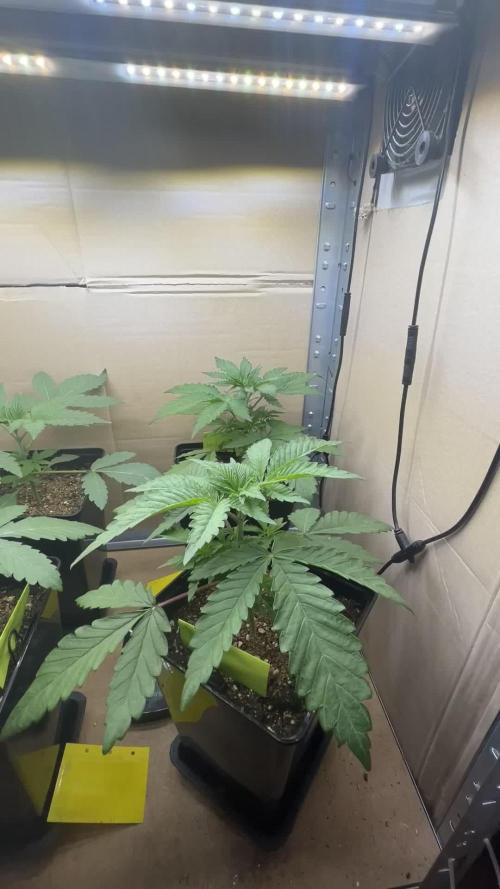
orange bud & king juice remaining
king juice will prob get chop next week somwhere and the orange the week after that
been giving them water 2x a week and 1x feed a week
i gave them overdrive last week but i dont think i like it, evrytime i give it the next week my PH gets lowerd by 0.5-1 (dunno if this is normal for overdrive to do that?) and the plants starts to eat itself way faster then i want it to
also my soil is past 10weeks now so the nuts inthere are gone





Likes
12
Share

@DogDoctorOfficial
Follow
💙 Project Blue Tent – Week 13
🌈 Blue Waffle F1 – Pheno A
❄️ A Rainbow of Colours, Dense Flowers, and the Final Chapter Approaching
Hello everyone, and welcome back to another chapter of Project Blue Tent! 💙🌱
If you're new to this diary, welcome! And if you've been following our adventure from the beginning, you already know that this project has become something truly special.
Four plants.
Two cultivars.
One shared ecosystem.
And four individual stories that we're documenting week after week.
We're growing Blue Waffle F1 and Pickle Lemon Haze F1 together inside the same tent, sharing the same environment, reservoir, irrigation system, and general cultivation approach.
We've spent weeks building the structure, training the plants, managing the canopy, and establishing the lighting and irrigation systems.
But now, my friends...
We're entering another chapter.
The final stage of flowering is approaching, the environmental conditions are changing, and the girls are starting to show us some absolutely beautiful colours.
And Blue Waffle F1 Pheno A?
Oh my God! 😂🌈
This girl is looking outstanding.
Compact, dense, colourful, beautifully structured, and smelling absolutely incredible.
But before we get into the details of this particular phenotype, let's take a quick look at what's happening throughout the room, because the latest adjustments are part of the bigger story.
🌡️ THE WHOLE ROOM – PREPARING FOR THE FINAL STAGE
The first thing worth mentioning this week is that we've started bringing the temperatures down throughout the room.
Both daytime and nighttime temperatures are being reduced as we move towards the end of flowering.
We're also lowering the solution temperature and substrate temperature, which are now sitting at approximately 21°C.
During the night, when the plants are sleeping, the air temperature is dropping to around 19–20°C.
These changes are part of our approach to the final stage of flowering.
We're aiming to provide a slightly cooler environment while the plants continue maturing, and we're particularly excited to observe how their natural colours develop over the coming days.
Of course, every cultivar and phenotype has its own genetic potential.
Some plants develop spectacular reds, blues, purples, and other shades as they mature, while others remain predominantly green.
We can't force a plant to express colours that aren't in its genetics, but we can observe how each individual responds as flowering progresses.
And in this room?
We're starting to see some beautiful changes! 🌈💙
🍃 HUMIDITY – DON'T BELIEVE EVERY SINGLE SNAPSHOT!
A quick note about the environmental readings shown in the photographs.
Some of the screenshots show relative humidity at 66%, but our actual target reading for the room is around 55%.
Why the difference?
Well, sometimes the biggest environmental variable inside the tent is... me! 😂
When I'm working inside the room, moving around, taking photographs, checking equipment, and breathing, the humidity reading can rise.
Even with the air conditioning running, the conditions can temporarily change while I'm in there.
That's why I don't treat every single screenshot as a perfect representation of the room's normal operating conditions.
The important distinction is between a temporary reading during maintenance and the conditions we're actually maintaining once the room has settled.
For this week's report, we're recording the relative humidity at approximately 55%.
It's a small detail, but it's worth explaining so that anyone following the project understands what they're seeing in the photographs.
Transparency matters, especially when we're documenting a shared environment across multiple diaries.
💧 NUTRITION – WE'RE STARTING TO LOWER THE NUMBERS
Another important change this week is our nutritional program.
We've started reducing the quantities of Hydro A and Hydro B.
The new recipe is:
PLAGRON Hydro A – 1.8 ml/L
PLAGRON Hydro B – 1.8 ml/L
PLAGRON Power Buds – 1 ml/L
PLAGRON pH Plus – as required
PLAGRON pH Minus – as required
The recorded pH is approximately 5.96, and the EC is around 1.86 mS/cm.
As expected, reducing Hydro A and Hydro B has also reduced the overall nutrient concentration, reflected in the EC and TDS readings.
The pH can also change as the solution composition changes, although it doesn't necessarily move in a predictable direction every time.
Our approach is straightforward.
We aim to keep the pH close to 6, allowing for small variations above or below that point, and we avoid unnecessary adjustments as long as the reading remains within our intended range.
We're not chasing a perfectly fixed number every minute.
We're looking at the measurements, considering the complete solution, and keeping the system stable.
As we move towards the end of flowering, we're also beginning to reduce the overall nutrient input rather than continuing with the same concentrations indefinitely.
We'll continue observing the plants and adjusting the program according to how the room and the individual cultivars develop.
🌡️ SOLUTION AND SUBSTRATE TEMPERATURES – EVERYTHING IS COMING DOWN
The solution temperature is now approximately 21°C.
The substrate temperature is also around 21°C.
At night, the room temperature drops to approximately 19–20°C.
Together with the reduction in daytime temperature, these adjustments are part of our approach to the final flowering stage.
We're particularly interested in observing the plants as the temperatures change and their natural colours become more visible.
Some cultivars can express more intense pigmentation under cooler finishing conditions, depending on their genetics and the environment.
However, colour development isn't guaranteed, and cooler temperatures aren't automatically better in every situation.
Our aim is to provide a stable, appropriate environment while observing what each plant naturally expresses.
And Blue Waffle F1 Pheno A is already giving us plenty to appreciate!
💡 LIGHTING – A GRADUAL REDUCTION FROM ABOVE
We've also started reducing the power of the overhead LEDs.
The main lights are now running at approximately 90%.
From here, our plan is to reduce their output gradually, by around one or two percentage points per day, as we progress through the final stage.
The idea is to make these adjustments progressively rather than suddenly changing the entire lighting environment.
We're also taking the under-canopy lighting into consideration.
The two LumiFlora 150W full-spectrum fixtures remain arranged in their X-cross configuration beneath the canopy.
For now, we're keeping their output around 90–95%, with the possibility of reducing it closer to the finish.
This gives us a different balance between the overhead lighting and the supplemental lighting underneath the canopy.
The main LEDs continue providing the primary light from above, while the LumiFlora fixtures supplement the lower portions of the plants.
One of the things we're particularly interested in is how this arrangement affects the development of the lower flowering sites.
Those flowers are part of the plant too, and we want to observe how they progress rather than focusing exclusively on the upper canopy.
The idea is to maintain useful light distribution throughout the plant while gradually reducing the overall overhead intensity as we approach the end.
Whether this helps the different flowering sites finish more uniformly is something we'll continue observing.
We're not going to assume the result before we see it.
We'll document the changes and let the plants tell us their story. 💡🌿
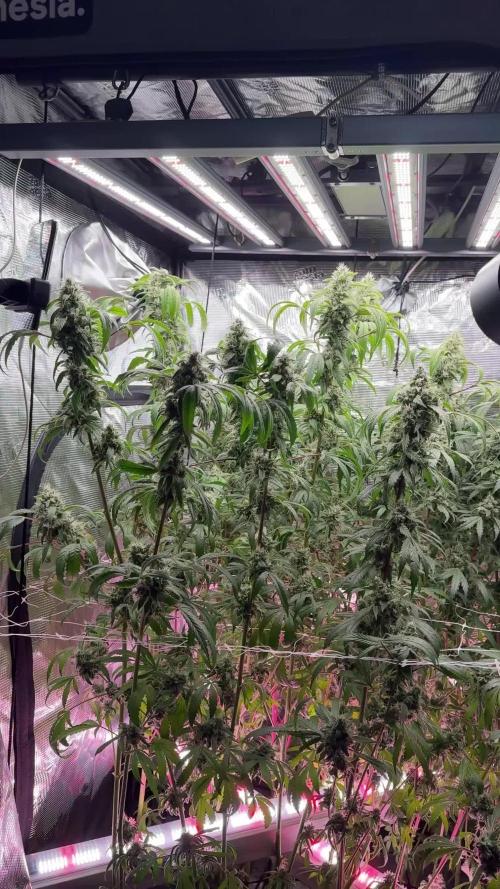
🌈 BLUE WAFFLE F1 PHENO A – THIS GIRL IS A RAINBOW!
Now, let's talk about the star of this week's report.
Blue Waffle F1 Pheno A.
My friends...
This girl is absolutely beautiful! 😂💙🌈
The first thing that catches my attention is her structure.
She's compact, dense, and beautifully developed.
The flowers have a substantial appearance, the overall plant structure remains impressive, and the whole phenotype looks like she's reaching another important stage in her flowering journey.
And then we get to the colours.
WOW.
We're seeing greens, blues, purples, reddish tones, and beautiful orange accents throughout the plant.
It's like she's decided to show us a little bit of everything!
Of course, these colours don't all necessarily have the same cause. Some pigmentation is associated with the plant's genetics, while the changing environment and stage of maturity can influence how those colours become expressed.
But whatever the combination of factors, the visual result is stunning.
She's developing her own beautiful palette, and I'm loving every minute of it.
The flowers are dense, the structure is compact, and the changing colours are making her increasingly photogenic.
And this is precisely why we keep documenting each phenotype separately.
Even when the plants share the same ecosystem, each one can express her own characteristics.
Blue Waffle F1 Pheno A is certainly making herself noticed this week! 🌈❄️
🌸 COMPACT, DENSE, AND BEAUTIFULLY STRUCTURED
Let's come back to the structure for a moment, because it's one of the defining features of this phenotype.
She's compact.
She's dense.
And the flowers are developing beautifully within the structure we've established throughout the project.
Remember the earlier weeks?
The training.
The topping.
The SCROG.
The canopy management.
The defoliation.
The work involved in keeping the plants organized inside this shared space.
All of that earlier work forms part of the story we're looking at today.
Now, as flowering progresses, we're able to appreciate the resulting structure without constantly having to reshape it.
The branches are supported, the canopy is established, and the plant has had time to develop within that framework.
This is where the earlier work starts to make sense visually.
We're no longer looking at a plant that needs to be built.
We're looking at a plant whose structure is already there, with the flowers becoming the main attraction.
And in this case, those flowers are looking fantastic!
❄️ THE FLOWERS – DENSE, FROSTY, AND GETTING CLOSER TO THE FINISH
The flowers are another reason this girl deserves her own spotlight.
They're developing a dense, compact appearance, and the photographs capture the changing details of the buds as they progress through flowering.
The pistils are changing, and we're also watching the trichomes closely as they develop and mature.
Those are two important visual details to follow at this stage.
Pistils can darken and curl as flowering progresses, but their appearance alone doesn't tell us everything about maturity.
Likewise, trichome appearance can provide useful information, but it needs to be interpreted alongside the overall development of the plant and flowers.
That's why we'll keep observing rather than relying on any single visual indicator.
The main thing I can tell you right now is that Pheno A is looking beautiful.
The flowers are dense, the structure is compact, and the whole plant is showing us the results of weeks of development.
We're getting closer to the finish, and I'm very curious to see how she continues changing.
🌿 RED STEMS – AND A BEAUTIFUL EXPRESSION OF HER CHARACTER
Something else worth mentioning is the colour of the stems.
We're seeing beautiful red and reddish-purple tones developing along the plant.
And before anyone jumps straight to a deficiency diagnosis because they see red stems, let's remember that plant pigmentation can have several causes.
Genetics can play a major role in stem colour, and environmental conditions can also influence pigmentation.
A red stem on its own doesn't establish that a plant has a nutritional deficiency.
In Pheno A's case, the overall plant looks vigorous and beautifully developed, with healthy-looking foliage and impressive flowers.
We're not going to diagnose a problem simply because a stem has a particular colour.
Instead, we'll continue considering the entire plant, its development, the environmental measurements, and the other signs it shows us.
And visually?
Those red stems are another beautiful detail in the colourful picture this girl is creating.
🌈💙
👃 THE SMELL – THE WHOLE ROOM KNOWS SHE'S HERE!
Now, we need to talk about the aroma.
Because, my friends...
THE WHOLE ROOM SMELLS AMAZING! 😂🌸
The aroma throughout the tent has become increasingly noticeable, and Pheno A is certainly contributing to that experience.
She's developing a strong, distinctive smell, and every time I spend time in the room, it's another reminder of how much these flowers have progressed.
Aroma is one of the most interesting characteristics to follow as flowering advances.
It's also something that photographs simply cannot communicate.
We can show the structure.
We can capture the colours.
We can photograph the trichomes.
But the aroma?
You'll have to take my word for it!
😂💙
I'm not going to invent a detailed terpene profile or assign specific aromas without properly documenting them.
For now, what I can say is that the smell is strong, the room is wonderfully aromatic, and this girl is becoming increasingly impressive as she approaches the final stage.
📸 STACKING, PHOTOGRAPHY, AND A LITTLE LOOK BEHIND THE SCENES
This week, we've continued documenting the plants through close-up photography and focus stacking.
As many of you already know, focus stacking allows us to combine multiple photographs taken at different focus distances to produce a final image with greater depth of field.
It's a process that requires patience, especially when photographing intricate flower structures.
And sometimes, the final image is only a small part of the work involved.
There's the time spent setting up the camera, choosing the composition, capturing the individual frames, processing the stacks, and reviewing the results.
But I genuinely enjoy the process.
It gives us another way to document the plants and appreciate details that are easy to overlook when looking at the whole canopy.
The photographs in this update are part of that ongoing documentation.
And we've also prepared a longer video showing the stacks, sharing a little of my own medicine, and taking you around the garden.
The video isn't simply about showing the finished photographs.
It's about giving you a better idea of the process behind them and what happens when we're working inside the room.
There's a personal soundtrack included as well, titled "Who Owns the Sky".
The soundtrack and the growing footage aren't necessarily telling the same story, but I felt the music suited the atmosphere of the video.
Sometimes, you put something together because it feels right.
And this one felt right to me. 💙🎶
🎥 A LONGER VIDEO – COME AND SPEND SOME TIME IN THE GARDEN
Alongside the photographs, we've included a longer video showing the photo stacks and giving you a closer look at the garden.
You'll see me sharing the results of the stacking process, moving around the room, and showing a little more of what goes on behind the scenes.
It's not a short highlight reel designed to show only the most dramatic moments.
It's an opportunity to spend a little more time with the project and see how the process unfolds.
From the plants themselves to the equipment, the photographs, and the work that goes into documenting everything, there's a lot happening behind the scenes.
I wanted to share more of that with you.
The video also includes my own soundtrack, "Who Owns the Sky", which adds a personal touch to the experience.
I hope you enjoy it as much as I enjoyed putting it together.
And if you have a little time, settle in, enjoy the video, and come take a walk around the garden with me! 🌿💙
🔬 FOUR PLANTS, ONE ECOSYSTEM – BUT EVERY PHENOTYPE MATTERS
One of the most important parts of Project Blue Tent is the way we're documenting each plant.
The girls share the same room, lighting environment, reservoir, irrigation, and general cultivation approach.
That gives us a useful basis for comparing their development over time.
But it doesn't mean every plant will respond identically.
Each phenotype has its own genetic background and may express different characteristics as flowering progresses.
Some differences can be subtle.
Others can become much more obvious as the flowers mature.
That's why we're keeping individual diaries rather than putting everything into one general report.
Blue Waffle F1 Pheno A has her own story.
Her compact structure, dense flowers, developing colours, red stems, and strong aroma are all part of that story.
And we'll continue documenting those characteristics as she moves towards the finish.
The shared environment gives us the context.
The individual observations give each plant her identity.
And that's what makes these reports worth following.
🌡️ CURRENT GROW CONDITIONS – BLUE WAFFLE F1 PHENO A
Cultivar: Blue Waffle F1
Phenotype: Pheno A
Flowering: Week 13
Height: Approximately 145 cm
Light schedule: 12/12
Day air temperature: 25°C
Night air temperature: Approximately 19–20°C
Relative humidity: Approximately 55% under normal room conditions
pH: 5.96
EC: Approximately 1.86 mS/cm
Solution temperature: Approximately 21°C
Substrate temperature: Approximately 21°C
CO₂: Approximately 666 ppm, as recorded
Pot size: 8 litres
Watering volume: Approximately 1.6 litres per plant per 24 hours
Nutrient line: PLAGRON Hydro
Hydro A: 1.8 ml/L
Hydro B: 1.8 ml/L
Power Buds: 1 ml/L
Main LED output: Approximately 90%, with gradual reductions planned
Under-canopy lighting: 2 × LumiFlora 150W full-spectrum fixtures
Under-canopy output: Approximately 90–95%
Under-canopy arrangement: X-cross configuration
The humidity reading can temporarily rise while I'm working inside the room. The approximately 55% value above represents the normal operating condition described for this update.
💙 A QUICK INVITATION – COME JOIN OUR DISCORD FAMILY!
Before we wrap things up, I also want to invite everyone to join our Discord community.
If you're already part of it, you know how much fun we have in there.
And if you haven't joined us yet, you're more than welcome!
We have a beautiful community of growers who share their experiences, help each other, exchange ideas, and enjoy this hobby together.
No level requirements.
No need to be an expert.
No need to have the biggest garden or the fanciest equipment.
Everyone is welcome.
We also organize giveaways and photo championships, with prizes for the winners.
It's a great place to share your photographs, meet other growers, learn new things, and become part of a community where people genuinely enjoy helping one another.
For me, the best part is that it feels like a family.
So, if you'd like to join us, here's the invitation:
💙 DogDoctorOfficial Discord:
https://discord.gg/dogdoctorofficial
Come say hello, introduce yourself, share your garden, and get involved.
We're always happy to welcome new members!
🌈 FINAL THOUGHTS – THIS GIRL IS SOMETHING SPECIAL
My friends, Blue Waffle F1 Pheno A is looking outstanding.
And honestly, all four girls are looking beautiful right now.
But this particular phenotype deserves her own moment in the spotlight.
She's compact.
She's dense.
She's beautifully structured.
She's developing gorgeous colours.
Her stems are showing beautiful red tones.
Her flowers are progressing.
And the aroma throughout the room is becoming increasingly impressive.
We're also making the transition towards the final stage of flowering.
The temperatures are coming down.
The solution and substrate temperatures are around 21°C.
The nutrient concentrations have been reduced.
The overhead LED power is being lowered gradually.
And the under-canopy lighting remains in place as we continue observing the development of the lower flowering sites.
We're making these adjustments while keeping the wider ecosystem in mind.
The goal isn't to force a particular appearance or assume that every plant will respond in the same way.
It's to maintain a stable environment, document what happens, and appreciate what each phenotype naturally expresses.
And Pheno A is giving us plenty to appreciate.
The colours are beautiful.
The flowers are dense.
The structure is impressive.
And the smell?
Absolutely incredible! 😂🌸
We're getting closer to the end of this journey, but there's still plenty to observe and document.
So we'll keep the camera ready, keep monitoring the environment, and continue giving these girls the attention they deserve.
Thank you for following another chapter of Project Blue Tent.
Thank you for being part of the journey.
And if you haven't joined our Discord yet, come and say hello!
Until next week, my friends...
More colours.
More flowers.
More photographs.
More observations.
And hopefully, even more beautiful moments to share with you.
💙🌈❄️🌸
🙏 A HUGE THANK YOU
A huge thank you to Zamnesia for making Project Blue Tent possible and giving us the opportunity to document these beautiful Blue Waffle F1 and Pickle Lemon Haze F1 cultivars.
Thank you to PLAGRON for the Hydro nutrient line supporting the girls throughout their flowering journey.
A massive thank you to Zamnesia for the Phytonaut LED lighting, curved scissors, and clip fans that continue playing important roles inside the tent.
Thank you to Mars Hydro for the irrigation and drainage equipment that helps us maintain consistency throughout the room.
And a special thank you to LumiFlora for the under-canopy lighting that we're using to explore another dimension of supplemental lighting.
Thank you to GrowDiaries for providing the platform where we can document the plants, share our photographs, and record the lessons we learn along the way.
And finally, thank you to everyone who follows Project Blue Tent, supports the diaries, watches the videos, and takes the time to leave a comment.
Your support means a lot.
Remember to join us on Discord if you'd like to become part of the community:
https://discord.gg/dogdoctorofficial
Growers Love, happy growing, and take care everyone! 🌱💙



Likes
46
Share


@nonick123
Follow
Día 63 (23/06) Riego con 500 ml H2O RO
Día 64 (24/06) Sigue generando pistilos en los cogollos, de modo que voy a dejarla crecer un poco más
Tampoco muestra signos de senescencia en las hojas
Empezaré a revisar los tricomas, pero voy tener paciencia y dejarla que madure!
Día 65 (25/06) Riego con 500 ml H2O RO
Día 66 (26/06) N/A
Día 67 (27/06) Se acerca la cosecha! La pequeña está casi lista. A la grande le falta un poco...
Riego con 750 ml H2O RO
Día 68 (28/06) Cosecha de la planta pequeña!
Día 69 (29/06) Riego con 500 ml H2O RO
🚀 FastBuds 15% DISCOUNT code "NONICK" 2fast4buds.com @fastbuds.official
💦 BioTabs 15% DISCOUNT code "GDBT420" biotabs.nl/en/shop/ @biotabs_official
🌱Substrate PRO-MIX HP BACILLUS + MYCORRHIZAE @promixmitch @promixgrowers_unfiltered
Likes
43
Share


@TheCannaProphet
Follow
~ GG4 SHERBET FAST FLOWER by FastBuds ~
Well fam, here we go again with another epic strain from FastBuds Fast Flowering stable. After having such tremendous success growing their Gorilla Cookies Fast Flower outdoors last year, I've decided to run another of their fast flowering strains outdoors this year... GG4 Sherbet Fast Flower!
The best description of this awesome cultivar comes directly from my friends at FastBuds which is as follows:
"Bred from extremely potent and flavorful Gorilla Glue and Orange Sherbet genetics, GG4 Sherbet FF (Fast-Flowering) takes all the best traits to the next level, offering a high-yielding strain that can produce up to 600 g/m2 in a 7-week flowering time. This super resilient Indica-leaning hybrid thrives indoors and outdoors, and in all types of climates while producing mouth-watering sweet, fruity, spicy and earthy terps that translate into a delicious sugary hazelnut aroma. Expect an extremely relaxing and overall happy effect that’ll leave you with a huge smile from ear to ear. It’s the perfect strain for growers of all levels of experience seeking low-maintenance yet highly productive photoperiod varieties that deliver quality and quantity without extra effort.
GG4 Sherbet FF grows chunky buds with long dark orange hairs and spade-shaped calyxes that get encrusted with trichomes by harvest time, giving them a gorgeous silvery-white appearance. This medium-sized photoperiod can reach up to 200 cm in height and yields up to 650 g/m2 while developing that typical hybrid structure. GG4 Sherbet FF grows with a stocky, bushy appearance, developing one sturdy main cola and fat side branches that support huge yields without much effort. This super-fast variety produces distinctive light-green buds with a high bud-to-leaf ratio, making your trimming sessions a breeze. It’s a top-notch resin producer that doesn’t need much maintenance and will thrive in almost every climate, rewarding growers of all levels with extremely flavorful resin that makes for outstanding hash end extracts."
________________________________________________________________________________________________________________________________________________________________________________________________________________________________________________________________________________________________________________________
The Setup:
This is going to be an outdoor grow, but I have started the GG4 Sherbet Fast Flower indoors as our weather is still too cold to put her outside (nighttime temp's dipping regularly into the 30's℉).
The plan is simple... let her grow inside under a 19/5 light schedule until the nighttime temperatures stay above the mid 40's℉, at which point she'll be moved outside and transplanted into the soil which I have already setup and inoculated with beneficial microbes, and then let the fun begin!🤪💚
________________________________________________________________________________________________________________________________________________________________________________________________________________________________________________________________________________________________________________________
Weekly Updates:
5/2- Here we go into the fifth week for the GG4 Sherbet Fast Flower from FastBuds.
Our weather is finally beginning to warm up and you can start to see it in the GG4 Sherbet FF as she is beginning to 'wake up'.
5/4- I have yet to see any insects either on top of, or underneath her leaves to determine what's causing the perforations on her leaves. I went ahead and sprayed her down with Neem oil and I'll keep an eye out to try and determine what the culprit is.
5/6- Rain showers today handled the watering duties and all I did was to add some straw to a couple of bare spots on the mound.
5/8- I'm not seeing much in the way of any new damage to the leaves of the FastBuds GG4 Sherbet FF. I will continue with the Neem oil preventative, along with spreading some powdered cayenne pepper around the base of the plant to take care of any slugs that may think of trying a taste of sherbet!
Thank you for checking out my diary, your positive comments and support make it all worthwhile! 💚Growers Love!💚😎🙏
Likes
49
Share


@masterofsmeagol
Follow
6/23 Due To The Two 8 Day weeks this week will only consist of five days to get me back on track. SEE LAST WEEK FOR DETAILS. I DID ANOTHER EIGHT DAY WEEK. I'LL DO THIS WEEK AS SIX DAYS. THAT WAY IM BACK ON SCHEDULE. WATERED 6/22. WENT BACK AT NIGHTCAND WATERED ANOTHER GALLON WITH 1/3 TSP Armor Si. I mixed the solution with kelp you kelp me but I dumped it out. I've mixed silica with other nutes before but I had read something earlier about bioavailability issues and I didn't want to risk it. My plants are the healthiest I've ever grown. I'm considering transplanting the large 10th planet that I'm light depping. I also need to develop my ipm and my nute schedule. Still gonna have to keep an eye onvthe water situation. Luckily I have a buddy in my corner that's co tinualkt Bern a great help.
WENT BACK OVER AROUND NOON. BEAUTIFUL OUTSIDE AND THE PLANTS WERE LOVING THIS SUN. I DEFOLIATED SOME BURNED LEAVES AND MIXED A SOLUTION IF KELP ME KELP YOU THAT I PLAN TO FEED TO THE GARDEN TODAY. IM HAPPY WITH HOW THINGS ARE GOING. WE HAVE SOME RAIN AND THINDERSTORMS COMING. I NEED TO GET MY IPM UP AND RUNNING AND THE NUTES ONLINE. I ALSO NEED TO DECIDE IF IM GOING TO TRANSPLANT THE LIGHT DEP 10th PLANET. Went back over to put the girls to bed at six and if was still 90 degrees. The water from yesterday had dissipated. The tops were dust dry. I mixed two gallons of kelp you kelp me and fed it to the garden. Afterwards I pointed qbd found a couple plants that were more open to the wind were a little lighter. I know tomorrow will be very hot. Maybe quarter inch of rain. However after that it will rain (showers) off and on for days. I wanted to make sure the girls had what the needed to make it through tjis heat wave until they get that rain. I had another gallon mixed up and I'm thinking I should've given it to them. Oh well. I'd rather underwater than overwater any day. I did notice a burnt top on the plant furthest from the tarp that the sun JUST BARELY TOUCHES when the rest are in shade. I'll just raise the tarp a little. These are tiny problems. Can't upload video until tomorrow.
6/24 Good thing u gave the plants that water. I know it wasn't much but we didn't get any rain. Suppised to get a qtr in today and another qtr in tomorrow. Then rain a couple more days. It's working our really good for my watering schedule lol. Yesterday the girls got there first dose of a bottled nute. They got two gallons of kelp me kelp you (1/3 tsp per gallon) and another gallon of just phed water. I was going to do another gallon but held off due to the threat of syring rain. Didn't get it bur it looks like the plants loved the kelp. It had reached 90 yesterday. They look better today. It's 70 at 9 today. I LST the 10th planet in the 3 gallon. It's getting huge. I should start a separate diary for those three light dep plants. Its cool as hell watching this. One of the purple punches is flowering pretty good. I probably should start another diary for them. I'll be starting to feed my plants soon. Wondering if I should pinch plants again. TUCKED THE LITTLE GIRLS IN AT SIX AND SHOT A VIDEO AND TOOK SOME PUCTURES. PLANTS LOOKED PHENOMINAL! GOT HOME AND AROUND SEVEN IT JUST STARTED RORREBTIAL DOWNPOURS! THE TYPE OF RAIN THAT BREAKS STEMS. I SHOULDVE PUT MY OTHET TARP UP BUT I DIDNT. I WISH I HAD. IM A LITTLE NERVOUS. I KNOW THESE GIRLS ARE STRONG THOUGH! TOMORROW. ILL ROLL THE RARP UP AND SECURE THE BOTTOM FOR FAST ACCESS. IM ALSO GOING TO KOOK INTO FINDING A TOP FOR MY CAGE I CAN USE IN INCLIMENT WEATHER.
6/25 That little qtr in of rain we were supposed to get turned into torrential downpours and high winds. Luckily no REAL damage. If you watch the video you'll see what I mean. I'm going to havecto be cognizant moving forward. Noticed a few chunks from leaves butvplants are still healthy. I'm surprised how well these girls withstood this storm. They are certainly resilient. The 2 purple punch 1 10th planet that I'm light depping are flowering nicely now. They missed all the commotion from the storm as they were inside. It's smelling good. I'm happy.
6/26 It's what a friend would say is "maineing") out. That mistcthe plants love. I'm surprised the plants are doing as good as they have been considering the wind. Will be adding nutes soon. Need to add extra supports too. Light dep
6/27 Brief periods or torrential downpours. Light depped 3 gallon 0lants are under an overhanfcwhete the hatsxrain can't hurt them but they still get sun. They are really starting to flower now! I'm going to begin feeding with a base nute and a flower nute I think. I'm thinking about giving the light dep some open sesame or something similar. I need to set up a nute program soon but the plants ALL look so healthy! And it's been raining! I've only watered like once or twice since they've been in the big pots. I've seen zero pests aside from a chunk missing from a grasshopper. Usually by now I'd have battled half a dozen things and be battling another half dozen. However I was posing from clones. These are seeds and boy don't I see the difference!

Likes
16
Share


@Anonymus420
Follow
Everithing Grow fast, all is green, leaf are healthy
Actually No problem 💪🏻
🤓 staY tuned for the new week upgrade 🤪
Likes
4
Share


@HowtoBubatz
Follow
The transition is officially happening—the plant has now fully entered the flowering phase!🌱
The stretch is kicking in, and it’s growing rapidly, really taking off this week.
It looks incredibly healthy, with vibrant green leaves and strong development.
Thanks to the LST, it has spread out beautifully, allowing for even light distribution and great bud site exposure.
I’m really happy with how things are progressing and excited to see how the buds start forming in the coming weeks! This one is looking very promising.💪😎
Likes
14
Share


@Ultraviolet
Follow
Soaked seeds in pure coconut water for 24 hours @ 78 degrees F before leaving in humidity dome @80RH/85degree for remainder of germination.
BLOOM PLUS 4000 62,000 lumens of sexy funky flux yeah baby.
Plants are fully grounded to Earth at root level.
Abstract
Sound waves technology has been applied to different plants. It has been found that sound waves were at different frequencies, sound pressure levels (SPLs), exposure periods, and distances from the source of sound influence plant growth. Experiments have been conducted in the open field and under greenhouse growing conditions with different levels of audible sound frequencies and sound pressure levels. Sound waves at 1 kHz and 100 dB for 1 h within a distance of 0.20 m could significantly promote the division and cell wall fluidity of callus cells and also significantly enhance the activity of protective enzymes and endogenous hormones. Sound waves stimulation could increase the plant plasma-membrane H+-ATPase activity, the contents of soluble sugar, soluble protein, and amylase activity of callus. Moreover, sound waves could increase the content of RNA and the level of transcription. Stress-induced genes could switch on under sound stimulation. Sound waves at 0.1–1 kHz and SPL of (70±5) dB for 3 h from plant acoustic frequency technology (PAFT) generator within a distance ranged from 30 to 60 m every other day significantly increased the yield of sweet pepper, cucumber and tomato by 30.05, 37.1 and 13.2%, respectively. Furthermore, the yield of lettuce, spinach, cotton, rice, and wheat were increased by 19.6, 22.7, 11.4, 5.7, and 17.0%, respectively. Sound waves may also strengthen plant immune systems. It has been proved that spider mite, aphids, gray mold, late blight and virus disease of tomatoes in the greenhouses decreased by 6.0, 8.0, 9.0, 11.0, and 8.0%, respectively, and the sheath blight of rice was reduced by 50%. This paper provides an overview of literature for the effects of sound waves on various growth parameters of plant at different growth stages.


Likes
11
Share


@Bread_n_Buds
Follow
Here we are, ready, after a week of really fruitful germination we have 20 beautiful plants all marked with the Z of Zamnesia.
They are a strain in test. Super secret because from the start it seems explosive, but we are only on day nine and we are not used to talking too early, so we keep quiet and work hard we have learned to enjoy the results at the end, only when they are obtained.
---- New Home - The ladies have almost all been transplanted into 11-liter pots which is my favorite size to get the best ratio presence of plants in the grow box / yield. Especially if you do not have to do exaggerated topping or you have to grow the plants straight with main cola as I do for catalog needs as I do, 11 liters guarantees you to make excellent plants. Topping with 11 pots is recommended up to a maximum of 16 tops (4 main crops) - The pots are square plastic and canvas pots branded Zamnesia - The soil used is Plagron Promix with peat and worm castings but not fertilized -
--- Start feeding program - A very serious feeding program branded Plagron has begun. We have created our own personalized table based on the chosen soil (Plagron Promix 100% organic) that you can all do at the link https://plagron.com/en/tools/grow-schedule-calculator and I started to give:
- Power Roots - 1ml/l
- Alga Grow - 2 ml/l
- Pure Zym - 1 ml/l
- Sugar Royal - 1ml/l
- Vita Race - 1 ml/l
- The 100% Organic pack by Plagron can be found on Zamnesia at the link:
https://www.zamnesia.io/it/11457-plagron-easy-pack-natural.html
We are giving a lot of humidity with a humidifier and we oscillate between 65% and 70%.
// Strain Description // New Strain testing coming soon... -
- Get a seed of this fantastic strain --- new strain coming soon get some others on - https://www.zamnesia.io/
- Soil and Fertilizers entirely organic --- https://plagron.com/en buy on www.zamnesia.io
- Growbox and air sistem --- https://www.secretjardin.com/
- Light - Sp3000 --- https://marshydro.eu/
- Music and sound --- I made my girls listen to 432hz frequencies and music from www.radionula.com
- Z --- You can find these seeds, much more from the world of cannabis, mushrooms and an incredible series of accessories and gadgets on the reference site not only mine but of many growers ---- https://www.zamnesia.io
Processing
Likes
8
Share


@eldruida_lamota
Follow
Esa familia, buenas noches , pues vuelvo de nuevo a actualizaros la semana, traigo novedades, primera semana en floración, todo va de vicio, ya han marcado su sexo, y no veáis que color y vigor.
Ph en 6,2 temperatura y humedad están dentro de los parámetros correctos. Menos de 50% y temperatura inferior a 27 grados.
Solo tenéis que ver las fotos y los vídeos y apreciar su salud.
Agradecer a marshydro la confianza puesta para poder ofrecer estos proyectos, y a agrobeta por su gama de nutrientes que probaremos en futuros proyectos.
Un saludo fumetillas , la semana que viene vuelvo con más.

Likes
25
Share


@crystal_garden_0
Follow
Great week. Everything is going amazing. Plants have gotten huge in size. So far biggest auto I have grown, hopefully all goes well. I'm smelling lemon starting
Likes
14
Share


@KannaKullektiv
Follow
Aloha Freunde der Sonne 😊
Obwohl die Mädels immer noch kein Dünger bekommen haben, geht es Ihnen so gut wie noch nie. Sie fühlen sich mehr als wohl bei mir.
Viel Spaß🙏

Likes
74
Share


@AsNoriu
Follow
Day 82. First of two is down.
Day 88. Second down. Both will be decent by weight and structure, but smell and taste .... maybe after cure ? ;)))
Day 92. First went to jars. Will be hard to keep fingers away ... ;)))
Day 98. Both in jars ! 170 g of my very likeable smoke ;)
Will update later
Happy Growing !!!


Likes
14
Share


@Wenz004
Follow
Schmeckt extrem weich...kratzt null...kann auch daran liegen dass es im Zelt mehr oder weniger 2 Monate Kopf über hing bei ca. 60% RH
17 Hermasamen am Ende rausbekommen...eins davon habe ich zwischen zwei Feuchttücher gelegt und nach 3 Tagen keimte es...ist es der Beginn einer neuen MILF Ära?😉 Update - musste es abbrechen - noch 16 übrig und warte auf Gelegenheit - mache jetzt erstmal andere Strains

Likes
2
Share


@fabialien
Follow
Comenzamos esta aventura el dia 1 Agosto 2024.
Hidratare por 24 hrs en vaso de agua con agua oxigenada, posteriormente pasaremos a servilleta y dejaremos se 24 a 48 hrs para pasar a maceta.
Lunes 5 de Agosto hacemos trasplante a maceta definitiva.
