


Likes
Comments
Share


@Pokan187
Follow
This week went by well, I will start checking the trichomes on the Runtz at the end of this week. It should be ready for harvest in the next 2 to 3 weeks
The G13 is still smelling like magic, looking majestic.
The GDP buds are starting to put on weight

Likes
38
Share


@GreenCasual
Follow
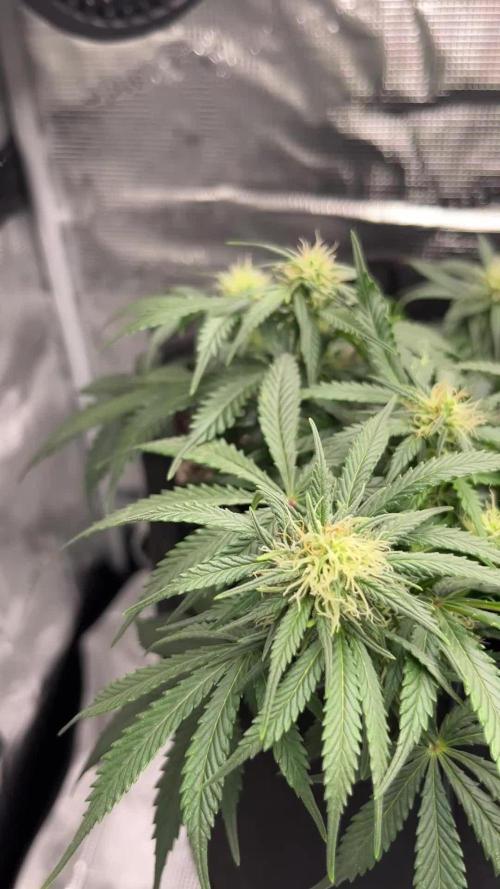
The Dwarf has definitely strong genetics. I recommend it for newbies that don’t have a lot of money to spend on growing kits. Yet, I wish I could have grown her under better lights (75W is CLEARLY not enough). I’m sure that the yield would have been a lot bigger with great lights. But it was a great grow : this dwarf convinced me to continue !
I’ve chosen seeds with bigger yield potential for the upcoming months (Blackberry and Gorilla Glue from Fast Buds).
Good luck and thanks a lot to this community.
Keep growing (and destroy capitalism) 🍁000



Likes
15
Share


@902EastCoast
Follow
This strain was easy to grow right from seed. I think it will be one of my favourite strains this grow. Time to dry and cure. I will report the weight when dry. 💚✌️🏼


Likes
9
Share


@Hoso_sake1
Follow
Ricordi di un bellissimo esemplare.
La ragazza è stata coltivata indoor ed è riuscita a riempire un growbox 4x4 da sola,con semplice e leggero LST.
Giù il cappello per questa buonissima qualità di Paradise Seeds!

Likes
9
Share


@Bread_n_Buds
Follow
After the first few days of germination, when it was time to fertilize our Fruit Punch Automatic plants started off strong.
In this diary you will find the plant worked with the first topping that led to the formation of our mainfold thanks to the cleaning of everything else and we will continue with the mainlining technique.
The other one you will find in the other diary left to grow free like a wild plant.
Comparison is the salt of experience.
We have started the Plagron fertilization program, we are in 100% organic configuration, the soil is recycled Promix + 1/3 fresh soil + 10% Perlite + RQS Mycorrhiza Mix (4 mixes, 1 under the small fiber pot).
We are administering // 1 ml/l of Power Roots - 2 ml/Alga Grow
I have doubts about the compatibility of Pure Zym with mycorrhizae. If in doubt, ask the experts, do not mix too much at random.
https://plagron.com/en
Doubts about Pure Zym / Mycorrhizae compatibility have been dispelled, they can go well together according to Plagron experts. If someone tells you that enzymes eat mycorrhizae, which in principle may seem possible, explain to them that it is not true.
https://www.royalqueenseeds.it/growing/452-easy-roots-mix-di-micorrhize.html
Try this strain, it's one of the best in recent years with a very high THC level
---- https://www.zamnesia.io/it/10965-zamnesia-seeds-fruit-punch-automatic.html
Brief description of Zamnesia // Sativa strains are very rewarding to grow, but their long flowering times and their greater susceptibility to disease and overfertilization can make them a little more difficult to manage. Also, their imposing heights are less suitable for indoor use and can attract unwanted attention if grown outdoors. However, with the arrival of Fruit Punch Automatic, growing sativa strains at home just got a whole lot easier. Combining Skunk #1, Haze and ruderalis, Fruit Punch Auto is 70% sativa dominant and produces up to 21% THC, along with a delicious blend of terpenes. Plus, it can be grown indoors, outdoors and in greenhouses. With their bright green hues, golden pistils and thick layer of resin, Fruit Punch Auto buds always have a great appeal. When you smoke her, you will be amazed by her flavours, aromas and effects! As the name suggests, Fruit Punch Automatic boasts delicious tropical aromas reminiscent of banana, pineapple, mango and citrus. When you open the jars you will feel like you are in a tropical cocktail bar on an exotic beach. Fruit Punch Auto will delight your palate with pungent fruity notes followed by light notes of Skunk and spice on the exhale. Within minutes of your first hit, this potent sativa will stimulate your mind, leaving you in an energetic and carefree state, ideal for morning or daytime sessions, as well as social settings or creative pursuits.
You can find the entire world of growing on Zamnesia and more, just take a look at the site and you will find "all the best that nature has to offer" in various shapes and colors.
The new strains are fantastic and the old ones are no exception...
p.s. no hermaphrodites yet, can you growers say the same?
---- // www.zamnesia.com

Likes
226
Share


@Natrona
Follow
Frostbanger Plants 1-6
Week 12 June 8-14 FLOWER 7
Sadly, my journey with Frostbanger is almost over. This grow started as an unnamed FBA2502 tester strain completely unknown regarding growth habits, size, flavor profile or smoke effect. I used LST on two plants: #1 because she was leaning over so I decided to pin her down immediately. I decided to LST Plant #3 when I saw her nodes were short and stems were tight. To quote Fastbuds “Growers must know that these difficult-to-grow plants will pose specific challenges in terms of environmental control and nutrition” , making them best suited for cultivators with some experience under their belt. I mention this because 2 plants #4 & #5 always looked lighter than their counterparts. Having overfed in the past grows, I did not want to repeat the same mistake, especially when the other plants were lush and green and did not look deficient. I thought it was genetics, but I found out that these two plants probably had nutrient lockout and would have benefitted from a good flush. Overall, I didn’t make mistakes with overfeeding or over trimming. I had to manually control the environment since the ventilation went out. I did pretty good at maintaining a functional environment.
Plants #2 & #5 developed pretty reds in their upper buds and leaves probably because of the air conditioner. The A/C brought the night temperatures to 65-68.
This week I am flushing with an anticipated harvest this weekend. I did the last plant pictures and videos and trichome shots on each plant. I did preliminary defoliation removing the remaining fan leaves. For most of the sugar leaves I trimmed off the ends leaving the base with all the frost. These are going into the trim bag to be washed into bubble hash. I plan on pressing #5 because she is the frostiest.
6/9 PH 6.46 PPM 239, temp 68 2 ltr each
6/10 PH 6.6, PPM 230, temp 68 2ltr each
6/12 PH 6.4, PPM 242, temp 68.5 2ltr
Thank you for sharing this journey with me and as aways, thanks for visiting, for the likes and most of all growers’ love and support.
Stay green, growers love 💚🌿my friends.
💫Natrona💫
Likes
18
Share


@eldruida_lamota
Follow
La primera semana de floración les sentó bien la echaron su sexo, hembras, ahora ya queda ir viendo cómo se forman las flores.
La temperatura no pasa a los 30 nunca.

Likes
34
Share


@SalocinSpecial
Follow
D61 (21/01/2021): First day for week 5 of flowering. It's incredible how the buds are forming and getting bigger. It easily doubled (if not more) in size in the last 7 days. Since beginning of bloom, I normally gave water every other days. I make sure the soil is dry and the pots feel light when I lift them before giving any water. But it's not ideal cause it means that the plant drank all the water at his disposal and maybe it missed some. I will try a different watering schedule by giving water every 36 hours instead of every 48 hours. I will still make sure the soil his not wet and the pot not heavy (soil full of water) when I will give water. At this stage, they need a lot of nutrients to produce big buds. I will give nutrients every other feeding and only Max Minerals the others. Today I gave 1/2 of the recommended dose of Max Minerals.
- temp: 24-26C light ON ; 21-22C light OFF
- water: PH6.3 , 329PPM , less then a gallon each
- run off: PH6.9 and 1090PPM for Glue Gelato ; PH6.9 and 940PPM for Banana Kush
- RH: 50% light ON ; 48-49% light OFF
D62 (22/01/2021): Nothing special for today. The lamps are now at 12 inches from higher colas.
- temp: 24-25C light ON ; 20-21C light OFF
- no water
- RH: 50-52% light ON ; 48-52% light OFF
D63 (23/01/2021): I gave full dose of Max Minerals and Max Bud and 1/2 of Max Grow. All base on mid late flower recommended dose. Relative humidity % was difficult to maintain low last night. It is normal since I give water more often. I removed leaves to help reduce humidity. Both look and smell sooooo good! 😋
- temp: 24-26C light ON ; 21-22C light OFF
- water: PH6 , 940PPM , less then a gallon each
- run off: PH6.7 and 1270PPM for Glue Gelato ; PH6.7 and 1100PPM for Banana Kush
- RH: 50% light ON ; 55% light OFF
D64 (24/01/2021): I gave half dose of Max Minerals.
- temp: 24-26C light ON ; 21-22C light OFF
- water: PH6.4 , 360PPM , less then a gallon each
- run off: PH6.9 and 950PPM for Glue Gelato ; PH6.9 and 1030PPM for Banana Kush
- RH: 50% light ON ; 45-47% light OFF
D65 (25/01/2021): I'm at day 65 and base on the website I bough the seeds, they are close to harvest. They say 65-75 day from seed. My girls are not ready. I guess maybe 2 more weeks. The trichomes are all cloudy for Glue Gelato and 90% cloudy 10% clear for Banana Kush. I think it is time to start flushing. I will only give tap water at proper PH for the next 10-14 days and keep looking at trichomes. I consider also reducing air temperature and humidity for the rest of the grow. We are getting close! 😍😎
- temp: 24-26C light ON ; 20-22C light OFF
- no water
- RH: 49% light ON ; 49-50% light OFF
D66 (26/01/2021): I decided not flushing today. I gave only full dose of Max Bud. Glue Gelato is getting very frosty! She has approximately 50% white pistils and 50% brown pistils but she keep growing new pistils. Banana Kush is less frosty but thicker and look a bit behind in maturity compared with Glue Gelato.
- temp: 24-25C light ON ; 21-22C light OFF
- water: PH6 , 440PPM , less then a gallon each
- run off: PH6.8 and 930PPM for Glue Gelato ; PH6.8 and 1220PPM for Banana Kush
- RH: 48% light ON ; 47-50% light OFF
D67 (27/01/2021): The electric breaker where all the equipment of my tent is plug tripped. It took me around 20 min to notice it. During that time the relative humidity % went up around 75%. I don't think it will cause anything bad but I wanted to document it. I started the flush today by giving tap water at proper PH. The tap water of my city is around 130-140 PPM. I always let it sit in a bucket for 24h.
- temp: 24-25C light ON ; 20-21C light OFF
- water: PH6, 135PPM, less then a gallon each
- run off: PH6.9 and 625PPM for Glue Gelato ; PH6.9 and 725PPM for Banana Kush
- RH: 48% light ON ; 52-55% light OFF


Likes
38
Share


@Crownlaura
Follow
8 weeks / 56 days today.
Growth has slowed down a lot this week luckily. Smell is getting really hard to contain now.
Sticky orange buds still nowhere near as big as purple skunk but definitely a bit fatter than last week. Purple skunk buds are getting a lot fatter. Both are really sticky to the touch, looking a bit frosty close up and can see plenty of trichomes.
Little bit of leaf burn but not a lot I can do because of the space issue so just tucking the branches and leaves as best I can and moving the lights around a bit to minimise it.
Watering between 1 and 1.5 litres every other day and they are soaking it all up. Increased to 3ml per litre of nutrients too.
Humidity has been a lot easier to keep under control this week and hasn’t risen above 60 all week so I am happy with that. it’s been a worry for a few weeks.
I had a real panic this week when I thought I saw seed sacks forming at the base of each branch. But after hours and hours of reading, I am pretty sure they’re calyxes.
No intentional defoliation this week but I’ve accidentally snapped a couple of fan leaves whilst watering. I really need a bigger tent!
Would love opinions on when you all think they might be ready for the chop. Comparing to other diaries I still think I’ve probably got another 6+ weeks but I’m daring to think about how/where I’m going to dry them out. I’m pretty sure purple skunk will be ready first so drying in the tent will be a no go.

Likes
25
Share

@Brujha77
Follow
Start 9 Blütewoche
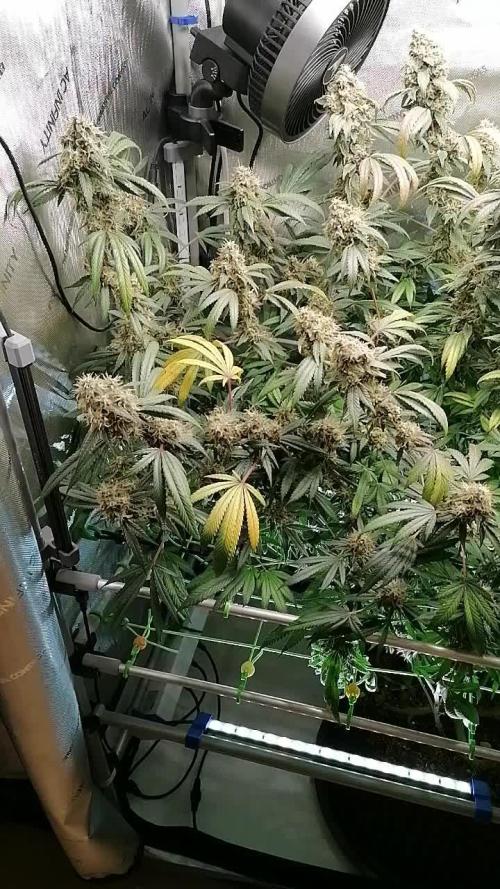
Langsam kommt etwas Farbe. Trichome werden langsam Trüb👍
Ich schätze mal in 2 Wochen sollte es Dan soweit sein.
Tag61
Heute gab es nochmal 5l Wasser.
Die gute müsste irgendwann nächste Woche so weit sein 🥀🥀👍
Langsam kommt ein deutliches Heidelbeeraroma

Likes
5
Share

@Stork
Follow
Day 84 Mon
PH 5.7
EC 0.6
DLI 12h
PPFD
Water 23
Day 86 Wed
PH 5.8
EC 0.6
DLI 12h
PPFD
Water 18c
Day 87 Fri
PH 6.1
EC 0.6
DLI 12h
PPFD
Water 19c
Day 88 Sat
Add Water and ph down
PH 6.2 - 5.7
EC 0.7 - 0.4
DLI 12h
PPFD
Water 20c

Likes
1
Share


@kauilmayel1996
Follow
So nice
Pero me faltó la maya
Looking good
No sé ni que crecí pero es bastante hermosa

Likes
12
Share


@Daviz_42
Follow
Como podemos ver ya todas están para el corte o casi, en algunas tendré que seleccionar el pheno, ya que hay alguna que me gusto más que la otra, en general un terpeno muy diferente en cada variedad y también la calidad de la resina, en general mucha resina, pero por ejemplo he podido observas que los tricomas de la Gorilla Melon son más grandes y se oxidan de una manera más lenta, ideal para hacer extracciones, en cambio, la Reinbow Melon .... ese terpeno dulce intenso tanto que es hasta abrumador...me muero de ganas ya de probarla... la Lemon Mandarín es exagerado el olor que tiene a mandarina si cierras los ojos y ueles fuere parece que te vayas a comer una buena mandarina y la Paya Sherbet tiene un olor dulce y muy agradable, pero nada que aún pueda relacionad del todo..... un saludo y buenos humos fam.
Likes
43
Share


@MrGrow
Follow
04.06.2023
🌱 136 giorni dal seme
🌼 64 giorni di fioritura
📈 ph 6.0
💦 2.5 litri/48h
Siamo arrivati al capolinea ragazzi✌️🏻
I tricomi stanno iniziando a diventare ambrati, ma sono ancora molto pochi.
Ho intenzione di aspettare ancora 4 5 giorni, fare un'annaffiata con acqua e ghiaccio per dargli l ultimo forte stress termico, e poi 48 h di buio prima di tagliare.
In questi ultimi giorni sto annaffiando solo con acqua, le foglie stanno rapidamente cambiando colore e appassendo leggermente. Credo che la pianta stia prendendo tt i nutrimenti da esse.
Prossimo aggiornamento con il raccolto✌️🏻
A presto ragazzi🙏💚

Likes
11
Share


@Jays_Not_Here_Man
Follow
Looking forward to this ❤️ This strain has been a favourite of mine for years. 34 street seeds have been consistent, and have great germination rates in my experiences.
I picked one seed, soaked in water with a splash of hydrogen peroxide for 6 hours and then planted directly into the starter pot. 36 hours later we had a sprout.
Lots of humidity, trying to keep it in the 70’s and the temp has been steady at 77 degrees as the lights are being kept on for 24 hours for the time being. Happy Gardening 🇨🇦👊❤️

Likes
1
Share


@Green_Peace
Follow
Transplanted to 5 gallon pots half way through the week and heavily watered/fed for the next 2 days, then topped for the first time yesterday.
The 3rd clone didn't make the cut and is now on my windowsill.
Next couple of weeks will be about keeping the plants trained and the same height.
2 timelapses this week. Enjoy!
Likes
16
Share


@the_medicine_grow_uk
Follow
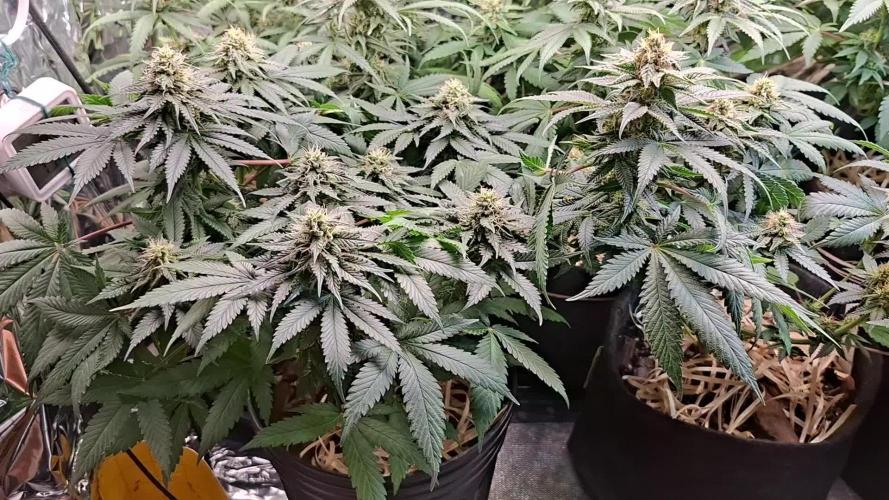
So she’s a week into flush with only about 10% amber trichomes so has a few more days yet. The bud size isn’t moving but the density of the buds has definitely increased.
Let me know what you think. 🙌🏼🙌🏼


Likes
2
Share


@Ultraviolet_
Follow
Wakíŋyaŋ, I am who I am, the salt of the earth.
Thunderbird is an allegory; his conflicts with other forces in nature are then an attempt to allegorize relationships observed in the natural order, such as the changing of the weather. He is essentially an attempt to represent the patterns of activity of a powerful, mysterious force in a way that can be understood simply and easily – sort of the way in which a weather map functions today.
Moving from18x60x60 = 64,800 seconds in 18 hours.
64800x860(ppfd) = 55,728,000 umol per daylight.
Into Flower
12x60x60 = 43,200 seconds in 12 hours.
43200x1145(ppfd) = 49,464,000 umol per daylight.
It's asking a lot of Rubisco regeneration to maintain 50 DLI in the 12 instead of 18. Raised the ambient CO2 to 1200 to 1500 ppm to achieve efficient gas exchange.
Not particularly recommended, but adding sugar to an indoor growing medium is a highly effective way to stimulate microbial activity, which rapidly breaks down the sugars and releases CO2 through cellular respiration. You can safely capture this CO2 to fertilize indoor crops and boost photosynthesis. While this process works, the setup requires precise understanding and management to avoid common indoor growing hazards.
The plant Carbon to Nitrogen C:N ratio defines the balance between structural carbon (sugars/cellulose) and nitrogen (proteins/enzymes). It acts as a master regulator of plant health, growth, and metabolism.
Rubisco (Ribulose-1,5-bisphosphate carboxylase/oxygenase) is the engine of photosynthesis responsible for fixing atmospheric CO2 into sugars. It is intimately tied to the C:N ratio for three primary reasons. It is the Plant’s Biggest Nitrogen Sink, Drives the Carbon Side, and it is the Nitrogen Control Knob. Understanding this relationship allows you to predict how plants respond to environmental stress or fertilizer.
Rubisco acts as the primary storage sink for leaf nitrogen, accounting for up to 30% to 50% of a C3 plant's soluble protein. Deep Green Leaves signal a rich abundance of both chlorophyll and Rubisco proteins. The plant possesses the heavy enzymatic machinery required to handle 1145 PPFD. Pale or yellowing leaves indicate a nitrogen deficiency. The plant is actively breaking down its own Rubisco to salvage nitrogen for newer growth, drastically reducing its light-tolerance threshold. Subtle difference, but understanding is important in order to be able to judge when to dial light intensity up and light intensity down, when to push, and when to back off. An extra dose of magnesium is vital if a plant is going to push through the growing pains of high-intensity lighting.
Foliar application of magnesium is an excellent and rapid way to assist with Rubisco regeneration within a plant, so long as it is applied correctly.
Spray strictly in the early morning or late evening, mixing your magnesium with a little fulvic acid or chelator, but only when she gets a little limey on top.
This, for me, is the experience of growing, akin to "riding the surf" maintaining efficient Rubisco regeneration through visual identification of the shade of green. Surf a razor-thin wave when balancing light intensity, nutrient availability, and transpiration to maximize Rubisco enzyme efficiency. Keeping the Calvin cycle fully charged without tipping into nutrient toxicity, light stress, or the dreaded chlorosis requires paying close attention to the visual cues the plant provides. By monitoring these subtle shifts in color, turgor pressure, and leaf posture, you adjust your environmental controls and surf that exact razor-thin wave.
Nute recycling acts as the vital execution mechanism for autophagy, which defines senescence. Natural senescence is a genetically programmed developmental stage aimed at nutrient recycling, whereas triggered autophagy is a rapid survival response activated by environmental stress. While both processes utilize the vacuole to break down cellular material, their triggers, selectivity, and overall goals are entirely different. Cannabis plant senescence is not separate from nutrient recycling protocols; rather, nutrient recycling is the primary physiological purpose of senescence, and autophagy serves as the core switch mechanism executing both processes.
Takes about 24 to 48 hours to notice visible changes once the signals have initiated the autophagic response. Not too late at all. A little bit of fade from senescence 2 weeks from harvest is normal and genetically expected. Send the C:N 32:1 signal 1 week from harvest for the best effect in your organic grow.
Understanding what makes leaves fade is not always senescence, but also strongly linked to Rubisco regeneration. That's a whole other subject. Vital to understand the differences if you want a correct diagnosis and to transition from hobby grower to master stoner, differentiating between a true genetic fade and a decline in photosynthetic proteins.
Nitrate is nitrate, whether it oxidizes or not is not up for debate. If it's not sunk by the plant you are smoking some if not all of, it's regardless of what your feelings are on the matter. Senescence is highly critical. It is the natural end-of-life stage where the plant redirects energy to ripen flowers. Properly managed, it breaks down harsh chlorophyll, allowing the terpenes (which provide taste and aroma) to peak. Harvesting outside this window leads to an "unripe" or degraded flavor comparable to going without.
To initiate the response you seek, you can trigger it multiple ways, when growing synthetically its triggered by nutrient starvation, generally when the entire medium is flushed. This is more to do with N starvation than being entirely empty. Nonetheless. PK boosters are N starvation through maximizing P and K. (Generally only works for synthetic grows)
Normally, a medium only holds 10-30% of its nitrogen as ammoniacal ta part boosts this to 50% as it triggers the "ripen" signal, but you don't want to keep ammoniacal above 30% for more than 7-10 days if you can help it. Its a trigger mechanism no more.
PK BOOST with 50% ammoniacal N signals floral maturation.
PK BOOST with N starvation signals nutrient recycling/sinking.
Because you are using organic nutes and you want to maintain the rhizosphere, what you want to do is add carbon in the form of sugars (powdered molasses). It's almost impossible to empty a medium enough when microorganisms are constantly releasing nutrients into the direct EC. Very difficult to initiate starvation responses with ammoniacal nitrogen. Manipulating the C:N ratio is the key to triggering an autophagic response and resulting nutrient recycling in the last days using organic nutes and without having to flush.
Generally not recommended for new growers. So do what you want. But if you don't trigger the plant to dump its nitrates into root zones, you will smoke nitrates as NO3- does not oxidize during the dry and cure no matter what you do or how long you dry or cure. Doesn't matter what anyone "feels" about it, how many grows they had with no fade.
"Clover steals valuable nutrients."
Crop and drop the clover come flipping to flower, its benefit comes from creating an airy and porous rootzone. I don't need to crop and drop once the plant fills the canopy, she blotches out the light, and the clovers die. This is the nitrogen the microorganisms use to convert carbon for respiration throughout the flowering stage.