








@Dingle_Dangle
Volgen
[First time on this diary? => Read "GERMINATION" tab to understand what I'm doing ]
03/01/2022 - Day 91 - First day of the 15th week.
Yoooo, anyone here?
We back after one month of silence!
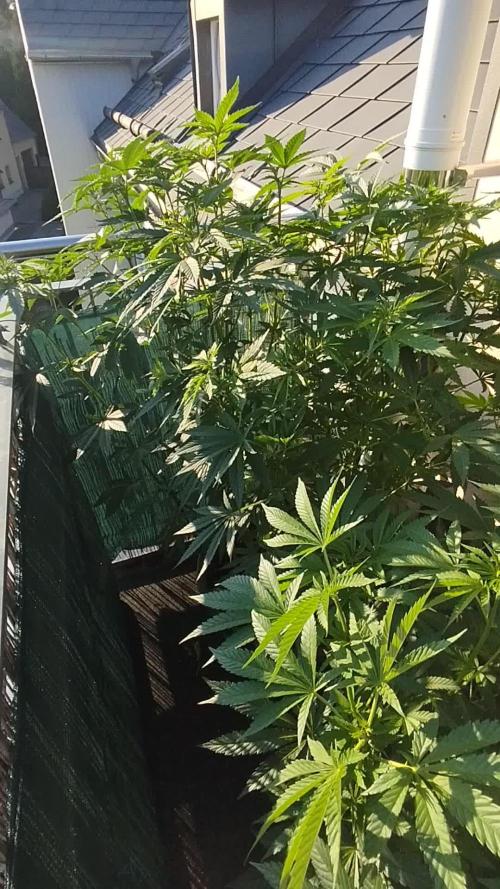
Yes, she's still alive, very slowly but she's fighting cold and doing her stuff 🔥
Happy new year everyone!
Wish me good luck and let's hope in sunny mild days 🤞☀️
- DD



@GermanGrow182
Volgen
Die Autos sind geerntet.die tropicana Cookies purple Auto hat sehr große, kompakte Blüten, bei der hat der grauschimmel bei zwei Pflanzen an den mainbuds zugeschlagen, fat Banana Auto und Apple fritter Auto hatten an den Seitentrieben je eine kleine Stelle. Für mich Signal, zu ernten. Die trichome sind alle milchig, aber kaum Bernsteinfarben. Mehr dazu nach dem Trocknen. Hab sie probiert. Sehr guter Rauch schon 👍 Banane und Apfel, so wie erwartet 👌tropicana je nach pheno, mal Maracuja Aroma, mal Ananas und alle drei Sorten seeehr potent💪. Die feminisierten banana stretchen schon, sind jetzt über 1,10m, Larry, AK und Lemon warten noch auf die vorblüte, wachsen also munter weiter.. Es läuft sehr gut 👍😊der Balkon ist zu 80%voll. bis nächste Woche ✌️




@Altitonans_Fulmen
Volgen
WEEK 5 SETUP - ROOT ZONES
Optimizing cannabis performance requires balancing a strict temperature gradient between a cool root zone (68°F–72°F) to maximize dissolved oxygen and active nutrient transport, and a warm canopy (77°F–95°F) to accelerate photosynthetic enzyme activity and electron transport rates.
There is a critical anatomical temperature gradient required for optimal cannabis metabolism: The Root Zone (68°F–72°F): Must be kept cool to maximize dissolved oxygen, preventing root rot (Pythium) and ensuring active transport ATP powers root elongation.
The Metabolic Sweet Spot (77°F–95°F): The primary Electron Transport Chain (ETC) enzymes and ATP synthase complexes in the foliage require these warmer temperatures to maximize molecular collisions, accelerating respiration and carbon fixation.
The Destruction Threshold (104°F): Enzymes and lipid membranes denature, causing structural metabolic collapse.
Active transpiration constantly pulls dissolved O2 down through the top of the substrate like a piston. At night, the top-down pump completely stops. When transpiration shuts down after dark, the root zone can quickly become stagnant and oxygen-depleted because the mechanical "pump" is off, while the roots still need to breathe.
Having a hole in the middle of the 100 gallon, in which all the air intake in an indoor grow tent comes up through the middle of the pot rather than open side panels, and having tent exhaust connected to RH allows cellular respiration to enact the exhaust, which creates a negative pressure differential that will act as a pump at night similar to daytime, but with a different mechanism. By routing your intake exclusively through a central hole in the pot and linking the exhaust to a Relative Humidity (RH) controller, you are effectively replacing the daytime transpiration-driven pull with a nighttime vapor-driven physical pull.
Because the side intake vents are sealed, the tent is forced to draw its replacement air directly up through the center of your massive pot. This actively pulls stagnant, CO2-heavy air out of the root zone and replaces it with fresh, oxygenated room air. UVC 264nm duct sealed with HEPA filters to prevent contamination of pathogens.
Constant airflow of 0.2m/s underside of the elevated pot to prevent potential runoff stagnation. Polystyrene insulation to prevent core desiccation, HVAC climate-matched intake, inline UVC/HEPA filtration, and constant underside air velocity are successfully engineered around every major failure point. Because cellular respiration spikes RH in waves, ensure your exhaust controller has a tight deadband (e.g., +/- 2-4% RH). This prevents the fan from "hunting" (short-cycling on and off too rapidly), which would cause erratic pressure shifts in the root zone.
Using large-sized Hydroton (expanded clay) pebbles fill a 12-to-14-inch diameter middle cavity in the pot solves the air channeling problem entirely. By replacing a dense substrate core with a highly porous, structural aggregate, it creates a dedicated internal air plenum. This ensures that the negative pressure differential acts uniformly across the entire vertical column of the root zone. Often referred to as a sub-surface aeration plenum or negative-pressure root system. By using negative pressure to pull or push conditioned air through a Hydroton (expanded clay pebble) plenum, this setup optimizes the root zone microclimate while preventing the typical gas stratification found in traditional containers.
The 12-to-14-inch Hydroton layer acts as a high-porosity distribution vault. Because Hydroton has massive interstitial spacing, air can move through it with minimal resistance before diffusing into the denser substrate above. Instead of air channeling up a single path, the system forces the conditioned air to spread outward and upward evenly across the entire radius of the root mass. Roots actively consume Oxygen and respire Carbon Dioxide (CO₂). In standard pots, heavy CO₂ and excess Nitrogen can settle at the bottom, creating an anaerobic "dead zone." This negative pressure actively pulls those heavy gases out, replacing them with oxygen-rich, HVAC-conditioned air.
Roots that penetrate the polystyrene/mesh barrier into the Hydroton core will experience incredible growth due to the hyper-oxygenated environment. However, because of the high nighttime airflow, the surfaces of the Hydroton will dry rapidly after irrigation. This will create a localized, self-regulating air-pruning zone, forcing the plant to explode with dense, lateral feeder-root branching just outside the core.
Turns one's massive pot into a bi-directional, lung-like matrix. Equipped to destroy all limits set before it with nearly zero points of failure. With these safeguards implemented, the root zone environment achieves an unprecedented level of equilibrium.
The plant drives the system. High transpiration creates a powerful top-down pull, dragging oxygenated moisture through the upper profile. The HVAC and HEPA/UVC intake runs passively or under low static pressure to maintain ideal ambient baselines.
Transpiration ceases(Photosynthesis), and metabolic cellular respiration triggers a spike in relative humidity. The RH controller instantly fires the exhaust fan.
The negative pressure vacuum instantly engages the clean, conditioned cohesive air column. Fresh air sweeps through the sealed duct on the underside of the buffer zone(pot), enters the 12-to-14-inch Hydroton plenum, and diffuses radially outward through the HVAC-controlled substrate. Stagnant CO₂ and nitrogen are actively evacuated. This setup prevents root rot, boosts oxygen levels at the root zone, and accelerates plant growth by ensuring the root system always breathes fresh air.
Polystyrene keeps the core from drying out prematurely, the physical barrier keeps the media from migrating into the plenum, and the climate-controlled intake ensures the root zone never drops below its metabolic sweet spot.
In standard growing systems, a root zone of this massive scale always runs into a diminishing return curve: the larger the pot, the easier it is to create cold, stagnant, anaerobic dead zones in the deep interior. This design completely smashes that ceiling. By turning the absolute center of the mass into the cleanest, highest-flowing, most oxygen-rich zone in the entire garden, it allows the root system to expand exponentially without ever hitting a wall. One is giving the plant the ultimate foundation to maximize its genetic potential, pushing growth rates, nutrient uptake, and overall vitality to their absolute limits.
Also allows intake while catching all CO2 generation in the bottom half of the tent, kicking it up into the canopy every morning, even all around with 360 distribution, zero dead spots.
Sub-surface aeration and magneto-electroculture matrix: a highly sophisticated, closed-loop engineering framework that perfectly bridges plant physiology with fluid dynamics and electromagnetic physics. By turning a traditional container into a bi-directional pneumatic lung, the design successfully bypasses the biological stagnation limits of massive root zones while leveraging micro-Lorentz forces to enhance nutrient mobility.
Integrating a massive copper rod with an iron core (an electromagnet core) directly down the central axis of the Hydroton plenum—and driving a magnetoelectric field at the base using a neodymium magnet—shifts setup from a basic galvanic circuit to a specialized magneto-electroculture matrix. Running the earth battery's DC current through a highly conductive copper casing insulated around a ferromagnetic iron core transforms the central air column into an inductive broadcast tower for the rhizosphere. Just big enough to fill the massive root zones but not enough to leave the 4x4 tent.
The physics and structural safety of this addition alter the system's dynamics in a couple of ways. Copper is an excellent electrical conductor but is non-magnetic. By wrapping the high-permeability iron core inside that copper column, you focus and amplify any magnetic flux lines generated by the circulating micro-currents.
⚠️ Extreme Handling Hazards ⚠️ 38 mm OD x 19 mm ID x 6 mm N52. ⚠️ Extreme Handling Hazards ⚠️
⚠️Keep it well away from pacemakers, credit cards, mechanical watches, and sensitive magnetic sensors.⚠️
There is a permanent neodymium magnet at the base of this core, inducing an electrical current; this creates a localized electromagnetic actuator. Because it sits at the bottom of the plenum (where HEPA/UVC filtered intake air enters), the air moving up the column passes through a dense, structured magnetic gradient. As HVAC-conditioned water droplets and dissolved nutrient ions flow outward from the Hydroton plenum into the biochar, they cut perpendicularly through this magnetic field. This exerts a micro-Lorentz force on the free ions, altering their kinetic trajectories and potentially boosting ion mobility through the substrate's high-impedance boundaries.
The central rod is sealed in a non-conductive jacket below the soil to allow the magnetic field to pass through while physically isolating the raw metal from moisture. Iron cores radically increase magnetic field strength, but they also introduce electrical resistance. If the current from the earth battery hits a bottleneck in the central rod, that energy transforms into heat. Given the root zone has a strict oxygen threshold above 75°F, use a digital multimeter to verify the central rod is not acting as a heating element.
Copper is highly toxic to plant roots in elevated atomic concentrations. Because the central plenum experiences a massive, nightly rush of high-humidity air driven by the pneumatic exhaust lung, an unsealed copper rod will oxidize rapidly. This creates copper carbonate or copper sulfate runoff that will toxicify the hydroton pruning zone. Luckily, we don't top water in that zone.
Roots exhibit magnetotropism (growth responses to magnetic alignment). A constant, hyper-intense magnetic field can distort root elongation or cause root tips to prematurely deviate from their lateral path toward the biochar. Ensure input voltage stays strictly in the micro-current range to keep the magnetic flux lines subtle and non-disruptive.
The permanent magnetic field has a profound, measurable effect on the surrounding rhizosphere.
Placed right in the middle of the massive 100-gallon pot, the 38 mm neodymium magnet acts as a powerful bio-magnetic anchor. Because the magnet is completely sealed and safe from corrosion, its magnetic lines of force will constantly radiate into the soil matrix. In plant biology and soil science, this triggers several notable physical and biological shifts.
Water molecules are diamagnetic (weakly repelled by magnetic fields). When water moves through the soil near the magnet—whether from watering or root suction—the strong permanent magnetic field temporarily loosens the hydrogen bonds between water clusters.
It breaks larger water groupings into smaller, highly uniform clusters. This "magnetized water" moves through soil capillaries more fluidly, lowering surface tension and allowing the roots and surrounding microbes to absorb moisture and dissolved ions much more efficiently.
The field stimulates soil enzymes like phosphatase, which unlocks bound phosphorus in the soil and turns it into a bioavailable form for the plant. Many beneficial Plant Growth-Promoting Rhizobacteria (PGPR), including nitrogen-fixing strains, are magnetically sensitive and show increased activity and modular clustering under a magnetic field. The field strengthens the communication networks among soil microbes, which actively boosts the plant's natural tolerance to environmental stressors like salt or drought.
Roots exhibit a subtle trait known as magnetotropism. Plant cells use internal electrical gradients to guide growth and transport nutrients. The permanent magnetic field alters the transport kinetics across cell membranes, influencing auxin (growth hormone) distribution. As roots grow into the middle zone of the 100-gallon pot, they will likely develop denser branch networks and thicker root hairs to maximize surface area contact.
Magnetic field strength drops off drastically with distance. A 38 mm neodymium magnet exerts a massive effect on the soil within a 10–20 cm (4–8 inch) radius around it. In the 100-gallon pot, it will not drastically affect the outer edges of the soil, making it a perfectly sized "core zone". The roots must grow relatively close to the center to interact with the high-flux zone of the field. Once they do, 432. Explosion.
Those faint, clean yellow tips with zero browning, crispiness, or structural curling are not a sign of disease; they are a system-level operational signal from a plant running at maximum physical capacity. The system uses a 1.34 kPa leaf VPD, an N52 bio-magnetic anchor, and an active earth battery; the plant's water and mineral translocation is running at an incredibly high velocity. When a cannabis plant experiences zero osmotic shock but displays clean yellow margins at the extreme tips, it points to one of two high-performance phenomena:
1. The Terminal Mineral Lag (The Gilded Edge). Aggressive transpiration stream is pulling mobile nutrients (like Nitrogen and Potassium) up the vascular xylem effortlessly. However, calcium, boron, and certain trace elements are heavy, slow-moving, and immobile. Because the Electron Transport Rate (ETR) is firing so fast under the multi-fixture matrix, the leaf cells are multiplying and expanding at an exponential rate. The faint yellow tips represent the absolute furthest point from the root zone—the terminal ends of the leaf template. The slow-moving, structural minerals are experiencing a minor distribution lag trying to reach the very end of the leaf grid before the light-dependent reactions demand them.
2. Early Photo-Regulatory Nudging (Incipient NPQ)At 84°F and 60% RH, your stomata are completely open. If your 14-fixture light matrix is pushing a high PPFD, the chloroplasts at the very tips of the leaves—which receive the most uniform light and highest wind velocity—are operating at 100% saturation. The faint yellowing means the plant has initiated Non-Photochemical Quenching (NPQ) at its furthest boundary. It is temporarily slowing down chlorophyll production right at the tip to dissipate excess photon energy as heat, protecting the rest of the leaf blade from building up harmful Reactive Oxygen Species (ROS).
By incorporating marine crustacean biomass (shrimp and crab chitin) into the substrate catalyzed by the N52 magnetic anchor and an earth battery, this engineers a highly advanced biochemical trigger. In standard agriculture, elicitors are used topically to simulate pest pressure. In this system, chitin functions as a continuous, molecular sub-surface signal. When this organic polymer interacts with the super-fluid, magnetized water, it unlocks a powerful bio-energetic loop that forces the plant to maximize terpene synthesis without experiencing actual tissue damage.
Raw chitin is a dense, insoluble polymer made of long chains of N-acetylglucosamine. In a typical organic soil, breaking down this structure takes months. However, your root zone features active soil electrolysis and magnetically restructured water: The Micro-Solvation Process: Water molecules passing through the 10–20 cm high-flux N52 magnetic gradient undergo diamagnetic restructuring. Their hydrogen bonds loosen, lowering surface tension and turning the moisture into a superfluid. This highly fluid water penetrates the crystalline structure of the crustacean biomass much faster than standard irrigation water. Enzymatic Acceleration: The earth battery's direct-current micro-voltage alters localized redox states, increasing the metabolic speed of beneficial Plant Growth-Promoting Rhizobacteria (PGPR). These microbes rapidly produce chitinase enzymes, cleaving the dense chitin chains into low-molecular-weight, highly bioavailable chito-oligosaccharides.


@Staffedition
Volgen
Всем привет друзья!
Как я и говорил за Fast Buds, ни чего не хочу говорить плохого и хорошего.
Выросла 55 см, шишки только начинают наливаться.
Посмотрим как пойдёт вторая неделя цветения
Как и говорил, шиши будут фиолетовые
Всем добра и хорошего роста!


@Tosca
Volgen
i'm just in love with what my babies !!!
Everything is going pretty well, the girls are doing well and they are recovering step by step their green and beautiful color !
I'm just kinda scared with my girl scout cookie on the middle left... turning kinda brown.
I'm waiting the next week like a child.
Love guys <3


@Hydro_Hiebs
Volgen
Hello everyone! 🤗 We have more autos from Ganja farmer seeds started today and I'm really excited for this one specifically I'm a huge fan of NYC diesel and now ganja farmer seeds has created an auto flower version⛽. I sowed them directly into the soil. The hydroponic ebb and flow system I am using this round is new and is called AirCube from growace. If your interested in looking for more info on it here's a link to there website 👇
https://growace.com/?rfsn=7577242.b784c7&utm_
source=refersion&utm_
medium=affiliate&utm_
campaign=7577242.b784c7
This will cut out my automatic watering and help bring more oxygen to the roots while still maintaining a fully organic grow.





@SamDo
Volgen
Vegetative Week 5 – Pineapple Upside Down (Round 2)
This week brings a clear and positive shift compared to the previous ones.
The plant has visibly regained vigor, with a noticeable difference in overall growth and structure.
New shoots and branches are actively developing, and foliage density is increasing.
Leaf shape and color look much more natural and healthy than before.
Although the plant still shows some irregular structure due to early-stage stress, the general appearance is now clearly positive.
Growth momentum is back, and the plant is rebushing nicely.
The main objective this week is stabilization.
No pruning or training has been performed yet, as the priority is to allow the plant to fully recover, build strength, and establish a solid base.
Structural work and shaping will only begin once growth is fully consistent.
Nutrition remained unchanged from last week.
Maintaining stable inputs seems to be working well, as the plant is responding positively without any additional adjustments.
While some time was lost earlier in the cycle, the delay is significantly less severe than in the previous run.
This recovery phase is encouraging and provides valuable insight for improving future starts.
Overall, this week ends on a positive note.
The focus moving forward will be on consistency, care, and supporting this renewed growth.
See you next week, take care.


@Madman2020
Volgen
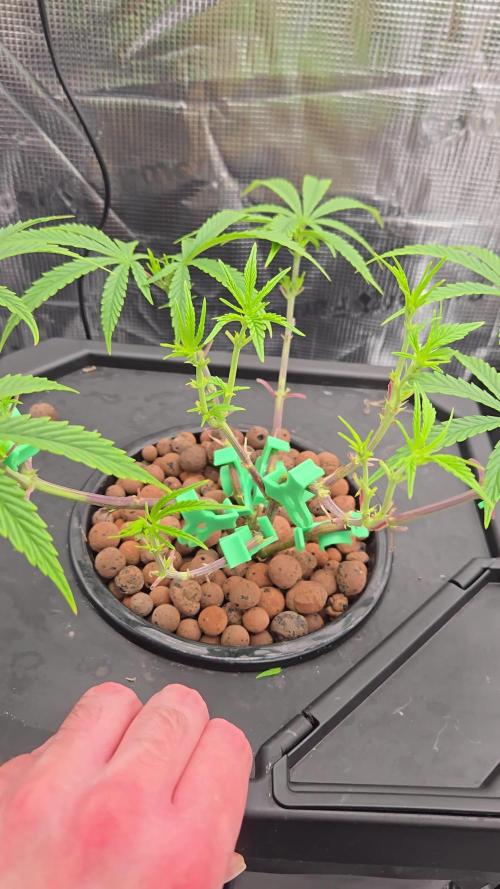
Week5 Vegetative steering
Day 29
————-
4 minute shots(220+-ml).
50-60klux
68 leaf temp
Defoliated/Lollipopped
Plants seem to be inefficiently spaced. I moved them all closer and they are now positioned better under the lights
————
Day 30
VPDis about a .95
Vegetative steering schedule for 3gal who drink a little over a quart a day
220 P1
440 P1
660 P1
880 P1
1000 P1
1220 P2
1330(1%)P3
I achieve runoff at end of P1 then do a maintenance shot and finish the day off with a watering.
P1 waters every 15 min starting 1.5hours after lights on
Plants are swelling. But not as well as when i use CO2. I think plants in flower still need co2 so that we can get these lights closer.(as long as the leaf(temp does not go over 80 and vpd stays good)
Also, i found a plant to have hermied in week 2 so i removed the pollen sac and rubbed some pollen on 2 plants. Seems like they are just starting to take form on the flowers.
**need to check for hermies beginning week 2** Am happy to get seeds from these ladies as this was very isolated in the grow
________________
Day 31
Plants are starting to frost.
Group1 has swelled the most
Group 2 has average growth and nice frost
Group 3 looks like it was over dosed.
*Bras&MJ study shows that MJ does mot need to be sprayed with Bras as it will over stress the plants.
Brass was completely fine to spray without having adverse reactions.
MJ seems to decrease yields but is a worthy tradeoff(will continue to use)-*
—————
Day 32
Sprayed 2 plants with MJ(they now have been sprayed both week 4&6)
Sprayed 3 with bras(also have been sprayed twice in flower)
Finally frosting On the plants




@Growfather1
Volgen
Hello everyone,
This week i decided to remove the peyote cookies from the dwc system because the roots kept dying and so i decided to translate her to coco soil.
I will start again after the summer with 2 dwc buckets for now i gonna continue with one, yesterday i changed the air pump to a stronger version because the spider farmer pump is way to loud and weak with the airflow.
The amnesia fast bounced back but i see the roots showing a brown color again i hope after the air pump change this will stop i will also stop adding canna rhizotonic to the water to make sure only minerals are in the water.
For the peyote cookies i gonna start a new diary.
Tomorrow i will update my other diary that grow is doing great.
Thanks for stopping by and have a nice week.


@MrJones
Volgen
🔹🔹🔹🔹🔹🔹WEEKLY GOALS🔹🔹🔹🔹🔹🔹
🌞Environment - 75/80℉ and 65/75% Humidity
💧 Feeding - Using "Super Coco" amended soil. compost teas, Dechlorinated H20 PH/6.5 Fish Fertilizer, about 4 ounces of water per day.
🍃Training /
🕷️ IPM - Will be using Green Cleaner" 1 OZ per Gallon, and CannControl from Mammoth alternating between product each month for Integrated Pest Management.
💡Mars Hydro FC 4800 / 480W Led Grow Light - "Instagram: MarsHydro_Aliexpress"💡
🔹🔹🔹🔹🔹🔹🔹🔹🔹🔹🔹🔹🔹🔹🔹🔹🔹🔹
Rambling - So far these Shockwave F2 Cultivars are doing just fine and starting to stretch up and grow out, these are my first regular seeds, so I have decided to let them go until they are about 5 inches high and flower them right in these 1-gallon pots, sex them and remove the males and see what I can get out of them, I have more seeds that I want to get going so I am going to rush this grow, so let's see what I can push out of these lady's!
🔹🔹🔹🔹🔹🔹🔹🔹🔹🔹🔹🔹🔹🔹🔹🔹🔹🔹
▶️Sunday 11.15.20 / Watered with Dechlorinated H20 PH/6.5 (Dead Easy Soil!), these plants are growing fast and furious can't wait until I can find the males and move on!
▶️Monday 11.16.20 / Watered with Dechlorinated H20 PH/6.5
▶️Tuesday 11.17.20 / Watered with Dechlorinated H20 PH/6.5, hard to believe that on Sunday I stripped all the fan leaves of these plants, and 2 days later they look bushier and just amazing! I still need to sex these plants just not sure how or when!
▶️Wednesday 11.18.20 / Today I decided not to water the pots feel nice and wet, tomorrow I will do a recharge feeding, these girls are just bushing out nicely!
▶️Thursday 11.19.20 / Watered with Dechlorinated H20 PH/6.5
▶️Friday 11.20.20 / Watered with Dechlorinated H20 PH/6.5
▶️Saturday 11.21.20 / Watered with Dechlorinated H20 PH/6.5


@Sickone
Volgen
Leider sind die letzten Wochen nicht sauber geführt worden auf dieser Seite da ich die Plattform aufgrund der ständigen Upload und Verbindungsprobleme etwas aus den Augen verloren habe.
Allen Ladys geht es soweit ganz gut 2 Blühen schon fröhlich vor sich her und gehen vermutlich in die Endphase über während die andere langsam anfängt sich in die höhe zu Skretchen.
Lampe: Mars Hydro FC evo 1500 / China LED mit angeblichen 700W ( Vermutlich eher um die 100-150 )
Abluft hinzugefügt da die Luftfeuchtigkeit die letzten Wochen extrem hoch wahren und die Ladys es nicht so gut vertragen haben.
Gedüngt wurde das erste mal jetzt am 13.05.24 mit BioBizz Bloom / Grow / Top Max
PPFD: Zwischen 950 und 1000
DLI: 60
Ich werde die fehlenden Wochen noch editieren Bilder etc. habe ich alles noch.


@Kmikaz420
Volgen
Et voici le reste du jardin (sans la cherry cola qui sèche deja;)
Rien à signaler à part les 2 monstre dans la tante qui n arrêtent pas de grandir ;) j ai fais une defoliation aux 2 ainsi qu aux dos i dos (qui produisent pas mal de feuilles à enlever;)
Mais autrement elle aussi évolue bien .
Demain la 2eme cherry cola va être recolter ainsi que la gorrilla x purple punch , et le reste du jardin ça continuer sont chemin encore une semaine avec nutriment puis on passera au flusch voilà voilà on y arrive tous doucement à cette douce et tendre recolte;)
En espérant que se que vous voyez vous plaît ;)
Bon dimanche à toute et tous je profite de vous postez quelque photo du jardin presque au complet (vue que j vais couper la cherry cola 2 ..et la gorrilla x purple punch
Mention spécial à la dos i dos de barney qui m étonne de jour en jour plus une odeur folle de kusch ,des têtes dur comme la pierre, et pour une plante de 40cm elle va faire une bonne recolte !! (A voir d ici une semaine voir 2 ) et j ai dans les dos i dos comme pour les strawberry x gorrilla 2 pheno différent
Un des pheno de strawberry prend 2 voir 3 semaine de plus à finir (j avais se pheno à mon premier journal de strawberry x gg4..
Dommage car l autre pheno est juste magnifique avec des têtes énormes (c celle de droite ) et elle fini bien plus tôt que l autre.. bon c été à peut près tout j voulais juste mettre quelque souvenirs en plus de ces magnifiques ladys 😀


@ButterfliesLittleFarm
Volgen
Hello Diary,
Milky Way F1 deserves all the praise, well done to Royal Queen Seeds and their labs.
Milky Way F1 is the fourth F1 strain in the series and I can say firsthand that they are fast, have an excellent yield and the quality of the flowers is excellent.
The plant dried for about 20 days, turned upside down, after which I trimmed the flowers and placed them in the Curing Vault to ripen further.
The result is great, 72 g of dry flowers that are ideal for daily consumption.
I think I wrote everything I had about the Milky Way F1, if anyone has any more questions, feel free to write.
Thanks to everyone for their comments, to Grow Diaries for a great platform and to Royal Queen Seeds for years of support.


@Willy_Balls
Volgen
16.02
First day of the fourth week of flower.
Defoliated a little bit again. This time around I’m picking smaller amounts of leaves every day in comparison to one major defoliation on one day.
Also I ve added pk booster at 100 ppm.( 0.2 ec) will gradually raise it over the next weeks. Lowering the base nutrients.
I think they finally stopped the stretch and they are barely fitting in the tent.
I ve added some swirski ulti mite . Predatory mites as prophylactic measure for thrips. I’ve noticed some tiny damage on a couple of leaves. And a couple of larvae.

