


Likes
Comments
Share


@DeepRootsGrowTrees
Follow
SATIVA DREAM by KANNABIA
WEEK #13 Overall
Week #12 Flower
This week no issues to report she's doing good she's stayed growing even with the heat. Stay Growing!!!
Kannabia.com. SATIVA DREAM

Likes
66
Share


@mulch
Follow
8/14/17 Sorry for lack of updates. Been feeding the new flowering schedule. It will modify slightly every week, most likely.
FloraMicro 4ml gal
FloraGrow 1.25ml gal
FloraBloom 8ml gal
SM-90 2.5ml gal
Cannazym 2.5ml Gal
Ful-Potential 2.5ml gal
Liquid Koolbloom 2ml gal
Floralicious Plus 1ml gal
ArmorSI 1.5ml gal
Florablend 2.5ml gal
CaliMagic 3.75ml gal (1 plant started showing def again)
FloraNectar 2.5ml gal
Drip Clean 0.4ml gal
A few things were added, the Photosynthesis Plus and roots excelerator have been removed, Florablend is out next week.
It sure is crowded in that tent. Humidity is now being lowered to 45% during lights out as it was spiking during that time. Dehumidifier is on it's own timer and runs during lights out taking a liter or so water out a night. With the canopy that thick for a couple feet vertically and all the way horizontally, i do not want to take any chances with either stagnant or damp air now that most of the girls are actively flowering.
They missed a transition week, but they were suffering deficiencies so I had to quickly get them on flowering nutes. All seems good so far except for the very crowded workspace when I do anything in there.
I think I am going to drop grow. I REALLY didn't expect them to pass 3 feet but the danger is real. I have just over a foot of space to move my light up, so now seems like a good time to drop FloraGrow


Likes
10
Share

@Limez
Follow
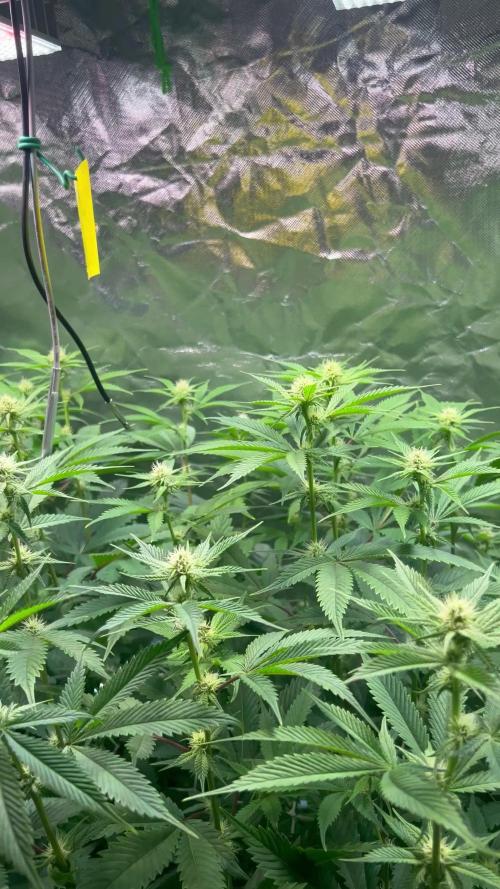
Gude, wir schreiben BT17 und der Stretch ist in vollem gange und die Blütenbildung beginnt schon. Ich sehe aber kein wirkliches Höhenwachstum mehr, ich denke das war es soweit.
Die 3 bekommen alle 2 Tage je 3.5L calmag korrigiertes Leitungswasser (105mg cal/ 50mg Mg).
Licht knallt in den Spitzen mit knapp 800PPFD drauf und ganz unten sind es ca 600PPFD. Die Seitenbeleuchtung läuft auf der maximalen Stufe, was insgesamt nochmal 40W extra sind.
Am Sonntag ist BT21, da wird entlaubt. Denke dadurch kommt das Licht von der Seite super an die unteren Buds und es wird richtig ordentlich.
Grüße

Likes
4
Share


@Littledaan
Follow
Now with more water haha
Follow me on: https://supergreenlab.com/public/plant?id=718890da-822b-4656-b0bd-cc186a2bdd8f



Processing
Likes
13
Share


@Ferenc
Follow
It was easy to harvest she was very small jut cut it quickly without stalks the wet weight is 17 g of the buds, nicely coated with THC and it was approx 70% milky and 40% amber trichomes. Hopefully good time to be harvested. This site has changed can not update and edit the comment section. The smoke is nice it is kind of relax and strong high. Not the best but not bad at all. I like it.

Likes
4
Share

@DogDoctorOfficial
Follow
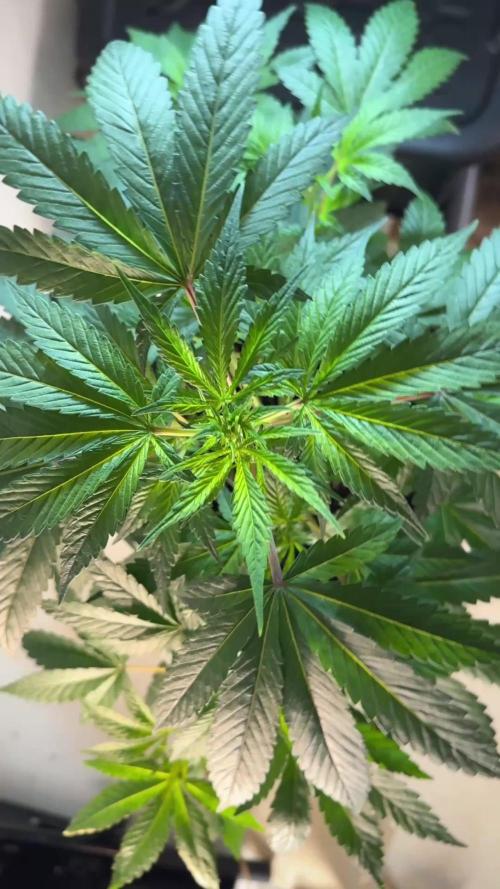
✨ Fairytale Leaves & Phenotype Magic
Welcome to flowering, where potential meets reality.
Both Gelonade phenos are stepping into this new phase with vigor, balance, and beauty — but one of them is telling a very special story.
🍃 Pheno #2: The Leaf Dancer
This pheno has leaves that defy convention — opening in a structure that resembles a human hand folding out from the palm, each finger unfurling in elegant rhythm.
Imagine:
• Three central “fingers”
• Each outer one splitting into three more
• Forming a seven-pointed star, nested within a trinity of growth
It’s not a mutation that hinders — it’s a genetic flourish.
A dance of symmetry, expression, and vitality. 🌿
These aren’t just leaves. They’re art.
🖼️ We’ve captured this in photos and video — no filter needed. Just nature doing its finest work.
Plant Stats – Week 1 Flower / Week 5 from Seed:
• Height: approximately 40 cm
• Light Intensity (PPFD): 766 µmol/m²/s
• Temperature: 31°C
• Humidity: 50%
• VPD: 2.23 kPa
• EC: 0.6
• pH: 6.1
Despite slightly high temps and VPD, the girls are loving it. They’re adapting, stretching slightly, and showing excellent turgor and coloration.
⸻
💧 Nutrition & Soil Strategy
This run is driven by a super soil base, and it’s doing the heavy lifting. That’s why we’re keeping the water feed light and strategic.
💦 Current Feed (per liter):
• Aptus Regulator – 0.15 ml
→ Strengthens cell walls, improves nutrient flow
• Aptus CalMag Boost – 0.25 ml
→ Supports structure and photosynthesis
• Aptus Top Booster – 0.25 ml (new this week)
→ Prepares for flower, encourages early bloom structure
⚠️ No All-In-One Liquid now
→ The slow-release pellets in the soil cover the macro-nutrient demands.
→ This keeps EC low (~0.6) and prevents salt buildup.
We’re letting the soil biome + amendments guide the bulk of nutrition. Water is a carrier, not a crutch.
⸻
Why Switch from Start Booster to Top Booster?
Start Booster = roots & early leaf
Top Booster = flower signal + potassium focus
This switch marks the turning point:
Roots are now established, and it’s time to nudge the girls toward blooming, gently and with precision.
Top Booster also enhances:
• Early bud site formation
• Transition metabolism
• Potassium availability for cell expansion
⸻
Gear Check
Everything is tuned in and working in harmony:
• Lights: Future of Grow LED + ThinkGrow Model One
• Controllers: TrolMaster Tent-X + Spider Farmer GGS
• Airflow:
• Two 6” carbon-filtered exhaust fans
• One 6” filtered intake
• Controlled by both ecosystems
All this tech = manual precision + automated consistency
⸻
🔮 What to Expect Next
We’re not seeing pistils yet, but the structure is shifting.
Nodes are spacing. Branches are reaching. Energy is focusing upward.
Here’s what we might expect in Week 2 Flower:
• First signs of pistils
• Shift in leaf texture
• Possible terpene expression (early scent)
• Stretch phase (up to 2x height)
⸻
The Fairytale of Pheno #2
Sometimes, a single plant will speak louder than others.
Pheno #2 is doing just that, not with speed or size, but with shape, rhythm, and elegance.
The leaves whisper a story:
Of lineage, light, and mystery.
Of something old reborn in a new form.
Of a garden that listens, and a grower who sees.
⸻
💚 Final Thoughts
This isn’t just a grow.
It’s a living exploration of genetics, care, and love.
As the Gelonades move toward flower, we’re watching not just for yield, but for expression. For surprises. For beauty in all forms.
Week 1 of flower is quiet, but underneath, everything is shifting.
Let’s walk slowly. Observe closely. Love fully.
And let’s see what Week 2 has to say 🌸
With love and green respect,
DD (Dogdoctor) & The Gelonade Girls
📲 Don’t forget to Subscribe and follow me on Instagram and YouTube @DogDoctorOfficial for exclusive content, real-time updates, and behind-the-scenes magic. We’ve got so much more coming, including transplanting and all the amazing techniques that go along with it. You won’t want to miss it.
• GrowDiaries Journal: https://growdiaries.com/grower/dogdoctorofficial
• Instagram: https://www.instagram.com/dogdoctorofficial/
• YouTube: https://www.youtube.com/@dogdoctorofficial
⸻
Explore the Gear that Powers My Grow
If you’re curious about the tech I’m using, check out these links:
• Genetics, gear, nutrients, and more – Zamnesia: https://www.zamnesia.com/
• Environmental control & automation – TrolMaster: https://www.trolmaster.eu/
• Advanced LED lighting – Future of Grow: https://www.futureofgrow.com/
• Root and growth nutrition – Aptus Holland: https://aptus-holland.com/
• Nutrient systems & boosters – Plagron: https://plagron.com/en/
• Soil & substrate excellence – PRO-MIX BX: https://www.pthorticulture.com/en-us/products/pro-mix-bx-mycorrhizae
• Curing and storage – Grove Bags: https://grovebags.com/
⸻
We’ve got much more coming as we move through the grow cycles. Trust me, you won’t want to miss the next steps, let’s push the boundaries of indoor horticulture together!
As always, this is shared for educational purposes, aiming to spread understanding and appreciation for this plant. Let’s celebrate it responsibly and continue to learn and grow together.
With true love comes happiness. Always believe in yourself, and always do things expecting nothing and with an open heart. Be a giver, and the universe will give back in ways you could never imagine.
💚 Growers love to all 💚

Likes
4
Share


@CR_ONIKZ
Follow
After flushing them and defoliation, they have come back looking much more bushy! I’m definitely happy with how they are coming along, though would like to see some more stretching and growth from the smaller plant. They had their first water in 9 days on the 11th
Likes
12
Share


@Jays_Not_Here_Man
Follow
Nearing the finish line! OMG these ladies are blowing me away 😳 the Tricomes are carpeted, the buds are fat and dense. I’ve been. Tapering off all the nutrients and feeding ph’d water until I get 10-15% runoff from the pot to help break up the pockets left behind and to use up what’s left in the plant. Have some very distinct phenos, all of them are stellar but there are a few standouts… won’t be much longer 🇨🇦👊❤️

Likes
4
Share


@Mr_nugs_lover_David
Follow
She's 53 days from seed exactly,looks super green and healthy,seems to be enjoying the sun,I topped her twice on 2 of the 4th main colas,let's see how she does.love this strain man,definitely will keep on growing this beautiful black cherry punch.

Likes
5
Share


@CanarianGrow92
Follow
Week 2 vegetation for the gorilla cookies from fastbuds 420.
All good at the moment, we are testing the xpert line with these girls.
1ml of master grow A+B
1ml of master root
We removed the 2 lowest sets of leaves and branches. We do this because we have the girls in 7 liters and quite some plants together, so i prefer to concentrate on the main bud and only some side buds
Likes
2
Share


@moswald14
Follow
plants keep impressing me. cannalope is growing some 16 or 17 petals on a leaf after some weird reveg or stress. it flowered early for some reason. might be because of the bennies and the N abundance. after the weird 16 leafed freak is some good looking regular 13 petaled ones. its gonna be legit. maybe I should clone one of the 13 pedals to keep the pheno. the other colas have the regular 7 or 11 petals.
the lemon skunk is flowering nice. I have a feeling its going to be some tasty bud. no mutations or anything weird going on with it. she is looking just fine.


Likes
20
Share


@TPBzh
Follow
Still going fast. They are quite compact, and look healthy. Everything is alright
Likes
Comments
Share

@FPVGROWCZ
Follow
Ahoj všem....
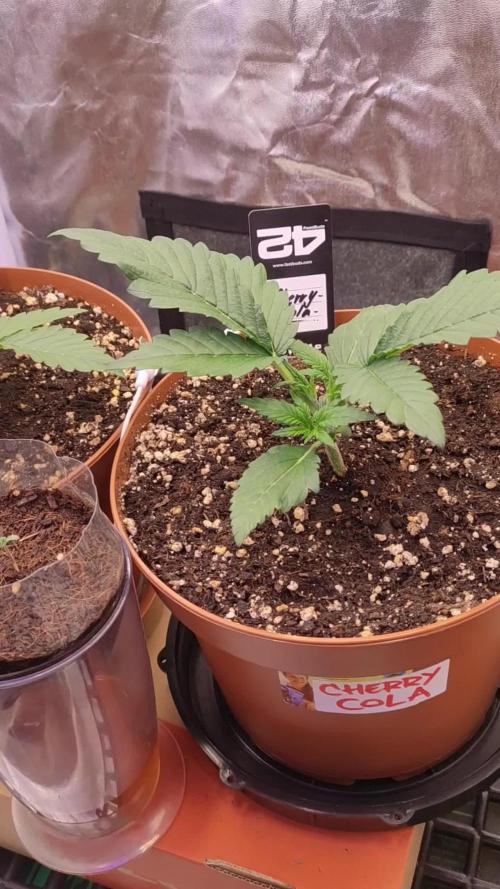
Hele je to tu ✂️🥦 Konec druhého týdne a beru nůžky a obě přijdou o vršek. Světlo jede neustále na 35% a holkám se to líbí. Berou to 24/7 a jedou totální bomby. Každý den jde vidět rozdíl a konečně to začíná být ta pořádná sranda 😅 pár hodin než poberou co po nich chci a další fáze bude LST 🚀
Ať to všem jede stejný bomby.
42FastBuds 👌
Likes
67
Share


@Roberts
Follow
Was a great grow. 1 gram shy of a quarter pound plant. Can't complain about that. Thanks again sweet seeds for making this available to the public. Also thank you grow diaries community for the likes, follows, and subscriptions on my YouTube channel. I greatly appreciate the support. I am always open to questions, if I can help anyone. Happy growing and be safe out there 👍💨💨💨🙃
Likes
33
Share


@Wicked_Stix
Follow
Gave the girls a flush and a complete water change this week. That was only the second water change they have had this grow. I have just been letting them drink the reservoir almost empty and then filling it up with fresh nutes. The 5 plants are drinking about 4 gallons a day combined. Been running AC when the lights are on and the dehumidifier 24 hours a day. All of the plants are showing some decent trichome production. Running 1/2 tsp maxibloom and 1/8 tsp beastie bloomz per gallon every time I add water. Seems to be keeping everyone happy.


Likes
4
Share


@Ganjatalks
Follow
8th week , 4th of flora
They are tall, strong and healthy
Using the same fert proportions as vegetative stage.
They reached 77cm tall