Likes
7
Share
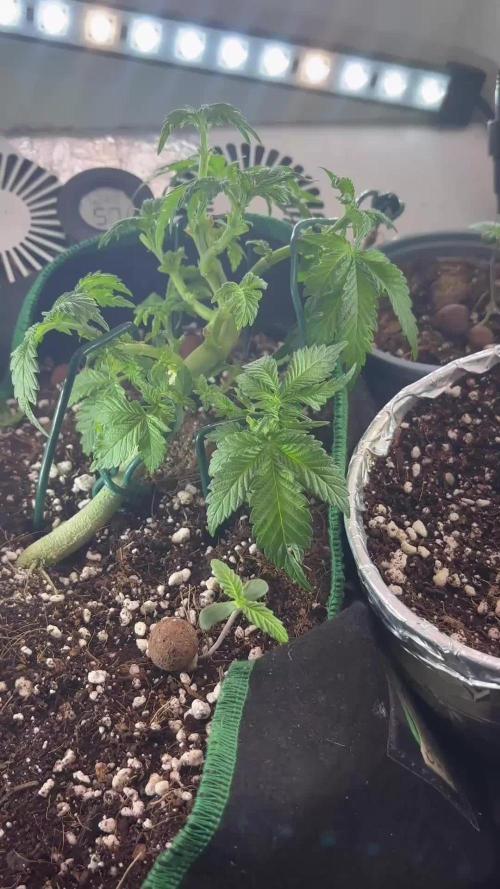
Watering just the first day no other in the first week
Likes
16
Share
Today on day 17 from date of birth Iam preparing a worm casting tea. In a cheese cloth bag ,Made up of 2 cups of worm castings 2 tablespoons of unsulfured molasses,2 tablespoons of mineralized phosphate (bat shit) ,2 tablespoons of soluble seaweed extract . 2 tablespoons of alfalfa meal 2 tablespoons of all purpose 4-4-4 all Gia green products other than. I also sprinkled in some great white premium mycorrhizae inton2 gallons of water. Tea will brew for 24 hours before applying.
Likes
68
Share
@Sparkles
Follow
Brought to u by Mars Hydro. Grow on Earth. Grow with Mars 🚀🚀 All pics and videos taken day 28. Almost half way there. Rice is frosty, Simily not so much. Eat. Sleep. Grow 🌲🌲
Likes
15
Share
For the last month, I've been dealing with severe back issues. Not gonna lie, but it's been challenging to keep up with daily DWC chores. That aside, this particular girl also experienced ph swings, so reservoir change end of mid-week 6 flower. I also switched from Fox Farm to GH trio and supplementing with FF Chi Ching during week 5 and into week 6 w/ppm running at 800. Next bucket change, I will begin lowering ppm to 500-520 range. I'll continue bringing ppm down right up until flush. She's finishing nice, given what little I've been able to do physically. Ganja Farmer Seed genetics, so happy with first run using this breeders gear and happy w/results so far being this is my first attempt at DWC. Enjoy the PHOTOS and hit LIKE, if you're inclined to do so :)
Likes
3
Share
@Sugahmama
Follow
They got a Magnesium deficiency and it was time to change the water and give them nutrients. The next day they showed a explosive growth. By the end of the week they should be Back on track. Nice. Its Day 21 and I decided to top 3/4. I give them one day to recover and going to do some LST
Likes
4
Share
0.23v tuned to 7.83Hz Plants exposed to the Schumann resonance often show greater resistance to stress factors such as drought, diseases, and pests. It is possible that these natural electromagnetic waves strengthen plants' immune systems and increase their ability to resist disease. Pretty neat, in the afternoon when the tent hovers around 84F the plants are 🙏, can visually see in time around 10 minutes after I opened the tent the temp had dropped to 76 pressure was lost, she is still chilling but she doesn't quite have that perk anymore. *Salinity3.5% - 100ml H2O=100g The concentration of salt in a solution 3.5%= 3.5g in 100ml. Growing well. Not going to top or do any training, I'll let the plant do its own thing, she is constructing foundations now for what she senses ahead. Smart girl. ✨️ Let her, do her thing, let me do mine. The voltage that is needed for electrolysis to occur is called the decomposition potential. The word "lysis" means to separate or break, so in terms, electrolysis would mean "breakdown via electricity. Green hydrogen is hydrogen produced by the electrolysis of water, using renewable electricity. The production of green hydrogen causes significantly lower greenhouse gas emissions than the production of grey hydrogen, which is derived from fossil fuels without carbon capture. Electrolysis of pure water requires excess energy in the form of overpotential to overcome various activation barriers. Without the excess energy, electrolysis occurs slowly or not at all. This is in part due to the limited self-ionization of water. Pure water has an electrical conductivity of about one hundred thousandths that of seawater. Efficiency is increased through the addition of an electrolyte (such as a salt, acid or base). Photoelectrolysis of water, also known as photoelectrochemical water splitting, occurs in a photoelectrochemical cell when light is used as the energy source for the electrolysis of water, producing dihydrogen . Photoelectrolysis is sometimes known colloquially as the hydrogen holy grail for its potential to yield a viable alternative to petroleum as a source of energy. The PEC cell primarily consists of three components: the photoelectrode the electrolyte and a counter electrode. The semiconductor crucial to this process, absorbs sunlight, initiating electron excitation and subsequent water molecule splitting into hydrogen and oxygen. Water electrolysis requires a minimum potential difference of 1.23 volts, although at that voltage external heat is also required. Typically 1.5 volts is required. Biochar, a by-product of biomass pyrolysis, is typically characterized by high carbon content, aromaticity, porosity, cation exchange capacity, stability, and reactivity. The coupling of biochar oxidation reaction (BOR) with water electrolysis constitutes biochar-assisted water electrolysis (BAWE) for hydrogen production, which has been demonstrated to reduce the electricity consumption of conventional water electrolysis from 1.23v to 0.21v. Biochar particles added to the electrolyte form a two-phase solution, in which the biochar oxidation reaction (BOR) has a lower potential (0.21 V vs. RHE) than OER (1.23 V vs. RHE), reducing the energy consumption for hydrogen production via biochar-assisted water electrolysis (BAWE). BAWE produces H2 under 1 V while eliminating O2 formation: key word "eliminating". Air with a normal oxygen concentration of around 21% is not considered explosive on its own; however, if a flammable gas or vapor is present, increasing the oxygen percentage above 23.5% can significantly increase the risk of ignition and explosion due to the enriched oxygen environment. The addition of ion mediators (Fe3+/Fe2+) significantly increases BOR kinetics. Air: Nitrogen -- N2 -- 78.084% Carbon Dioxide -- CO2 -- 0.04% Hydrogen in homosphere H -- 0.00005% Hydrogen "GAS" H2 in homosphere - 0% "Nitrogen, oxygen, and argon are the three main components of Earth's atmosphere. Water concentration varies but averages around 0.25% of the atmosphere by mass. Carbon dioxide and all of the other elements and compounds are trace gases. Trace gases include the greenhouse gases carbon dioxide, methane, nitrous oxide, and ozone. Except for argon, other noble gases are trace elements (these include neon, helium, krypton, and xenon). Industrial pollutants include chlorine and its compounds, fluorine and its compounds, elemental mercury vapor, sulfur dioxide, and hydrogen sulfide. Other components of Earth's atmosphere include spores, pollen, volcanic ash, and salt from sea spray." Although the CRC table does not list water vapor (H2O), air can contain as much as 5% water vapor, more commonly ranging from 1-3%. The 1-5% range places water vapor as the third most common gas (which alters the other percentages accordingly). Water content varies according to air temperature. Dry air is denser than humid air. However, sometimes humid air contains actual water droplets, which can make it more dense than humid air that only contains water vapor. The homosphere(where you live) is the portion of the atmosphere with a fairly uniform composition due to atmospheric turbulence. In contrast, the heterosphere is the part of the atmosphere where chemical composition varies mainly according to altitude. The lower portion of the heterosphere contains oxygen and nitrogen, but these heavier elements do not occur higher up. The upper heterosphere consists almost entirely of hydrogen, cool. 78%nitrogen as N2, a far too stable bond to be used by organisms. 20%oxygen 0.04%co2 0.00005% hydrogen When lightning strikes, it tears apart the bond in airborne nitrogen molecules. Those free nitrogen atoms N2 nitrites then have the chance to combine with oxygen molecules to form a compound called nitrates N3. Once formed, the nitrates are carried down to the ground becoming usable by organisms. Will it react with the oxygen in the air spontaneously, the answer is no. The mixture is chemically stable indefinitely. A mixture with air near the release point can be ignited, but if this does not happen then when its concentration gets below 4% it will be unable to carry a flame. Taking a small detour into chemistry here, a key concept to understanding the health impact of nitrogen-based compounds is knowing the difference between nitrates and nitrites. What Are Nitrates and Nitrites? A nitrite (NO2) is a nitrogen atom bonded to only two nitrogen atoms. Very strong bond A nitrate (NO3) is a nitrogen atom bonded to three oxygen atoms. Weaker bond The optimal pH for nitrate (NO3-) depends on the process and the type of bacteria involved. Nitrification The optimal pH for nitrification is between 7.5 and 8.6 Nitrification is the process of oxidizing ammonia to nitrate and nitrite Nitrosomonas has an optimal pH between 7.0 and 8.0 Nitrobacter has an optimal pH between 7.5 and 8.0 Nitrification ceases at pH
Likes
5
Share
Lemon cherry cookies + lemon cherry cookies +frozen face all have distinct colours and frosty buds with interesting aromas to each plant Have been in flushing for 3 weeks now gonna leave for a one last week for coco to dry out and ripen so can Harvest
Likes
4
Share
@Ageddd
Follow
Flush week for Ultra Lemon Haze, stinking a little more this week, and eating the stored nutrients. AH1 is getting weird, loosing colour, i dont know why, im going to increase the nutes a little... Giving Top Bloom (2ml/l) and Big One (0,5 ml/l). AH2 is branching and branching, and growing a lot. Feeding Top Veg 2ml/l + Green Explosion 0,5 ml/l.
Likes
62
Share
@nonick123
Follow
Día 57 (16/12) CBD Auto 20:1 #1 ha empezado a bajar el consumo de agua... pero sigue creciendo! ¿Tendrá fin el stretch de esta planta? CBD Auto 20:1 #2 empieza a perder hojas por senescencia. Está a punto de cosecha!?!?!?! LSD-25 Auto está increiblemente dura y brillante. Un color morado oscuro casi negro OG Kush Auto ha bajado un poco el consumo de agua, pero empieza a formar unos cogollos monstruosos, completamente cubiertos de resina+ Día 58 (17/12) CBD Auto 20:1 #1 empieza a tocar la lampara! Vuelvo a subir la lampara.... Además presenta una ligera coloración morada en las puntas de las hojas... ¿Coloración natural o deficiencia de P? CBD Auto 20:1 #2 tiene un montón de hojas con senescencia acelerada de un dia para otro! Ha llegado el día de la cosecha! 😍💥 LSD-25 Auto sigue acercandose al final... todos los cogollos son duros como pelotas de golf 💥 OG Kush Auto estaba practicamente seca! Vuelvo a darle 1250 ml de H2O RO. Va a hacer unos cogollos brutales Día 59 (18/12) CBD Auto 20:1 #1 - empieza a mostrar coloración morada en las puntas de las hojas ¿Genetica o deficiencia? Aprovecho el riego con BIO PK 5-8 10 ml/L y darle un booster! LSD-25 Auto - se acerca la cosecha! 😍💥 Cogollos duros como piedras en todas partes y bajando el consumo de agua... OG Kush Auto - muestra más avanzada a deficiencia de hace unos dias, de modo riego con BIO PK 5-8 10 ml/L. A ver como le sienta! Día 60 (19/12) CBD Auto 20:1 #1 - sigue mostrando más deficiencia de P con alguna mancha en las hojas superiores. Menos mal que ayer la regué con el BIO PK 5-8! LSD-25 Auto - Le miro los tricomas y aún no está lista. 50% trasparentes + 50% nublados. Pero solo faltan días! OG Kush Auto - Está empezando a apilar cogollos de forma brutal, y el olor es una maravilla! Además se muestra sedienta! Eso es buena señal Día 61 (20/12) Busy time Día 62 (21/12) LSD-25 Auto - muy cerca de la cosecha. Apenas consume agua.... Día 63 (22/12) LSD-25 Auto - harvest day! Tricomas mayoría nublado y alguno ambar. Perfecta! 💦Nutrients by Bio Tabs - www.biotabs.nl/en/ 🌱Substrate PRO-MIX HP BACILLUS + MYCORRHIZAE - www.pthorticulture.com/en-us/products/pro-mix-hp-biofungicide-plus-mycorrhizae "GDBT420" 15% DISCOUNT code for the BIOTABS Webshop https://biotabs.nl/en/shop/
Processing
Likes
10
Share
@BodyByVio
Follow
This week I top all 8 Green Poison ( 4dwc and 4 coco ) clones. They look healthy and happy and few days later I already start to low stress training (LST) them.
Likes
10
Share
@bvsbuds
Follow
Hey growmies, After a feed, I like to water with molasses and the plants love me for it. I raised the light a few inches because they are stretching fast. I also topped dressed with worm castings and added a bio enhancer. Officially 18th day of flower. Happy growing 😎
Likes
14
Share
@Njanne
Follow
They are in small felt pots for now, but I plan to transplant them in to big pots very soon. I want to try to avoid root bound plants... I've got some 30gal pots lined up.
Likes
15
Share
Die neue Woche im Growzelt fühlt sich ein bisschen an wie ein Besuch bei einem übermotivierten Fitnessstudio-Neuling: alles wächst, alles drängt nach vorne, und niemand kennt sein Limit. Der Permanent Marker steht da wie eine gedrungene Schönheit mit breiten Indica-Blättern, so gesund, dass man fast ein schlechtes Gewissen bekommt, überhaupt eine Schere in die Hand zu nehmen. Triebe überall, kräftig, ehrgeizig, alle mit dem festen Vorsatz, der Main Character zu sein. Die Auswahl, wer bleiben darf, gleicht eher einer Castingshow als Gartenarbeit, denn eigentlich hätte jeder eine Runde weiter verdient. Der Nodienabstand ist so kurz, dass man zweimal hinschauen muss, um überhaupt zu sehen, wo ein Abschnitt endet und der nächste beginnt, was das Ganze nicht gerade einfacher macht. Die Pflanze verträgt Dünger, als wäre es ein Energy-Drink, und quittiert jede Gabe mit noch mehr Wachstum, sehr erfreulich, aber auch leicht beunruhigend, wenn man Richtung Zeltdecke schielt. SCROG rückt damit endgültig vom netten Plan zur absoluten Notwendigkeit auf. Ein Trieb hat sich im Eifer des Gefechts verabschiedet (RIP, kleiner Held), wurde aber stoisch weggesteckt. Die verbleibenden Kandidaten haben die frei gewordene Energie dankend übernommen. Insgesamt bleibt das Gefühl: alles läuft hervorragend, vielleicht sogar zu hervorragend. Wenn das so weitergeht, wird nicht die Frage sein, ob der Permanent Marker performt, sondern ob das Zelt am Ende groß genug für seinen Ehrgeiz ist. Was sagt ihr zu unserem Permanent Marker?
Likes
371
Share
D85. At the start of week seven of flower, the girls are just humming along. I gave each girl 2.5 liters of water @ pH 6.6. ------------------------------ D87. I brewed a compost tea with worm castings, kelp meal, neem meal, rock dust, biochar, and molasses and gave each girl 2.5 liters @ pH 6.3. ------------------------------ D89. Each girl got 2.5 liters of water @ pH 6.3 with Bokashi Juice. ------------------------------ D91. We're at the end of the seventh week of flower, and things are uneventful in the tent. I still can't find any thrips when I scout, so that's good. Yesterday, each girl got 1.25 liters of water @ pH 6.6 with fulvic acid and FFJ, and today, they also got 1.25 liters of water @ pH 6.6 but with humic acid. ------------------------------