Likes
Comments
Share
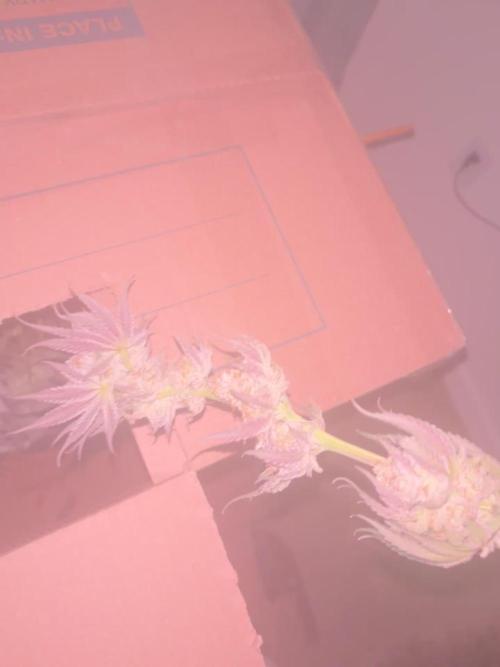
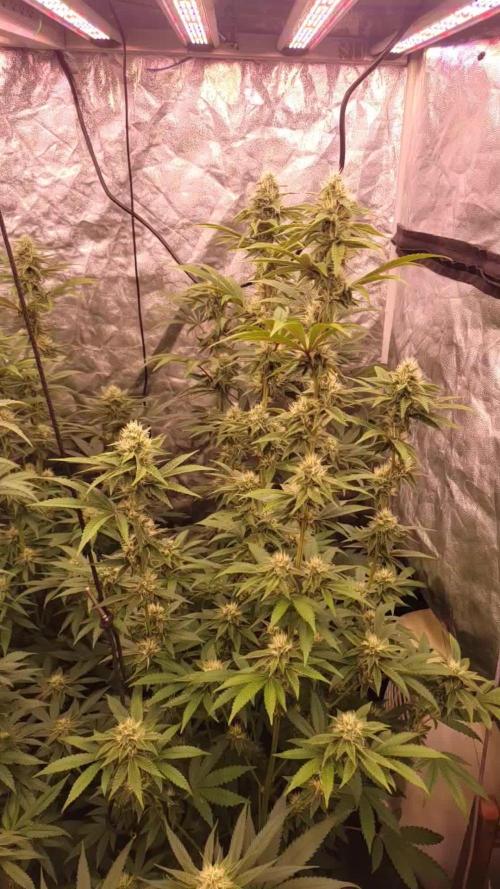
Week 8 of flower is at a close and these girls are really starting to express themselves. They're slowly putting on their colours and getting ready to really shine. Some of the close up pics looks like a red trichome here and there, will have to break out the scope soon and keep an eye, aiming for the 5-10% range. They're smelling delicious and quite strong. Not as strong as the Pink Lemonade I did last run, but they're close! Nice fruity smell and a heavy dankness hahaha. Carbon filter on the 6" fan , don't even notice the tent smell being in the same room. Dropping humidity to 45%, will have the VPD between 1.1-1.3 for the remainder of the grow. Let's keep these girls healthy and cruise to that finish line!
Likes
81
Share
Hey! Welcome to week 8! Karen is mid way through her flowering stretch. Please check back to last week as I update daily so the week is now complete. I count about 20 colas now. Day 51: Have reconfigured the tent, see video. Karen is now 36cm and still stretching. Karen has more light now. Smell is still there hits you when you open the tent. Fertigated 2l. Day 52: Height: 39cm. Karen's scent is heavenly. I have reconfigured again and installed some upgrades. Better reflector. Much bigger carbon filter. Increased airflow. Better config. More efficient pot layout. Karen is lovely. I am grateful to her and for her, so I wrote her a little poem, I hope she liked it. "Karen! Oh Karen! The phoenix of flowers, Three lowly weeks she struggled in vain, Shadowed and starved for five hundred hours, He slowly wept to witness her pain. Karen! Oh Karen! I P-H'd your showers, and in the fourth week you started to gain, Hallowed and hard you survived as you cowered, I thought you meek, I was wrong once again. Karen! Oh Karen! Forgave me my howlers. She set a pace, a pace she maintained, Now shes a girl at the peak of her powers, And so I'm a geek, with buds on the brain." Day 53: Approx 48h into a simulated dry spell. Alright I think it is time for Karen to get her first MAJOR defoliation. I will update shortly with photos and info. I will also be doing some gentle LST to separate the colas a bit. Day 53.5: Defoliation and LST. Finally got chance to photograph that bunda. Enjoy! Day 53.75: Bit of a fail. Messed up the timer and the lights ended up being off for about 3 or 4 hours. Because I was cooling the room (open window) to keep temperature in the tent down, without any light the temperatures absolutely plummeted as it is sub-zero outside. By the time I realised and turned the lights on, the temp in the main tent had dropped to 14 degrees celsius. Whoops! How is that for mistreating your girl? Defoliated about 80% of her leaves, 4 nodes, significant LST, then stuck her in the cold and dark for 1/6 of a day. Not to mention she is now almost 3 days into a "dry spell". There do not seem to be ill effects, and Karen has already begun to respond to the LST; all the colas that had been changed in angle are now upright again. The dry spell I keep mentioning, there is a method behind my madness, I have spotted one or two small flies and I think they may be fungus gnats. I am starting to suspect that the 2nd seedling in the Purple OG Punch Auto grow was actually beheaded by fungus gnat larvae. So I am drying out the mediums as much as I dare. I am closely monitoring the plants, so far the only one I have had to break the drought for is Enigma; all the girls in big pots haven't even noticed it's dry yet. How far am I going to push it? Well I will judge it on a plant by plant basis, but quite honestly I am hoping to see physical signs of thirst before I breakdrought. Of all the plants the two I think will respond most strongly to this will be Karen and Bertha, because of where they are. Karen here is actually probably 4 weeks into flowering rather than two, so about now is a good time to give her a little hydration stress. I do not think I will push it past 5 days, as RH is 34%. By now all the plants will be compensating for the lack of moisture and the high temperatures and low humidity. They will be taking more and more moisture out of the coco, and as the coco dries further and further down, those plants that have space will start desperately growing roots to find moisture. Mark my words, 24 hours after I end this drought, every plant in the tent will throw out crazy growth. Day 54: Ended drought and fertigated 6l, no run off, I will re-fertigate tomorrow. Karen is still stretching her height post LST is now 37cm. The two tallest colas seem to have stopped but the other colas are still stretching. Day 55: Alright so it has been 5 hours since lights on, and Karen is looking in good shape, all her drooping leaves have perked back up and she has added quite a bit of foliar growth. The colas are all still rising, except perhaps the two tallest. This girl is absolutely loaded with pistils, I'm starting to see trichomes on the sugar leaves, but trich production hasn't started in earnest yet. She has a least 20 colas, and 6 of them are thicker/taller than the primary cola at her tip. Every one of her nodes has reinforced itself with a bulbous growth and these cola branches are swelling rapidly. I am increasingly of the opinion that, all being well, this girl is going to surprise us all with her yield. My first grow, which was just mucking about really, I got 60-70g of the two main plants, and they were just bare sticks with 2 colas. Although her height is less than theirs was, 2/3 of their height was bare stick... whereas every mm of her is befoliaged and living. So in terms of the height of the actual cola I think they were about comparable in usable space on a per cola basis. The main difference being that Karen has 20+ colas whereas they had 2 primary and 2 lower. I know that it is probably unrealistic to expect more than 70g from a single auto grown indoors. Nevertheless my gut tells me this baby could achieve at least 100g, perhaps as much as 150g. The next few weeks will determine that, but given where we were in week 3 I will be grateful for any yield of quality bud. I have dropped the lights down to 18/6 from 'tonight' onwards. I really have no idea how long we have left for Karen. According the the "brochure" she flowers for 7-8 weeks, with a total crop time of 9 weeks. The problem is I don't know what a total crop time is? Does that mean from seed to finish? If so Karen is clearly not going to be anywhere near that timescale.I am going to go ahead an assume that, for my plant anyway, the first 4 weeks were veg weeks. I think it is fair to count week 5 and 6 as flowering because pistils were popping out very early in week 5 if not before. So that makes this week four of flowering. I am going to assume 8 weeks rather than 7, so I think we have another 4 full weeks give or take a week. On that basis I am expect harvest week to be around week 12 or so. I am not fixed on this though, I am determined not to harvest this girl early. Day 55: Photos taken 00:00 9/3/23 Strong 24h of veg growth as predicted. Day 56: Existing leaves continue to swell. Stretch appears to be slowing. I've taken so many media this week that I cannot scroll down far enough to select a recent thumbnail. Probably Karen's biggest week in terms of changes. She is looking like she is going to impress. Height 39cm.
Likes
4
Share
Another easy week. Bud and trichome production seem to be on point. This plant is truly maxed. She is 18 inches with about 12 inches being above the scrog screen. She stretched a little more than expected. She was supercropped in several location and didn't skip a beat. Obviously, the angle of my camera doesn't give the whole picture. But now there's some buds that can be watched in development. I'm fighting night time humidity. My little Vivosun dehumidifier can't keep up. Likely a future upgrade as I'm sure I'll struggle to get to 50% with lights on next week. Temps when my light off could ideally be lower as well. Not enough that I see the need to invest into anything like an A/C. Loving to see the little bits of purple start to come out. I'm sure lower night temps would amplify that. I did a final top dress of Build-A-Flower, an 1/8 cup of Craft Blend, and a topping of Kashi followed by a half gallon watering with the listed nutrients once at the beginning of the week.
Likes
6
Share
Y hasta aquí, el corte última semana ya de todo el proyecto, solo queda tijera en mano y esperar para catarlo. Os muestro mi zona de trabajo en un video 🤷‍♂️ Para mi consumo justo
Likes
43
Share
~ GG4 SHERBET FAST FLOWER by FastBuds ~ Well fam, here we go again with another epic strain from FastBuds Fast Flowering stable. After having such tremendous success growing their Gorilla Cookies Fast Flower outdoors last year, I've decided to run another of their fast flowering strains outdoors this year... GG4 Sherbet Fast Flower! The best description of this awesome cultivar comes directly from my friends at FastBuds which is as follows: "Bred from extremely potent and flavorful Gorilla Glue and Orange Sherbet genetics, GG4 Sherbet FF (Fast-Flowering) takes all the best traits to the next level, offering a high-yielding strain that can produce up to 600 g/m2 in a 7-week flowering time. This super resilient Indica-leaning hybrid thrives indoors and outdoors, and in all types of climates while producing mouth-watering sweet, fruity, spicy and earthy terps that translate into a delicious sugary hazelnut aroma. Expect an extremely relaxing and overall happy effect that’ll leave you with a huge smile from ear to ear. It’s the perfect strain for growers of all levels of experience seeking low-maintenance yet highly productive photoperiod varieties that deliver quality and quantity without extra effort. GG4 Sherbet FF grows chunky buds with long dark orange hairs and spade-shaped calyxes that get encrusted with trichomes by harvest time, giving them a gorgeous silvery-white appearance. This medium-sized photoperiod can reach up to 200 cm in height and yields up to 650 g/m2 while developing that typical hybrid structure. GG4 Sherbet FF grows with a stocky, bushy appearance, developing one sturdy main cola and fat side branches that support huge yields without much effort. This super-fast variety produces distinctive light-green buds with a high bud-to-leaf ratio, making your trimming sessions a breeze. It’s a top-notch resin producer that doesn’t need much maintenance and will thrive in almost every climate, rewarding growers of all levels with extremely flavorful resin that makes for outstanding hash end extracts." ________________________________________________________________________________________________________________________________________________________________________________________________________________________________________________________________________________________________________________________ The Setup: This is going to be an outdoor grow, but I have started the GG4 Sherbet Fast Flower indoors as our weather is still too cold to put her outside (nighttime temp's dipping regularly into the 30's℉). The plan is simple... let her grow inside under a 19/5 light schedule until the nighttime temperatures stay above the mid 40's℉, at which point she'll be moved outside and transplanted into the soil which I have already setup and inoculated with beneficial microbes, and then let the fun begin!🤪💚 ________________________________________________________________________________________________________________________________________________________________________________________________________________________________________________________________________________________________________________________ Weekly Updates: 7/1- Here we go into the FastBuds GG4 Sherbet Fast Flower's 13th week from seed and this lady is kickin ass and taking names! I am continuing to water late in the afternoon on days when we don't get any rain and she seems to like it. I will also be top dressing her in about two weeks to keep the microbial colony fat and happy! 7/3- The weather continues to be hot and humid and the daily watering of the GG4 Sherbet FF continues. I also removed a few shade leaves that were below the canopy, as well as some in the middle of the plant that were blocking a lot of light to new shoots. 🎉HAPPY 4th of JULY!🎉 7/5- Early this morning we had a thunderstorm pass through early in the day, which provided about an inch of rain in a short time. I went ahead and watered in the afternoon, but only gave the GG4 Sherbet FF approx. 3g of well water from the garden hose. 7/7- The daily watering continues, as does our blistering hot🔥weather. All is well with the FastBuds GG4 Sherbet Fast Flower and today, after watering, I got under the trellis net and removed a bunch of shade leaves that were growing straight down through the net doing absolutely nothing but sucking up nutrients better used elsewhere on the plant. Stick a fork in another week for the FastBuds GG4 Sherbet Fast Flower. This beautiful cultivar has gone through a tremendous growth spurt and I am hoping to see her begin to transition into flower over the course of the next couple of weeks... stay tuned! 😎✌️ Thank you for checking out my diary, your positive comments and support make it all worthwhile! 💚Growers Love!💚😎🙏
Likes
41
Share
@gr3g4l
Follow
This week the aroma they're giving off is noticeably stronger and really delicious. It's clear this week won't be their last. For whatever reason, they'll need more days than usual this time. At 62 days, the vast majority of trichomes were still clear, with a few amber buds—very few—and a slight tendency to develop foxtails; I'd been noticing this trend for a few days. At 63 days, I lowered the LED wattage to 220W, and regardless, I started the root flush. This consists of several waterings with nutrient-free reverse osmosis water until I decide to harvest. Esta semana el olor que desprenden es notablemente superior y  bien rico. A la vista está que esta semana no será su última semana. Por lo que sea esta vez necesitarán más días de lo habitual. A los 62 días la gran mayoría de tricomas seguían cristalinos y algunas pocas cabezas de color  ámbar, muy pocas y una cierta tendencia en generar foxtails, llevaba ya días viendo la tendencia. A los 63 bajé la potencia de los led a 220W. y quede como quede empecé con el lavado de raices. Consta de varios riegos con agua de osmosis sin nutriente, hasta que decida cortar.
Likes
16
Share
Likes
4
Share
Likes
15
Share
@BastiFarm
Follow
3 semana de vegetación y noté una clara deficiencia en las 2 plantas (1 más que en la otra) al principio no sabia lo que podía ser, y varios cultivadores me dieron opciones, busque la composición del alimento que uso y me di cuenta que no tiene calcio y muy poco porcentaje de magnesio, aparte que estoy regando con agua purificada+ósmosis inversa, así que por conclusión es carencia de calcio y magnesio, me recomendaron calmag un alimento rico en los 2 nutrientes así que lo compraré y espero ese sea el problema, no hay estancamiento pero si están creciendo más lento Hoy toco riego con alimento siguiendo la tabla de green house, realicé un riego foliar con acti vera como preventivo de alguna plaga u hongo.
Likes
8
Share
Hello everyone, The girls are finally outside in 20 gallon fabric pots. This season I have a greenhouse for them and I hope it goes good. Still have to build the first cages around them and start stretching them. 🎊🎉 finally, summer is here 🎉🎊 See you guys next week 🤞🤞🤘🤘👊👊👊
Likes
6
Share
@Kanbal
Follow
So I heard that matterhorn is an unstable plant but I never thought it was so unstable. One fenotype are doing well but plants from another mother are struggling. I checked the condition every day and every day the EC dropped and the pH rose. Which meant eating, but still showing problems on the leaves. During this period I made a mistake with the water temperature, namely when the water temperature is above 20 ° C the oxygen in the water drops drastically and these were the beginnings of my root problems. I didn't know it then, but later root rot appeared.
Likes
7
Share
Coming along nicely. The smells are developing. The frost has come in strong before the buds have even started to swell. Now they shall start to swell and we will see them at their full potential in another 4-5 weeks. Stay tuned. Come check out my YouTube. I'm going to be giving out some of the seeds I produce. They're untested but should be absolute fire.
Likes
10
Share
Voltage, also known as electric pressure, electric tension, or (electric) potential difference, is the difference in electric potential between two points. In a static electric field, it corresponds to the work needed per unit of charge to move a test charge between the two points. In the International System of Units (SI), the derived unit for voltage is named volt. The voltage between points can be caused by the build-up of electric charge (e.g., a capacitor), and from an electromotive force (e.g., electromagnetic induction in generators, inductors, and transformers). On a macroscopic scale, a potential difference can be caused by electrochemical processes (e.g., cells and batteries), the pressure-induced piezoelectric effect, and the thermoelectric effect. Since it is the difference in electric potential, it is a physical scalar quantity. A voltmeter can be used to measure the voltage between two points in a system. Often a common reference potential such as the ground of the system is used as one of the points. A voltage can represent either a source of energy or the loss, dissipation, or storage of energy. Dropping the temps will slightly raise the humidity, air holds less % water the colder it is. Lights on 25-35rh% the same water content will spike to 50rh% + at night just by dropping the temps. At night all the juice photosynthesis has been storing up is mashed and mixed up to make all the goodies we need for bud, water is used to transport all these things everywhere, like little solvent transport devices, once a nutrient/protein has been delivered to destination the plant needs to get rid of all this excess water molecules it was using to transport. The only solution at night is to spit it back out into the air at night. During the peak of flower, this can catch a grower unaware, with a 4x4 full tent it can be a challenge to control all that moisture exhaust overnight especially if you're really pushing the limits. We live in a water world, above or below, our misconception is we live on dry land, we don't live in less watery conditions than above or below. We fit into a very narrow band of moisture that just so happens to be full of lots of air and everything else required for life. Got my first full whiff of the smell of purple lemonade, always surprises me how accurately the smell fits names, the dominant terpenes in the Purple Lemonade weed strain are carene, linalool, limonene, and myrcene. Carene gives this strain its sweet, citrus flavor and some woody notes, whereas the linalool I recognize so well from Granddaddy Purp. Myrcene has been shown to have sedative qualities while bringing musky, earthy elements to the flavor profile. Trichome production started to ramp up, and the plant that grew taller/closer to UV showed noticeably thicker coatings. The taller plant shows slight yellowing of lower leaves, and the smaller plant is green and lush but the buds are slightly less progressed, interesting. I super-cropped the main stem of the tall one just over a week ago (clean). I expected it to be the one slightly behind in development. The plant has roughly 10-15% "Total resources" that it keeps in case emergencies arise. Reserves if you will. My rationale behind breaking anything goes hand in hand with slowing things down as production is lost due to the time it takes to repair damage. I recall watching a YouTube video, where a curly hair gentleman would super crop in a manner to damage but not disrupt using a twisting method, using fingers and thumbs placing them close together one goes clockwise other counter clock this varies a lot depending on the thickness of stem but what you wait for is a tiny snap, it may take several rolls to weaken if walls are tough I found. No snapping or bending of the stem, you want just to fracture it but not puncture this way the xylem and phloem channels remain flowing,the damage is repaired almost instantly and the 10-15% is dispatched with very little repair time. Everything in the general vicinity of the stress will now grow stronger so as to prevent further similar damage. This is why I had expected the tall one to lag behind in development once I had cropped it but low and behold it worked and the tall one has slightly more developed buds. The effects of birdsong on plant life may at first glance be far-fetched. Nigh on ten years ago an article appeared in Nexus Magazine on the discovery or invention of a method of growing plants using bird sounds. Christopher Bird and Peter Tompkins describe the development of Dan Carlson’s Sonic Bloom in their book The Secret Life of Plants. Many others have, it seems, recognized the role of birdsong in the growth of plants, and influenced or directly helped Carlson to develop his invention. Dan Carlson’s desire to see that no one need be hungry through shortage of food sought to understand the optimum growth of plants. He discovered that plants also feed from ‘the top down’ as well as the roots. Underneath all leaves are pores called stomata which open to take in nutrients and moisture from the air. Carlson’s observation that the more bird life there is on the farm, the more abundant is plant life, has been echoed by farmers throughout history, except in modern times. Where there is little bird life, plants are stunted, and dwarfed. Nature has the birds sing at dawn and dusk, which dilates the stomata, and so feeds the plants. One can immediately see the importance of trees. The development of Sonic Bloom was to create birdsong, which is played to the plants, while a foliar nutrient is sprayed onto the plants at the same time as they are being stimulated by the sound, to enhance their growth. This method produced fantastic results in the amount of abundantly nutritious produce from one plant, often in poor soils and in drought conditions. Carlson showed that the breathing leaves of plants are the source of the nutrient intake for growth. This of course is also true for humans—the breath is food. We shall discourse on this on another occasion. Plants transfer nutrients to the soil via this breathing, and Carlson showed that his plants improved the soil and helped earthworms proliferate. The secret of Sonic Bloom was the development of the music of the same frequency as the dawn chorus of the birds. With the help of a Minneapolis music teacher, Michael Holtz, a cassette was prepared. It seems that both birds and plants found Indian melodies called ragas delightfully suitable. This is actually quite profound, although the American farmers, especially women, who had to endure this music whilst it was played to the plants, found it irritating. Holtz found the “Spring” movement of Vivaldi’s The Four Seasons appropriate and concludes: “I realized that Vivaldi, in his day, must have known all about birdsong, which he tried to imitate in his long violin passages. Holtz, it is related by the authors Bird and Tompkins, also realized that the violin music dominant in “Spring” reflected Johann Sebastian Bach’s violin sonatas broadcast by the Ottawa University researchers to a wheat field, which had obtained remarkable crops with 66 percent greater yield than average, with larger and heavier seeds. Accordingly, Holtz selected Bach’s E-major concerto for violin for inclusion on the tape. “I chose that particular concerto,” explained Holtz, “because it has many repetitions but varying notes. Bach was such a musical genius he could change his harmonic rhythm at nearly every other beat, with his chords going from E to B to G-sharp and so on, whereas Vivaldi would frequently keep to one chord for as long as four measures. That is why Bach is considered the greatest composer that ever lived. I chose Bach’s string concerto, rather than his more popular organ music, because the timbre of the violin, and its harmonic structure, is far richer than that of the organ. Birdsong has long been loved but also studied with reference to the musical scale and harmonics. As Holtz deepened his study he said, “I began to feel that God had created the birds for more than just freely flying about and warbling. Their very singing must somehow be intimately linked to the mysteries of seed germination and plant growth. The spring season down on the farms is much more silent than ever before. DDT killed off many birds and others never seem to have taken their place. Who knows what magical effect a bird like the wood thrush might have on its environment, singing three separate notes all at the same time, warbling two of them and sustaining the others. Tree and bird life are essential to Earth's existence, which Carlson, Holtz, and others have shown, but indeed others see and feel. “Plants”, says Steiner, “can only be understood when considered in connection with all that is circling, weaving, and living around them. In spring and autumn, when swallows produce vibrations as they flock in a body of air, causing currents with their wing beats, these and birdsong, have a powerful effect on the flowering and fruiting of plants. Remove the winged creatures, Steiner warns, and there would be stunting of vegetation. Nothing more needs to be added here. It has been said that you cannot hurt the humblest creature or disturb the smallest pebble without your action having a reaction upon something else...You cannot think of an evil thought, no matter how private, without it having an effect upon somebody else. Whatsoever you do in life sets up some form of resonance. When I say the morning chorus of the birds awakens the earth I mean that the characteristic song of the birds sets in motion a series of vibrations which react upon other forms of life. Remember, the soil of the earth is full of living microorganisms. The plants are also living organisms. You, yourselves, are living organisms. Now, this is the beauty and wonder of it all—when one aspect of nature has been moved into a state of resonance it immediately relays its vibrational motion to something else. So when I say the dawn chorus awakens the earth I literally mean what I say. I do not suggest that the earth would come to a standstill without the bird song, but I do mean that life on earth would be sluggish and ineffectual without that first instigating outburst of vibrational power poured forth at just the right pitch and tone to set off a chain effect. I know some of you will say, what happens in those parts of the world where there are no birds? Well, what does happen? Very little, I assure you. The hot deserts and the polar regions where there are few, if any, birds are not renowned for their wonders of nature. It is as though they are asleep. Nothing grows, few things live. Little resonates and there is a great stillness over everything. You see, that outburst of sound just before dawn is like the little lever that works the bigger lever which turns the wheel which moves the machine…and so on. Never underestimate small things. Animals are blessed with instantaneous and unthought-out wisdom. They are in direct contact with God and they act and live as though they are fully aware of it. Men are also in contact with God, but most of them act as though they have never heard of God because they are largely veiled from their divine center by their own thinking minds of which they are so proud.
Likes
12
Share
I have a low consume of electricity today i change the light upped 50 watt the next week i started to fertilized. More auto of Dutch passion have more weeks to live for this in this time i prefer dont use any fertilized. I dont have idea the cbdv are strong plant for this i think wait to fiammingo the plant in the future in this time IS very early mi waiting... Next week bye
Likes
22
Share
@EhJay
Follow
D36 Collected runoff from #1 and was not happy with the results only the ph from the runoff was perfect. Performed a flush until the runoff was at 400ppm. Will give a small feeding when the soil dries up.
Likes
19
Share
@Naujas
Follow
the girl looks good :) I have already removed the yellow "autumn" leaves:) she received food with 1500ppm, the weather is not very good, I am afraid that it will start to rot :( there will be an update :) in 2-3 weeks ;) good luck growing
Likes
23
Share
(Update: 4/20/19) Please stand by while they dry. (Update Everything is going great though! The smell is very strong now; no more cut grass smell. From looking at all three today, I believe that some of the smaller branches will be done drying and ready for trimming and weighing in a day or two. I have one guess for dry weight of Big Lemon, any other guesses?? Remember, the picture of Big Lemon hang drying looks like its two plants, but its all Big Lemon; I had to cut it off to be able to hang it. The amputated branch left of the main plant is bigger than my other two plants alone! (Update 5/2/19) Woah...Okay. So after drying the whole for about nine days, and trimming for four days, Big Lemon's dry weight SO FAR is about 430ish grams of super dense and sticky nugs. Its amazing that I got more big bud than I got popcorn nugs from such a big plant. I have one more 1/2 gal Mason Jar of untrimmed tops to finish, then I'll post pics or a vid of the weigh up and glamour shots etc.. Oh, almost forgot, Little Lemon produced about 40 grams of very nice bud. This surpassed expectations because, although it was planted on the same day as Big Lemon, it was the runt of the bunch because it got pushed out of the main tent that had all the lights and Co2 environment and everything. It spent much of late veg under a very weak light. I remember how limp it was when I gambled on it and chose to switch her over to 12/12. But it was totally worth it in the end! Alight back to work for me. Check back later today for pics, vids! (Final Update: 5219 @11:09pm PT) Its done. Its finally done! I had to trim both plants with my own two hands! So Exhausting, yet so rewarding. So above are several videos of the weighing. Grand total for Big Lemon is 14oz of prime top shelf nugs, and about 3oz of nice popcorn/LARF (they are separated as shown above in a video. Forgive me for not throwing it all together to weigh it, I spent a long, long, very long time trimming and sorting and canning the buds according to their respective grade/quality. I may add one more update to show their respective weights. Oh and little lemon produced about an 1 1/2 oz of prime nuggets and quite a bit of popcorn/LARF, which I haven't gotten around to weighing yet. So, Grand Grand total of Both Lemon OG Candy (amazing job with this beast of a strain, Philosopher seeds) is about 18.5oz, or 1lb 2.5oz for two plants; 15.6oz of which is entirely made up of top-shelf buds 😎 Damn I love SoCal, I didnt even need to run carbon filters because no one be trippin about a lil stink weed. Thanks to those for following this grow! Tell me what yall think! Cant wait to see some comments from all you growers out there. (Update: smoke review after a week or two of cure) This Lemon OG Candy had an extended veg period, about 4 months maybe a little longer, and I harvested her on day 56 of flower (recommended harvest 60-70 days) because of the size/distance to light and her root-bound problems. The results so far, a very uplifting and stimulating quality.
Likes
15
Share
@BruWeed
Follow
🍀04/07 - Empieza su sexta semana en Etapa de floración. 🍀Me sorprende lo llena de tricomas que esta, su olor es fuerte y ya no veo la hora de poder probarla. 🍀Se encuentra perfecta de salud, solo que tuve que hacer un cambio de lugar a las lámparas porque crecieron demasiado alto para el indor que tengo, algunas hojas que se encuentran abajo están un poco amarillas pero nada grave. 🍀El ph del agua es de 6.2 🍀Voy a estar dejando videos de como se encuentra. 🍀En estos dias seguire subiendo mas imagenes. 🍀🇦🇷😶‍🌫️Podes seguirme en Insta gram como @bruweed_arg 🍀🇦🇷😶‍🌫️