




Likes
10
Share


@Blazeman
Follow
Auto looks done.
Pakistan Valleys look almost done.
Candy may need another couple weeks.
What do u think i should do guys? Should i wait and harvest all together? Or harvest the auto now, then the kush and lastly the Candy? What's the best way.
Also i had been planning to dry them all in my tent. If I do a staggered harvest, i have to build a box or empty out a closet to try and dry them in 😫


Likes
9
Share


Likes
21
Share


@MadeInGermany
Follow
Hey everyone 😃.
This week she has done great 👍.
It was done again on all the drifted topping and sprayed one last time with neem oil so that the last trips are finally gone 😁.
We haven't had any pests for so many years and all of a sudden we have such little shit parts 😅.
This week it was poured twice with 1.2 l of water.
GHSC enhancer was added during a pouring (1 g per l)
The tent was cleaned every day this week and the plants were checked for health.
The humidifier is filled once a day.
Next week I will decide how I will continue the training because I have space again in the flower tent 😀.
Until then, I wish you and your families a good start into the new year 2021 🙏🏻.
Stay healthy and let it grow 🍀
You can buy this Strain at
https://www.amsterdamgenetics.com/product/kosher-tangie-kush/
Type:
Kosher Tangie Kush
☝️🏼
Genetics:
Kosher Kush
X
Tangie
👍
Vega lamp:
2 x Todogrow Led
Quantum Board 100 W
💡
Bloom Lamp :
2 x Todogrow Led
Cxb 3590 COB 3500 K 205W
💡💡☝️🏼
Soil :
Canna Coco Professional +
☝️🏼
Fertilizer:
Green House Powder Feeding
☝️🏼🌱
Water:
Osmosis water mixed with normal water (24 hours stale that the chlorine evaporates) to 0.2 EC. Add Cal / Mag to 0.4 Ec Ph with Organic Ph - to 5.5 - 5.8 .

Likes
15
Share


@OrganikTek
Follow
First i have to say i messed up at gemenation 3 of them dyed and had to gereminat again. So:
Sweet seeds:
Black Cream Gem at 30/3, Veg at 6/4 is now preflowering at week 3 and was the only one that didnt dyed.
Zamnesia:
Wedding Cake Gem at 6/4, Veg at 12/4 is now at week 2
Bomberry Glue Gem at
8/4, Veg at 14/4 is now at week 2 also
Purple Couscous Gem at 11/4, Veg at 17/4 is now at end of week 1
Its going to be a strange diary but because the timelapse ideia makes all sense just to make one Diary.
When I was enjoying some smoke from a green gelato came to my mind what if i automated my garden? Hand on in some zigbee sensores and plugs and my Hassio. Done some flows on node red and this is what i have got till now:
Fully autometed light: 1 mars hydro ts1000 17.5h hours a day
2 Cosmorrow blooming 18.5 hours a day
1 uvb light 3 hours a day
Fan: Temperature controlled ( working on how can i control vpd with it)
CO2: Working But Disable( Jq300 not stable sensor it poles from cloud waiting for another sensor to arrive to connect to a esp32 and pole my values)
Vent: controles by inou temperature delta
Cam: Live feed and timlapse
My Hassio gives me telegram notifications and plugs control, ppfd, dli, vpd calculed and the normal temp and humidity.
Still No soil moiste control just a miflora but not very accuret still searching for sensor that works to come up with a watering system
All its maid to have a <300watts consum so small lamps and no dehumidifier buts very easy to scale it up.
Im all open in sharing my work and help on new ideas.
Please Coment and help develop it


Likes
3
Share

@undermink
Follow
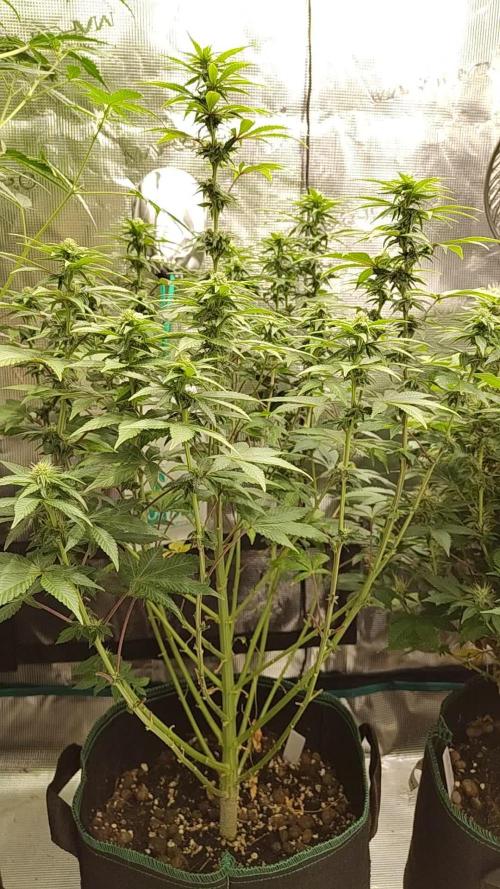
She looks fine after all.. I was away f9r about a week but she didnt miss me, hehe

Processing
Likes
97
Share


@DudeGrowsWeed
Follow
I’m baaaaack!!!
Sorry I’ve been away for a while. I’ve been busy getting everything together for the next phase…
Welcome to the Dude Garden 2.0!
I now have 3 grow areas. Two 2x4 tents (one for clone/veg, another for mothers) and a large 10x12’ish flowering area (its actually larger than that, but I’ll be conservative). The tents are running 300w LED’s and a T5 for the cloning/sprouting station. The flowering area has a 1000w HPS!!! I’m totally psyched to see how the HPS does with flowering for me. From all the research I’ve done It seems to still be undisputed that HPS is the best for flowering (but not so good on the electric bill).
I moved all plants from the tents to the new flowering area under HPS. That includes 3 Blackberry’s (FastBuds), NYC Diesel Auto (Barney’s Farm), DinaMed+ and Critical+ (DinaFem), Cream & Cheese CBD (Seedsman) and 3 Cherry Hemp (Elevator Supply Co).
You’ll see the first 2 Blackberry’s are getting close to harvest, but looking a bit funky due to the issues they had early on as seedlings. The 3rd is looking much better and will probably yield more than the first 2 combined. I do love the purple and the aroma is insane.
Note: The HPS gives much more of a yellow wash on the pics than I was expecting. I tried to color correct the pics the best I could and tried to get to the real colors, It should be pretty close.

Likes
11
Share


@w00tGrow
Follow
Here comes the last week, but i think they will need some extra time, will check later on mycroscope.
Likes
8
Share

@GREENPHOENIX6262
Follow
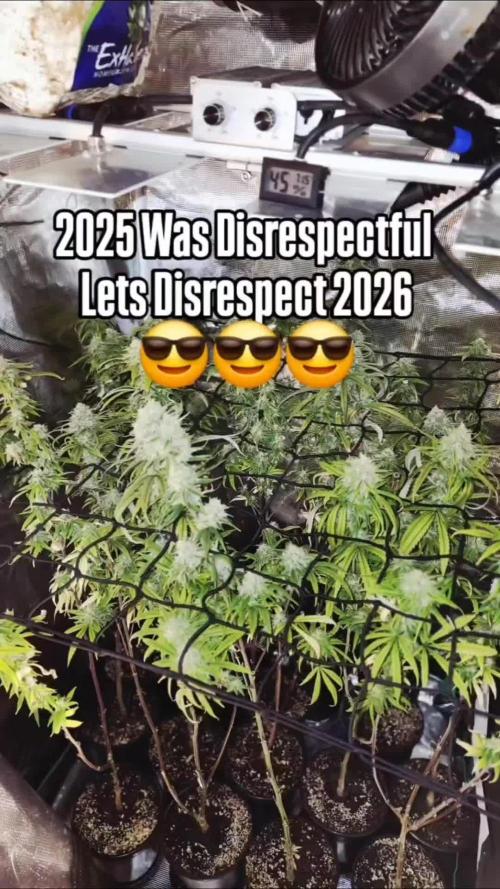
12/30 - Dropped the 3x3 net for spacing - Micro dosing Silica and Green Planet through harvest - Sick plants have bounced back and are flowering accordingly - Update concluded 😎😎😎😎

Likes
1
Share


@Sandero
Follow
Amazing strain with an absolutely amazing profile! best smelling flower ive ever smelt! easy to grow and has an awesome hybrid buz. had some problems with nitrogen tox, but besides that, these things grew great! These is probably my favorite strain ive ever grown!


Likes
8
Share

@GERGrowDesigns
Follow
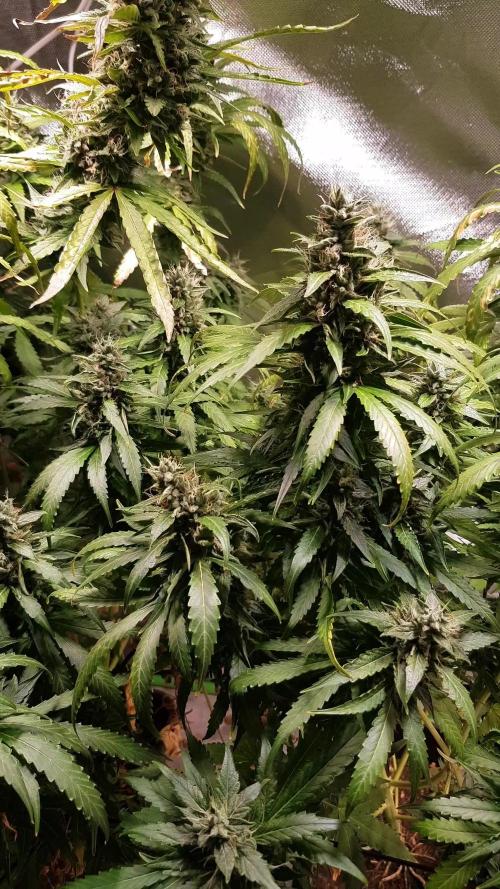
Got Big issues in this Grow Circle because of private Problems and time Problems, and this Strain performed anyway , great work fast buds will try it again ! Its almost died once and still Growed through Flower
Likes
24
Share

@Theia
Follow
Week 4 Flower Diary: The Generative Pivot & Structural Reinforcement
Phase: Mid-Flower / "The Bulking Engine"
Light Intensity: 950 µmol/m²/s
Environment: 28°C / 52% RH (1.56 kPa VPD)
1. Environmental Governance: Chasing the VPD
The primary focus this week has been the pursuit of the "Perfect VPD". As the Invisible Sun intensity was pushed to 950 µmols, the atmospheric pressure was increased to match the metabolic demand.
The 1.56 kPa Target: Raising the VPD at this stage is a form of Generative Steering. By increasing the "atmospheric pull," we maximize transpiration velocity, ensuring the raw materials from the Biotabs and Bactrex are pulled efficiently into the developing flower sites.
Heating Optimization: Introduced a Vivosun W70 heater to replace the bar radiator. This provides a more distributed thermal lift, eliminating the risk of localized root zone damage on inner-facing pots while maintaining the 21.2°C root-floor temperature needed for microbial stability.
2. Nutrient Strategy: Structural Reinforcement
With the PK Tea currently on a 36-hour bubble, the substrate was buffered today to support the high light load.
Silicium Flash Top-Dress: Applied a top-dress of Silicium Flash to provide a slow-release mineral foundation. The added Silicon is critical at 950 µmols; it reinforces cell walls and helps the plant regulate its stomatal aperture under high-intensity stress.
Top-Watering Protocol: Established a weekly 500ml top-watering routine. This serves two clinical purposes: it washes the Silicium Flash into the rhizosphere and prevents the accumulation of salts in the top inch of the media—a common issue in bottom-fed Autopot systems.
Microbial Maintenance: Integrated a monthly Bactrex recharge into this top-watering schedule to maintain the microbial density required to process organic inputs.
3. Photobiological Log: Spectral Steering
The 13/11 photoperiod continues to drive high efficiency via the "Sleep Hack".
Emerson Effect Efficiency: Running the Deep Red (680nm) and Far-Red (730nm) channels mid-day allows both photosystems (PSII and PSI) to operate in a synergistic series. This prevents the metabolic "bottleneck" that occurs when plants are pushed near their saturation point of 1000 µmols.
UV Status: While the Solacure Flower Power arrival was delayed, the room is being coaxed into high gear at 1.56 kPa in preparation. Once the bar is deployed, we will initiate the UVR8 process, where the plant perceives 280nm radiation and responds by increasing glandular trichome density as a biological defense.its some interesting science goes on when you blast 280nm photons at a plant. Proteins do mad stuff which I look forward to going on about once the damn light arrives..
4. Observations & Baseline
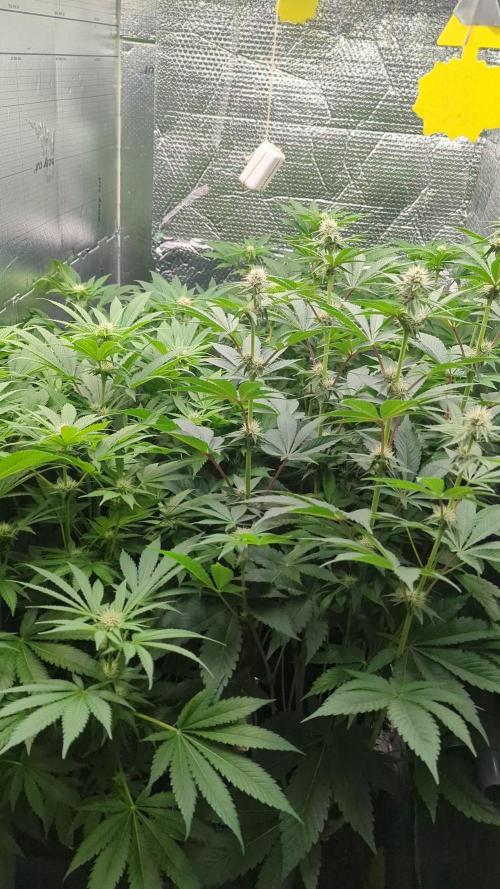
New flower site photos taken today establish the Pre-UV baseline. Stacking is dense due to the high Phytochrome Photostationary State (PSS) maintained by tmynlighting rig and the plants are currently praying to the light gods, indicating they have fully acclimated to the current 950 µmol load.
Weekly Tasking:
In 36hr Check PK Tea oxygenation and apply at the end of the brew cycle.
UV Arrival: Inspect Solacure bulbs and program the 15-minute "Acclimation Pulses" for the mid-day peak.
VPD Check: Ensure RH doesn't climb above 55% during the dark transition.
Thanks for looking.
Grow well.🌿💚🇬🇧

Likes
16
Share


@Naujas
Follow
107 days!! Here is another great experience :) The girl has matured, 330 grams of wet, full of sticky, resinous shiny, pleasantly smelling flowers :) I think it will be about 90 dry :) although the girl is definitely not the biggest, but she looks great, the smell is also amazing :) I also got some sugar leaves from which I will make bubble hash, For me personally it is really beautiful and good growth, which I think will definitely be confirmed by the dried and cured flowers :) there will be a smoke review, as well as the total dry weight. good luck to everyone :).

Likes
16
Share


@Dr_Rook
Follow
Ya casi un mes a 12/12 y entrando en su etapa más bonita.
Están resinando muy bien por todos lados y ya cada vez huelen más y mejor. Empiezan a coger color, demasiado pronto ya que a veces pasan más frío de la cuenta.
Esta semana les he alejado el foco unos centímetros. Estaban 3/4 centímetros por debajo de lo mínimo recomendado y no me fío de quemar mis primeras plantas de interior. (Ya habrá tiempo para experimentos)
La semana que entra ya deberían de entrar en la fase de engorde. Toca seguir atentos a ellas

Likes
78
Share


@Basementganja
Follow
This is my second time growing a Girl Scout Cookies autoflower! She turned out amazing! She showed signs of high potency, from early on in flower!


Likes
5
Share


@eldruida_lamota
Follow
Que pasa familia, vamos con la segunda semana de floración de estas Papaya Zoap F1 de Sweetseeds.
Vamos al lío, me quede con 3 por espacio, siempre pongo alguna semilla de más por si no abriese alguna por no perder ese hueco del indoor.
También se trasplantaron a su maceta definitiva, en este caso de 7 litros.
Y también superaron el shock por el trasplante se recuperaron 100%.
El ph se controla en 6.2 , la temperatura la tenemos entre 20/22 grados y la humedad ronda el 50%.
El fotoperiodo esta a 12/12 para floración. Las jodidas estiraron bastante, y es algo que no me gusta de todas las F1, que cultive hasta ahora.
Hasta aquí todo, Buenos humos 💨💨💨
Likes
1
Share


@DrGowOfficial
Follow
My first Grow with random cuttings.
I found growdiaries after the Haverest.
Likes
21
Share


@Insaniac_0
Follow
3/11 to 3/17 Veg Days 22 to 28
Week 3
Transferred to Auto pot base and continue to top feed for another week before setting up and turning it on. Began node strength training by simply pressing down on the branches to encourage water way repairs into the branches since these are the main arms of my mainlines. They more than doubled in size in just 4 days.
Feed this week was 3 cups of 6.3ph RO water once using 100ppm of Veg Mix (recipe Week 2) However, I also added 1ml/gal of CaliMagic (General Hydroponics 1-0-0). Then about 4 days later when I transferred to the auto pot, I added .5gal of plain RO water to top feed over the new soil.
Feed plan next week will be to start using the reservoir and autopot base feed by the end of the week. I expect to use another .5 top feed prior to that tho.
Likes
18
Share


@Lonnert
Follow
Did some low stress training on the GC again. My Clone rooted and received a 15 L autopot, flipping to flower next week on the 3th to 4th June once the clone has some decent rooting, Reservoir running with 3.0 EC and PH 5.9.
Plan for the next days: Dryback into irrigation Phase before i switch to flower next week in order to prevent salt buildups and a fair usage of already applied nutrients from the Reservoir.

Likes
3
Share

@Mexicanasseeds
Follow
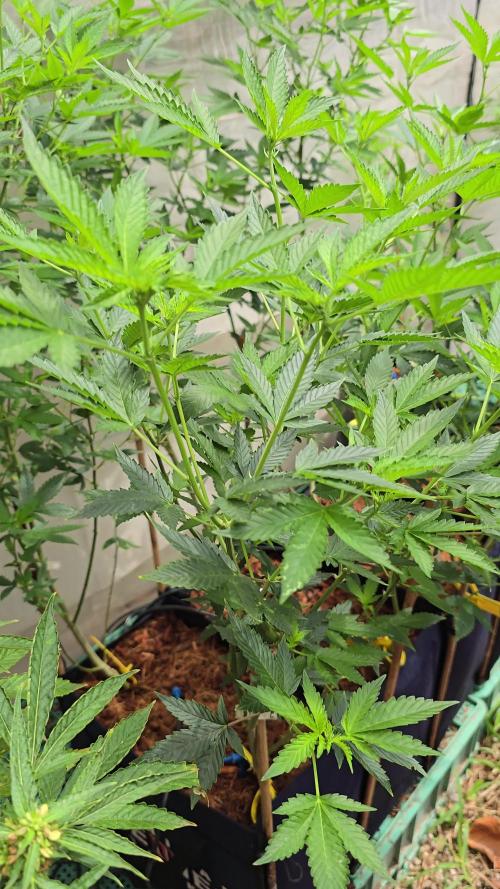
Seguimiento: Semana 1 de Floración (Día 7)
Cultivar: Evaluacion Morfologica de Clones Elite Banana OG (Feminizada) Selección de sobrevivientes al tratamiento antimitótico con Orizalina
Parentales: (OG Kush x Chiquita Banana)
1. Inducción Floral e Ingesta de Luz (Fotoperíodo 12/12)
- Transición Fisiológica: Completada la primera semana desde el cambio a fotoperíodo de floración (12/12). La planta responde con un tramo inicial vigoroso y controlado, manifestando la herencia estructural clásica de su linaje.
- Pistilogénesis Primaria: Se confirma visualmente la formación de los primeros primordios florales en los meristemos apicales y axilares, con la aparición clara de estigmas/pistilos blancos turgentes.
Pigmentación y Expresión Foliar: Tejido nuevo en tonalidad verde lima de alta actividad fotosintética, indicando una rápida movilización de nitrógeno y fósforo para sostener la división celular del estiramiento.
2. Arquitectura de Canopia y Control Estructural
- Elongación Entrenudal: Crecimiento vertical acelerado característico del cultivar, manteniendo una distancia inter-nodal uniforme que permitirá una óptima penetración de la radiación PAR en las partes medias e inferiores.
- Estructura y Soporte Mecánico: Se consolidó el tutorado individual con estacas de madera y anillos de sujeción para guiar la verticalidad de las ramas principales, preparando la estructura para la futura sobrecarga de biomasa en los cálices.
- Saneamiento Basal: Limpieza de bajeras ajustada para eliminar puntos de sombra ineficientes (sumideros de energía), canalizando los fotosintatos directamente a las puntas dominantes.
3. Dinámica del Sustrato y Fertirriego Hidropónico
- Medio de Cultivo: Mezcla inerte de sustrato de coco 50/50 (50% chips para macroporosidad / 50% fibra para retención y CIC).
- Régimen de Riego: Riego por goteo automatizado por micropulsos, distribuyendo la solución nutritiva de manera homogénea en el bulbo húmedo.
- Control Hidropónico:
PH en Drenaje: Mantenido en el rango dulce de 5.8
– 6.1 para asegurar la máxima biodisponibilidad de P, Ca y Mg durante la diferenciación floral.
- Fracción de Lixiviación: ~20% de drenaje por evento de riego para prevenir la acumulación salina (EC) en la zona radicular.
-Temperatura de Solución: Controlada a 24 °C para mantener la saturación de oxígeno disuelto (DO) y evitar estrés térmico directo en las raíces.
4. Estado Fitosanitario y Manejo Ambiental
- Protección Biológica: Invernadero protegido con malla anti-trips de alta densidad y malla sombra Raschel al 30%, mitigando picos de radiación infrarroja y estrés por DPV excesivo.
- Sanidad Foliar: Cero presencia de fitófagos (trips, ácaros o mosca blanca) ni síntomas de patógenos fúngicos (oídio/botrytis). Hojas con limbo bien expandido y estomas activos.