


Likes
Comments
Share


@ZombieKushAddicted
Follow
June25:🤦♂️🏿🙆♂️🏿🤷♂️🏿
June27: the lizards have attacked again... for this... today we are going to raise the girls and place a mesh
June28: I have no idea how they did it... but they got in again!

Likes
10
Share


@Grilla
Follow
March 25, 2023 at 1:48 PM
-Ever since I started watering them with lower pH water, 6.0 to 6.3, the 2 BOH’s really started to takeoff. I might do some slight defoliation on all the plants. I’ll takeoff their lower nodes to make it easier to bend them from the main stock. The strawberry crinkle has very close internodes and is really bushy with large and thick fingers. It’s too short to try and bend over so I might have to do more of the defoliation job in order for the lower nodes to get more light.
March 28, 2023 at 5:24 PM
-
March 29, 2023 at 2:01 PM
-I’ve bent over several stems this week. I have only had one small accident with the strawberry crinkle. The top was snapped off somehow but I don’t remember it happening, but it seems to be taking it well. I watered them the day before with some tea with ph at 6.3. so far I could bend over things every day. They are starting to cover the entire pot.
- Today’s the last day of week three.

Likes
25
Share


@BudHaks
Follow
Apologies for not updating last week, I have just been really busy!
These last couple of weeks have been great - her growth is coming along very well. There are no signs of any deficiencies as of yet, what is your opinion!
In regards to defoliating and lollipopping - what growth would you suggest I get rid off?

Likes
16
Share


@Naturalist
Follow
Uped lights to 30000 lux today added some mosquito bits as a few fungus gnats have been flying around, should be topping Gelato #1 soon its been really shooting ahead.

Likes
38
Share


@DeepRootsGrowTrees
Follow
TROPICANA COOKIES FF/ FASTBUDS
WEEK #11 OVERALL
WEEK #3 FLOWER
This week she's doing good buds are starting to get some trichomes and some structure to them she's looking healthy no issues so far!!
Stay Growing!!
Thank you for stopping by and taking a look!!
Thank you FASTBUDS!!
TROPICANA COOKIES FF / FASTBUDS


Likes
5
Share


@wheedtobeus420
Follow
Day 75. She’s huge and in the dark ice flushing. She smells amazing. I can not wait! 🎂🎂🎂🎂 we also added another meet Mortimer

Likes
6
Share


@RhodiesGrow
Follow
Day 22: First pistils showing.
Day 23: + Speed looking good. Largest of the group so far. Fed 750ml of 5ml FloraMicro, 6ml FloraGro, 4ml FloraBloom, 2ml CALiMAGic, 1ml RapidStart, 2.5ml ArmorSi and 1ml Floralicious Plus PH: 6.2 Solution Temp: 69º PPM: 900 Tent Temp: 79º RH: 56% PPFD: 600 VFD: .60 kPa
Day 24: Watered only PH: 5.8 Tent Temp: 79º RH: 56% PPFD: 600 VFD: .60 kPa
Day 25: Fed 4ml FloraMicro, 4ml FloraGro, 6ml FloraBloom, 2ml CALiMAGic, 1ml RapidStart, 2.5ml ArmorSi, 1ml Floralicious Plus, 1ml Liquid KoolBloom and 10ml FloraNectar PH: 6.2 Solution Temp: 69º PPM: 900 Tent Temp: 79º RH: 56% PPFD: 600 VFD: .60 kPa
Day 26: Watered only PH: 5.8 Tent Temp: 79º RH: 56% PPFD: 600 VFD: .60 kPa
Day 27: No water no feed. Let grow. Tent Temp: 76º RH: 56% PPFD: 600 VFD: .60 kPa
Day 28: Lite defoliation and LST. Little + Speed making a come back. May produce 1/4 oz by the time it's done. Fed .5gl 4ml FloraMicro, 4ml FloraGro, 6ml FloraBloom, 2ml CALiMAGic, 1ml RapidStart, 2.5ml ArmorSi, 1ml Floralicious Plus, 1ml Liquid KoolBllom and 10ml FloraNectar PH: 6.2 Solution Temp: 69º PPM: 900 Tent Temp: 77º RH: 55% PPFD: 600 VFD: .60 kPa
Day 29: + Speed looking quite nice. Good node spacing. Starting to stretch in her first few days of flowering. No water no feed. Bumped light up one notch on the controller to 8. Tent Temp: 76º RH: 52% PPFD: 750 VFD: .66 kPa

Likes
15
Share


@Waveform
Follow
Day 17 (starting Aug. 2nd afternoon): Will water them with a lightly enhanced RO water that was imprinted with frequencies via a PEMF coli for about one day when their day starts.
After being away over the extended weekend, on day 20 ladies have grown very nicely. I topped nr# 1 and #2 after I took the photos and will give them a bit of water with Root Complex to compensate for the shock later. Sadly my brilliant control equipment has crashed completely and will not even take a photo currently. Yikes. Hope I can get it back alive this week again. Also turned the left light up by another 20%, now running at 40 W, and lifted it a bit. Eye inspection told me lights were lower here and ladies can get a bit more.
At the end of their day 20, they seem to have survived the topping well. I managed to cut right above the new nodes which are already growing. Ladies are at 20 cm height before going to sleep.
Day 21 shows great growth again, with lady #1 being at 22 cm now and lady #2, while being a bit less tall, extremely good side branch development. I hope that the rearranged lighting on the left side of the tent will make #1 grow a bit bushier too.
Besides from that, I am really happy I tested Hesi HPE. I had such enormous success with room plants that made me want to see how Cannabis plants react to it. It will not add much to salinity, so I dared to add it quite early. While the photos are processed to compensate the lighting, I did not add much to saturation, so leaves are indeed of a very vivid, luscious green and ladies looking extremely healthy. Speed of growth has increased too as the added video shows. It also tells me lighting is enough – they are turning their leaves away right at the end of their day. I am really uncertain if I will change to usual Hesi grow fertiliser at all …
Did a bit of LST to the lowest branches of lady #2 which spread almost to the border of her pot.
Both temporary girls will leave the tent soon, so that the competitors will have maximum space to develop.
Day 22, end of week 3:
Outside girl went to get fresh air from now on. Wishing her luck, good weather and not a single male in the vicinity.
I rearranged the lights and positioned them a bit higher. First preflower signs appeared on the ladies, so I will change the lighting phase when I return next week. Currently, I have them at 18/6, 45 cm above heads, with 80% running to a total of 80 W.
I wasn’t so lucky topping #2. She has only one "top side" branch now … But grows extremely well, so ok!

Likes
11
Share

@CannaArchive
Follow
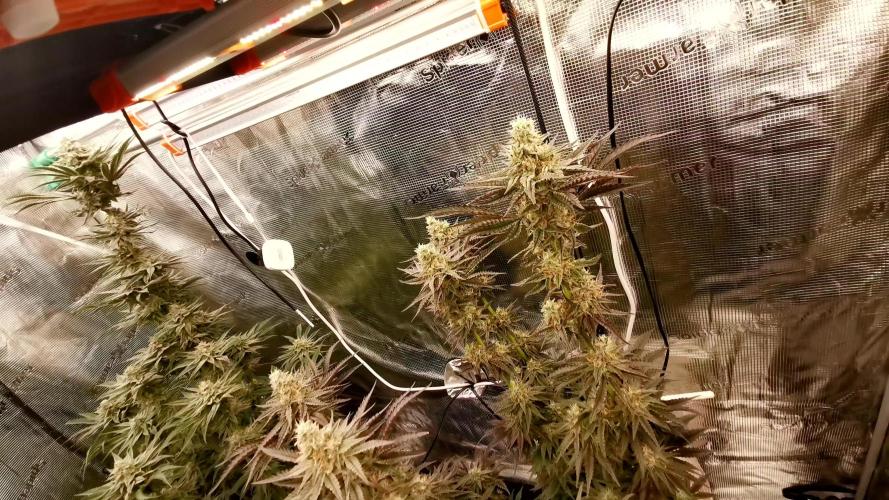
This week the Chicken n' Wafflez continued to bulk up steadily. Buds gained noticeable size and density while resin production increased across the entire plant. The sugar leaves are now heavily coated in trichomes, giving the flowers a very frosty appearance.
Environment:
25-26°C • ~60% RH 🌡️
Feeding:
Water, CalMag & 1x Orgatrex
The aroma became more complex this week. Alongside the sweet fruity and jam-like notes, a more herbal and spicy character started to emerge, adding extra depth to the terpene profile. 🍓🌿
Water consumption remained stable throughout the week and the plant showed no signs of stress. The foliage stayed healthy and green while the flowers continued stacking along the main cola and side branches.
Feeding was kept simple with plain water, CalMag and one application of Orgatrex. 💧
Overall, this week felt like a transition into the final stages of flower development. Buds are swelling nicely, resin production is ramping up, and the terpene profile is becoming richer with every passing day. ❄️🔥

Likes
25
Share


@I_Identify_As_A_Dan
Follow
Week 5 of flower for Lemon Orange by Greenhouseseedco,
1 of the phenos is a super super early developer, when compared to the other 2 its night and day difference for sure.
The other 2 phenos are also struggling with the feeding abit again... they just seem to be such heavy feeders... I'm not sure if ive got a Nitrogen problem or magnesium? If someone wants to throw out their thoughts that would be great.

Likes
18
Share

@Naujas
Follow
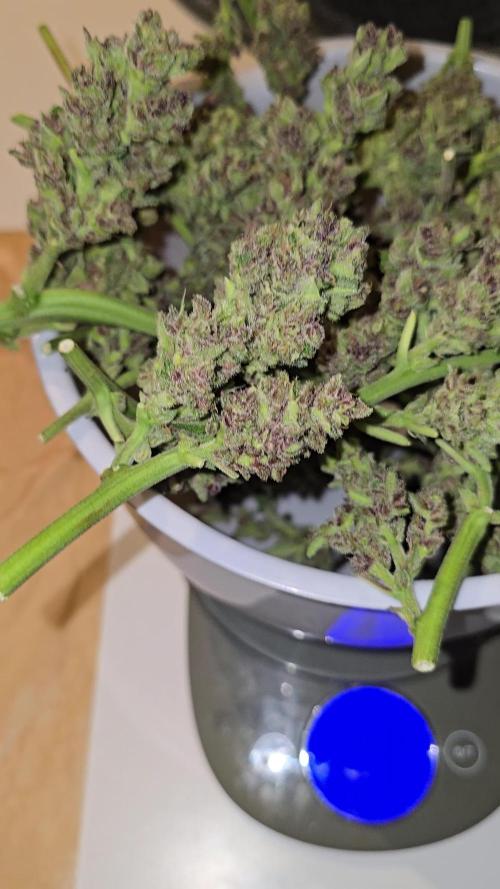
73 days!!!! That's how long my project on the northern balcony of the house has been missing, the last two weeks it was very hot about 35°, and now storms are approaching, so I decided not to risk it and harvest :) The whole growth went quite smoothly, there were no difficulties:) The flowers look very full of trichomes :) (I already want to taste it) :D knowing that my girls, received sunlight only for a very limited time around 4-5 am, she ripened really beautiful flowers:) @Plagron nutrients, it was very easy to dose, (that's amazing) next year, I think I will continue my balcony project:) good luck to everyone
Likes
70
Share


@CBD_Sweden
Follow
@MephistoGenetics,
Hi all the happy people here in GrowDiaries.
This is my second cultivation ever and it will be fun to try a bigger space than my closet grow.
First, I'm just going to say I'm done with the construction of my new growroom.
The room is 2.14 meters by 1.7 meters and has a ceiling height of 2 meters.
It provides a floor area of 3.6 square meters.
I use a 54 Watt Lightwawe T5 for germination and 2 Pcs 400 Watt HPS lamps.
I have a channel fan that replaces the room air about 40 times an hour to get a comfortable environment in the room, the air enters a fresh air intake from the outside.
The air is purified through a carbon filter to then leave the room to the rest of the basement.
Then I use that heat to heat the rest of the basement.
I will use 10 pcs 15 liter Autopots to grow with and a 100 liter water tank that supplies the pots of water and nutrition.
I will grow completely organically in soil and will watercure my buds to get the best possible medicine for me.
But there are no cultivation rooms to be displayed here, so I continue with what is most important.
I am very excited to see how the new growroom will work and how this Illuminauto 21 - Sour Crinkle will turn out.
Illuminauto 21 - Sour Crinkle (Grape Crinkle x Sour Crack)
Two of our fastest and frostiest varieties collide to make a sweet and sour delight!
Expect super frosty, compact nugs that won't be a toke for novices.
Destined to be a great strain for extraction work too!
Plant size - Small - Medium
Cycle time - 60-65 days from sprout
Indica/Sativa - 80/20
Frost level - Extra Ridiculous
https://www.mephistogenetics.com/product-page/illuminauto-21-sour-crinkle
--------------------------------------------------------------------------------------------------------
2017-09-18. Start of week 4. I have defoliated her and she got water and nutes. She is 20 cm high and have not start to stretch yet.
--------------------------------------------------------------------------------------------------------------------------------------------
2017-09-20. Kl 23.00. Did some massive defoliation, added video and pics
------------------------------------------------------------------------------------------------
2017-09-22. The girl has recovered well after my massive defoliation. She is now 24 cm high. Gave her water and nutrition today.
Likes
99
Share


@Kitties_and_Colas
Follow
~_~_~_~_~_~_~_~_~_~_~_~_~_~_~_~_~_~_~_~_~_~_~_~_~_~_~_~_~_~_~_~_~_~_~_~_~_~_~_~_~_~_~_~_~_~_~_~_~_~_~_~_~_~_~_~_~_~_~_~_~_~_~_~_~_~_~_~_~_~_~_~_~_~_~_~_~_~_~_~_~_~_
❤️💡🌱😽💨
Its been a decent week for this tent, the Kiss seems to be a little further along than most at week 3, I think this strain might be an early finisher but time will tell.. we noticed some yellowing from light stress so we raised the fixture again instead of playing with the dimmer (the Mars is at 75% strength now)..the cheese terps are coming off very strong already, its going to be insane in a few more weeks lol.. thanks for dropping by and happy harvests folks! ❤️🌱
~_~_~_~_~_~_~_~_~_~_~_~_~_~_~_~_~_~_~_~_~_~_~_~_~_~_~_~_~_~_~_~_~_~_~_~_~_~_~_~_~_~_~_~_~_~_~_~_~_~_~_~_~_~_~_~_~_~_~_~_~_~_~_~_~_~_~_~_~_~_~_~_~_~_~_~_~_~_~_~_~_~_

Likes
4
Share

@Spanish_dre_Grows
Follow
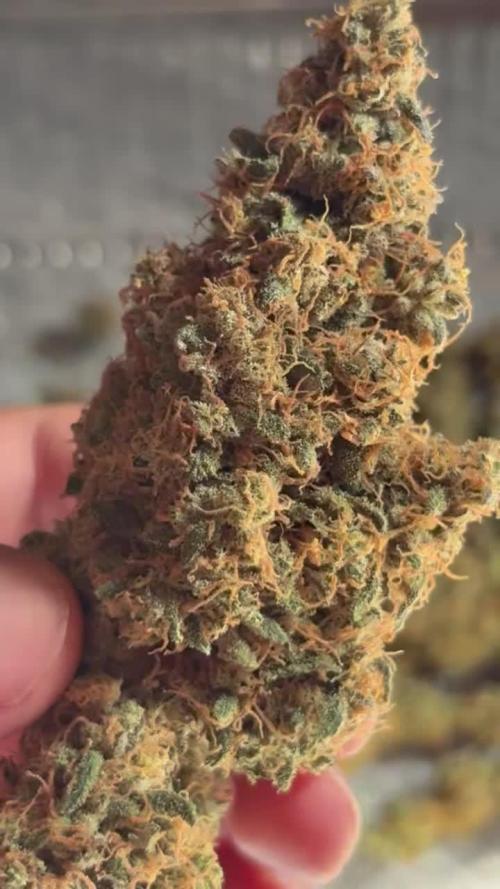
What a great run, Very resistant plant I left the light on 3 times for 24 hours on three separate occasions and it did not herm. Very funky and almost like a pine and menthol taste to it..definitely worth growing again. Got some huge, dense nugs !!!

Processing
Likes
15
Share


@Dico29
Follow
It’s now showing pistils pretty well, and I got some critical peyote from Barney farms In a napkin right now
There is a little burnt tip on fan leaves I think too much nitrogen since it’s in the big pot and the leaves are dark green. But looks good happy I picked the internodes during preflower too


Likes
20
Share


@JohnnyBlaz3
Follow
😍 shes actually very close to done, i might even harvest her tmr, if not then probably the next day, saw alot of milky with the odd amber today! She is also stankin nice a lovely. She has a little more flower than i expected to be honest, which still isnt very much but i'm pleased for the first outdoor grow. That is if she smokes as nice as she smells. I see a moderate amount of trichs, not like the tent but still nice and sugary. Next post should be the harvest report! I think i'll toss out a dried guess of 18 grams and its gonna be a little fluffy
Likes
7
Share


@MatimaisterWeed
Follow
En este periodo de la planta me preocupe de agregarle los nutrientes faltantes a la planta con Gold Sunshine e hice poda Apical

Likes
27
Share


@valiotoro
Follow
Pheno 1 dark purple : On the nose, it reveals a sharp burst of fresh lemon, layered with a powerful eucalyptus aroma that’s both invigorating and camphorous. A truly refreshing and vibrant terpene profile😈🍋
Pheno 2 Green : this one is a real surprise! If I close my eyes, it’s like Nutella! It’s as if you’ve just walked into a kitchen where hazelnuts have been freshly roasted 🤤🌰
Pheno 3 light purple : It’s a mix of the first two with a hint of amarena cherry at the end🍒🍧
Likes
28
Share


@Vincent11
Follow
Hi all grow buddy's.
Hopefully you all got a great week.
And nice, exiting things happening in your Grow rooms.
Another week gone in the cupboard with the RQS Organic Grow Gorilla Autoflower.
She's looking stunning. Day-36.
I am in Love 💕
She Started to form her buds slowly and nicely she's loaded with them all over.
Pistils poking out every where and we have a full canopy of bud sites.
Starting to smell slightly.
Accepted Easy Bloom booster tablets 1/4 twice this week with 1.2l water and only water 1.2L 6PH once.
I can say I haven't enjoyed an easy Grow as this RQS Organic Grow is turning out to be so far.
RQS have done amazing job on the organic fertilisers Easy Boost Organic Nutrition and Easy Combo Boosters Pack.
Congrats on that.
No other nutritions added and not any sightings of deficiency showing at this stage.
Last 10 pictures mid week update day 40 from germination
Thanks for following and good luck with your grows.
Happy Growing.
