Likes
15
Share
@BastiFarm
Follow
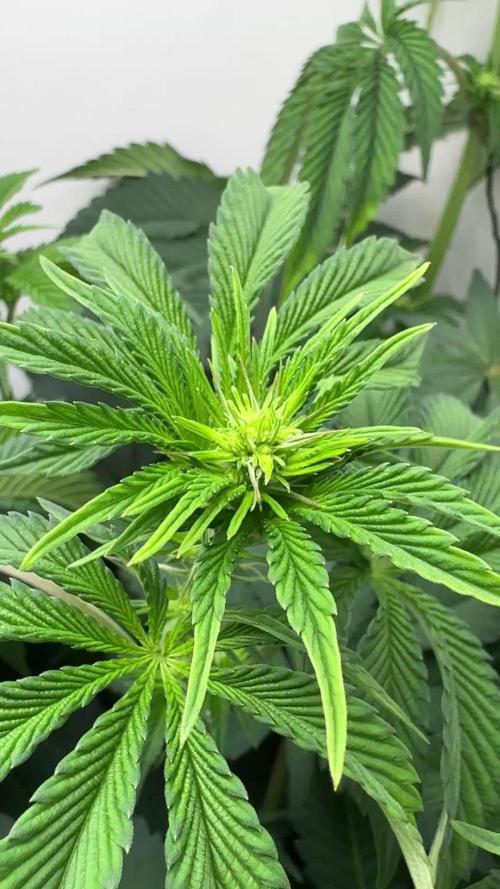
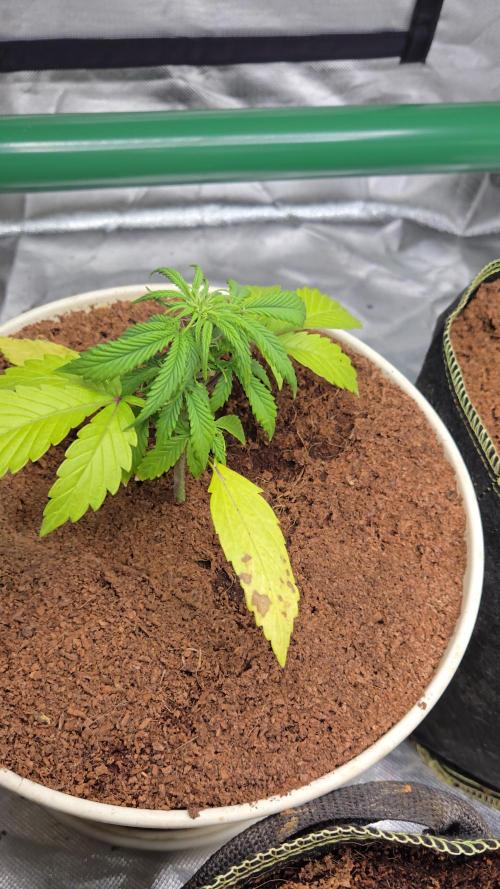
Cuarta semana de vegetación y he notado varios cambios en Kukulkán de la izquierda la veo con las hojas algo caídas a comparación a la de la derecha, que siempre está vigorosa siendo que riego con la misma agua y los mismos cuidados. Hoy toco riego sin alimento, pero con calmag para subir el ec del agua purificada y subir la cantidad de calcio, magnesio y otros nutrientes al agua , veremos qué tal funciona. A una semana aprox. de pasar a floración compré la línea orgánica de wonderland y me gustaría empezar a usarlos en floración, mi pregunta es si la planta tolera el cambio de alimento si alguien sabe, puede dejar su comentario 🙏🏽
Likes
Comments
Share
Full tilt for the next week & then flush next week with Rootdrip compost tea & cannazym Same Z smell but I’m loving the Bud formation less airy as other Z strains so far can’t wait to cut down!
Likes
15
Share
First pistils appear with purple hue even tho my temperatures are pretty high. They're loving the sun
Likes
5
Share
@Mattyice
Follow
Buds are definitely getting bigger the smell is so stab you in the nose potent it almost makes me sick up close. I really can't believe this is an autoflower that I barley trained. Definitely will be producing anywhere from 80-100g+ by the time its done I think is a good estimate. What I failed to mention in the first update is every branch has outgrown the main cola. It is buried but still growing strong apparently. It's impressive actually it grew like that without training. All those branches will be thicker than the main cola by far they already are. It's got me so excited this plant is frigging huge although short it is wide. It's so big the base of the main stem is probably the size of two fingers and it has roots growing out of all sides and a mess of roots underneath the cloth pot
Likes
3
Share
@CalGonJim
Follow
6/9 315am 6/10 9am 1868 All hope is lost, the War of Northern Aggression has been lost the ratification of Fourteenth Amendment has somehow passed, a cursed future at best awaits us...... Oh wait wrong diary..... FUCKING GREAT.... She LOVES the new light!!! 6/13 2am. got a little messed up order of pictures, she's doing GREAT
Likes
Comments
Share
🌿 Frosted Guava Auto by Zamnesia | Pheno B | Week 8 (Flower Week 5) 🌿 Small Plant. Big Personality. And Now… A Little Less Green. There are plants that follow the plan. And then there are plants that write their own story. Frosted Guava Pheno B has been doing the latter from the beginning. She has never been the biggest plant in the room. She hasn't chased height, hasn't tried to dominate the canopy, and hasn't demanded much intervention. Instead, she has quietly developed her own personality. Compact. Elegant. Beautifully structured. And increasingly covered in flowers. Now, entering her fifth week of flowering, she has reached another important moment in her journey. This week, she joined the group receiving a selective flowering defoliation. Not because she was struggling. Not because she was unhealthy. And certainly not because every plant needs to be defoliated. Quite the opposite. She was looking fantastic. But after looking carefully at her structure, her development, and the way light and airflow were moving through the plant, I felt that removing some unnecessary foliage was the right decision. So we went in. We cleaned her up. And now we're going to see what she does with the extra space. 🌸 Week 5 Flower – Her Own Story Frosted Guava Pheno B is currently around 108 cm tall. That still makes her one of the more compact plants in the room. But honestly? I don't think she cares. 😂 She has found her own architecture and she's sticking with it. The flowers continue developing beautifully, with increasingly visible frost and those characteristic white pistils reaching outward from the developing buds. Her foliage has remained lush and healthy, with that beautiful deep green colour we've been following since the beginning. The plant looks comfortable. The flowers are developing. And now we're starting to see more definition between the different parts of the plant. This is exactly the kind of moment where stepping back and looking at the whole plant becomes important. Because sometimes the question isn't: "Can I remove this leaf?" The better question is: "Does this leaf still have a useful job to do here?" And that's where this week's defoliation came from. ✂️ Defoliation – What We Actually Did This wasn't a complete strip. It wasn't a race to make the plant look naked. And it wasn't about removing leaves simply because they were large. The approach was selective. I removed most of the fan leaves carrying their own petioles, particularly where they were contributing to unnecessary shading or creating congestion inside the plant. I also cleaned the lower and interior portions of the plant where some flowering sites were positioned so far below the productive canopy that I didn't expect them to develop into meaningful flowers. Those areas are what I would consider the true bottoms on a compact plant like Frosted Guava. And that's an important distinction. Because this plant is small. Her lower sites really are lower. Even with the Lumiflora under-canopy lighting helping bring additional photons into the lower canopy, the primary productive zone of the plant remains higher up. So rather than allowing the plant to spend resources maintaining foliage and very low sites that are unlikely to contribute much, I decided to clean those areas selectively. But I didn't remove everything. Some lower flowering sites remain. I want to see what they can actually do. That's part of the experiment. 🌿 What Is Defoliation? For anyone new to growing: Defoliation is the intentional removal of selected leaves from a plant to alter the structure of the canopy. The goal isn't simply to have fewer leaves. The goal is to create a better balance between: light penetration + airflow + canopy structure + productive flowering sites. Leaves are extremely valuable. They're the plant's solar panels. So removing them should never be treated as something automatically beneficial. Every leaf removed is a piece of photosynthetic machinery removed. That's why I don't approach defoliation as: "Flower started. Time to strip the plant." Instead, I look at the plant in front of me. Is the canopy becoming too dense? Are leaves heavily shading developing flowers? Are there congested areas where airflow is poor? Are there leaves that are doing very little because they're buried underneath several layers of foliage? Are there lower sites that realistically have very little opportunity to develop? If the answer is yes, then selective defoliation can make sense. If the answer is no... Leave the plant alone. 🚫 What Defoliation Is NOT This is probably even more important. Defoliation is not: ❌ Removing every fan leaf ❌ Trying to expose every single flower to direct light ❌ A substitute for good plant structure ❌ A guaranteed way to increase yield ❌ Something every plant needs at the same time ❌ An excuse to strip a healthy plant simply because you can The objective isn't to make the plant look clean for the sake of appearance. The objective is to improve the functional canopy. And there's a big difference. A beautiful green leaf isn't a problem simply because it's a beautiful green leaf. If it's healthy, receiving light, contributing to photosynthesis and helping the plant, I have no reason to remove it. But when the canopy becomes crowded and certain leaves are contributing more obstruction than productivity, that's when selective removal becomes interesting. ✂️ How I Approach It My approach is simple: I observe first. I don't start with a predetermined number of leaves that must disappear. I start by looking at the structure. Then I work from the outside toward the interior and from the top toward the lower portions, looking for unnecessary congestion. Leaves that are heavily shading productive flowering sites can be candidates. Leaves buried underneath several other leaves can be candidates. Leaves occupying congested interior areas can be candidates. And lower growth that is so far beneath the productive canopy that it has little realistic opportunity to develop can also be considered. But I always keep the plant's overall health in mind. The goal is balance, not maximum removal. That's why Pheno B still has plenty of green. She's not naked. She's simply better organized. 💡 The Under-Canopy Question This is particularly interesting with Frosted Guava Pheno B because we're running Lumiflora under-canopy lighting. Someone might reasonably ask: "If you have light underneath, why remove the lower growth?" That's a very fair question. And the answer is that under-canopy lighting doesn't magically make every lower flower equal to a top flower. On a compact plant like this, the very lowest parts are still extremely low relative to the main productive canopy. The under-canopy lighting is helping reinforce the lower and interior areas, but I still want to observe where the plant naturally allocates its energy. That's why I deliberately left some lower flowering sites behind. I don't want to assume. I want to watch. Will those remaining lower sites develop? Will the extra light make a noticeable difference? Will the upper flowers continue dominating? That's exactly the kind of question this project allows us to explore. And the harvest will eventually give us the answer. ☀️ More Light Where It Matters The Future of Grow Black Series LED continues providing the primary light from above, with approximately 1,000 PPFD across the upper canopy. Frosted Guava may be compact, but she certainly isn't short on photons. She's been sitting underneath that light throughout flowering, converting those photons into leaves, flowers, structure and now increasingly visible resin. And with the selective defoliation, we're changing how some of those photons move through her architecture. We're not creating more photons. We're simply trying to make better use of the ones already available. That's the idea. Don't waste energy chasing light. Build a canopy where the available light can actually do its job. ❄️ And The Frost Is Getting Serious The name Frosted Guava continues becoming more appropriate every week. The flowers are developing beautifully, and the resin production is becoming increasingly visible. Those white pistils are still everywhere, creating an incredible contrast against the deep green foliage. And underneath all those hairs, the flowers are beginning to gain more structure and density. This is the stage where I love looking at the same plant from week to week. Because the change isn't always dramatic overnight. But compare the plant to where she was a few weeks ago... And suddenly you realize: She's building. She's filling out. She's gaining flower volume. She's becoming increasingly defined. She's becoming Frosted Guava. 🌿 Small Plant. Big Character. I've said this about her before, but this week makes it even more obvious. Frosted Guava Pheno B doesn't need to be the tallest plant in the room. She's already found something more interesting. Character. Her sister Pheno A has followed a different path. And that's one of the beautiful things about running phenotypes together. Same genetics. Same room. Same light. Same nutrition. Same philosophy. Different personalities. Pheno B has chosen to remain compact and elegant. And now, as flowering progresses, she's showing us exactly what that compact structure can become. 💧 Nutrition & Hand Watering We're continuing with hand watering throughout the room. Current feeding remains centered around the Plagron flowering program: Terra Bloom — 2.2 ml/L Power Buds — 1 ml/L Sugar Royal — 1 ml/L Green Sensation — 1 ml/L Lemon Kick — 0.03 ml/L Current recorded parameters are around: pH: 6.0 EC: approximately 2.0 mS/cm Solution temperature: 21°C Root-zone temperature: 21°C Watering: approximately 1.2 L per 24 hours Hand watering has also given me another opportunity to observe this plant closely. Every time I water her, I get another chance to look at the flowers, inspect the leaves, check the structure and notice those tiny changes that are easy to miss when everything is automated. It takes more work. But it also brings you closer to the plants. And sometimes that's where the best observations happen. 🌡️ Environment The room continues running under stable conditions: Day temperature: 29°C Night temperature: 25°C Relative humidity: approximately 72% Solution temperature: 21°C Root-zone temperature: 21°C CO₂: approximately 639 ppm With the canopy becoming increasingly dense, airflow and humidity management become even more important. That's another reason selective defoliation can be useful at this stage. Not because leaves are inherently bad. But because a dense flowering canopy can create small pockets where air movement becomes less effective. Opening selected areas gives the room a little more breathing space. And that's particularly valuable as the flowers continue developing. 🔭 Looking Ahead Now comes the interesting part. We've changed the architecture. We've removed some unnecessary foliage. We've cleaned the lower sections. We've opened some of the interior. And now... we wait and observe. I want to see how quickly she responds. I want to see how the flowers develop with the improved canopy structure. I want to see what happens to those lower sites we deliberately left behind. And most importantly, I want to see how Frosted Guava Pheno B continues writing her own story. Because she's already made one thing very clear: She doesn't need to follow anybody else's timetable. ❤️ Final Thoughts – Let Her Shine Frosted Guava Pheno B has been one of those plants that quietly earns your attention. She didn't arrive in the room demanding the spotlight. She didn't become the tallest. She didn't become the biggest. She simply kept growing. And week after week, she became more beautiful. Now she's entered another chapter. A little less foliage. A little more breathing room. A little more light moving through the canopy. And plenty of flowers left behind to show us what she's capable of. The important thing about this week's defoliation isn't how many leaves we removed. It's why we removed them. Because good cultivation isn't about following a recipe blindly. It's about looking at the plant in front of you and making decisions based on what she's actually telling you. And Frosted Guava Pheno B was telling me: "I'm ready." So we listened. Now let's see what she does. A huge thank you once again to Zamnesia for these beautiful genetics, Plagron for the nutrition, Future of Grow for the Black Series lighting, Lumiflora for helping illuminate the lower canopy, TrolMaster for environmental control and of course to everyone following this 8×8 Adventure on GrowDiaries. Every week, every phenotype tells us something different. And that's exactly why I love this project. Until next week... Let her shine. She has earned her spotlight. ✨🌿❄️ Growers love and happy growing! 🌱💚
Likes
31
Share
Likes
44
Share
@Roberts
Follow
Casey's Rollex OG sprouted on the second seed. The husk was caught on the leaf, and was wet. Which caused the burn from the light on the tip. Regardless she is started and doing okay. She is still very young. Nothing more to report yet. Thank you DutchFem Seeds, and Spider Farmer. 🤜🏻🤛🏻🌱🌱🌱 Thank you grow diaries community for the 👇likes👇, follows, comments, and subscriptions on my YouTube channel👇. ❄️🌱🍻 Happy Growing 🌱🌱🌱 https://youtube.com/channel/UCAhN7yRzWLpcaRHhMIQ7X4g
Likes
34
Share
Salut Amis cultivateur 🍁💥 Aujourd'hui on attaque la 6e semaine de floraison 🗓️ Plus les semaines avance plus dame nature me récompense 🤗 Nous arrivons bientôt dans la dernière ligne droite je pense les laisser encore trois semaines voir plus, pour qu'elle soit au maximum de leurs capacité. 🙏 La pure Skunk Go Fast, impressionnante elle a des buds d'une beauté magnifique il se forme tous au même niveau tous de la même grosseur, 16 têtes principales sur le pied comment dire que j'ai hâte de voir gonfler ses tête rapidement.
Likes
11
Share
@MRTHC
Follow
Well we finally reached the end. The last week was more cruise control. Just trying to remove the big fan leaves that's blocking any flowers. The trichomes looking kinda ready but still acceptable. During the last few days I maintained a daytime Humidity of around 60 and nighttime of 55. Temperatures are between 73 degrees and 67 degrees. Two days before chop they got 48 hrs of dark and 3 days of no water to add to the stress. After the 48hrs darkness all the ladies Came out extra frosty. Loving the change of hues on the blue gelato. The vanilla Kush is very oily and very very strong smell. Not a strong smell coming off the OrangeGelato though. The green gelato has a creamy smell.
Likes
22
Share
I deliberately sent my 2 ladies into flower 2 months earlier. roughly the 12/12h rule. Sometimes it was 10 hours in the sun, but sometimes 12 hours. In my region it will soon be rainy and cold. I'm toying with the idea of harvesting them before I catch mold or something else. The trichomes are all milky. About 15-20% amber colored.
Likes
Comments
Share
Scrog works well. We are about 5 days into 12/12. Stretch is doing fine so far, keeping it contained within the scrog
Likes
6
Share
These girls are mostly doing amazing I had an issue where my pup came in to the greenhouse and lollipopped my GG4 but she stayed alive.
Likes
38
Share
Flowering day 3 since time change to 12 / 12 h Hey guys . My cutting heating broke 3-4 weeks ago, which was fixed immediately and everything went wonderfully. Now, 3 days ago, the central heating broke down in the entire room, so that at night I only have temperatures of around 13 degrees :-( . One or the other lady is slowly starting to see a phosphorus blockage, as this can no longer be absorbed at temperatures below 15 degrees, like many other nutrients :-( . A friend looked at the heating yesterday and came to the conclusion that a real company had to do it, which is by no means possible for a stranger to enter my room. I quickly ordered heating mats for all the boxes so that the ladies could at least get warm feet. That's all I have this winter full can do . Let's hope everything will be fine 🙏🏻. As soon as the heating mats are attached in the coming days, I will post them in the pictures. Now for the update. Despite the severe cold, the ladies are still doing well and have made good progres . The ladies only had to be watered once this week, each time with 1 l, because it absorbs the water very slowly because of the cold and I don't want to overwater it. I took every single plant in the pot to take a close look at their roots. These are snow white and look very healthy 🙏🏻. It was also the last time neem oil sprayed so that the last trips are finally gone. Otherwise everything was checked and a lot of planning was done, like I do with the heating mats. Since a friend had the same problem in one winter and the heating mats got 10 degrees plus on the pots, I am very confident that it will at least bring something for the last cold month 😃 🙏🏻. I've started flowering even if some are still a bit small, but otherwise they'll get too wide from training and end up taking up space :-) until then have fun and stay healthy 🙏🏻 👇🏼👇🏼👇🏼👇🏼👇🏼👇🏼👇🏼👇🏼👇🏼👇🏼👇🏼👇🏼 You can buy this Nutrients at : https://greenbuzzliquids.com/en/shop/ With the discount code: Made_in_Germany you get a discount of 15% on all products from an order value of 100 euros. 👇🏼👇🏼👇🏼👇🏼👇🏼👇🏼👇🏼👇🏼👇🏼👇🏼👇🏼👇🏼 You can buy this strain at : https://www.exoticseed.eu/de/hanfsamen/hippie-therapy-cbd Water 💧 💧💧 Osmosis water mixed with normal water (24 hours stale that the chlorine evaporates) to 0.2 EC. Add Cal / Mag to 0.4 Ec Ph with Organic Ph - to 5.8 - 6.4 MadeInGermany
Likes
13
Share
@Drawer
Follow
I still found a few places with bud rot and I keep removing every spot I see. The plants have been doing fine beside that, they are looking and smelling great, they are super dense and I can't wait for them to be ready. Most trichomes are still clear so I am awaiting for the first ambers to show up, aiming for around 5% amber and 95% milky.
Likes
19
Share
@Ferenc
Follow
Lovely buds sweet and fruity with citrus smell and the taste of the smoke is the same. She has a potential to have a good yield if you have a good lamp. Nice buds really sticky, with nice trichomes. :)
Likes
10
Share
With Zamnesia's photoperiod Georgia Pie #2, we're taking another trip to America. We're in the Dirty South this time, and for the music on the reel, we've dusted off a Ludacris, whom I consider the father of that so-so music that can be summed up with the word trap. I've always preferred real hip-hop, but this time it doesn't hurt. We're talking about a very famous strain in America, much loved, and now I understand why: the smell, resin, and flower quality are exceptional. The flowers aren't gigantic like often happens with USA strains, but they are exceptionally high quality. Check out the resin content for yourself. Ripeness - The pistils have looked super ripe for a long time, especially the upper ones, which are very red, and we're still over 90%. The trichomes are about 30% amber, 40% cloudy/milky, and 30% clear, more or less naturally, but I think it's fine; it looks super ripe. The flowers are all top-quality, and the yield is excellent, I think 50-70 grams super clean and trimmed not whole plant on scale naturally. The overall shape of the plant is very good a tall girl no techniques used i have another 2 plants. We chose a 100% organic, 1000% Plagron soil, as always. The soil we chose is the recently launched Plagron Bio LightMix, which will allow us to start with more gradual and consistent watering, without the sudden changes that liquid fertilizers can cause. A week of soil is enough, so don't overdo it. Choose your favorite style and calculate your results on the website: www.plagron.com Visit the new Growshop area on the Zamnesia website: Z - https://www.zamnesia.io/it/531-growshop I can almost hear Ray Charles singing... Georgiaaa, try it. Z - https://www.zamnesia.io/en/11085-zamnesia-georgia-pie-semi.html Z - Spice up your grow with this delicious US hybrid. Originally developed in San Francisco, Zamnesia breeders worked hard to trace and stabilize the Gelatti x Kush Mints genetic line that gave rise to the original Georgia Pie. The result? A 50/50 indica/sativa hybrid that grows beautifully both indoors and outdoors, quickly producing dense buds with deliciously sweet terpenes and a powerful effect. Combining the genetics of two fantastic parent strains (Gelatti and Kush Mints), Georgia Pie is both productive and easy to grow. During the vegetative stage, plants grow vigorously, developing moderately spaced internodes and fairly broad fan leaves. Expect noticeable stretch during the transition to flowering: mature plants can reach 130 cm indoors and up to 200 cm outdoors, with numerous side branches that will develop large buds. Thanks to its exuberant leaf growth, Georgia Pie responds very well to regular pruning, defoliation, and training. These interventions will open up the plant's canopy, exposing even the lowest buds to light. Indoors, Georgia Pie typically requires 8-10 weeks of flowering to produce up to 500 g/m², while outdoors, plants are generally ready for harvest around mid-October, producing up to 500 g/plant. You know it, but I recommend it: here you will find so many wonderful things, practically "all the best that nature has to offer." Z - www.zamnesia.com Music // Ray Charles and Dirty South RAP Discography www.radionula.com + Feng Shui Music + Frequencies 432 Hz
Likes
12
Share