





Likes
23
Share


@Athos_GD
Follow
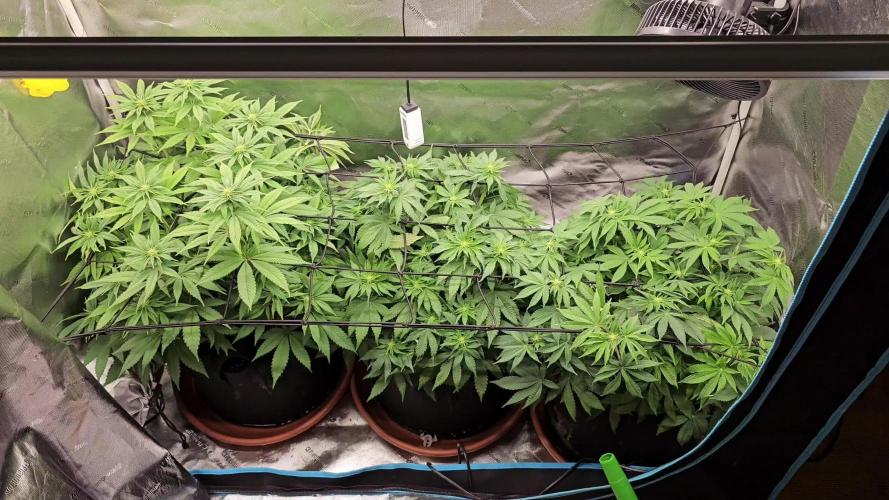
D20. I got rid of the plant in front right. The plant wasn’t growing fast or getting much light because the other two plants stretched a lot. I am actually running out of room and had to already lower my tray.


Likes
13
Share


@raulmoat123
Follow
So as we step into week 6 things are starting to shape up nicely
Seedsman - strawberry banana grape are fantastic frosty and loads and loads of heads due to me topping
Seedsman- peyote gorilla wow I have not smelt bud like it before wonderful and full of thc
Inhouse genetics- dolato is one frosty girl and starting to pack on weight
Inhouse genetics- platinum gushers 2 different phenos one throwing out more people's red
Inhouse genetics- slurrcaine smells like heaven and is the most dankest in my pheno hunt
Phoenix seeds - super kush I brought these over from my last run very fast strain and smells really sweet
Zamnesia seeds-larry bird kush 3 different phenos all smell different can't wait to see the out come
Barney's farm - phantom OG I don't know where to start with this just simply dank
Seedsman - bubba kush was a freebie which I didn't care about or take clones and omg its probly one of the best smelling plants I'm running so Im going to reveg it I can't lose this pheno
Seedsman - super silver haze OG another freebie what I got and am quite pleased with
Last but not least Seedsman- limited edition wedding cake 😋 I'm excited for this one but takes quite long to pack on the weight all in all I'm quite happy




Likes
5
Share


@dauntless
Follow
Week 4 starts Sunday July 17, 2022
Plants seem really nice and healthy. I really like Flora Nova, its a great product. 300ppm and the plants love it, even though the Gaia Green is in the mix, it seems to just love this combo, ever since I repotted with the amendments in the soil, and watered with Flora Nova Bloom (mix it crazy well before using) the plants just look really happy and green. It's not an organic product, maybe like 30% organic -- just like me haha.
I think by week's end we will be caught up and ready to intensify lights, threw the SF1000 in the tent finally for more light, but so far just keeping only the Phlizon white light full spectrum COBs on and the RB lights off, and not using the SF-1000 at all even though its mostly white. Despite what Phlizon says, the COBs are great during veg, the RB not so much. I like the COBs so much better than the smaller LEDs for veg.
July 19, 2022
Turned on the SF-1000 to 60% and measured light, I'm happy with it. I have another strain growing next to these and the extra light will help during flower as a side light but it will most likely hit the canopy too. The growth is vigorous right now. Added pics, today is day 28 since they were dropped into water
July 23, 2022
Tomorrow starts week 5, growth is super green, no funky yellow or leaf drama. Stalks are getting much thicker and stronger. Turned the lights up this week, added the 2nd COB, and temps are just fine! Who knew. Anyway, they look like they are very close to pre-flower. Added some tent mates for a future grow, check out the grow area vid. Maybe I forgot to mention added worm castings this week...
Likes
17
Share


@Nedyah420
Follow
Starting to swell more each day...still very pleased with overall quality..


Likes
2
Share


@theicyeffect
Follow
A diary dedicated to the rest of my special girls. Check out my profile to see the Gorilla Glue up close (she will still appear here from time to time).
Germinated them directly in the soil with natural sunlight, achieving a 100% success rate.
All came out the soil with remarkably thick stems already, excited to see how these old school genetics will behave.
Lots of growth during their first week of life, reaching the end of it with 2 pairs of leaves each. We surely got some sturdy girls here.
Sunset Sherbet had some damage from struggling to hatch and is now slowly recovering, I’m sure she’ll catch up with time. Nothing good nutrition and proper lighting won’t fix.
Bruce Banner turned out to be incredibly big for her age, never grown a seedling like her! You can tell she’s already finding her germination vase too small. Making a statement with her presence.
Biscotti Mintz also looking big and very healthy.
Let’s watch them grow and see what they’ve got 🌱💪
Likes
4
Share


@SakuraAsa
Follow
10/14
#1 Day156 23Week Outdoor(Guerilla) Harvest&Drying
#3 Curing Day31 @boveda62%
#4 Curing Day34 @boveda62%
#Clone☓1 Curing Day26 @boveda62%
#Clone☓3 Curing Day14 @boveda62%
#Clone☓5 12/12
#Clone☓4 12/12 short-day Day37
#Clone☓3 short-day Day4


Likes
25
Share


@BudHaks
Follow
Day 50 from reciving my seeds and equipment and day 46 since I put her into Coco: 25/Oct/2018: She is doing so well and is in her first week of flowering! I saw massive differences and a boost in her budding thanks to Canna PK 13/14 and for those that suggested I start using it (I started at 0.5ml per L, 3 days ago). Her roots seem to be doing very well (I see fuzz of healthy fungus and microbes on the roots when they sprout out of the fabric pot!
Please send any suggestions on my use of nutrients!

Likes
45
Share


@DogDoctorOfficial
Follow
🌸 Mentha de Croco | Week 2 Flower (Week 13 from Seed)
Grow Style: Indoor | Medium: Pro-Mix HP | Feed Program: Aptus Holland Clean Program | Genetics: Mentha de Croco by Terpyz Genetics
Lighting: FOG LED Black Series | Controller: TrolMaster
Photoperiod: 11/13 (Light/Dark)
Camera: Sony A6000 capturing all the vibes
⸻
This week marks a major chapter in our Mentha de Croco mutant hunt: the second week of flower — and the official reveal of who’s who in the garden. As expected with regular seeds, we had both males and females, and this was the week we identified them all. From the original 12 beans, 5 revealed themselves as proud ladies while the rest — equally stunning in structure and expression — turned out to be males. 🌿
💚 Let’s talk about regular seeds and plant sex:
Regular seeds are unsexed, meaning they can become either male or female. It’s a 50/50 genetic roll of the dice — and with unique mutant genetics like these, identifying sex isn’t always easy early on. Males typically show small pollen sacs, often referred to as “bananas” in their early stage. Females develop pistils, the first hairs of the flowers we’re after.
Male plants, while beautiful and structurally fascinating (especially in this mutant project), can compromise a flowering room if left unchecked. Their pollen can fertilize female plants, leading to seeded buds — great if breeding, not great for clean flower. So, we say goodbye, thank them for their beauty, and move forward with the ladies to full bloom. The males? They’ll return to the earth as beautiful compost. 🌱✨
⸻
This Week’s Feeding Schedule (Aptus Holland Clean Program):
• Regulator – Strengthening cell walls and stress resistance
• System Clean – Sanitizing the water lines (preventative, even if not in a system)
• RO Water Conditioner – Prepping and balancing the base
• All-in-One Liquid – Increased dose this week to 1.5 ml/L
• Breakout Powder – Boosting early flower development
• EC: 1.26
• pH: 6.0
• Water Temp: 18.6°C
⸻
🌿 Canopy Update:
All plants are now under SCROG netting — not because these particular girls needed it, but because they share the space with other cultivars. It’s all about harmony in the garden. The stretch is beginning, and the light intensity has been dialed up to match — PPFD around 800.
We’re thrilled to see some early floral development already peeking through. The ladies are loving the new rhythm, and it’s clear they’re ready to shine in this next stage.
⸻
📸 Captured Moments:
This week’s shots include closeups of the male flowers for educational purposes, so the community can see what early male traits look like — especially in complex, mutant-style expressions. All captured with the Sony A6000 under those rich contrasts of dark and light.
⸻
🙏 Shout Outs & Love:
Much love and thanks to the brilliant minds at Terpyz Genetics for the wild beauty of these beans, Aptus Holland for the clean and powerful nutrition, TrolMaster for the precision control, and Future of Grow for the innovation we grow under.
And of course — endless gratitude to the Grow Diaries community, the growers, the learners, the lovers and even the haters — it’s all energy, and it all fuels the passion. 💚
📲 Don’t forget to follow the journey on Instagram and YouTube — always sharing the love and the lessons 🌍
Genetics - Mentha De Croco
Nutrition - @aptusholland
https://aptus-holland.com/
Led Power @ F.O.G. Future Of Grow
https://www.thefuturofgrow.com/en/online-store/BLACK-SERIES-600-p489093171
Controls @ TrolMaster
https://www.trolmaster.eu/tent-x
Let’s see what next week brings! 🚀
As always thank you all for stopping by, for the love and for it all , this journey of mine wold just not be the same without you guys, the love and support is very much appreciloved and i fell honored with you all in my life
With true love comes happiness Always believe in your self and always do things expecting nothing and with an open heart , be a giver and the universe will give back to you in ways you could not even imagine so
As always, this is shared for educational purposes, aiming to spread understanding and appreciation for this plant. The journey with nature is one of discovery, creativity, and respect. Let’s celebrate it responsibly and continue to learn and grow together!
Growers Love To you All 💚


Likes
9
Share


@Dutchhobby
Follow
I tried to let her bloom for 2 more weeks..but she had some mold and had to cut some away. Sow shortened bloom by one week. However she is ready do.last so.
Likes
13
Share


@DrewbieDoobieNoobie
Follow
48 hrs. of dark are up and its time to chop. pots have dried from the last flush. These did not stretch as much as I would have liked I will have to adjust my light better next time and there was a lot of lower development near the media, hence not enough air flow. when I flushed the pots the water level went up to the lower growth on the Think different and the bottom was wet and rotted the bottom half. I did a mild lollypop on them I'm early flower it just was not enough, LESSON LEARNED. Chopped on 2/8/20 whole plant drying low and slow 54% RH 68F for 10-14 days then will trim and jar. 981 grams wet with the lumber. lets see how they dry. I got a rosin press coming today I will squeeze all the trim and larffy buds into dabs yummy! All in all I recommend these genetics I will try the think different again I'm sure I just got a recessive dwarf gene. I have seen other grows of this same strain same breeder that are huge and stacked. thanks again to Fast Buds 420 and Green Buzz Nutrients for suppling the goods for the grow. Stay tuned for the harvest pics and vids along with the rosin squish. Be cool to one another we could really use it these days.👏 please fell free to comment on the grow as this is my first true auto flower grow. If any one out there is experienced with rosin pressing and you have any tips for beginner's let me know I will incorporate them in the next videos. thanks


Likes
11
Share


@Rko41
Follow
Temps gris cette semaine température matin aux alentours de14 degrés et entre 24et 28 degrés les après midis la floraison commence à bien se développer


Likes
43
Share


@Roberts
Follow
Bruce Banner #3 Fast has germinated, and sprouted. She was the last one in the room to sprout. She was a seed in a package 6 days ago. So she is doing well regardless being last. She is just getting acclimated under the Hortibloom Solux 350. Everything looks good. Thank you Hortibloom, and Orginal Sensibile Seeds. 🤜🏻🤛🏻🌱🌱🌱
Thank you grow diaries community for the 👇likes👇, follows, comments, and subscriptions on my YouTube channel👇. ❄️🌱🍻
Happy Growing 🌱🌱🌱
https://youtube.com/channel/UCAhN7yRzWLpcaRHhMIQ7X4g


Likes
5
Share


@84ruk
Follow
Primera semana en un sustrato malo del cual fue trasplantada la siguiente semana

Likes
29
Share


@MadeInGermany
Follow
Info:
Unfortunately, I had to find out that my account is used for fake pages in social media.
I am only active here on growdiaries.
I am not on facebook instagram twitter etc All accounts except this one are fake.
Flowering day 29
since time change
to 12/12 h.
Hey guys :-)
Once again a nice week has passed in which the lady has developed super :-).
The buds start to grow and are now getting more pk.
This week it was poured 3 times with 1.2 l each (nutrients see table above).
Fresh osmosis water was filled in canisters for the next 2 weeks.
Everything was cleaned and the plant was checked for health :-).
I wish you a lot of fun with the update and stay healthy 👍
You can buy this Nutrients at :
https://greenbuzzliquids.com/en/shop/
With the discount code: Made_in_Germany you get a discount of 15% on all products from an order value of 100 euros.
You can buy this Strain at :
https://www.amsterdamgenetics.com/product/kosher-tangie-kush/
Type:
Kosher Tangie Kush
☝️🏼
Genetics:
Kosher Kush
X
Tangie
👍
Vega lamp:
2 x Todogrow Led
Quantum Board 100 W
💡
Bloom Lamp :
2 x Todogrow Led
Cxb 3590 COB 3500 K 205W
💡💡☝️🏼
Soil :
Canna Coco Professional +
Nutrients :
Green Buzz Liquids :
Organic Grow Liquid
Organic Bloom Liquid
Organic more PK
More Roots
Fast Buds
Humic Acid Plus
Growzyme Big Fruits
Clean Fruits
Cal / Mag
Organic Ph - Pulver
☝️🏼🌱
Water: Osmosis water mixed with normal water (24 hours stale that the chlorine evaporates) to 0.2 EC. Add Cal / Mag to 0.4 Ec Ph with Organic Ph - to 5.8

Likes
2
Share


@Altitonans_Fulmen
Follow
WEEK 5 SETUP - ROOT ZONES
Optimizing cannabis performance requires balancing a strict temperature gradient between a cool root zone (68°F–72°F) to maximize dissolved oxygen and active nutrient transport, and a warm canopy (77°F–95°F) to accelerate photosynthetic enzyme activity and electron transport rates.
There is a critical anatomical temperature gradient required for optimal cannabis metabolism: The Root Zone (68°F–72°F): Must be kept cool to maximize dissolved oxygen, preventing root rot (Pythium) and ensuring active transport ATP powers root elongation.
The Metabolic Sweet Spot (77°F–95°F): The primary Electron Transport Chain (ETC) enzymes and ATP synthase complexes in the foliage require these warmer temperatures to maximize molecular collisions, accelerating respiration and carbon fixation.
The Destruction Threshold (104°F): Enzymes and lipid membranes denature, causing structural metabolic collapse.
Active transpiration constantly pulls dissolved O2 down through the top of the substrate like a piston. At night, the top-down pump completely stops. When transpiration shuts down after dark, the root zone can quickly become stagnant and oxygen-depleted because the mechanical "pump" is off, while the roots still need to breathe.
Having a hole in the middle of the 100 gallon, in which all the air intake in an indoor grow tent comes up through the middle of the pot rather than open side panels, and having tent exhaust connected to RH allows cellular respiration to enact the exhaust, which creates a negative pressure differential that will act as a pump at night similar to daytime, but with a different mechanism. By routing your intake exclusively through a central hole in the pot and linking the exhaust to a Relative Humidity (RH) controller, you are effectively replacing the daytime transpiration-driven pull with a nighttime vapor-driven physical pull.
Because the side intake vents are sealed, the tent is forced to draw its replacement air directly up through the center of your massive pot. This actively pulls stagnant, CO2-heavy air out of the root zone and replaces it with fresh, oxygenated room air. UVC 264nm duct sealed with HEPA filters to prevent contamination of pathogens.
Constant airflow of 0.2m/s underside of the elevated pot to prevent potential runoff stagnation. Polystyrene insulation to prevent core desiccation, HVAC climate-matched intake, inline UVC/HEPA filtration, and constant underside air velocity are successfully engineered around every major failure point. Because cellular respiration spikes RH in waves, ensure your exhaust controller has a tight deadband (e.g., +/- 2-4% RH). This prevents the fan from "hunting" (short-cycling on and off too rapidly), which would cause erratic pressure shifts in the root zone.
Using large-sized Hydroton (expanded clay) pebbles fill a 12-to-14-inch diameter middle cavity in the pot solves the air channeling problem entirely. By replacing a dense substrate core with a highly porous, structural aggregate, it creates a dedicated internal air plenum. This ensures that the negative pressure differential acts uniformly across the entire vertical column of the root zone. Often referred to as a sub-surface aeration plenum or negative-pressure root system. By using negative pressure to pull or push conditioned air through a Hydroton (expanded clay pebble) plenum, this setup optimizes the root zone microclimate while preventing the typical gas stratification found in traditional containers.
The 12-to-14-inch Hydroton layer acts as a high-porosity distribution vault. Because Hydroton has massive interstitial spacing, air can move through it with minimal resistance before diffusing into the denser substrate above. Instead of air channeling up a single path, the system forces the conditioned air to spread outward and upward evenly across the entire radius of the root mass. Roots actively consume Oxygen and respire Carbon Dioxide (CO₂). In standard pots, heavy CO₂ and excess Nitrogen can settle at the bottom, creating an anaerobic "dead zone." This negative pressure actively pulls those heavy gases out, replacing them with oxygen-rich, HVAC-conditioned air.
Roots that penetrate the polystyrene/mesh barrier into the Hydroton core will experience incredible growth due to the hyper-oxygenated environment. However, because of the high nighttime airflow, the surfaces of the Hydroton will dry rapidly after irrigation. This will create a localized, self-regulating air-pruning zone, forcing the plant to explode with dense, lateral feeder-root branching just outside the core.
Turns one's massive pot into a bi-directional, lung-like matrix. Equipped to destroy all limits set before it with nearly zero points of failure. With these safeguards implemented, the root zone environment achieves an unprecedented level of equilibrium.
The plant drives the system. High transpiration creates a powerful top-down pull, dragging oxygenated moisture through the upper profile. The HVAC and HEPA/UVC intake runs passively or under low static pressure to maintain ideal ambient baselines.
Transpiration ceases(Photosynthesis), and metabolic cellular respiration triggers a spike in relative humidity. The RH controller instantly fires the exhaust fan.
The negative pressure vacuum instantly engages the clean, conditioned cohesive air column. Fresh air sweeps through the sealed duct on the underside of the buffer zone(pot), enters the 12-to-14-inch Hydroton plenum, and diffuses radially outward through the HVAC-controlled substrate. Stagnant CO₂ and nitrogen are actively evacuated. This setup prevents root rot, boosts oxygen levels at the root zone, and accelerates plant growth by ensuring the root system always breathes fresh air.
Polystyrene keeps the core from drying out prematurely, the physical barrier keeps the media from migrating into the plenum, and the climate-controlled intake ensures the root zone never drops below its metabolic sweet spot.
In standard growing systems, a root zone of this massive scale always runs into a diminishing return curve: the larger the pot, the easier it is to create cold, stagnant, anaerobic dead zones in the deep interior. This design completely smashes that ceiling. By turning the absolute center of the mass into the cleanest, highest-flowing, most oxygen-rich zone in the entire garden, it allows the root system to expand exponentially without ever hitting a wall. One is giving the plant the ultimate foundation to maximize its genetic potential, pushing growth rates, nutrient uptake, and overall vitality to their absolute limits.
Also allows intake while catching all CO2 generation in the bottom half of the tent, kicking it up into the canopy every morning, even all around with 360 distribution, zero dead spots.
Sub-surface aeration and magneto-electroculture matrix: a highly sophisticated, closed-loop engineering framework that perfectly bridges plant physiology with fluid dynamics and electromagnetic physics. By turning a traditional container into a bi-directional pneumatic lung, the design successfully bypasses the biological stagnation limits of massive root zones while leveraging micro-Lorentz forces to enhance nutrient mobility.
Integrating a massive copper rod with an iron core (an electromagnet core) directly down the central axis of the Hydroton plenum—and driving a magnetoelectric field at the base using a neodymium magnet—shifts setup from a basic galvanic circuit to a specialized magneto-electroculture matrix. Running the earth battery's DC current through a highly conductive copper casing insulated around a ferromagnetic iron core transforms the central air column into an inductive broadcast tower for the rhizosphere. Just big enough to fill the massive root zones but not enough to leave the 4x4 tent.
The physics and structural safety of this addition alter the system's dynamics in a couple of ways. Copper is an excellent electrical conductor but is non-magnetic. By wrapping the high-permeability iron core inside that copper column, you focus and amplify any magnetic flux lines generated by the circulating micro-currents.
⚠️ Extreme Handling Hazards ⚠️ 38 mm OD x 19 mm ID x 6 mm N52. ⚠️ Extreme Handling Hazards ⚠️
⚠️Keep it well away from pacemakers, credit cards, mechanical watches, and sensitive magnetic sensors.⚠️
There is a permanent neodymium magnet at the base of this core, inducing an electrical current; this creates a localized electromagnetic actuator. Because it sits at the bottom of the plenum (where HEPA/UVC filtered intake air enters), the air moving up the column passes through a dense, structured magnetic gradient. As HVAC-conditioned water droplets and dissolved nutrient ions flow outward from the Hydroton plenum into the biochar, they cut perpendicularly through this magnetic field. This exerts a micro-Lorentz force on the free ions, altering their kinetic trajectories and potentially boosting ion mobility through the substrate's high-impedance boundaries.
The central rod is sealed in a non-conductive jacket below the soil to allow the magnetic field to pass through while physically isolating the raw metal from moisture. Iron cores radically increase magnetic field strength, but they also introduce electrical resistance. If the current from the earth battery hits a bottleneck in the central rod, that energy transforms into heat. Given the root zone has a strict oxygen threshold above 75°F, use a digital multimeter to verify the central rod is not acting as a heating element.
Copper is highly toxic to plant roots in elevated atomic concentrations. Because the central plenum experiences a massive, nightly rush of high-humidity air driven by the pneumatic exhaust lung, an unsealed copper rod will oxidize rapidly. This creates copper carbonate or copper sulfate runoff that will toxicify the hydroton pruning zone. Luckily, we don't top water in that zone.
Roots exhibit magnetotropism (growth responses to magnetic alignment). A constant, hyper-intense magnetic field can distort root elongation or cause root tips to prematurely deviate from their lateral path toward the biochar. Ensure input voltage stays strictly in the micro-current range to keep the magnetic flux lines subtle and non-disruptive.
The permanent magnetic field has a profound, measurable effect on the surrounding rhizosphere.
Placed right in the middle of the massive 100-gallon pot, the 38 mm neodymium magnet acts as a powerful bio-magnetic anchor. Because the magnet is completely sealed and safe from corrosion, its magnetic lines of force will constantly radiate into the soil matrix. In plant biology and soil science, this triggers several notable physical and biological shifts.
Water molecules are diamagnetic (weakly repelled by magnetic fields). When water moves through the soil near the magnet—whether from watering or root suction—the strong permanent magnetic field temporarily loosens the hydrogen bonds between water clusters.
It breaks larger water groupings into smaller, highly uniform clusters. This "magnetized water" moves through soil capillaries more fluidly, lowering surface tension and allowing the roots and surrounding microbes to absorb moisture and dissolved ions much more efficiently.
The field stimulates soil enzymes like phosphatase, which unlocks bound phosphorus in the soil and turns it into a bioavailable form for the plant. Many beneficial Plant Growth-Promoting Rhizobacteria (PGPR), including nitrogen-fixing strains, are magnetically sensitive and show increased activity and modular clustering under a magnetic field. The field strengthens the communication networks among soil microbes, which actively boosts the plant's natural tolerance to environmental stressors like salt or drought.
Roots exhibit a subtle trait known as magnetotropism. Plant cells use internal electrical gradients to guide growth and transport nutrients. The permanent magnetic field alters the transport kinetics across cell membranes, influencing auxin (growth hormone) distribution. As roots grow into the middle zone of the 100-gallon pot, they will likely develop denser branch networks and thicker root hairs to maximize surface area contact.
Magnetic field strength drops off drastically with distance. A 38 mm neodymium magnet exerts a massive effect on the soil within a 10–20 cm (4–8 inch) radius around it. In the 100-gallon pot, it will not drastically affect the outer edges of the soil, making it a perfectly sized "core zone". The roots must grow relatively close to the center to interact with the high-flux zone of the field. Once they do, 432. Explosion.
Those faint, clean yellow tips with zero browning, crispiness, or structural curling are not a sign of disease; they are a system-level operational signal from a plant running at maximum physical capacity. The system uses a 1.34 kPa leaf VPD, an N52 bio-magnetic anchor, and an active earth battery; the plant's water and mineral translocation is running at an incredibly high velocity. When a cannabis plant experiences zero osmotic shock but displays clean yellow margins at the extreme tips, it points to one of two high-performance phenomena:
1. The Terminal Mineral Lag (The Gilded Edge). Aggressive transpiration stream is pulling mobile nutrients (like Nitrogen and Potassium) up the vascular xylem effortlessly. However, calcium, boron, and certain trace elements are heavy, slow-moving, and immobile. Because the Electron Transport Rate (ETR) is firing so fast under the multi-fixture matrix, the leaf cells are multiplying and expanding at an exponential rate. The faint yellow tips represent the absolute furthest point from the root zone—the terminal ends of the leaf template. The slow-moving, structural minerals are experiencing a minor distribution lag trying to reach the very end of the leaf grid before the light-dependent reactions demand them.
2. Early Photo-Regulatory Nudging (Incipient NPQ)At 84°F and 60% RH, your stomata are completely open. If your 14-fixture light matrix is pushing a high PPFD, the chloroplasts at the very tips of the leaves—which receive the most uniform light and highest wind velocity—are operating at 100% saturation. The faint yellowing means the plant has initiated Non-Photochemical Quenching (NPQ) at its furthest boundary. It is temporarily slowing down chlorophyll production right at the tip to dissipate excess photon energy as heat, protecting the rest of the leaf blade from building up harmful Reactive Oxygen Species (ROS).
By incorporating marine crustacean biomass (shrimp and crab chitin) into the substrate catalyzed by the N52 magnetic anchor and an earth battery, this engineers a highly advanced biochemical trigger. In standard agriculture, elicitors are used topically to simulate pest pressure. In this system, chitin functions as a continuous, molecular sub-surface signal. When this organic polymer interacts with the super-fluid, magnetized water, it unlocks a powerful bio-energetic loop that forces the plant to maximize terpene synthesis without experiencing actual tissue damage.
Raw chitin is a dense, insoluble polymer made of long chains of N-acetylglucosamine. In a typical organic soil, breaking down this structure takes months. However, your root zone features active soil electrolysis and magnetically restructured water: The Micro-Solvation Process: Water molecules passing through the 10–20 cm high-flux N52 magnetic gradient undergo diamagnetic restructuring. Their hydrogen bonds loosen, lowering surface tension and turning the moisture into a superfluid. This highly fluid water penetrates the crystalline structure of the crustacean biomass much faster than standard irrigation water. Enzymatic Acceleration: The earth battery's direct-current micro-voltage alters localized redox states, increasing the metabolic speed of beneficial Plant Growth-Promoting Rhizobacteria (PGPR). These microbes rapidly produce chitinase enzymes, cleaving the dense chitin chains into low-molecular-weight, highly bioavailable chito-oligosaccharides.