


Likes
Comments
Share


@Herbangardener671
Follow
Flushing 114 days from seed
The smell is amazing best smelling bud just need to let finish flushing and maturing. Excited to harvest

Processing
Likes
2
Share


@Mcblazingninja
Follow
This is most likely my last update before harvest. More and more trichomes are turning cloudy with about 2-5% Amber. Gave her her last feeding yesterday and I figure there's about a week left. My usual plan is letting the water level drop for a few days then flush when there's 3 days left. A lot of the buds in the middle are ending up fairly small but everything's really dense.
Likes
25
Share


@Grower_Of_Persia
Follow
my dry and cure style is this:
4 days of hanging upside down to get water activity lower to around 0.6 in 50% humidity and 26 C temp (i know its a little high but we are in a hot summer right now and i cant get it lower even with air conditioner) and then after 4 days of drying i remove leaves and stalks, trim buds and move them to jar for the rest of their life :D . and in the first 4 days of curing i open the jar door and let hem get some fresh air in the jar for about 5 minutes and close the jar door again, after 4 days of curing like that buds are smokable but they will get better as they getting cured about 1 month.
buds are one of the hardest as fucking rocks type of buds! very dense , compact , sticky , smelly , amazing at every aspect
growing stage was 60 days and flowering stage was 70 days total (harvested tops at day 63th)
the total weight of dry buds was : top buds 174 G + lower buds 55 G = 229 G
my overview of strain with details:
the seeds:
unfortunately i only got 1 seed cracked out of 5 so i will not know how much this genetic can get different but at least i got the chance to grow once of this wonderful strain
the plant :
in every stage you can ensure that you are dealing with a high level plant ,
she will get big so you have to control her height LST and SCROG highly recommended , will grow very well with tick stalks and big fan leaves , has good resistance for stress and will respond very well to stress trainings , she really has gorilla power in herself ,
fresh buds on plant :
buds are very compact and dense even from start , fresh blossoms smells like pineapple and mango , 2 different shades of sweet smells like you hold 2 junks of pineapple and mango in your hand and you smell them together, she is a trichome and resin factory , very very sticky , very oily , strong smell
dried buds:
very compact and dense , hard as rocks , has dark colors with purple hues inside it , it smells sweet
smoke :
very smooth and sweet like lollipop , pineapple , mango like , after 2 minutes it'll kick in and you'll get higher and higher with every breath , has a strange and especial high mind high mostly


Processing
Likes
15
Share


@MG2009
Follow
07/24/2020
She is flowering, I like her so far not much smell But it is early. Looking like they might be spear like COLAS !
Likes
7
Share


@HomeGrown_Medicinal
Follow
3 weeks down and this girl is finally (but slowly) coming into her own. I'm hoping now her fan leaves are getting a bit bigger she'll start to take off.
As for environment, today I've turned the ventilation fan on 24hrs with no breaks. I started getting paranoid that hour on hour off is not doing them any favors and I'm just gonna have to suck it up and bare the brunt of the power bill. This will also drastically reduce the RH, which I'm not totally sure of the effects it will have on the girls. Low RH has got to be better than RH too high, right? 🤷♂️
Likes
9
Share

@Gnrlymsntrp81
Follow
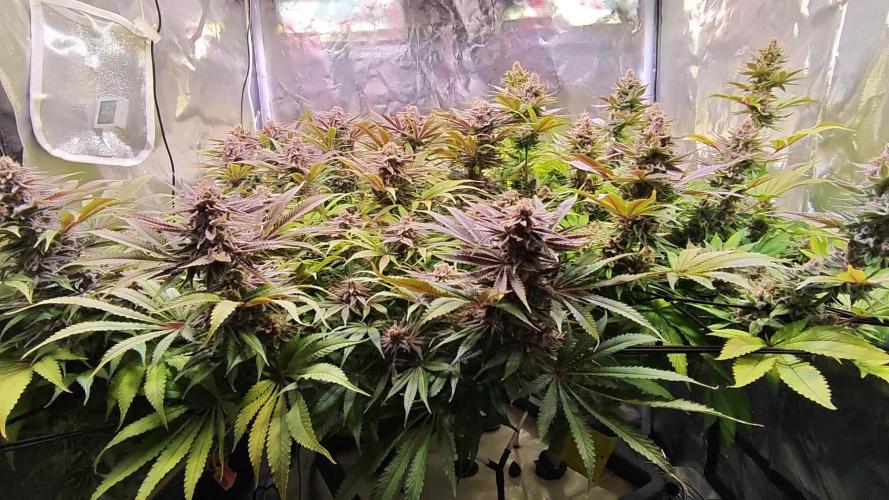
Hi Growmies,
Last week for my ladies, going to harvest any day. Not giving any nutrients .Conditions are perfect and 2 weeks no rain are predicted with temps around 18°. Thanks for swinging by .

Likes
63
Share


@Krisis
Follow
07/23/24. Going into week 4 flower
After last update, the things I mentioned worsened. The yellowing turned pasty and almost whitish. The leaves feel weird.. like thick and not rubbery.. but kinda. Don’t know how to describe it.
I had stopped feeding her, other than calmag with micros, one of which is iron. I had also backed the light off since she also appeared burned on the buds or something.
Wasn’t noticing much improvement so I checked runoff and it was very acidic. I then over a few hours time gave her large amounts of water until it got more clear when it came out. After that I finished off with just the calmag/iron.
A few hours later her leaves were perked up. They still looked bad obviously not going to change that fast.
Jumping to today, parts of the leaves look to be regaining some green, especially in the veins and in toward the bases, which is where the most white/yellow was. The buds are starting to grow again, but still appear burnt and lacking hairs. With the green returning..if you look now the symptoms would say nutrient burn. I’m not an expert, but I’m unaware of nutrient burn turning a plant white and yellow and being able to regain green after? If I’m wrong on that please let me know.
For now I am going to just keep going on with water silica and calmag OAC as it seems to be at least doing something that looks right. I also feel the lights way too dimmed (50% 22in) and high, but not taking chances. I’d rather have the plant healthy vs killing her for bud size.
Hopefully too much damage hasn’t been done and my once beautiful Pablita will once again be. 😿
Update: 07/26/24
More whiteness/pasty has decreased and a few little hairs have sprouted! This seems like progress. As green gradually reappears on top.. it’s disappearing in other spots.


Likes
4
Share


@Mr_nugs_lover_David
Follow
It's been a wonderful journey, I'm very happy about this lady's performance, she has produced a high quality harvest, low quantity but I didn't maximice the space as good as I should, but definitely a wonderful genetic to grow, the flowrs are super sticky, full of trichomes and the smell is just the clasic amnesia smell you expect.


Likes
16
Share


@Chocolopeison
Follow
Estuvimos un poco desaparecido por andar un poco desmotivado pero aquí vamos nuevamente, las nenas van bastante bien en la semana 8 la cambiamos a maceta de 3.5L y aprovechamos de darle GREAT WHITE SHARK, la técnica que usamos es de amarrar el central ya que le hicimos supper cropping y apical a nuestro central, amarramos el apical que le hicimos super cropping y le dimos fuerza a varios brazos. Para ir controlando la altura de los brazos le hicimos poda a pical a los que estaban tomando más altura y así poder ir equiparando los brazos. La verdad que no se cuantos brazos tengo que sacar y aun me quedan unas 4 semanas para poder desocupar mi armario de floración y poder pasarlas a flora, así que intentaremos hacer una muy buena estructura antes de pasarlas a floración. La defoliación la aplico cada vez que saco foto ósea semanal y trato de ir manteniendo de a 4 nudos o 6 nudos
La alimentación se mantiene igual lo que si no se si lo dije pero:
Rhizotonic: Lo estoy usando solo en trasplantes y cuando hago alguna poda.
Cannazym: Lo estoy usando 1 vez por semana.
Orca y Myco Chum: Lo estoy usando 1 vez cada 1-2 semanas
Alimentación diaria: Calmag, silicia, supervit y canna coco a+b
Alimento a cada una con 250-350 cc de solución, 2 horas que encienden las luces y 2 horas antes de que se apaguen. Gracias a esta receta no eh tenido tanta variedad en mi runoff y las nenas se mantienen muy sanas.
Saludos


Likes
10
Share


@Northern_Ent
Follow
June 10: very nice late spring day but the air is too dry for seedlings. To raise the humidity I’m misting the leaves a few time a day. Good for seedlings but also bigger vegetating plants. Check out the owl video.
June 14: rain all day. About 50-60 mm so far.
Processing
Likes
3
Share


@Sammy23
Follow
J'ai sorti la plante quand il y avait un rayon de soleil, sinon, elle passe le plus clair de son temps à l'intérieur. Je n'ai pas arrosé de la semaine. Elle avait été trempée avant par de fortes pluies. La plante a pris un coup de froid. Ça se voit sur certaines feuilles de la tête principale. Je fais attention maintenant de la rentrer le soir. Bonne semaine, dans l'ensemble.

Likes
61
Share


@Esoteric_growing
Follow
Pics taken right before chop, currently hanging for the next 8-12 days and then a cure for a good few weeks.
Pictures speak for themselves, I had high temps, supercropped the help out of them and yet are still the nicest looking bud I have ever grown since I started in 2003.
Can’t wait to test how they smoke. I have two phenos but off to buy some more to do a more in depth pheno hunt.
Likes
9
Share


@PlumpPelican
Follow
Pistils are slowly turning brown, trichomes cloudy and buds are ripening.
Started flushing the soil this week for the next 7-14 days depending on the progress of the plants.

Likes
13
Share

@Aleks555
Follow
Divine Seeds - Opium
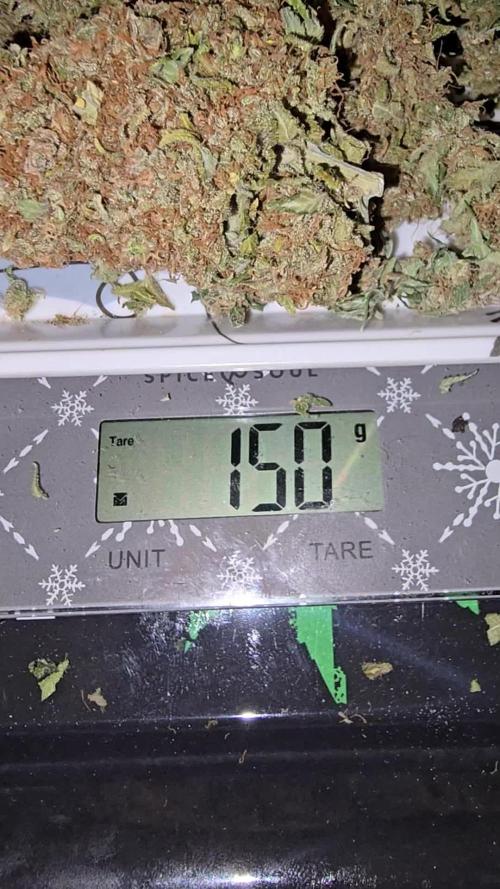
After 122 days of growth and 74 days of flowering, it's time to say goodbye to this stunning beauty and bring in the harvest! The buds are massive, dripping with resin, and have an incredibly strong, alluring aroma. We are absolutely thrilled with how she turned out!
We decided not to weigh the buds while they’re wet; we’ll wait until they’re dried to get the final weight. But from the looks of it, we expect a very satisfying yield.
A huge shoutout to Xpert Nutrients for their exceptional support, reliable service, and, most importantly, their outstanding fertilizers that have consistently helped us grow such powerful, high-quality plants. Year after year, your products prove to be a key element in our success.
We also want to express our deepest gratitude to Divine Seeds for providing such superior genetics. We’re beyond impressed with Opium and are excited to grow even more from your incredible lineup in the near future.
And yes, we’ve already sampled her, and the smoke is nothing short of premium quality. The strength and flavor are exceptional, leaving no doubt that this is top-shelf cannabis. It’s a true connoisseur’s dream!
Thank you again to Xpert Nutrients and Divine Seeds for making this grow so successful and enjoyable! We can’t wait for our next adventure with your products and genetics!
Likes
46
Share


@PEAKYPLANTERS
Follow
good evening to all, brothers of the weed!
Welcome back to the PEAKY gardens where it is grown for passion
A good perfume all made in Holland comes out of the tent!
The beautiful Punch are the ones that surround the whole tent, while the barneys cookies are the purple ones in the center of the tent!
They seem to travel quite well and without irregularities ! We begin to see the first little heads of trichomes
Likes
89
Share


@BioBuds
Follow
I sure need to get used to the Auto way of growing. My methods and system with soil for regulars are not directly portable to cultivating auto's, so it seems. So what started out as a comparison/battle, is now just a normal grow, since it's not fair that the battlefield was tainted.
It does seem the XL Runtz adjust better to my climate and growing style than the Forbidden Runtz.
Also looking for ways to keep my tent cooler. Considering growing outdoor this summer with seeds started in the tent. It gets way too hot in here as it is now, with outside temps just at 10 to 15 degrees C.
I'm just watering, alternating with a bit of BAC Bloom and Calmag, and some Topmax.
From here I hope its some smoother sailing and hoping the other three will pick up some pace.
Thanks for checking in again!!
Bud
Likes
8
Share


@Piro420
Follow
Finally the stretched stopped.
Cut about 10 tops bent about 20 with 90s. Still right in the lights. They are looking very happy even though they are so close to the light ( thanks to high c02 levels most likely.)
Another week or 2 before I cut the temps and co2 levels down.
Been trimming all leaves below light line.
Stinky and brutally sticky I feel like Clark griswold with pine sap when ever I am bending the tops and such..
I think even with them being in the lights I will still get a few pounds of premium flower to smoke :)
Likes
9
Share


@masterofsmeagol
Follow
6/30 I messed up and put 8 days last week so I'll have tp do a six day week to get back on schedule. Pounded rain last night I guess. Very intense but very brief. As you can see in the video the plants are found great. A few have revegged so I'll need to defoliate the middle. I could make a TON of clones but it's pretty late for that. I might clone a couple outstanding plants to keep the genetics. Still seeing some pillar damage. Might do bt tonight. I'll keep this updated.
