


Likes
Comments
Share


@eldruida_lamota
Follow
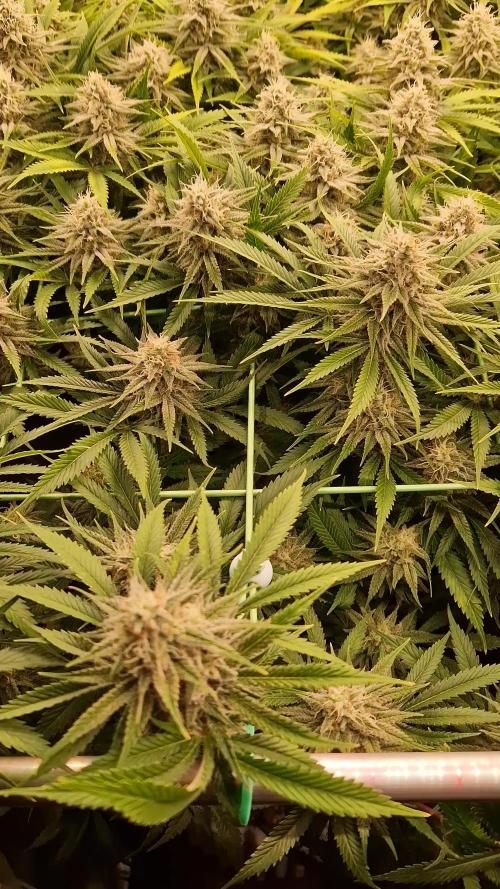
Acabamos la séptima semana de floración de las Original de GrowBarato familia, y no podéis imaginaros lo bien que huelen.
Tienen un buen color, se ven sanas, y van progresando adecuadamente la flor va poco a poco engordando y tirando bien de tricomas.
Creo que seguiré abonando una semana más , ya iremos viendo estos días que hago pero si creo que una semana más es necesario.
Agrobeta:
https://www.agrobeta.com/agrobetatiendaonline/36-abonos-canamo
Mars hydro:
Code discount: EL420
https://www.mars-hydro.com/
Las maximas de temperatura no superan los 26 grados y las mínimas no bajan 20, así que no me puedo quejar.
Los niveles de humedad también son los correctos van entre 45%/55% de humedad relativa.
Por supuesto el Ph lo estamos dejando alrededor de 6.
Hasta aquí es todo, buenos humos 💨💨💨.

Likes
25
Share

@TrickzGrowz
Follow
Ich bin sehr verliebt in diesen Pheno. Wenn sie jetzt auch noch lecker schmeckt und gut wirkt, würde ich sie sogar nochmal anbauen.

Likes
6
Share


@Plantinator
Follow
2nd topped on day 20 and she is reacted well to HST, she is too busy with growing, there is no time to get stunted.
I give her 1/3 of the feed schedule’s recommendation. Soon I will switch to bottom feed.
DLI has been set to 30.
Day 26 - today I installed the Megapot system. She has been transplanted from a 5 gal bag to a 6 gal one, it was quite a torture I must say. More stress for the plant. I had to do this for the better drainage. Was it a stupid move? We shall see.

Likes
6
Share


@Barcelona_Farmers710
Follow
Aquí empezó los problemas por el regulador...no podíamos bajar la potencia de 320w y los pelos se quemaron un poco, apesar de todo los colores empezaron a florecer! Buenos humos compañeros 🍁

Likes
41
Share


@MMSC16
Follow
Jan 4 - Had some high temps in the morning. Plant is growing with buds fattening. Less green on base of calyx' means there's probably less than a week to go. Some wilting occurring as senescence comes to an end.
Jan 5 - Watered at 3.30PM. Calyx Trichomes still show clear. Defoliated two wilting leaves to provide better airflow for the next week.
Jan 5 - HARVEST UPDATE (7 Days Drying) - First plant showed signs of first small branches snapping. I've snipped buds (with sugar leaves) into a jar to cure. I'll manicure once I ensure the humidity level is ideal.
Jan 6 - 11.30PM Calyx' are finally showing amber, and quite a few! There's still clears, but this likely means harvest is close. Removed 1 wilting fan leaf.
Jan 7 - 5.00AM Harvested remaining plant, removed fan leaves and left sugar leaves. Hang drying at 60F and 60%RH, will check on in a week.
Jan 17 - Jarred both plants at 63%-64%RH. Dry weight for first plant 17.4g is and Second plant after trim is 25.9g. Total harvest is 43.3g dry.
Likes
20
Share


@AsNoriu
Follow
Added first time molasses during feeding will be doing it for last 3 weeks before flush.
For couple plants with redish leaves stems gave epsom salt. Thinking to give it to all of them.
To me they look too skinny, but its aftermath of strech i quess ...
Would love to have one more hlg 240 ...

Likes
20
Share


@PREPPYPUNK
Follow
Trichomes look small, not tall and big. I gotta stop complaining about everything. I have at least enough to get through the holidays and its good stuff. I suspect my real problem lies in dry and cure. Sometimes you pop a couple of autoflowers and they just grow like mad dogs and sometimes its a major challenge esp if you screw something up like over water. I maintain that i have never had a dry/ cure that ended up smelling like anything at all. I have been blaming the seed vendor but it just cant be as plenty of people have good harvests with same strain im doing. Problem is i have a neighbor whos having same issues. I got the idea of 70 degrees and 50-58% rh. Every dry and cure is different but i got my not good program from youtube videos. You never get enough information to learn anything most times and you still have to watch your grow like a hawk and be patient. I have a new program for dry. After the cut, the rh needs to be at least 60 from that time all the way into the jar and onward or you 100% lose terpines. Other thing is temprature. So i have a small room with a window ac unit and next dry will take 7-12 days at a constant temp of 65 , so ac will be on nonstop for a few days and rh has to stay at 60 so humidifier needs to be maintained. THE OTHER THING IS AIR CIRCULATION. YOU DONT WANT A FAN BLOWING ON IT BUT STAGNANT AIR IS NO GOOD. So, if this works, and i start getting that dank bag apeal with terps and sticky resin everywhere and crystals......What im thinking is hang it all in the tent which is in the room with ac unit and maybe 2 6 inch fans and exhaust on at 190 cfm. LET SIT IN DARK 48 HOURS BEFORE CHOP. The must have ac and 65degrees came from youtube guy i think canucks grow. Everything this guy touches turns to gold and his house is xtra clean. Its too clean. Has to have a cleaning lady. but hes changed his mind over time on dry and cure and the latest is 60 rh and 65 degrees temp to dry and 60 rh till its all gone. Maybe this will work and the harvest wont smell like hay or nothing at all. Growing weed is a big comitment and a shitload of work and you need to do alot of research and make all the mistakes i think. I dont know why people title "first grow ever" and it comes out looking like top shelf shit. I dont buy it. Its not that simple. Though with the right genetics and proper watering you could have an amazing harvest first time out. I just have a hard time accepting the fact that i have no idea what im doing and do not have the knowledge regarding nutrients and when and how much etc...but i have a good idea. This COVID SHIT IS SOME FREAKING SHIT but if you have an indoor garden to maintain, you always have something to look forward to. I gotta go see the Wizard. actually the Wizard owns the head shop and the grow supply guy who looks like he has been ripping bongs since a toddler, hes zombie boy. Zombie boy recommended that i add this fungal growth shit called orca and the main reason was i need it according to his assesment of what i said i was using and his final closing statement was, its only 10 bucks so.....and then hes like, you should buy some fish shit, you want some fish shit? What i want to do is make the clock go faster and it aint happening so plan next grow while maintain current. I got some skunk comming from seedsman if it ever gets hjere. Im going to treat the skunk better than i would a good friend!!!!!

Likes
15
Share


@Marsgenetic
Follow
Really impressed with this strain it was slow at first and took off and never stopped got about 4.4 oz would of been more if i didnt test it

Likes
25
Share


@TegridyCal
Follow
The baby gelato war ready to the first top. We want to try a double central cola and stop to the first top this time to verify the dimensions of buds. We use foliar nutrition by lord grow


Likes
14
Share


@nonick123
Follow
Día 22 (03/02) Se está desarrollando estupendamente!
El sustrato sigue húmedo, así que el suelo vivo siga haciendo su trabajo!
Día 23 (04/02) Riego con 500 ml H2O RO
Se muestra sedienta!
Día 24 (05/02) Un desarrollo espectacular en estos 24 días de vida! 😍
Día 25 (06/02) Riego con 500 ml H2O RO
Se ve radiante!
Día 26 (07/02) Riego con 150 ml
Día 27 (08/02) Riego con 350 ml
Día 28 (09/02) Flip to 12/12! 💥💨😁
Khalifa Genetics - https://khalifagenetics.com/product/lemon-blanco-v3/
💦 BioTabs 15% DISCOUNT code "GDBT420" biotabs.nl/en/shop/ @biotabs_official
🌱Substrate PRO-MIX HP BACILLUS + MYCORRHIZAE @promixmitch @promixgrowers_unfiltered
💡2 x Mars Hydro FC1500 EVO Led Grow Light (2024 NEW FC 1500-EVO Samsung LM301H 150W LED) - https://marshydro.eu/products/fc1500-evo-led-grow-lights/ - https://www.amazon.de/dp/B0CSSGN5D8?ref=myi_title_dp

Likes
24
Share


@Kountryboi90
Follow
Day 38 since flipping and I'm loving what I see. This girls LOVES to eat so I had to switch my feeding cycle to feed, feed, water, instead of feed, water, water. The strong orange citrus aroma is oh so lovely! In the next couple of weeks she should start packing on more weight. I can tell that they are heavy already just but the swaying of the cola from air circulation. I think I messed up by removing my scrog net but I'll tie her up and give her support as needed!
Likes
12
Share


@AlienScrOG
Follow
More crop ..more top .. To be contiued... Intrusa si chiama pinepple expres barneyfarm bye Edopurplekush


Likes
4
Share


@mad_nad
Follow
Here we go!
The plants are still stretching!
All plants are mature now and develop small buds!
Last day of the week I watered them with TOP CROPs “BUD PACK” and gave them the minimum recommended dosage.
I’m very interested if the TOP BUD flower stimulator will show some immediate results.
🤞
Likes
27
Share

@eldruida_lamota
Follow
Esa familia, otra vez aquí enseñando la cuarta semana de crecimiento , estás do sweet dos van con un buen ritmo , y sin carencia alguna.
.
La humedad anda entre 60/70% la temperatura está entre 23/26 grados, el led es increíble , y como siempre el ph , ya que es de lo más importante,está en 5,8/6,0.
.
AgroBeta:
0,8 ml x L Growth black line , vía radicular.
0,2 ml x L Tucán , vía radicular.
0,15 ml x L Flash Root , vía radicular.
0,05 ml x L Gold Joker, vía radicular.
.
Esto es todo fumetillas, muy pronto las veremos echando flores 💨💨💨 buenos humos.

Likes
69
Share

@AsNoriu
Follow
Day 92. Girl went down. Very easy trim job.
Day 101. She brought wonderful result ! 161 g of sticky, smelly and sweet on through weed !!!
Happy Growing !!!

Likes
8
Share


@Adkguerrilla44
Follow
All in all this was an amazing strain to grow and looks and smells insanely delicious 😋 i cannot wait for her to cure up so i can get a proper session in!!!


Likes
3
Share


@GanjaFarmer101
Follow
Smooth trim, last of the first wave of autos this summer - yields are very low but the bud looks great :)
Likes
1
Share


@BonusPackage
Follow
Day 17
All good, big and healthy
Day 19
Her leaves are the largest and are touching the soil. I'm hoping her height catches up to her width
Day 21
Her main stem is really thick and I think she is struggling a bit with the weight of her leaves
