Likes
176
Share
@Hologram
Follow
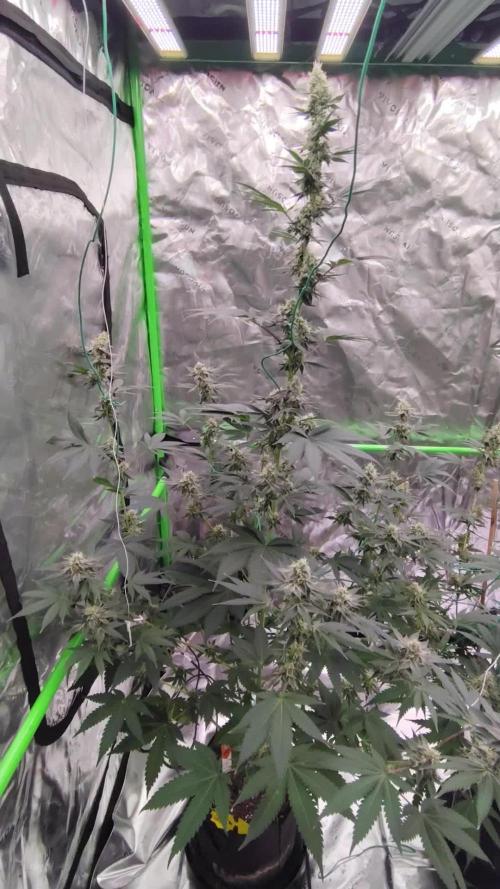
Goodday growbrethren and sistren hope yal r enjoying the green life 😸 Dosidos is doing great, despite of being eaten alive by Caterpillers ATM.. She is almost done so i cant spray anything on her ... 'luckily'the CP's are big now, so i can spot them more easily But dammit!, they have eaten almost all the leafs! She has had a lil accident too this week, Runtz has fallen on top of her!! (sudden strong winds..they were standing on the ground) But luckily nothing was totally broken.. I gave her some bandage for the cola that was injured (i use bandage and not tape, bc thats more flexible) and some support with wire 👍 and another luck we are having here rn (im so lucky, im gonna fall under a bus!) is that we are having a nice 'late summer' here.. temp is still above 20C with lots of sun and now and then a big rainfall...(she goes in safehouse then) so i think(hope!) she can finish her buds before the CP's do!!(next year, im gonna throw a net over the safehouse, over the openings, to protect from evil butterflies😳 and such. think its gonna help.. a bit) happy growing for all✊
Likes
38
Share
Oh yes, my friends .... Peaky is back stronger than before to compete with the best! Take a look at my updates The best crops and best regards
Likes
35
Share
Welcome to my Dutch Passion Diaries Competition 2025 entry! For this competition, I’ve chosen the Indoor Feminized strain: Orange Bud 2. Media from Week 7 of Moving into he New Tent for the next Veg weeks and Recovering from there stare . Here’s what I’m working with for the Final Tent after Moving for the Flower time in the Future : • 🌱 Tent: 220x150x150 • 🧑‍🌾 Breeder Company: Dutch Passion • 💧 Humidity Range: 50 • ⏳ Flowering Time: 8W-10W • Strain Info: 20-25%THC, Sativa • 🌡️ Temperature: 26 • 🍵 Pot Size: 0.5l • Nutrient Brand: Narcos • ⚡ Lights : 720W x 2 Were going with 2x 150w LEDs in a 60x180 tent for The Next Veg Weeks . Every plant got Topped Several Times over the Last 7 Weeks . A huge thank you to Dutch Passion for allowing me to be a part of this amazing competition and for supporting the grower community worldwide! Your genetics and passion speak for themselves! Curious to try these strains for yourself? You can check them out and support me at the same time through my personal link: https://dutch-passion.com/?a_aid=GGD I would truly appreciate every bit of feedback, help, questions, or discussions – and of course, your likes and interactions mean the world to me as I try to stand out in this exciting competition! Let’s grow together – and don’t forget to stop by again to see the latest updates! Happy growing! Stay lifted and stay curious! Peace & Buds!
Likes
102
Share
Great strain for beginners, easy to grow don't require too much attention or special techniques . She will grow fast, gorgeous and smell very very strong, I didn't think I was going to be able to harvest more than an ounce (because this is my first time) but hey, I'm very happy with my 41G! The buds were skinny but dense in flavour, I wonder why the buds didn't get fat, its because of my LED panels, or genetics? Overall I recommend this strain for first time growers!
Likes
82
Share
@WhiteEdge
Follow
28.04.2024 Continue into week 9 Clean nutrient tank for the last time...This is last week of flowering for almost all girls. Electrical Conductivity (EC): 0.8 for this week.. Wedding Cheesecake: one girl finish this week, two others probably in middle of 10 week. Massive plants, tons of yelled. Creamy undertones, sticky buds. Love it! They starve whole grow, didn't have possibility for separate line just for them. Love odor and bud structure. Tropicana Cookies: Second phenotype will be harvested within couple off days. Insane plant, so frosty. It getting more colorful every day Purple Lemonade: First pheno is insane! Shape, size ,color, bud hardness, appearance, frostiness' all attributes to become photo model! Beautiful and high odor in the room! Lighting Parameters: PAR Map: Maximum PPFD is 800, minimum PPFD is 550. VPD: Ranges from -0.1-1.1 Daytime Temperature (DT): 23-24°C. Nighttime Temperature (NT): 19-20°C. Leaf Temperature: 21-22°C. Light Distance: 45-55 cm from the plants. CO2 Levels: 700+ ppm. HLG Scorpion Diablo: Set at 60%, positioned at a 45-55 cm distance. Girls drink less water, so for this week and till the end of flowering new misting timing's Daytime: ON for 50 seconds, followed by 30 minutes OFF. Nighttime: OFF for 50 seconds, followed by 45 minutes OFF. Nutrient Tank (NT): pH: Maintained between 5.80 and 6.00. Stable PH, small drifting up and downs EC: 0.87 Temperature: 19-21°C 01.05.2024 Cruse mode , observing girls, looking trichomes under phone microscope. Still have to wait. Purple Lemonade is almost ready all three girls. This is last week for them for sure. Second Tropicana Cookies will be harvested in day or two.. First and second Wedding Cheesecake are finishing this week. Third still need some time.. Almost all pistils still white, only clear with some milky trichomes Lighting Parameters: PAR Map: Maximum PPFD is 800, minimum PPFD is 550. VPD: Ranges from -0.1-1.1 Daytime Temperature (DT): 23-24°C. Nighttime Temperature (NT): 19-20°C. Leaf Temperature: 21-22°C. Light Distance: 45-55 cm from the plants. CO2 Levels: 700+ ppm. HLG Scorpion Diablo: Set at 60%, positioned at a 45-55 cm distance. Girls drink less water, so for this week and till the end of flowering new misting timing's Daytime: ON for 50 seconds, followed by 30 minutes OFF. Nighttime: OFF for 45 seconds, followed by 45 minutes OFF. Nutrient Tank (NT): pH: Maintained between 5.80 and 6.00. Stable PH, small drifting up and downs EC: 0.89 Temperature: 19-21°C 04.05.2024 EC start to raise slowly and PH is dropping . Low water consumption, girls finishing Tomorrow is harvest day for second Tropicana Cookies and all three Purple Lemonade. Last day off this week is going to be last day for Weeding Cheesecake also. Without AC unit I'm not able to additionally control temperatures.. For drying it will be little higher temps, but it is what it is.. Water keep cool for whole week, from 18c to 20c, This week watering routine is changed to 45s ON time and 45min Off time Every day perform one long misting cycle, 2min ON... Nutrient tank is top-up with pure RO water + Hypochlorous Acid@5.8PH 05.04.2024 Second harvest day.. Purple Lemonade all three girls, second Tropicana Cookies also is harvested. Lots off hard buds on this girls, frosty, fat, insanely hard buds. Odor in the room is fantastic 😋 Tomorrow on last day off week 9 , Wedding Cheesecake harvest, first Girl No.3 , then day after girl No.2. Third Weeding Cheesecake is wait for a couple off days or full week. This girl is so massive, its a pounder in yield I think!
Likes
2
Share
"And God said, Let there be light, and there was light." Genesis 1:3 Inhale for 13s, Exhale for 13s, Inhale for 8s, Exhale for 8s, Inhale for 5s, Exhale for 5s, Inhale for 3s, Exhale for 3s, Inhale for 1s, Exhale for 1s, Alignment. 1.618 More energy, more blueprint. Electrical Conductivity refers to how easily a material or solution allows electrons or ions to flow continuously when an electrical potential is applied. Electrochemical Reactance is the opposition to alternating current (AC) caused specifically by the temporary storage of energy in electric or magnetic fields, rather than energy being lost as heat. Reactance does not directly alter a material's intrinsic electrical conductivity. Instead, it dictates how the system stores and releases energy over time, which creates a temporary barrier to current flow in AC circuits. Together with resistance, reactance makes up total impedance. Electrical impedance (the combination of resistance and reactance) in the rhizosphere dictates how easily ions and water move into plant roots, directly impacting the Electron Transport Rate (ETR). High impedance restricts ion mobility, leading to nutrient deficiencies that decrease ETR and stunt overall plant growth. Using copper and zinc plates in the plant medium to form a natural earth battery to assist with Electrochemical Reactance. The moist soil acts as an electrolyte, while zinc serves as the anode and copper as the cathode. Zinc is a highly reactive metal and oxidizes, losing electrons into the soil. These electrons travel through an external wire to the copper plate. The moisture and dissolved salts in your plant medium allow charged ions to move freely between the plates, completing the circuit and generating a small direct current (usually between 0.8 and 1.1 volts). This micro-current subtly alters/the Electrical Conductivity (EC), allowing more effective breaking apart of chemical bonds in the soil (electrolysis), making soil nutrients like phosphorus, calcium, and potassium more accessible to roots. Buried the zinc plate on one side of the plant’s root zone and the copper plate on the opposite side. Ran an insulated copper wire above ground to connect the zinc plate to the copper plate, creating a closed loop. Make sure your soil remains moist and contains natural mineral salts; entirely distilled water or bone-dry medium will prevent ion exchange and block the current.
Likes
Comments
Share
@gr3g4l
Follow
Esta semana notamos que los Led estaban demasiado cerca de las copas cuando los apicales mostraron un inicio de albinismo así que tocó alejarlos un poco, a 40 ctms áprox. igual poco menos. Las dos Amarettotarmac muestran una diferencia notable en la morfología de los cogollos pero de olor ambas afrutadas, cereza, fresa, algo muy rico y notable a larga distancia, que huelen mucho. xd
Likes
5
Share
@Ensign420
Follow
Greetings fellow growers 🖖 and welcome to my first grow ever. This adventure actually started several months ago when I decided to stop buying flower from dispensaries and just grow my own bud. How hard can it be!? This is actually my second seed of this strain. The first bean sadly died due to over watering (sorry girl, RIP). I was literally watering the cube to the point where water was dripping from the bottom, then heavily sprayed the humidity dome and tray with the vents completely closed. Everyday. Multiple times. I never let the dome or try dry out. So after about 8 days of not sprouting, there was a funky smell of rot. So that was that. Later I learned that rockwool retains a lot of water and can easily drown seeds. So a wet/dry cycle is best for rockwool germination. So even after hours of researching and digging through forums and tutorial videos, I was still under prepared for this journey. Did not consider how delicate the germination phase is. Oh well. Lesson learned. Reset and try again! I hope everyone is safe and stoned during this corona crisis. Just like everyone else in the world, I want this pandemic to be over with. But in the meantime, let's grow some weed! 🖖 [START OF WEEK 01] Day 01 - Monday - 08/03/20 - Total Days: 001 ----------------------------------- - [0830]: Light Schedule: 24Hrs/0 --- Soaked cube in 5.5 PH water for 10 min. Did not shake water out. --- NO NUTES! Only PH'd down to control the PH levels. --- Did not use the default hole (way too deep). --- Flipped cube upside down and made a shallow hole for the seed (less than 0.25" deep). --- Placed seed in and pinched hole close. No additional water added. --- Sprayed the tray and dome with straight water (5.5 PH). --- Vents are cracked opened a for ventilation (about 1/4 opened each). --- Distance between the light and tray was 53" --- AC was set to 80 °F --- Exhaust fan was set to 86 °F --- Room average temp was at 85 °F --- Dome humidity was at 85-99% when sprayed. --- Allowing to completely dry before respraying. - [2200]: Dome and tray were completely dry! Sprayed only tray and dome with more water. Day 02 - Tuesday - 08/04/20 - Total Days: 002 ----------------------------------- - [0845]: Sprayed dome and tray in the morning. Everything was dry. --- Hoping for the best! - [2130]: Everything was dry again, so sprayed dome and tray at night along with a light spray on the cube. Day 03 - Wednesday - 08/05/20 - Total Days: 003 ----------------------------------- - [0830]: Everything was dry again. Resprayed dome and tray. Slightly sprayed cube. - [2125]: Hooo damn!! She popped! Am little stub is visible! Resprayed dome and tray again. --- Still going 24/0 for lights. - [+0033]: Just checked up on her and I swear she grew a bit taller! Getting excited! Day 04 - Thursday - 08/06/20 - Total Days: 004 ----------------------------------- - [0845]: Wow! Went from a little stub to fully sprouted overnight! Everything was pretty dry again so resprayed dome and tray. - [2200]: Tap root is visible! Over 1" long too! Just resprayed dome and tray again. -- Going to prep for hydroton transplant tomorrow! Day 05 - Friday - 08/07/20 - Total Days: 005 ----------------------------------- - [0930]: She keeps growing! -- Added a bit of CalMag to the spray bottle (8 drops to 650ml of distilled water). Resprayed dome and tray. Water was at a 5.4 PH with 141 PPM. - [1045]: Prepped the bubble bucket with 4.5gal of water. Water is high enough to reach about 0.25" above the bottom of the net pot. --- Added 3 drops of Superthrive --- Added 3.5ml of CaliMagic --- Added 2ml Hydroguard --- Then PH'd down to 5.6 --- Solution Strengh: 120 PPM --- Water chiller is set to 20 °C - [1100]: Transplant time! --- Filled the net basket 1/3 with hydroton. When placed in the bucket, air bubbles are not visible, but are slightly below the surface (slight digging will reveal the water/bubbles below). --- Removed plastic on rockwool cube and placed in basket, then filled around and covered with hydroton. Making sure to block any light from passing through the net pot and into the nutrient solution. --- Covered with a half-bottle dome sprayed with the CalMag water from earlier. --- Hoping for the best! - [1300]: Raised Bucket 5" higher. Now light distance is 48" to top of bucket. - [1820]: Lowered tent exhaust temp to 76 °F --- Lowered AC to 75 °F --- Raised bucket even higher so light distance is 30" to top of bucket. - [2300]: Looking good! --- Sprayed dome and surrounding hydroton with more CalMag water. --- Attached timer to light! So new 18 Hrs On/6 Hrs Off light schedule. --- Lights On: [1600] (4pm) --- Lights Off: [+1000] (10am the next day) --- Decided to go with lights on during the evening/night and off during the later mornings/afternoon (the hottest part of the day) to see if temps can be controlled better. --- Please survive girl! Day 06 - Saturday - 08/08/20 - Total Days: 006 ----------------------------------- - [0800]: Everything was dry. Resprayed hydroton and dome. - [2000]: Here first night cycle seemed to go well! Get'n taller! --- Dry again. Removed the dome. --- PH went up to 6.5 so PH'd down to 5.7 --- Ran the top feed drip ring for a bout a minute to wet the hydroton and rockwool with the nutient solution. ---Too scared to leave the top feed on 24hrs (I don't want over water her and cause dampening-off). Will let dry before re-watering. - [2100]: After closer inspection, I think she's looking a bit yellow. --- Decided to add a bit of grow nutes to the bubbler solution. --- Added 2ml of Sensi Grow A --- Added 2ml of Sensi Grow B --- Solution strength after adding more nutes: 176 PPM --- PH went up to 6 --- I hope that the extra chelating properties of the 'PH Perfect' solution is enough of a buffer for proper nutrient uptake. Day 07 - Sunday - 08/09/20 - Total Days: 007 ----------------------------------- - [0800]: Water dropped a bit (mostly due to evaporation) so solution strength was at 190. --- Checked PH again. Was still at 6, so PH'd down to 5.4 --- Ran the top feed for a minute to wet the hydroton a bit. - [0915]: Since she's looking perky but still a bit yellow. So decided to up the nutrient concentration even more before lights out. --- Added 2ml more of Sensi Grow A --- Added 2ml more of Sensi Grow B --- Solution strength after adding more nutes: 199 PPM --- PH went up to 5.8 - [1700]: Checked nutrients. --- PH: 5.9 --- Solution strength: 202 PPM --- Added 4ml of Voodoo Juice --- Added 4ml of B-52 --- PH after adding more nutes: 5.9 --- Solution strength after adding more nutes: 238 PPM - [2130]: Decided to make a new foliar spray to address the continued yellowing. --- Started with 500ml of distilled water. --- Added 3 drops of CaliMagic --- Added 3 drops of Sensi Grow A --- Added 3 drops of Sensi Grow B --- Added 3 drops of B-52 --- Added 1 drop of Superthrive --- Solution strength: 164 PPM --- PH was at 5.9 and did not adjust. --- Gave her one spray. --- Also sprayed the surrounding hydroton. [END OF WEEK 01]
Likes
18
Share
These genetics are amazing! So hardy! These are two identical clones taken from the best mother out of a 5 pack of seeds. Still got the mother. This pheno’s Unique aroma is already pushing my carbon filters to the max. Cannot wait to get some of this dangerously addictive cheese down me gullet!! 😂 Hope you all like the setup have had some very kind compliments from people and I am happy to share my learnings lol. Peace out A-town!!
Processing
Likes
8
Share
Me costó adaptarme a la cantidad de agua que necesitaba, prácticamente 1.5 litros todos los días. Temperatura 23-25 centígrados, HR 45%. Me pueden contactar por ig @federicocabreraf , por si quieren saber mas detalles o algún comentario que me quieran hacer, paz.
Likes
72
Share
@BodyByVio
Follow
Day 65 : officially 1st day of flush . Changed the reservoir with fresh water and 1.2g/5 gallons of Yucca extract and 5ml/gallon of Cleanex from Botanicare . Day 68- I did some defoliate. Few more days until harvest.
Likes
3
Share
Started using overdrive this week let's see how it goes
Likes
5
Share
en espectáculo a la vista mis bellas, ya dan señales que el otoño llego y están próximas a su cosecha
Likes
13
Share
Langsam kann man erahnen wo es enden wird. Ich muss immer wieder an den Blättern zupfen und daran riechen.
Likes
2
Share
67 days since April 16th, 2026 We become aware at such times of man's wonderful ability to bring seemingly unrelated elements into harmonic balance, and receive a glimpse into a world where everything exists in conscious sympathetic attunement to everything else. When we listen to a piece of music that seems to strike a beautiful chord somewhere inside us, or view a painting that simply glows with harmonic awareness well executed, we probably do not spare much time to contemplate the wonderfully intricate combination of vibrations that our sensors make it possible for us to perceive. We tend to appreciate the relationship between the parts of something by an awareness of the harmony or dissonance of the whole. This ability enables us to say "what a beautiful house!" instead of "analysis has proven that this collection of building materials exhibits certain elements of harmonic proportion." While this ability to instinctively appreciate the beauty of true harmony has an important role to play in evolution, a more analytical understanding of the laws involved can be most useful. This is especially so if we wish to create works of art where each part exists in true harmony, not only with the other part of that particular whole, but with the universe within which the creator and the created exist. Everything vibrates. From the most dense matter to the most subtle cosmic rays, everything which our senses allow our thoughts to become aware of, can be specified in terms of wavelength or frequency of vibration. These two terms define the same thing, but from different points of view. The following are the approximate wavelengths of various energy carriers: Cosmic rays 0.000,000,001 mm Gamma rays 0.000,000,1 mm X rays 0.000,500 mm Ultraviolet rays 0.003 mm Visible light 0.006 mm Infrared 0.01 mm Sound waves 1 meter Radio waves 300 meters Violet light 400 nm to 450 nm Blue light 450 nm to 500 nm Green light 500 nm to 570 nm Yellow light 570 nm to 590 nm Orange light 590 nm to 610 nm Red light 610 to 700 nm 1 nanometer (nm) = 0.000,000,1 cm = 1/10,000,000 cm If a guitar string is plucked and we hear a sound, it is not too difficult for the human mind to associate this sound with the vibration of the guitar string. With color it is quite different. It is difficult for us to conceive that the color of a substance is not an inherent property of the substance itself, but an indication picked up by our senses of that substance's ability to absorb or reflect the light which happens to be shining on it at that moment. Neither the matter nor the light is colored. What happens is that the brain learns to differentiate between the frequencies reflected or transmitted by the substance the eyes are focused on. The same thing happens with sound. When we say "Oh! Listen, they're playing my favorite song," what we really mean is: "My brain has stored within it a particular pattern of frequencies. I have compared the new information being received with this stored pattern and have deduced the answer that the two patterns are similar within certain specified tolerances." The 'pleasure' involved could have something to do with our running the pre-recorded pattern at the same time, in 'sympathy' with the new pattern as it is received. The word sympathy describes very well our ability to appreciate color and sound. It also describes the reason behind certain elements of harmony. For instance, if a substance vibrating at 100 cycles per second (tone 1) is in the proximity of another substance vibrating at 200 cycles per second (tone 2), we could perceive, if we had the right equipment, a certain sympathetic relationship between the two. We will see from this that there is a uniform doubling of the first tone seen in the second. At various points along the waves, the two are the same in amplitude. At other points, they are at opposite poles to each other. This doubled frequency has more points of similarity to the original than any other frequency except the original itself. If the equipment we had available for measuring these two frequencies was a soundboard amplifier and a pair of ears, then we would hear what would sound to us like one tone. If we had the opportunity to hear one at a time, we would hear that although they sound the same, one is higher in pitch than the other. This characteristic of 'the same but different in pitch', musicians have called the octave. Any two tones produced where one has exactly doubled the frequency of the other is called an octave. Speaking in ratios, an octave would appear then as the ratio 2:1 or 1:2, depending on whether we are talking of an octave up or down. A single note produced by almost any instrument will contain more than one wavelength or frequency. It will have a dominant frequency, the wavelength of which we would call the note's 'fundamental' or 1st harmonic. It will also have a varying number of upper harmonics, gradually fading in intensity into infinity or silence. Natural harmonics always have the same pattern of intervals between them. The interval between the 1st and 2nd harmonic is a perfect octave; between the 2nd and 3rd a perfect fifth; between the 3rd and 4th a perfect 4th; and so on, the intervals becoming smaller and smaller until they lose any relationship with the western 12 tone scale as it exists at the moment. Just as an octave has certain elements of sympathy with its fundamental, so some intervals have been noted to be more perfectly in sympathy with the fundamental than others. The ratio of the 'perfect 5th' or interval of 7 semitones, as it occurs in the harmonic series, is 3:2 or 2:3, while that of the 'perfect fourth" is 4:3 or 3:4. All the tones in the western 12 tone scale can be expressed in terms of the ratio between the upper tone and its fundamental. This would seem to be an ideal way of generating a scale from any given fundamental and several attempts have been made to do this, the Pythagorean system being probably the most well known. Although when working with a single tone instrument playing on its own, the Pythagorean formula works wonderfully well, if we had several instruments tuned this way together and asked them to play almost any western music, we would find that at times they sounded quite out of tune to each other. The lack of flexibility of the various scale systems based on the harmonic series has led to what is known as the 'tempered' scale. This uses as its primary unit of interval the ratio of the octave or 2:1. It then proceeds to divide the interval between any fundamental and its upper octave into 12 smaller intervals by applying the ratio: two to the one-twelfth power, to one (21/12:1). This equals 1.059463094, so by multiplying any frequency by this number, we will obtain the tempered semitone next up from our fundamental. We will also find that any tone twelve semitones up from any other tone, in a scale generated in this way, will have exactly double the frequency. If we took the note middle C on a piano and halved the wavelength, we would have the note C one octave above. If we halved this, we would have the C above, and so on. However, within about 6 octaves, we would find that although a 'sound' was being produced, no human ear could perceive it. If we kept on going, halving and producing upper octaves of our fundamental C, we would proceed through the infrared band, into the visible light spectrum. If we happened to be outside during the day, we would, for one octave only, see the note C with our eyes. The next octave above would already be in the ultraviolet band, and outside the eye's sensitivity range. If we can think of color as being an indication of a substance's vibratory rate or wavelength, we may begin to see a relationship that could exist between the color and sound spectrums. The logical extension of what has so far been said is that there exists a scale in the color spectrum that corresponds exactly to the scale in the sound spectrum, each color tone being an octave of the equivalent note in the sound range. This is not the end of the story but only the beginning. If we can for the moment accept that any wavelength in one band has upper and lower octave stretching out to infinity, then the next question is 'fine, but what shall we use as our fundamental? A particular color? A particular sound frequency?' The musicians among us will probably say 'A 440'. This means that the note A should vibrate at 440 Hertz, or 440 times per second. They would tell us that this is standard pitch has been adopted by most orchestras around the world; pianos are tuned to it, instruments are constructed to formulas based on it, and so to them it would probably seem the most appropriate place to begin. Some of these musicians may know of the battle that is still raging with regards to this being the standard, but few would know why A = 440 Hz was chosen except that it worked when it was set to be a suitable compromise between the many different pitches in use at the time. 432 Hz is said to be mathematically consistent with the patterns of the universe. Studies reveal that 432 Hz tuning vibrates with the universe’s golden mean PHI and unifies the properties of light, time, space, matter, gravity, and magnetism with biology, the DNA code, and consciousness. When our atoms and DNA start to resonate in harmony with the spiraling pattern of nature, our sense of connection to nature is said to be magnified. Another interesting factor to consider is that the A=432 Hz tuning correlates with the color spectrum, while the A=440 Hz is off. Audiophiles have also stated that A = 432 Hz music seems to be non-local and can fill an entire room, whereas A=440 Hz can be perceived as directional or linear in sound propagation. Once you adopt the idea that sound (or vibration in general) can have an equalizing and harmonizing effect (as well as a disturbing effect), the science of harmony can be applied to bring greater harmony into one's life or tune to specific energies. There is a form of absolute and relative harmony. Absolute harmony can, for example, be determined by the tuning of an instrument. The ancients tuned their instruments at an A of 432 Hz instead of 440 Hz - and for a good reason. There are plenty of music examples on the internet that you can listen to in order to establish the difference for yourself. Attuning the instrument to 432 Hz results in a more relaxing sound, while 440 Hz slightly tenses up the body. This is because 440 Hz is out of tune with both macro and micro cosmos. On the contrary, 432 Hz is in tune. To give an example of how this is manifested microcosmically: our breath (0,3 Hz) and our pulse (1,2 Hz) relate to the frequency of the lower octave of an A of 432 Hz (108 Hz) as 1:360 and 1:90. It is interesting to note that 432 Hz was the standard pitch of many old instruments and that it was only recently (19th and 20th century) the standard pitch was increased. This was done in order to be able to play for bigger audiences. Bigger audiences (more bodies) absorb more of the lower frequencies, so the higher pitch was more likely to “cut through”. One of the oldest instruments of the world is the bell ensemble of Yi Zeng (dated 423 BC), tuned to a standard F4 of 345 Hz, which gives an A= 432 Hz. The frequency of 345 Hz is that of the platonic year! Similarly, many old organs are tuned in A=432 as well; for example, St. Peter’s Capella Gregoriana, St. Peter’s Capella Giulia, S. Maria Maggiore in Rome. Maria Renold’s book “Intervals Scales Tones and the Concert Pitch C=128 Hz” claims conclusive evidence that 440 Hz and raising concert pitch above scientific “C” Prime=128 Hz (Concert A=432 Hz) disassociates the connection of consciousness to the body and creates anti-social conditions in humanity. The difference between concert pitch A=440 Hz and Concert A=432 Hz is only 8 cycles per second, but it is a perceptible difference of awareness in the human consciousness experience of the dream we share called existence.
Likes
29
Share
@Sidbank
Follow
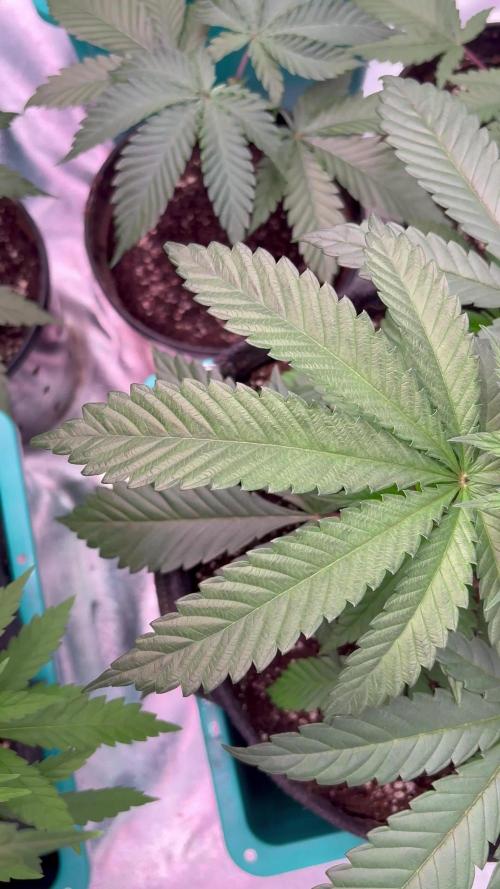
25.05 As can be seen in the attached images, they are not ready to be switched yet. They still need another week. I have spread them across the entire surface of the tent and turned on the second lamp. I set them at 40% power, applied Soil Attack, a minimal dose of Nitrogen using Organic Grow BAC, and liquid mycorrhizae. This time, I adjusted the pH to 5.9 using an organic pH regulator. By the end of the week, I will remove four more plants, keeping a total of 25. Unfortunately, I will have to leave again for a week, which I'm concerned about because all the efforts might go to waste. :P. Keep your fingers crossed for the success of this cultivation! Wszystkich polskojęzycznych obywateli planety ziemia zapraszam na serwer Breedbros na discordzie o uprawie! https://discord.gg/NjTyKJ7E 27.05 Today, I added homemade NPK 10-8-10 fertilizer tablets to my plants - two tablets on each side of the stem, 5 cm away from it. From now on, I will only water them until the end. After switching, I will also introduce mycorrhizae and provide foliar feeding. Depending on how the flowers develop, I might consider adding a bloom stimulator. 30.05 I;m waiting to the end of the week and switch them on 12/12