


Likes
Comments
Share


@Naujas
Follow
The girl's upper leaves look terrible :( I didn't manage to give her more potassium in time :( Well, the flowers bloomed really well, they are not small, and there is definitely a lot of sugar on them :) the smell is also amazing :) apart from the upper leaves, everything looks pretty good :) when I cut her, her image will change :) I think she has max 2 weeks left ;)

Likes
4
Share

@Bear_Grows_Green
Follow
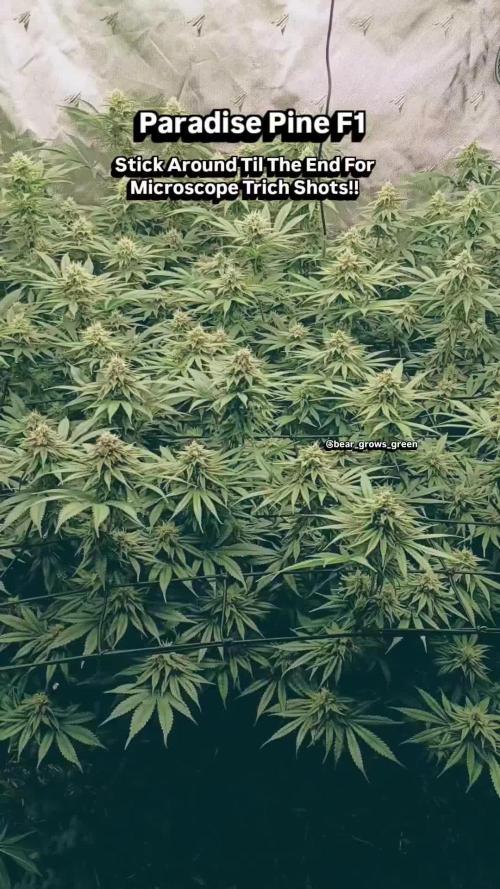
02/05 day 29 flower and holy shit things are popping. The smells are strong of tropical fruit punch on the run when I open the tent it smells of over ripe or slightly fermented fruit yummy. Stacking and filling out awesome! They got water and fed today.
02/09 got watered with bio phos, and bio catalyst 7 gallons total water. Terp check on them all. #1 straight tropical fruit punch very loud strongest and most unique terps in the tent. #2 slightly gassy pretty generic smell I feel I've smelled a million times before. #3 slight gas and fruit punch but subtle nothing impressive. #4 2nd strongest terps on the tent a even mix of gas and tropical fruit punch. I'm gonna have a hard time letting go of #1 or #4 honestly so they are both getting ran again next round for fresh frozen and will be kept around at least til I try the end rosin.
Processing
Likes
14
Share


@Mr_Og_GreenThumb
Follow
Week 12, Day 83 from seed and 3rd day of flower.....The 5 day of this week officially marked the start of the flowering season!! So I flushed both of these bad boys with ph'd water for two days and then today I switched them to 12/12. I gave them their first dose of bloom nutrients and then lollipoped them as you can see, pixs . Grateful no issues to report for the past 3 weeks have been trouble-free!! I'm going to leave the MH bulb in for an additional 2 weeks to prevent any stretching before switching to the HPS. But so far they are still loving their environment. I'm also in the process of keeping clones of fat banana and hulkberry while i try this new strain of Peanut Butter Tree.


Likes
15
Share


@HollowSource
Follow
Tops galore. Again not stretched as much as I had hoped but putting that down to the amount of training she has had. She has a lovely even canopy and I'm looking forward to lots of dense nugs! Looking forward to seeing this girl develop. I've never smoked this before but i have had the chance to smell a fellow growers plants that are currently in late flower and it smells unreal!

Likes
17
Share


@blazin_skywalker
Follow
Day 18 - This plant's leaves are just so fat and happy. I love how thick and healthy she looks! Trying to decide how I'm going to grow this one.... Maybe a top ✂️?
Day 20 - Gave 3ml of Veg A, Veg B and Coco Cal. Girl is fat and happy!

Likes
2
Share


@Ultraviolet_
Follow
18 hours in seconds, 60x60x18 = 64,800 seconds, now multiply by the 833μMol/s reading off the PAR metre. μMol/s (micromol) is the unit in which P.A.R. is expressed.
64,800x833=53,784,000μMol
53,784,000μMol = 54 Mol
54 DLI @ 800ppm, powerful combination. Pushing photosynthesis to peak capacity, accelerated growth and increased biomass. Applied net, stretching her around for a week. Maintaining a minimum air velocity of 0.3m/s within the inner canopy.
E=MC2 looks like a simple multiplication problem; it describes a fundamental physical truth: mass and energy are the same thing. The equation doesn't just calculate a value; it reveals that mass is effectively "congealed" energy. Energy is just numbers. Energy isn't a physical "substance" you can hold or touch. It is essentially an abstract, calculated number that we assign to a system to predict how it will change, interact, or move. A numerical label we attach to matter to track how it behaves. Because the universe runs on laws of symmetry (specifically, that the laws of physics don't change over time), a single global number must be conserved. We call that number "energy".
How well a seedling grows is down to how much knowledge one can acquire to increase the level of conversion to occur. Applying knowledge effectively requires intuition, which comes from hands-on experience. A seasoned stoner learns to read subtle signs—like a slight change in leaf turgor (stiffness), subtle color shifts, or the specific texture of the soil—before a textbook diagnosis can be made. Ultimately, growing is the application of botanical science blended with active observation. Knowledge dictates your potential, but adaptability and attentiveness to the plant's immediate environment determine your results. The human eye is capable of distinguishing more shades of green than any other color in the visible spectrum.
1.618
Nature mathematically optimizes quantum energy transfer and light absorption efficiency within the photosynthetic machinery, as it naturally dictates energy scaling hierarchies and resonance dynamics. External vibration or electromagnetic wave that perfectly matches a plant's natural frequency directly influences plant growth. Low-frequency sound waves and targeted electromagnetic fields stimulate cellular processes and boost photosynthetic efficiency. An angular frequency aligned with the Golden Ratio is often used in wave mechanics and quantum physics to optimize energy transfer.
Alignment with what already exists.
Law of nature, not my opinion: Constructive interference occurs when two or more overlapping waves meet in phase, meaning their crests and troughs perfectly align. Their amplitudes add together, creating a new, amplified wave with greater intensity than the individual components.
Constructive interference is the foundational mechanism that establishes a resonance hierarchy across physical, structural, and acoustic systems.
"Frequencies utilizing this ratio naturally minimize resistance (or impedance) and allow for highly efficient resonance, which can facilitate an increase in Electron Transfer Reactions (ETR) or energy pathways in molecular structures."
Quantum coherence in photosynthesis occurs when a photon of sunlight strikes a leaf; the energy it carries must travel to a reaction center to be converted into chemical energy. This process operates at nearly 100% efficiency. If the energy moved in a traditional "bunching" or random hopping manner, a large portion of it would be lost as heat. Instead, plants utilize quantum superposition. The energy particle (exciton) doesn't just take one path; it exists in a wave state and explores multiple pathways simultaneously. It essentially "chooses" the most efficient route to the reaction center simultaneously.
Research shows that molecular vibrations and the specific network arrangements of chlorophyll molecules (like the naturally evolved Chlorophyll A & B ratios) actively protect against energy overflow, optimizing light capture across different light intensities. Enzymes are the biological catalysts that speed up chemical reactions within a plant's cells, allowing them to grow, metabolize, and repair. Rather than relying solely on the classical kinetic energy of molecules colliding, plants use quantum tunneling. Subatomic particles like electrons and protons (hydrogen ions) can literally "teleport" through energy barriers that they normally wouldn’t have the energy to climb over. This makes vital metabolic reactions happen far faster than classical physics could ever explain!
Effective quantum efficiency of photosystem II, often denoted as ΦPSII, represents the proportion of light absorbed by Photosystem II (ΦPSII) that is actually used in photosynthetic electron transport. It is a key indicator of how efficiently a plant is using light for photosynthesis, as opposed to losing it as heat or fluorescence. ΦPSII (effective quantum yield of photosystem II) functions primarily as a "multiplier" (a coefficient of efficiency) rather than an additive factor when estimating the overall photosynthetic electron transport rate (ETR). Multipliers are considered far more beneficial than additions because they generate exponential growth, leverage existing resources to their full potential, and create sustainable, self-multiplying capacity, rather than just incremental, linear increases. This fascinating observation is rooted in the intersection of subatomic geometry, fractal scaling, and quantum dynamics. In specific molecular arrangements—such as in conjugated polymer networks or biomolecular architectures—the Golden Ratio (PHI) naturally dictates energy scaling hierarchies and resonance dynamics. Mathematically tied to the fine-structure constant, which defines the strength of the electromagnetic interaction. The Golden Ratio can be mapped geometrically as the Golden Angle (137.5 degrees) in atomic structures, linking the charge of the electron to fundamental quantum constants like Planck's constant.
An electromagnetic wave is neither electric nor magnetic, but a combination of both. 137.5
The Golden Angle (137.5) This angle is derived from the Golden Ratio (1.618). It is the smaller of two angles created when a circle is divided such that the ratio of the arcs equals the Golden Ratio.
In quantum physics, Alpha (Α/α) is the approximate denominator of the fine-structure constant (often represented by the Greek letter Alpha (Α/α). It is a fundamental, dimensionless number that dictates how strongly charged particles (like electrons) interact with the electromagnetic field. Its value has puzzled physicists for over a century, as it bridges quantum mechanics, electromagnetism, and relativity.
In quantum mechanics, Omega (Ω/ω) usually represents angular frequency. When applied to "quantum coherence"—the ability of particles to exist in overlapping states without immediately degrading—is key to calculating how long these states last.
The Golden Angle, the value 137.5° is the geometric Golden Angle. It is derived from the Golden Ratio (1.618) and is famously responsible for the beautiful, mathematically optimized spiral patterns found in nature (such as sunflower seeds, pinecones, and leaf arrangements). Because of this, theoretical physicists and mathematicians have long speculated about why nature relies so heavily on the number 137 and the golden angle to govern everything from subatomic light interactions to the macroscopic geometry of the universe.


Likes
127
Share


@DreamIT
Follow
🎃👹👽MONSTERCROPPING RED MANDARINE 👽👹🎃
____________________________________________________________________________________
💀 19.2
💀 20.2
💀 21.2
💀 22.2
💀 23.2 vacation week
💀 24.2
💀 25.2 ...
____________________________________________________________________________________________
📜👀 A look at the details of what I'm growing 👀📜
🍊💚 Red Mandarine F1 🍊💚 by 🌱🍭 Sweet Seeds 🍭🌱
📋 Details
⚧ Gender
▪️ Feminised
➰ Genes
▪️ 55% Indica / 45% Sativa
🎄 Genetics
▪️ Red Poison Auto (SWS39) хCalifornia Orange x Skunk hybrid)
🚜Harvest
▪️ 400 - 500 g / m²
🌷Flowering
▪️ 49 - 63 days
✨THC
▪️ 16%
✅CBD
▪️ 0,2%
🏡Room Type
▪️ Indoor
🌄Room Type
▪️ Outdoor
🕋Room Type
▪️ N/D
🎂Release Year
▪️ 2019
__________________________________________________________________________
👀📷🥇 Follow the best photos on Instagram 🥇📷👀
https://www.instagram.com/dreamit420/
🔻🔻🔻Leave a comment with your opinions if you pass by here🔻🔻🔻
🤟🤗💚Thanks and Enjoy growth 💚🤗🤟

Likes
2
Share


@KannaGrowing
Follow
Esta semana seleccionamos las plantas más adelantadas de nuestro cultivo, para colocarlas bajo la nueva luminaria Led LazerLite Pro 720 de The Pure Factory, con la potencia ajustada al 50%.
Miramos de que las cuatro variedades estén representadas bajo el led y bajo las lamparas HID, de esta forma podremos ver las diferencias entre los dos sistemas.
Seguimos con nuestra rutina de fertilización para la fase vegetativa Grow Soldier + Green Mystic by JUJU Royal y CALMAG de BioBizz.
Al final de la semana, cambiamos el ciclo lumínico para pasar a 12/12 Floración.

Likes
52
Share

@blazin_skywalker
Follow
This is a very special strain that was created especially for me by Nate at The Bakery Genetics.
These genetics are:
Neytiri (Blue Dream x Purple Haze) X Skywalker OG (Skywalker x OG Kush)
This will be my first ever soil grow (eek). I will be growing indoors in a 2x4x8 Gorilla Grow Tent using using M3 Michigan Made Mix in Rain Science Grow Bags under California Lightworks 550 Solar System LED Lights.
5 regular seeds were soaked in water for 24 hours, and then placed in Rapid Rooters. Rapid Rooter plugs were placed in a seedling tray upon a heating pad and towel and put in darkness for 30 hours.
4/5 had sprouted in that time, pushing their little seed shells to the surface.
1/10/2020 - DAY 1 - 4/5 are thriving 48 hours later. Checked on the 5th seed and it never cracked so I'm moving forward with these 4 and hoping to get at least one female! 🙏🙏🙏
I surrounded the seedlings with clay pellets to block out light.
Day 2 - Seedlings were transplanted into 16oz solo cups filled with M3 Michigan Made Mix. I cut slits in the bottom of the cup for drainage and have each one resting in a 12oz cup underneath to collect run off.
I watered them very slowly until I had some drops of run off.
I hate not being able to see their roots. 😭 #hydrogrowerproblems
Current Light Settings - R39 W49 B99
Day 5 - Gave them some 6.5 pH water slowly until I had some runoff drops. These plants are looking fat and happy!!! 😍
Day 7 - Had my first learning experience, as I found some roots coming out of the bottom of my solo cup. I wasn't sure what to do or why it happened so I did some internetting and realized that my roots were seeking the moisture at the bottom of their runoff collecting cup. I had neglected to empty the runoff from one of the solo cups (not much at all mind you) and it was enough to attract the roots. I removed the cups from all 4 and will let the air-pruning commence! - air-pruning being another thing I learned about today!
I'm really enjoying getting to experience the "new grower" feeling all over again. It's pretty cool. 😎
Slowly increasing Red and White light on my LEDs to gradually move seedlings into full Veg settings. 💜

Likes
2
Share

@ItalianDesertBalcony
Follow
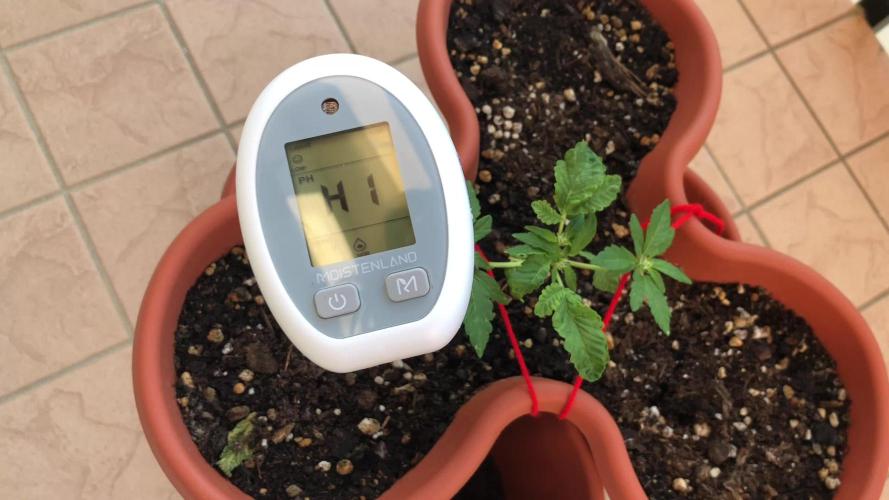
So, thinking this is the first day of week5, but I’m not sure.
📢🗣️ I think this is ‘flowering’ but I’m not sure; comments to help me define ‘flowering’ would be appreciated, please judge my photos and let me know!
📢🗣️ I made a video of my PH reader and a photo. Comments with help for that would also be appreciated, is the PH really over 9 (my readers max) due to calcium buildup up, or is the humus lombrico giving a false reading?
500 ml distilled water (still trying to flush high calcium buildup from the local water).
When the fertilizers arrive I’ll start giving her food:
9/8 200 ml bloom, 60 ml CalMag sup
10/8 250 ml filtered tap water
Moved her to a different balcony that gets a little less morning sunlight 🌅 but a lot more afternoon sunlight ☀️
Tightened the first two LST yarns, added 2 more and discovered 2 more bud sites!
Likes
10
Share


@Organic473
Follow
This girl almost died. The tape and tying wire worked as she continues to put on weight….I have to watch out for the full moon rains coming in March…some lite showers I hope.


Likes
20
Share


@DeepRootsGrowTrees
Follow
KRITIC AUTO by KANNABIA
Week #12 Overall
Week #9 Flower
This week she's doing great 👍 looking outstanding frosty dense buds she smells great she's almost done a few more weeks. Stay Growing!!
Kannabia.com
KRITIC AUTO
Likes
Comments
Share


Likes
43
Share


@TheCannaProphet
Follow
~ FastBuds PAPAYA SHERBET Photoperiod~
Well here we go on another journey together through 'Canna-land' and this one's kinda special... forget that, it's VERY special because this is FastBuds newest surprise for the community, a FEMINIZED PHOTOPERIOD STRAIN!🤯
I was fortunate enough to score these seeds, of which only 1000 were available and can't wait to see what this strain can do! This Papaya Sherbet, according to FastBuds, is a hybrid with a 9-10 weeks flowering period. For a more detailed and accurate description of this strain the following from FastBuds says it best:
"Combining the massive stature of Papaya (Oni Selection) with the strength and resilience of one of our best keeper cuts (Sunset Sherbet), this strain develops into a big, expansive bush adorned with numerous bud sites that later transform into a generous harvest of medium-sized buds. Papaya Sherbet flowers deliver a signature flavor of premium cannabis with subtle citrus undertones that emerge upon inhaling. During growth, her aroma makes for a sweet yet pleasantly bitter fragrance, giving you an idea of what the smoke will taste like. Notably stress-resistant, Papaya Sherbet is a great choice for growers working in challenging environments. She is very forgiving and rebounds quickly from any adversity, allowing growers the freedom to experiment with confidence that she will take everything like a champion she is. This strain embodies resilience, flavor, and abundant yields in every grow cycle."
Sounds like an epic strain and I personally cannot wait for this lady to strut her stuff!😍
________________________________________________________________________________________________________________________________________________________________________________________________________________________________________________________________________________________________________________________
The Setup:
This is going to be an outdoor grow, but I have started the Papaya Sherbet photoperiod indoors as our weather is still a bit too chilly to put a newly sprouted seedling outside (nighttime temp's dipping regularly into the 40's℉).
The plan is simple... let her grow inside under a 19/5 light schedule until the nighttime temperatures are in the mid 50's℉, which shouldn't be long. After which, she'll be moved outside and transplanted into the soil which I have already setup and inoculated with beneficial microbes from BioTabs and slow release dry amendments from Gaia Green. Once she's established herself outside she'll be given periodic top dressings of Gaia Green 4-4-4 and 2-8-4 along with worm castings and Compost Tea's. Her grow area is approx. 5'x5' and I have posts and a trellis net set up already for when she gets bigger to aid in training her. Let the fun begin!🤪💚
________________________________________________________________________________________________________________________________________________________________________________________________________________________________________________________________________________________________________________________
Weekly Updates:
9/20- Here we gooo... Week 6 of flower and the FastBuds Papaya Sherbet photoperiods flowers are exploding now!
9/22- My daily routine of watering, removing dead foliage and checking over the Papaya Sherbet continues. She is unfortunately starting to show signs of Septoria which is a bummer, but at least it's showing up late in flower so it hopefully won't affect the outcome too much.
9/24- Our weather has now cooled off dramatically, with daytime highs in the mid 60's℉, and nighttime temperatures dipping into the low 50's℉. As a result I have cut back on the amount of water the Papaya Sherbet photo is receiving daily.
9/26- There's another exciting week of flowering on the books for the FastBuds Papaya Sherbet photo and from the looks of her, she only has a couple of weeks to go! I'm so excited!🤩
Thank you for checking out my diary, your positive comments and support make it all worthwhile! 💚Growers Love!💚😎🙏
Processing
Likes
49
Share


@Ganjagrandaddy
Follow
Hi all. Hope we are all well amd healthy. This was the last weeks veg period for the FFT crew. The poorly girls are not going to break any records for returns in the grow but thankfully the 2 that are in soil are more than making up for the miniture FFT#8. she is the right colour at least . Her size really is small which is down to the root rot issues that hit the tank hard.
FFT#9 is a different game all together and is getting very big. I expect the stretch to help flatten and widen her out to give a nice sized canopy. Inner growth is getting nice and plentiful too so should be a good yielder.
FFT#10 is really looking Indica leaning now with the colour of deep green all the way through. Her leaves are nice and broad for those lumens that need to be grabbed too. I would love to know what these strains are and have a few of the FFT i would vertainly purchase and grow. I think most of us testing them have a very positive experience in general
Well done Fastbuds.
Lets see these ladies with some stretch on next week. I will use this week to get them as lateral and flat as possible and rhen use atretch week 2 to build the bud spikes. Plan is to defoliate at around day 18/19 as they are fast flowering so should be showing some flowers forming by then. Thet are alsondue sone ecothrive charge , bio-sys and life cycle to boost them for their flowering start.

Likes
10
Share


@MrGrowthSpurt
Follow
I started by soaking the seeds in a cup of water for 24 hrs, next I switched to the paper towel method and kept them in a tupperware container with the lid attached and sprayed with water for 24 hours, I planted them 7am today 9/29/21.