Likes
25
Share


@Ultraviolet
Follow
ANTHOCYANIN production is primarily controlled by the Cryptochrome (CR1) Photoreceptor ( !! UV and Blue Spectrums are primary drivers in the production of the pigment that replaces chlorophyll, isn't that awesome!
1. Diverse photoreceptors in plants
Many civilizations, including the sun god of ancient Egypt, thought that the blessings of sunlight were the source of life. In fact, the survival of all life, including humans, is supported by the photosynthesis of plants that capture solar energy. Plants that perform photosynthesis have no means of transportation except for some algae. Therefore, it is necessary to monitor various changes in the external environment and respond appropriately to the place to survive. Among various environmental information, light is especially important information for plants that perform photosynthesis.
In the process of evolution, plants acquired phytochrome, which mainly receives light in the red light region, and multiple blue light receptors, including his hytropin and phototropin, in order to sense the light environment. .. In addition to these, an ultraviolet light receptor named UVR8 was recently discovered. The latest image of the molecular structure and function of these various plant photoreceptors (Fig. 1), focusing on phytochrome and phototropin.
Figure 1
Ultraviolet-visible absorption spectra of phytochrome, cryptochrome, phototropin, and UVR8. The dashed line represents each bioactive absorption spectrum.
2. Phytochrome; red-far red photoreversible molecular switch
What is phytochrome?
Phytochrome is a photochromic photoreceptor, and has two absorption types, a red light absorption type Pr (absorption maximum wavelength of about 665 nm) and a far-red light absorption type Pfr (730 nm). Reversible light conversion between the two by red light and far-red light, respectively(Fig. 1A, solid line and broken line). In general, Pfr is the active form that causes a physiological response. With some exceptions, phytochrome can be said to function as a photoreversible molecular switch. The background of the discovery is as follows. There are some types of plants that require light for germination (light seed germination). From that study, it was found that germination was induced by red light, the effect was inhibited by subsequent far-red light irradiation, and this could be repeated, and the existence of photoreceptors that reversibly photoconvert was predicted. In 1959, its existence was confirmed by the absorption spectrum measurement of the yellow sprout tissue, and it was named phytochrome. Why does the plant have a sensor to distinguish between such red light and far-red light? There is no big difference between the red and far-red light regions in the open-field spectrum of sunlight, but the proportion of red light is greatly reduced due to the absorption of chloroplasts in the shade of plants. Similar changes in light quality occur in the evening sunlight. Plants perceive this difference in light quality as the ratio of Pr and Pfr, recognize the light environment, and respond to it.
Subsequent studies have revealed that it is responsible for various photomorphogenic reactions such as photoperiodic flowering induction, shade repellent, and deyellowing (greening). Furthermore, with the introduction of the model plant Arabidopsis thaliana (At) and the development of molecular biological analysis methods, research has progressed dramatically, and his five types of phytochromes (phyA-E) are present in Arabidopsis thaliana. all right. With the progress of the genome project, Fi’s tochrome-like photoreceptors were found in cyanobacteria, a photosynthetic prokaryotes other than plants. Furthermore, in non-photosynthetic bacteria, a homologue molecule called bacteriophytochrome photoreceptor (BphP) was found in Pseudomonas aeruginosa (Pa) and radiation-resistant bacteria (Deinococcus radiodurans, Dr).
Domain structure of phytochrome molecule
Phytochrome molecule can be roughly divided into N-terminal side and C-terminal side region. PAS (Per / Arndt / Sim: blue), GAF (cGMP phosphodiesterase / adenylyl cyclase / FhlA: green), PHY (phyto-chrome: purple) 3 in the N-terminal region of plant phytochrome (Fig. 2A) There are two domains and an N-terminal extension region (NTE: dark blue), and phytochromobilin (PΦB), which is one of the ring-opening tetrapyrroles, is thioether-bonded to the system stored in GAF as a chromophore. ing. PAS is a domain involved in the interaction between signal transduction-related proteins, and PHY is a phytochrome-specific domain. There are two PASs and her histidine kinase-related (HKR) domain (red) in the C-terminal region, but the histidine essential for kinase activity is not conserved.
3. Phototropin; photosynthetic efficiency optimized blue light receptor
What is phototropin?
Charles Darwin, who is famous for his theory of evolution, wrote in his book “The power of move-ment in plants” published in 1882 that plants bend toward blue light. Approximately 100 years later, the protein nph1 (nonphoto-tropic hypocotyl 1) encoded by one of the causative genes of Arabidopsis mutants causing phototropic abnormalities was identified as a blue photoreceptor. Later, another isotype npl1 was found and renamed phototropin 1 (phot1) and 2 (phot2), respectively. In addition to phototropism, phototropin is damaged by chloroplast photolocalization (chloroplasts move through the epidermal cells of the leaves and gather on the cell surface under appropriate light intensity for photosynthesis. As a photoreceptor for reactions such as escaping to the side of cells under dangerous strong light) and stomata (reactions that open stomata to optimize the uptake of carbon dioxide, which is the rate-determining process of photosynthetic reactions). It became clear that it worked. In this way, phototropin can be said to be a blue light receptor responsible for optimizing photosynthetic efficiency.
Domain structure and LOV photoreaction of phototropin molecule
Phototropin molecule has two photoreceptive domains (LOV1 and LOV2) called LOV (Light-Oxygen-Voltage sensing) on the N-terminal side, and serine / on the C-terminal side. It is a protein kinase that forms threonine kinase (STK) (Fig. 4Aa) and whose activity is regulated by light. LOV is one molecule as a chromophore, he binds FMN (flavin mononucleotide) non-covalently. The LOV forms an α/βfold, and the FMN is located on a β-sheet consisting of five antiparallel β-strands (Fig. 4B). The FMN in the ground state LOV shows the absorption spectrum of a typical oxidized flavin protein with a triplet oscillation structure and an absorption maximum wavelength of 450 nm, and is called D450 (Fig. 1C and Fig. 4E). After being excited to the singlet excited state by blue light, the FMN shifts to the triplet excited state (L660t *) due to intersystem crossing, and then the C4 (Fig. 4C) of the isoaroxazine ring of the FMN is conserved in the vicinity. It forms a transient accretionary prism with the tain (red part in Fig. 4B Eα) (S390I). When this cysteine is replaced with alanine (C / A substitution), the addition reaction does not occur. The effect of adduct formation propagates to the protein moiety, causing kinase activation (S390II). After that, the formed cysteine-flavin adduct spontaneously dissociates and returns to the original D450 (Fig. 4E, dark regression reaction).
Phototropin kinase activity control mechanism by LOV2
Why does phototropin have two LOVs? Atphot1 was found as a protein that is rapidly autophosphorylated when irradiated with blue light.
The effect of the above C / A substitution on this self-phosphorylation reaction and phototropism was investigated, and LOV2 is the main photomolecular switch in both self-phosphorylation and phototropism. It turns out that it functions as. After that, from experiments using artificial substrates, STK has a constitutive activity, LOV2 functions as an inhibitory domain of this activity, and the inhibition is eliminated by photoreaction, while LOV1 is kinase light. It was shown to modify the photosensitivity of the activation reaction. In addition to this, LOV1 was found to act as a dimerization site from the crystal structure and his SAXS. What kind of molecular mechanism does LOV2 use to photoregulate kinase activity? The following two modules play important roles in this intramolecular signal transduction.
Figure 4
(A) Domain structure of LOV photoreceptors. a: Phototropin b: Neochrome c: FKF1 family protein d: Aureochrome (B) Crystal structure of auto barley phot1 LOV2. (C) Structure of FMN isoaroxazine ring. (D) Schematic diagram of the functional domain and module of Arabidopsis thaliana phot1. L, A’α, and Jα represent linker, A’α helix, and Jα helix, respectively. (E) LOV photoreaction. (F) Molecular structure model (mesh) of the LOV2-STK sample (black line) containing A’α of phot2 obtained based on SAXS under dark (top) and under bright (bottom). The yellow, red, and green space-filled models represent the crystal structures of LOV2-Jα, protein kinase A N-lobe, and C-robe, respectively, and black represents FMN. See the text for details.
1) Jα. LOV2 C of oat phot1-to α immediately after the terminus
Rix (Jα) is present (Fig. 4D), which interacts with the β-sheet (Fig. 4B) that forms the FMN-bound scaffold of LOV2 in the dark, but unfolds and dissociates from the β-sheet with photoreaction. It was shown by NMR that it does. According to the crystal structure of LOV2-Jα, this Jα is located on the back surface of the β sheet and mainly has a hydrophobic interaction. The formation of S390II causes twisting of the isoaroxazine ring and protonation of N5 (Fig. 4C).
As a result, the glutamine side chain present on his Iβ strand (Fig. 4B) in the β-sheet rotates to form a hydrogen bond with this protonated N5. Jα interacts with this his Iβ strand, and these changes are thought to cause the unfold-ing of Jα and dissociation from the β-sheet described above. Experiments such as amino acid substitution of Iβ strands revealed that kinases exhibit constitutive activity when this interaction is eliminated, and that Jα plays an important role in photoactivation of kinases.
2) A’α / Aβ gap.
Recently, several results have been reported showing the involvement of amino acids near the A’α helix (Fig. 4D) located upstream of the N-terminal of LOV2 in kinase photoactivation. Therefore, he investigated the role of this A’α and its neighboring amino acids in kinase photoactivation, photoreaction, and Jα structural change for Atphot1. The LOV2-STK polypeptide (Fig. 4D, underlined in black) was used as a photocontrollable kinase for kinase activity analysis. As a result, it was found that the photoactivation of the kinase was abolished when amino acid substitution was introduced into the A’α / Aβ gap between A’α and Aβ of the LOV2 core. Interestingly, he had no effect on the structural changes in Jα examined on the peptide map due to the photoreaction of LOV2 or trypsin degradation. Therefore, the A’α / Aβ gap is considered to play an important role in intramolecular signal transduction after Jα.
Structural changes detected by SAXS
Structural changes of Jα have been detected by various biophysical methods other than NMR, but structural information on samples including up to STK is reported only by his results to his SAXS. Not. The SAXS measurement of the Atphot2 LOV2-STK polypeptide showed that the radius of inertia increased from 32.4 Å to 34.8 Å, and the molecular model (Fig. 4F) obtained by the ab initio modeling software GASBOR is that of LOV2 and STK. It was shown that the N lobes and C lobes lined up in tandem, and the relative position of LOV2 with respect to STK shifted by about 13 Å under light irradiation. The difference in the molecular model between the two is considered to reflect the structural changes that occur in the Jα and A’α / Aβ gaps mentioned above.
Two phototropins with different photosensitivity
In the phototropic reaction of Arabidopsis Arabidopsis, Arabidopsis responds to a very wide range of light intensities from 10–4 to 102 μmol photon / sec / m2. At that time, phot1 functions as an optical sensor in a wide range from low light to strong light, while phot2 reacts with light stronger than 1 μmol photon / sec / m2. What is the origin of these differences? As is well known, animal photoreceptors have a high photosensitivity due to the abundance of rhodopsin and the presence of biochemical amplification mechanisms. The exact abundance of phot1 and phot2 in vivo is unknown, but interesting results have been obtained in terms of amplification.
The light intensity dependence of the photoactivation of the LOV2-STK polypeptide used in the above kinase analysis was investigated.
It was found that phot1 was about 10 times more photosensitive than phot2. On the other hand, when the photochemical reactions of both were examined, it was found that the rate of the dark return reaction of phot1 was about 10 times slower than that of phot2. This result indicates that the longer the lifetime of S390II, which is in the kinase-activated state, the higher the photosensitivity of kinase activation. This correlation was further confirmed by extending the lifespan of her S390II with amino acid substitutions. This alone cannot explain the widespread differences in photosensitivity between phot1 and phot2, but it may explain some of them. Furthermore, it is necessary to investigate in detail protein modifications such as phosphorylation and the effects of phot interacting factors on photosensitivity.
Other LOV photoreceptors Among fern plants and green algae, phytochrome ɾphotosensory module (PSM) on the N-terminal side and chimera photoreceptor with full-length phototropin on the C-terminal side, neochrome (Fig. There are types with 4Ab). It has been reported that some neochromes play a role in chloroplast photolocalization as a red light receiver. It is considered that fern plants have such a chimera photoreceptor in order to survive in a habitat such as undergrowth in a jungle where only red light reaches.
In addition to this, plants have only one LOV domain, and three proteins involved in the degradation of photomorphogenesis-related proteins, FKF1 (Flavin-binding, Kelch repeat, F-box 1, ZTL (ZEITLUPE)), LKP2 ( There are LOV Kelch Protein2) (Fig. 4Ac) and aureochrome (Fig. 4Ad), which has a bZip domain on the N-terminal side of LOV and functions as a gene transcription factor.
4. Cryptochrome and UVR8
Cryptochrome is one of the blue photoreceptors and forms a superfamily with the DNA photoreceptor photolyase. It has FAD (flavin adenine dinucle-otide) as a chromophore and tetrahydrofolic acid, which is a condensing pigment. The ground state of FAD is considered to be the oxidized type, and the radical type (broken line in Fig. 1B) generated by blue light irradiation is considered to be the signaling state. The radical type also absorbs in the green to orange light region, and may widen the wavelength region of the plant morphogenesis reaction spectrum. Cryptochrome uses blue light to control physiological functions similar to phytochrome.
It was identified as a photoreceptor from one of the causative genes of UVR8 Arabidopsis thaliana, and the chromophore is absorbed in the UVB region by a Trp triad consisting of three tryptophans (Fig. 1D). It is involved in the biosynthesis of flavonoids and anthocyanins that function as UV scavengers in plants.
Conclusion
It is thought that plants have acquired various photoreceptors necessary for their survival during a long evolutionary process. The photoreceptors that cover the existing far-red light to UVB mentioned here are considered to be some of them. More and more diverse photoreceptor genes are conserved in cyanobacteria and marine plankton. By examining these, it is thought that the understanding of plant photoreceptors will be further deepened.

Likes
262
Share


@Ju_Bps
Follow
Hello my friends growers!👨🌾👨🌾,
All was fine this week,
Buds continue to grow up well 🌲,
Plant look healthy and happy,
I start to have a nice sweet/fruity smeel, look nice for the future weeks 😍.
I give water each 2/3 days,
Water + bloom tabs rqs + sugar royal 2.25l/plant
Water + cannaboost 2.25l/plant
Water + bloom tabs rqs
PH@6
I grow in underground so, sometimes it's really difficult to regulate humidity.
Average RH 65%, not really well in blooming, sometimes 50%, sometimes 80%,
Hope next week will be more stables.
Have a good week mate, and see you next week 🌲👊👨🌾💨💨

Likes
2
Share


@Greenbean420
Follow
For 6 plants I got 415 grams which is so far, again my most yield to date. I think the light is deffo a factor plus the genetics help.
It says it has up to 27% THC, it was deffo one of my favourites and I think I’ll be growing this again in the future. I’m terrible of explaining the smell and taste but it was really danky and a lot of my mates loved it.


Likes
20
Share


@NONSENSE
Follow
Hi there,
This is the last week of the flowering.
I will start flushing within next 3 days.
The plant looks good and healthy.
I feed the plant every day 2-3 L.
The arome is just amazing sweet and fruity.
Likes
10
Share


@IndoorNewb
Follow
Began week picking off yellowing foliage. Started her on a PK booster. I know I'm late to the PK party but only just hearing about it. Details in video.

Likes
2
Share

@KyGrow42
Follow
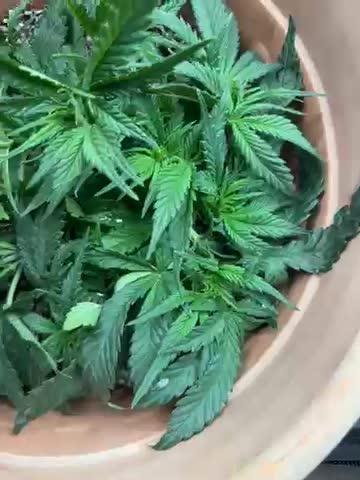
I tied her down had to be real careful cause the stalk is so thick it’s crazy you cant really see much in the photos cause she’s so bushy she loves the nutrients been watering about every 3 days getting real close to flowering I think until next time happy growing
Likes
7
Share


@dinosdarko
Follow
Blütewoche 8 – Der Endspurt des Bruce-Banner-Monsters! 🚀
Willkommen auf der Zielgeraden meines Bruce-Banner-Grows! 🥦💥
Wir befinden uns jetzt offiziell am Beginn der 8. Woche, gezählt seit dem Erscheinen der allerersten weißen Härchen. Wenn man sich die Pflanze im Gewächshaus aktuell anschaut, ist sie einfach ein absolutes Kraftpaket!
📊 Aktuelle Daten & Beobachtungen:
• Gewaltige Dimensionen: Die Pflanze hat mittlerweile eine stattliche Höhe von 2,00 Metern erreicht und glänzt mit einer enormen Breite von 1,50 bis 1,60 Metern.
• Ergebnis der Triebselektion: Das gezielte Training auf den Haupttrieb und die drei starken Hauptarme („Beine“) hat sich voll ausgezahlt. Zusammen mit dem gründlichen Freischneiden (Lollipoppping) im unteren Bereich ist die Energieverteilung perfekt. Die Blütenstände messen am Zollstock bereits stolze 25 bis 30 Zentimeter!
• Enorme Gleichmäßigkeit: Die Entwicklung ist von oben bis unten absolut einheitlich. Es sind bisher nur sehr wenige braune Härchen zu sehen – die Pistille stehen fast überall noch schneeweiß und gerade, was zeigt, dass die Buds noch fleißig an Masse zulegen.
• Massive Harzbildung & Potenzial: Die Produktion der Trichome auf den Blüten und Zuckerblättern läuft auf Hochtouren und legt eine frostige, klebrige Schicht über die Buds. Hier kommt die legendäre Genetik von OG Kush und Strawberry Diesel voll zur Geltung. Das Potenzial für eine Rekordernte und extreme Potenz ist unübersehbar!
💧 Bewässerung & Klima im Gewächshaus:
Die Pflanze strotzt vor Gesundheit und zeigt keinerlei Mangelerscheinungen. Da wir uns aber dem Finale nähern, steht sie ab jetzt auf einer strikten Diät mit klarem Wasser (Spülen). Damit zwinge ich sie langsam in den „Herbstmodus“, damit sie die restlichen Nährstoffe aus den Fächerblättern verbraucht.
🔮 Der Fahrplan für die nächsten Tage:
Die visuelle Kontrolle zeigt deutlich: Die Pflanze braucht definitiv noch mindestens eine Woche (Minimum 7 bis 10 Tage), damit die Blütenkelche maximal anschwellen und die Trichome perfekt reifen. Wegen des typisch feuchten Oktoberwetters laufen die Ventilatoren im großen Gewächshaus ab jetzt rund um die Uhr (24/7), um maximale Umluft zu garantieren und diese dichten 30-cm-Buds optimal vor Schimmel zu schützen [Relevance: October weather in Germany].
Die Ziellinie ist in Sicht und ich bin absolut begeistert von der Struktur und Vitalität dieser Pflanze. Das Ernte-Update folgt bald! ✂️🍂
Du

Likes
11
Share

@Thomas86
Follow
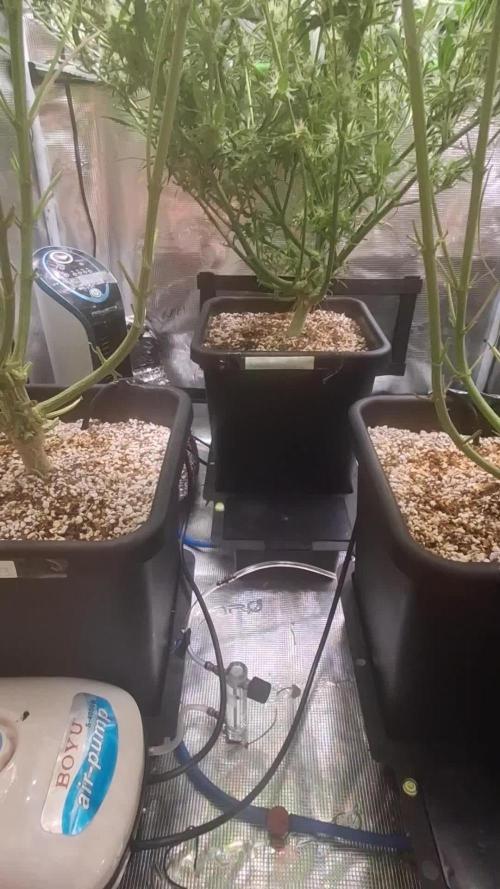
Plants at the back look very green and overfed so I dropped the Ec a little, Had to defoliate again to try combat the high humidity, hoping it drops a bit, probably stunted the growth a little but hoping I didnt stress them too bad, My lights are max height so hoping they stop growing vertically, they got a little taller this week and some leaves are getting bleached.
Likes
15
Share

@Ribemarti
Follow
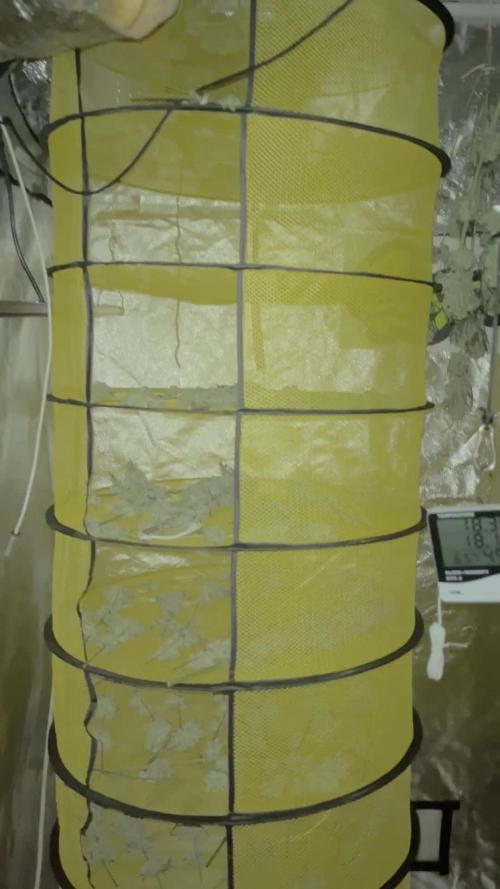
55 Dias se han cortado estas plantas muy tapida!!
Variedad cargada de resina y cogollos duros como piedras,
El olor a chucherias afrutadas es impresioannte en algunas plantas, estan 16 en las mallas de secado y 3 que han salido al fenotipo de gelato las he puesto colgadas, ventilador pequeño giratorio deshumificador y extractor,
Es muy importante el secado que vaya despacio, si no despues de todo el trabajo que se ha echo lo puedes lanzar todo a perder, ahora cuando este seco al bote a que se curen las golosinas, Nos vemos en el siguiente cultivo que ya esta en marcha
Likes
59
Share


@DaGrowQueen
Follow
This strain has easily become one of my top 10 favorites over the past year, to smoke and grow.

Likes
46
Share


@Rollex420
Follow
Day 18
Transplanted today the plants into their 11L pots.😊
While instead i will let the Lemon Tree grow for another 4/5 days in the same pot because she only got 13 days, so I prefer to have it strengthened a little before the transplant.
Day 24
Mimosa, Meringue, and Kmintz were Topped, Defoliated and also applied a light LST to the main stems of the plants.
I will do the same for the Lemon Tree in the next 2/3 days..
I hope they have a quick recovery 🤞🏻
Day 27
LST also performed on the side branches of all plants except the Kmintz which is too small to bend its branches.
Also Today we got 21 days for the Lemon Tree which has a great shape! Carried out topping, LST and a little defoliation.. 🙌🏻
In the next few days I will let them grow them without further stress.
Have a great weekend gromies!! ☮️💚
Likes
2
Share

@Guerrilla_grower777
Follow
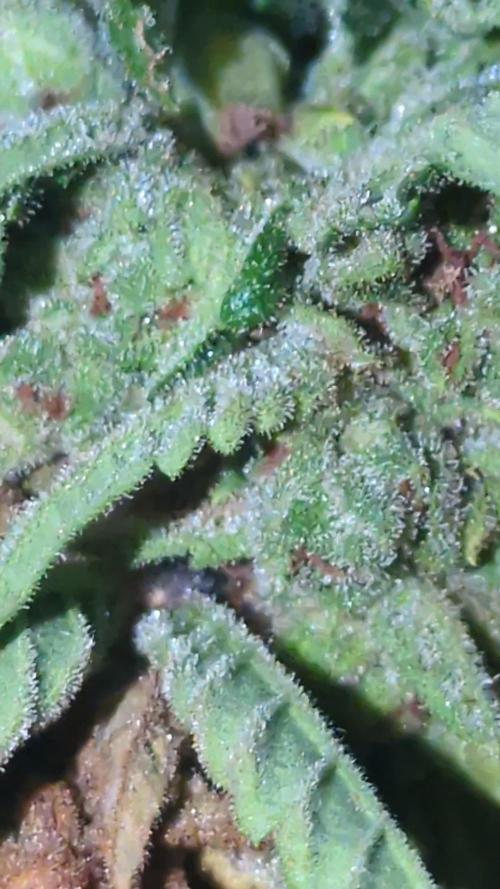
Strange hot week in the very end of Summer
I had to write something here to post this😄😄

Likes
20
Share


@RunWithIt
Follow
I mean, overall this was an extremely painless grow. The test of whether we should or shouldn't top autos is still TBD imo. Our topped candidate produced denser, frostier buds, but weighed slightly less, at 14 grams of bud total. And our lst plant produced 18 grams of bud, not as frosty, and almost as dense as our topped girl. I'll be topping autoflowers from here on out only under the circumstance I have 4+ to grow at the same time. Seems like it could be used to speed up the autoflower grow cycle if done properly, like with right. Since I'm doing a perpetual cycle, it's still a viable option for me in the long run. A few tips I have for anyone growing this strain in organics:
Start feeding bloom nutes a little bit prior to flower transition - this makes the transition more seemless. From weeks 1-3 flower, I slowly dropped the grow dosage until I cut off grow nutes week 3 flower.
Starting the flush around week 6 flower seemed to really bring out this plant's potential. But I think you could get away with starting the flush around week 5. I hope this helps anyone trying this strain out. It's a good one, I hope to see more journals of it, eventually.
Cheers everyone! Time for me to take a well-deserved puff. :) ☁️ 🌼
Likes
31
Share


@BigBadLion
Follow
Hey guys! Another update! 💪
I bought a Cal-Max from Grotek 👌 From the photos I shared it seems Matcha and Pistachio are suffering from some Magnesium deficiency (I hope that's the issue 😰) and this should help with the issue. I foliar spayed both of my babies and then I added the recommended dosage to all the waterings I made during the week. Gladly the first changes were clear after 48 hours of spraying them and I'll probably see the rest of the changes next week (or the week after) 😱
Besides that Matcha is still super small compared to Pistachio and I wonder what might be the issue. Maybe I'm watering her a bit too much or the heat is too high and it's not letting her take the proper nutrients? Maybe her roots are still small (for some reason I think this might be the main issue) or the damage she suffered from the lack of magnesium was way too severe and can't be fixed? No idea but she seems to be recovering so I'll let her continue that way for a bit more (and let her grow some more roots) before switching into flower. Oh! And I switched places between her and Pistachio, in case the lights were a bit too strong for my baby!
As for Pistachio, she's growing strong so I suspect she'll be a huge plant during the stretch phase 😃(you can only dream). She's also showing some chlorosis but absolutely nothing compared to Matcha.
I also defoliated both of my plants, they were getting bushy and I want all the "new" colas to receive as much light as poooooosible!
Anyway, that's all for now. I hope you'll all enjoy the photos and video!
See you all in the next update! 👍
Likes
112
Share


@SwissKush
Follow
Day 99 - Ripening week in DWC
a. pumped out the Flowering blend, and installed the Ripen
b. this plant is certainly a small bush like FastBuds claimed
c. I can see how this would be perfect for SOG
d. Her pistils are all almost colored, and the trichomes are milky
Day 100
a. I always love using Ripen, it works so well
b. first day, already notice the top of the buds filling out more
c. her life is coming to an end. she will get this week to ripen, then next week we will flush/chop
d. growing in DWC makes the ripening and flushing mush faster than other substrates
Day 101 - the purple is setting in
a. looks like they are ripening up fast, the purple is getting darker and the buds harder
Day 102 - ripening really nice, the smell is quite intense
a. she is smelling up our barn, we dont have a filter
b. Ripen always makes the buds very hard, she is drinking a L a day right now in the end.
Day 104 - incredible smell
a. this is finally smelling pungent like kush, well kushy haze
b. sampled a small top bud, its killer
c. Will be cutting down in a few days
Day 105 - ripe
a. the buds are ripe, I will gradually start the flush before harvest
b. will give them 1 or 2 more days of ripen formula, then flush with Florakleen for a day
Likes
16
Share


@GardenOfHerbs
Follow
* harvest: 8 weeks veg. 60 days flowering
* pot size: 10liter air-pot
* dry bud yield: 59gram
* Appearance: the most frosty buds i have ever seen in my life. Its shining like a diamond. I could look at them all day
* Bud density: 10/10
* Aroma : smelling like gas with a mix of ripe peaches
* Taste : damn the peach terps are insane on the inhale, a strong gas taste on the exhale
* Potency : 10/10
* Kind of high: next level strong, like you are smoking extracts
* Colour of thrichs at time of harvest: 20% amber 80% milky
* Drying time: 10 days in the dry tent, curing 10 days
* Good comments: This has to be the frostiest plant i have ever grown, the trichome/resin production on this plant is insane and never seen before. Also one of the prettiest plants i have grown, the leaves turned out completely dark purple/black at the end of flower. The terpenes on this plant are incredible. Im super impressed by this seedbank and i will definitly grow more from them.
* bad comments: this pheno wasnt a heavy yielder but thats ok, quality over quantity
Likes
13
Share


@DeepSouthDank
Follow
Another fantastic week!
The girls grew nicely during the stretching phase filling out most of the space, but have now started to calm down. It has been 14 days since switching to a 12/12 light cycle.
We lowered the light and are running it at 100% power.
The girls are being fed five times a day through a drip feed system @1500EC.
No problems so far. Happy daze 😁

Likes
15
Share