


Likes
Comments
Share


@Grilla
Follow
March 25, 2023 at 1:48 PM
-Ever since I started watering them with lower pH water, 6.0 to 6.3, the 2 BOH’s really started to takeoff. I might do some slight defoliation on all the plants. I’ll takeoff their lower nodes to make it easier to bend them from the main stock. The strawberry crinkle has very close internodes and is really bushy with large and thick fingers. It’s too short to try and bend over so I might have to do more of the defoliation job in order for the lower nodes to get more light.
March 28, 2023 at 5:24 PM
-
March 29, 2023 at 2:01 PM
-I’ve bent over several stems this week. I have only had one small accident with the strawberry crinkle. The top was snapped off somehow but I don’t remember it happening, but it seems to be taking it well. I watered them the day before with some tea with ph at 6.3. so far I could bend over things every day. They are starting to cover the entire pot.
- Today’s the last day of week three.



Likes
3
Share


@Chilitom420
Follow
🌱 MENTAL RAINBOW 🌈
Na, akkor induljon a történet.
Sokan csak a kész növényt mutatják meg. A nagy bokrokat, a gyönyörű virágokat és a végeredményt.
Engem viszont mindig sokkal jobban érdekelt az út, ami odáig vezet.
Ezért most úgy döntöttem, hogy ezt a növényt az első pillanattól kezdve végig dokumentálom. Nem csak a sikereket, hanem a hibákat is. Nem csak azt, ami működik, hanem azt is, ami nem.
A főszereplő egy Mental Rainbow a Sweet Seeds-től.
Jelenleg még csak egy apró mag, amely a Root Riot kockában pihen. Kívülről nézve még semmi különös nem történik. Nincs gyökér, nincs levél, nincs növény. Csak egy mag és egy lehetőség.
De minden nagy növény pontosan így kezdi.
A következő hetekben és hónapokban végig követjük a fejlődést a csírázástól egészen a betakarításig. Valós körülmények között, valós döntésekkel, valós hibákkal és remélhetőleg valós sikerekkel.
A cél egyszerű:
Lásd, mit lehet megszívni.
Hogy ne te szívj vele...
😄 Szívok helyetted én.

Likes
16
Share


@Northern_Ent
Follow
June 1: May was a cool month and she has been slow to recover since the topping five days ago. This week should be better and the week after is perfect cannabis weather.
Did foliar spray of Extreme Blend this morning.
June 2: watered with molasses.
June 3: rained all day.
June 6: starting manual LST to gently keep the two stems from growing close together.
June 7: brought back inside because it will be too cold for the next two days. Daytime high of only 8 C and the overnight low will be 1 C. That’s pretty cold for early June.

Likes
9
Share


@bigolebuds
Follow
Week 9: Still coasting, but on the last day of this week the plants showed some major signs of being both thirsty and wanting some more nutrients. Not only were some leaves dried and shriveled, but others were limp and some new leaves started showing slight loss of green.
I'm attributing this to our delay in watering the plants this week and it being time for another round of 444. This will be their last full Veg fertilizing, before we flip. In 3/4 weeks we will feed half strength 444, half strength 284, another round of bloom boost, some recharge for the soil and we will hope for the biggest, densest, dankest mugs possible! Idk how I forgot to mention but at this point our babies are mothers! We let some of the branches get a little longer than we should before snipping and voila.. an opportunity for a new plant and maintained genetics.
A little behind on the scrog net, getting 2 plants out this tent, and feeding extra silica.. but I think our babies are gonna push through.

Likes
4
Share


@JeyGanesha
Follow
Prima settimana di fioritura e tutto procede bene ☺️ è impressionante come funziona bene advance nutrients....fanno il lavoro che devono.......

Processing
Likes
12
Share


@Homegrown_Meds
Follow
Harvest report in progress. Please check back soon for update..
Likes
5
Share


Likes
14
Share


@Bluntblazer66
Follow
Dec 13th
Week 20 flowering week 9
Dec 14th
Switched nutes to dense Buds
Buds are on the smaller side and quantity is looking low
If I get an ounce out of this I’ll be surprised. Hopefully the quality is good
Dec 16th
Switched nutes to weekly nutes

Processing
Likes
10
Share


@zombikush81
Follow
they grow healthy and strong, after the stress caused by the repotting has started to grow very quickly, it has really excellent genetics no problem encountered. It has an excellent structure with well distributed branches. But we will see all its potential in bloom as it explodes. After all, the gorilla and a very beautiful bitch.

Likes
69
Share


@DogDoctorOfficial
Follow
Eternity Grow Cup - Week 11 VEG Report
This is a pivotal week in our Eternity Grow Cup journey as we wrap up VEG and prepare to transition into FLOWER. Our goal has been to ensure that the plants are thriving and optimized for the next phase. This report will detail everything that took place during this crucial week.
Mass Defoliation & Structural Training
We began the week with an extensive defoliation session. Every leaf with a stem was removed to clear space for optimal light penetration and airflow. This process was done mostly by hand, clicking them off in the opposite direction of growth, while some stubborn ones were snipped with scissors. By the end, it felt like we had taken out nearly half a kilo of leaves! The room now looks clean, structured, and ready to fill out the ScroggNet.
To further enhance the plant structure, branches were attached to the pots, allowing for better horizontal growth. This technique helps maximize canopy exposure and prepares the plants for even light distribution once flowering begins. Defoliation before flowering is a key step as it reduces overcrowding, improves airflow, and sets the plants up for efficient energy use in the next phase.
Light Schedule & Adjustments
This week, we introduced a subtle but effective light adjustment. While still maintaining an 18-hour light cycle, we initiated a 15-minute delay with the whites, allowing the reds to start first. This gradual shift signals the plants that a change is coming. Similarly, at the end of the light cycle, the whites turn off 15 minutes earlier, leaving the reds on for an extended period. This strategy mimics natural sunrise and sunset, helping the plants transition more smoothly into flowering.
Additionally, at the end of the week, we will be implementing 48 hours of darkness before the official flip to flower. This method has worked exceptionally well in past grows, helping plants recognize the transition and encouraging a strong start to flowering. However, it's important to emphasize that this is a personal technique and not a universal rule. Every grower should experiment with different methods to find what works best for their specific environment.
Environmental Conditions & Challenges
Currently, our temperature is at 27°C with 60% humidity, resulting in a VPD of 1.50. While slightly higher than the ideal for VEG, our CO2 levels are over 1000 ppm, and the light intensity is at 570 PPFD, making it a manageable balance. The solution pH is 5.79 (essentially 5.8), EC is 1.38, and water temperature is 17.7°C.
One challenge we are facing is maintaining optimal reservoir temperatures. Currently, it's a bit low at 17.7°C, and we are exploring solutions to raise it slightly. However, the medium temperature sits at 22.2°C, which is a good range. The humidifier is still in use, though it struggles to increase humidity further, so we are working with what we have to keep the VPD in check.
ICL-300s Integration
The ICL-300 lights are now fully active. Unlike the last grow, where we introduced them later, this time they are on from the start of flowering prep. This adjustment is an experiment to see if the plants respond better to an early introduction. Learning is at the core of this journey, and each grow offers new insights. Whether this proves to be the optimal strategy or not, it will be a valuable lesson for future grows.
TrolMaster Hub & Data Monitoring
Throughout the week, we have been closely monitoring our grow using the TrolMaster App TM+. We are displaying some of the collected data for everyone to see the details. Stay tuned as we explore this further in the next report!
As always, we want to extend a huge thank you to our sponsors and the amazing community. Special thanks to Aptus, Groovebags, Cannakan, Promix, Ziggy Papers, TrolMaster,and Plagron, Zamnesia and Grow Diaries for making the Eternity Cup possible.
I apprecilove the support from all sides—lovers, haters, competitors, and fellow growers. The competition continues to push us to improve, and i am thrilled to see the incredible reports from others. This is a challenging yet rewarding experience, and i couldn’t be happier to be part of it.
For those following along, we invite you to check out our YouTube channel, where we upload full 4K episodes showcasing the entire journey. Some episodes are too large to be uploaded directly to Grow Diaries, so YouTube is the best place to catch everything in high definition.
This marks the end of VEG, and we are officially ready to flip to FLOWER. Next week, we will dive into the TrolMaster System in action, check the data insights, and monitor how the garden adapts to the shift. Stay tuned!
Growers Love to all, happy growing, and best of luck to all competitors!
See you all in the next update!
Genetics - Runtz https://www.zamnesia.com/6000-zamnesia-seeds-runtz-feminized.html
Nutrients - Plagron https://plagron.com/en/hobby
- Aptus Holland https://aptus-holland.com/
Controls - Trol Master https://www.trolmaster.eu/
LED - https://www.futureofgrow.com/en
LED - https://www.thinkgrowled.com
Soil - https://www.promixgardening.com/en
Germination - Cannakan https://cannakan.com/?srsltid=AfmBOopXr-inLXajXu3QFgKXCXXos4F1oEvScjMKIB5MR5dk8-GJ-F49
DOGDOCTOR 15% off
Smoking Papers - https://ziggioriginal.com/
Terpene saver - https://grovebags.com/
As always thank you all for stopping by, for the love and for it all , this journey of mine wold just not be the same without you guys, the love and support is very much appreciloved and i fell honored with you all in my life
With true love comes happiness Always believe in your self and always do things expecting nothing and with an open heart , be a giver and the universe will give back to you in ways you could not even imagine so
As always, this is shared for educational purposes, aiming to spread understanding and appreciation for this plant. The journey with nature is one of discovery, creativity, and respect. Let’s celebrate it responsibly and continue to learn and grow together!
Growers Love To you All 💚
#EternityGrowCup #RuntzHunt #GrowersLove #CannabisCommunity #AptusHolland #ProMixSoil #TrolMaster #Zamnesia #Plagron #ZiggiPapers #Grovebags

Likes
33
Share


@All_our_small_plants
Follow
5000 ml jeden 3 Tag in der Zehnten Woche
pH-Wert: 6,3
EC-Wert: 1.4 mS/cm
Temperatur: 30ºC
Luftfeuchtigkeit: 50%
Schädlingsbekämpfung: im Moment haben wir keine Anzeichen das es was zu bekämpfen wir haben aber Raubmilben ins spiel gebracht zur vorsorge gegen Spinnmilben und andere Schädlinge 😉💪
Düngemittel: Brenneseljauche self made hat einen EC wert von ca 1.6 und etwas PH up von Biobizz
Besonderheiten: Sie wurde nun in den Outdoor Bereich gesetzt und wartet auf das umtopfen.
-Tag 64 heute haben wir ihr wieder Wasser mit Jauche gegeben und wir haben den PH wert etwas nach oben verschoben in dem wir PH-Up von Biobizz dazu gegeben haben. sie bildet immer schönere und dichtere Buds. Sieht sehr gut aus und so langsam steigt auch ihr Duft in die Nase 😍
-Tag 66 nicht viel mehr zu sagen heute, sie legt schön an dichte zu und Geruch.
-Tag 68 heute haben wir ihr wieder Wasser gegeben 👍
-Tag 70 heute wieder Wasser gegeben und Blüten Kontrolliert, ob sich irgendwo Pollensäcke bilden. Man weiß ja nie was da kommt 😜
Likes
10
Share


@DeepRootsGrowTrees
Follow
MIMOSA ZKITTLEZ / GANJA FARMER
WEEK #17 OVERALL
WEEK #7 FLOWER
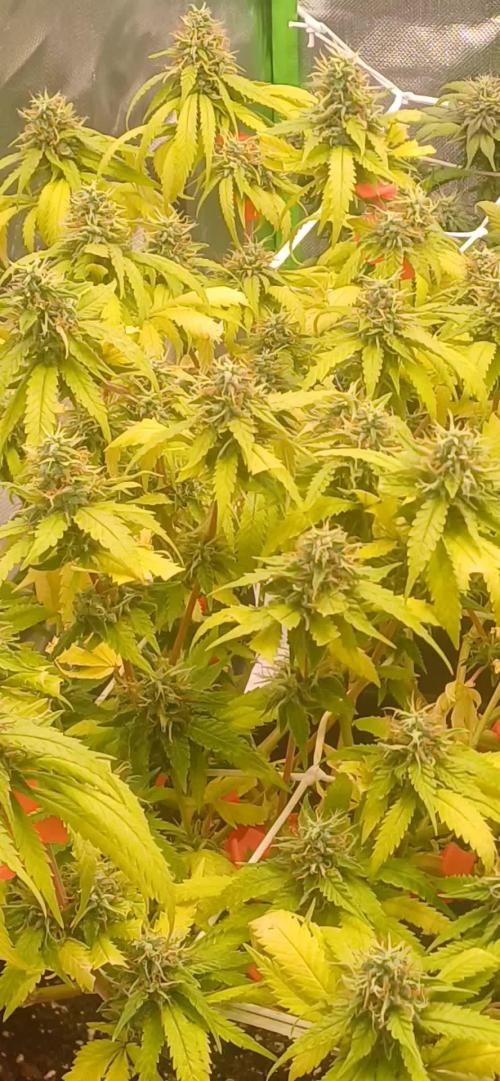
This week she's in week #7 of flower got another week or so left befor harvest. She's stacking up nicely and she's got good trichome coverage she's a big plant. Stay Growing!!
Thank you for stopping my and taking a look it's much appreciated!!
THANK YOU GANJA FARMER!!
BUDTRAINER.COM BUD CLIPS
MIMOSA ZKITTLEZ / GANJA FARMER


Processing
Likes
36
Share


@Island
Follow
Week 8 -
Dead line is coming, starting week 8 of flowering.
The routine is maintained, feeding only with water.
The pistils take on an orange color and some leaves change color.
Likes
2
Share


@GREENPHOENIX6262
Follow
08/18 - Transplanted from a 1 gallon pot to a 7 gallon - Topped all main COLAS - Tied dowm MAIN STEMS - Watering 1 gallon every 3 days - Clean water/nute feed overlapped
08/23 - Prepping the mother for first set of clones - 10 per gen - Started mist spraying for rapid root growth when clones are cut - Adding clonex root gel at cutting for clones😎


Likes
52
Share


@Stick
Follow
Well well well thanks to all of you for reading my diary and supporting that project 😎 This was the longest run I've been through for a while, but it was worth it. I was rewarded with 168g of top shelf quality buds, while she was under a 110W SMD (LM301B) board.
Only 110W... I was amazed by these boards by InvisibleSunLed, and very happy of my investment. Samsung diodes are game-changers and it will get even better in a near future, what an exciting time for us modern growers! If you plan to buy some SMD boards, make sure the driver is dimmable, the light intensity can be so strong at its maximum, you could burn your plants (or your eyes). I started the board at 50% (~55W) and slowly increased the wattage as I was seeing a happy plant enjoying her indoor sun. I was also very surprised by the cheap IKEA bulbs, some ingeneers at IKEA must be growing pot, these tiny things do really work! I wouldn't try to flower anything with these, but it was perfect for the first weeks of my THC-Bomb.
I made some canna-butter using the sugar leaves from the trim and some decarboxylated buds, and cooked a big cake. That s*** was strong as hell, I was unable to do anything for 24 hours 😭 If you're not used to edibles, start with small pieces rather than a big cake, I learned it the hard way 😜
I will now work on gaining knowledge about nutrient absorption in coco, improving my photo skills (must get a new camera..), and I will also look for a better way to produce timelapses.
Shout-out to the brands who made this possible:
🇬🇧 Bomb Seeds (breeder)
🇬🇧 Invisible Sun Led (lights)
🇺🇸 Greenleaf Nutrients (nutrients)
🇬🇧 Air-Pot (pots)
🇸🇪 IKEA 😂 (lights)
I enjoyed sharing this experience with you, stay tuned for some other grow report, and happy growing to all 👊


Likes
6
Share


@DG422
Follow
Läuft alles wie es soll. Dünger frisst zwar viel Geld aber es wird sich für die Ernte lohnen.
