




Likes
56
Share


@Cannabeast40
Follow
Welcome back to yet another short update☺️
Transplanted and filled with tender care and love 🤗 A bit colder temperatures then inside the veg tent , but I’m not worried at all🤩
Videos show the process, hope you enjoy 💯💚
See you next week🤩
------------------------------------------------------------------------------------------
Light source:
Medicgrow SpectrumX
880W LED
Build in PPFD
4 controllable spectrums V1, F1, VS, FS
Visit https://medicgrow.com/ for more informaton.
Light measurement:
Apogee MQ-610 & Apogee DLI-600.
Fertiliser:
Organics Nutrients
https://www.organicsnutrients.com/en/
Green Buzz Nutrients
Discount Code: GD42025
Grants 25% with a minimum Order value at 75 Euro.
https://greenbuzzliquids.com/en/shop/

Likes
3
Share


@Mett420
Follow
Effettuato topping, lst con clip e defogliazione degli strati più vicini all internodo (questo la settimana scorsa), e si può vedere un importante espansione delle foglie e irrobustimento degli steli. Tagli e tecniche necessarie per questo tipo di genetica e setup

Likes
6
Share


@GoldenWeedGrower
Follow
Legend
Timestamp: 📅
EC - pH: ⚗️
Temp - Hum: 🌡️
Water: 🌊
Food: 🍗
pH Correction: 💧
Actions: 💼
Thoughts: 🧠
Events: 🚀
Media: 🎬
D: DAY, G: GERMINATION, V: VEGETATIVE, B: BLOOMING, R: RIPENING, D: DRYING, C: CURING
______________
📅 D36/V32 - 21/05/24
⚗️ EC: 1.0 pH: 6.0
🌡️ T: 20°C H: 70%
🌊
🍗
💧
💼 LST
🧠
🚀
🎬 1 TL in her new home and one TL of LST job
______________
📅 D37/V33 - 22/05/24
⚗️ EC: 1.0 pH: 5.4
🌡️ T: 20°C H: 70%
🌊
🍗
💧
💼 LST
🧠
🚀
🎬 1 TL video and one TL of LST job
______________
📅 D38/B01 - 23/05/24
⚗️ EC: 1.0 pH: 5.3
🌡️ T: 20°C H: 70%
🌊 2L
🍗
💧
💼
🧠 As I saw clear signs of blooming, I need to pass to bloom phase so I put B01, in the header.
🚀 Clearly she's starting flowering
🎬 1 TL video and 1 LST video
______________
📅 D39/B02 - 24/05/24
⚗️ EC: 1.1 pH: 5.3
🌡️ T: 20°C H: 70%
🌊
🍗
💧
💼
🧠
🚀
🎬 1 TL video and 1 LST video
______________
📅 D40/B03 - 25/05/24
⚗️ EC: 0.2 pH: 5.3
🌡️ T: 20°C H: 70%
🌊 15L
🍗
💧
💼 Flush for two days and then flowering nutes
🧠 I think no more LST, she's now full blooming
🚀
🎬 1 TL video
______________
📅 D41/B04 - 26/05/24
⚗️ EC: 0.2 pH: 5.3
🌡️ T: 20°C H: 70%
🌊
🍗
💧
💼 Flush for two days and then flowering nutes
🧠 I think no more LST, she's now full blooming
🚀
🎬 1 TL video
______________
📅 D42/B05- 27/05/24
⚗️ EC: 1.1 pH: 6
🌡️ T: 20°C H: 60%
🌊 15L
🍗 Calmag - Bloom A-B - Bud Candy - B52 - Big Bud - Seaweed
💧
💼 👉👉👉 Changed res and added nutes
🧠 I think no more LST, she's now full blooming
🚀
🎬 1 TL video

Processing
Likes
8
Share


@Max1973
Follow
Day 49 - lookin good..... been bending her, trimmin abit, messin with the water solution.....
ph and ppm have been all over the place..... lol
she's been transitioning from grow to flower, and once she settles into night mode, the
solution and growing should stabilize......
the new fan is cool... tents working properly now, neg pressure, drawing in air behind the floor fan, blown around the bottom,
and cpu extractor fan pushing the air out the top of the tent, straight into the filter..... really nice way to run a little tent, low airflow........
keeps the impurities out of the buds.....
the stalks have all tuffened up since trimmin, and pretty strong now.... should hold the full weight that's about to occur all over the place......
i've simplified the nutrients, they were gettin alittle confusing, so started doin nuets differently, .... so,
just making my own nuet solutions, nothing fancy just base amount of normal elements ....
should be a pretty good christmas ......
Day 51 - pics/vids...
👍😎

Likes
6
Share


@SirBudAlotts
Follow
She is loving life!!
I decided to top her to see how she responds.
My first time topping an autoflower!!!!
I hope I didn't mess her up with that type of training 😅 😬..

Likes
8
Share


@Herbangardener671
Follow
Did some heavy feeding the past few days now getting reading to flush soon, end of week 6 last feeding now flushing for the final weeks.

Likes
37
Share


@iMpulsive_Grow
Follow
I went in scared that I would screw this up and waste money. I kept learning and fell kore and kore in love with it. Now I’m building a room and already growing 7 plants moving to 20 🙏🏼😝

Likes
15
Share


@DaddyPrime2
Follow
7/7 Grow diaries isnt letting me post a harvest week. So heres a little teaser. 65 grams dry. 2ounces 9. kaprikorns website says this is a low yielding plant. i cannot fathom what their high yeilding plants will do. this cultivar was only 12 inches from the soil line. i trained her fairly intensely but it was worth it. not much larf and the main nugs are nice and uniform. if you didnt train this plant, i can see how it wouldnt really yield much.

Likes
60
Share


@Professor_Chaos
Follow
Beginning of week..
So instead of feed, water, feed.. I think I'm gonna feed, feed, water this week.. PPM going in is 900 PPM and runoff is still coming out around 500 PPM.. Still seems weird to me.. But whatever lol. She is looking a little deficient in some areas (more than 1)... Not horrible.. But it's there.. Some spotting.. Little yellowing here and there.. But that is expected at the end of flower, of course.. Buds look nice tho.. Fucking gorgeous plant! Trichomes are for sure gettin cloudy.. Very few amber in there.. So yeah, this should be the last week of feeding and then beginning the 2 week flush!
Mid week..
Not too worried about the coloring and spotting.. Just thought I'd post it along with this lady.. She is looking pretty good tho.. Smells amazing.. Got a few pretty fat colas... Haven't really checked to see how dense.. Don't wanna just squeeze them lol.. But I'm almost positive that the nitrogen toxicity she hit may have contributed to keeping her a bit airy.. Well.. One more update and then the 2 week flush will begin!!!
End of week..
Tried to get more trichome shots but trichomes kept smearing all over the lens so I gave up lol.. ALOT of cloudy.. A small amount of amber.. Starting the flush tomorrow with some pics for the next week! This is gonna be some epic bud for sure! Can't wait!!! Gonna use some FloraKleen tomorrow and just pH'd water until harvest! May use FloraKleen a couple times this week depending on how the runoff reads.. But according to my screw up during transition one time with FloraKleen should be more than enough lol.. But we shall see... On to the next week!!!...
Likes
13
Share


@kevgrow
Follow
First time grower - Day 3 - Seedling Stage
Unknown strain, hopefully its a female
Light meter currently reads 101 lux x100
Should I give it more lighting or put it closer to the plant?
Using roots organic soil, should I prepare for nutrient feeding after week 1? And if yes, what nutrients should I feed them?
Processing
Likes
5
Share


@Christmas
Follow
The branching beast is doing well, but it's time again to bring her in a good shape.
Also I'll set the LST new cause of the fast growing one of the branches started splitting up.
So see ya next week when I maybe repot her in a bigger pot and cleaned her up!


Processing
Likes
28
Share


@Master_weeda
Follow
Bonjour à tous les padawans et maîtres jedis
Quelle plante mes amis!! 135 centimètres dans un pots de 11 litres !
Cela fais maintenant 5 semaines qu'elle reste exclusivement sur mon balcon car mes box ne sont pas adaptées pour de si grande plante
Je précise une nouvelle fois que le pot de 11 litres sera son pot définitif.
Je l'arrose tout les 2 jours environ avec 2 litres d'eau ph6.3 à laquelle j'ajoute 0.7 gramme de feeding hybrids greenhouse et ce 2 fois sur 3

Likes
5
Share


@XaXaXa
Follow
Day 28 to 35
26C 65%RH
32DLI
Girls going crazy, cant say much, just did some defol of old leaves, LST with topping
on day 29 they got Vita Race spray
started doing dipping of pots into water 2-3 times a week so they dont dry out on outside so quickly (big problem of textile pots)
Will post more videos on day 34


Likes
7
Share

@Webacca
Follow
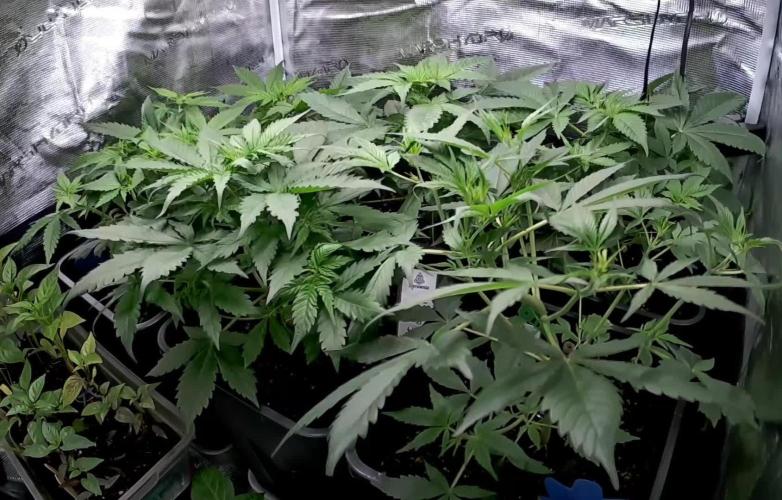
Was soll man sagen? Es waldet quasi. Alle Damen haben gut zugelegt und gehen nun sichtbar in die Blüte. Scheinbar mache ich nicht allzuviel falsch.
Die Sherbet, die ich natürlich beim LST abgeknickt habe, interessiert das genau gar nicht. Die Knickstelle ist verdickt und die Madame wächst munter weiter.
Zwischendurch noch was defoliert, aber sieht man auch schon wieder fast nichts von.
Es duftet zunehmend im Zelt und selbst die Chili zeigen Knospen. Wow. Love it.
Licht unverändert, bleibt jetzt auch so. Leichte Feuchtigkeitsproblemchen, aber der Ablüfter arbeitet nun auch.
Videomitschnitt der letzten Woche wie immer am Ende.
Immerhin sind 8 - 21 cm Wachstum drauf
Update: nochmal ne Runde entlaubt. So alles, was kein/kaum Licht kriegt, oder zuviel Schatten gibt.
Processing
Likes
21
Share


@LittleBigTrees
Follow
The plants were so crowded I decided to put them into a Larger tent to allow some light to the lower bud sites and to help lower the humidity amongst the plants. I'm sure they will love the extra space.
The light has now been raised 20cm (20cm taller tent)
Allowing me to turn out right up which is 45000 lux in the centre right below it.
I will up the bloom to 2ml/l this coming week.
Likes
29
Share

@BudBrewerz
Follow
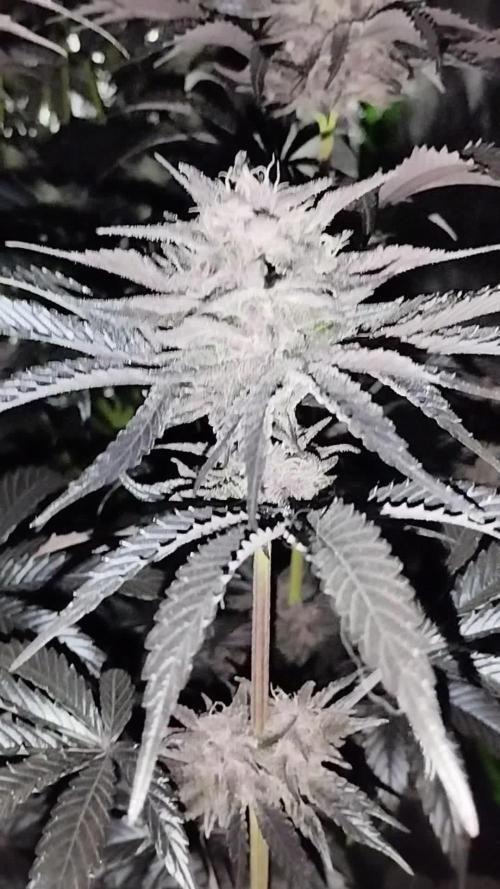
Tis Fruit Tartare has grown on some pretty buds by now and waaaaauw the colour she's got is amazing. The purple has gotten even more darker and intense , she's a real beauty. I'm guessing she has got another two to three weeks to go, so Im hoping for her buds to get a little thicker and denser before she goes.

Likes
31
Share

@Sadhus
Follow
**Semaine 6 : Sixième Semaine de Floraison – Phase Bulking (25-31 mars 2026)**
**Note :** Mise à jour hebdomadaire complète. Tout est RAS, les plantes sont en pleine forme et le bulking se passe parfaitement. Données regroupées TrolMaster + GrowOps (semaine 6 / semaine 10 globale).
### Contexte et Objectifs de la Semaine
On est maintenant en plein cœur du **bulking** (gonflement massif des buds). Le stretch est terminé depuis plusieurs semaines, l’énergie de la plante est entièrement redirigée vers le remplissage des calices, la production de résine et la densité florale.
Steering : **végétatif maintenu** (irrigations fréquentes, runoff 20-30 %, dryback modéré 8-12 % la nuit, VWC stable).
Objectifs : maximiser le volume et la densité des buds, booster la résine avec UV 90 min/jour, maintenir une stabilité parfaite des paramètres jusqu’au pic de trichomes (semaines 7-8).
**Petit point éducatif : Pourquoi le bulking est la phase la plus importante en flo ?**
Après le stretch (semaines 1-4), la plante passe en mode « remplissage ». C’est là que l’on gagne le plus en poids final. Le steering végétatif (irrigations fréquentes + VWC plus haut) permet une meilleure absorption des nutriments et une expansion cellulaire maximale dans les buds.
À ce stade, l’ajout de **PK 13/14 + Sugar Royal + Green Sensation + Pure Zym + Silica Force + Cal-Mag Amino** est idéal :
- PK 13/14 → phosphore/potassium pour la formation des fleurs et la résine
- Sugar Royal → sucres et carbohydrates qui augmentent le poids et les terpènes
- Green Sensation + Pure Zym → bio-stimulants + enzymes qui améliorent l’uptake racinaire et la santé microbienne en coco
- Silica Force + Cal-Mag Amino → renforcement cellulaire et prévention des carences classiques en flo (Ca/Mg)
Le tout à EC 2.6 et pH 5.8-6.0 donne un équilibre parfait sans risque de lockout ou de burn.
### Observations des Plantes
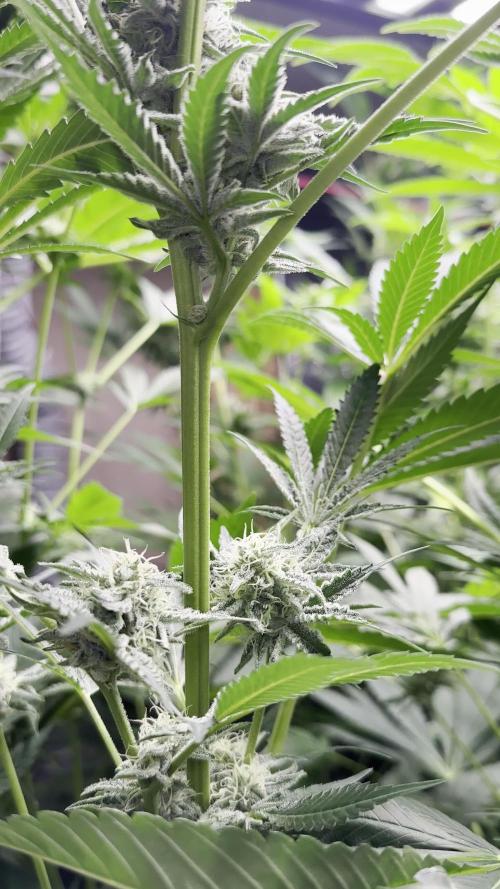
La plante dominante (la plus belle) mesure maintenant **150 cm** de hauteur. Elle a clairement pris le dessus avec une structure énorme, une canopée dense mais bien aérée et une vigueur exceptionnelle. Le stretch est complètement terminé (+10 cm seulement la semaine dernière, stabilisation totale).
Les buds grossissent rapidement, les calices s’épaississent, les trichomes deviennent de plus en plus visibles et brillants sur les sites supérieurs. Pistils encore majoritairement blancs mais commencent à s’enrouler.
Santé générale : excellente, vert profond, aucune feuille jaune ou brûlée, zéro pest, zéro stress, zéro carence ou excès. La plante secondaire suit bien. Clones toujours très vigoureux. Les plantes sont concentrées à 100 % sur le gonflement des fleurs.
### Paramètres Environnementaux (TrolMaster + GrowOps – synthèse semaine 6)
- **Température jour** : 20-23 °C (moyenne live 23.3 °C, cible 24 °C)
- **Température nuit** : 18-20 °C
- **Humidité jour** : 60-70 % (live 58.9 %, cible 62 %)
- **Humidité nuit** : 49-59 %
- **VPD** : 0.8-1.2 kPa (live 0.94 kPa → parfait pour bulking)
- **PPFD moyen** : 750-777 (max 814) → DLI 32 mol/m²/jour (optimal)
- **UV Light** : 90 min/jour (augmenté cette semaine)
- **Far Red Light** : 30 min en fin de cycle (lights-off)
- **CO₂** : setpoint 900 ppm jour (enrichment actif)
- **EC solution** : 2.6 mS/cm (live 1.85-2.95 selon relevés)
- **pH solution** : 5.8-6.0 (live 6.43, runoff 5.8-6.2)
- **Runoff EC** : 4-5 mS/cm
- **Irrigation** : Fréquente (4-5 cycles/jour)
- **Runoff % daily** : 20-30 %
- **Night dryback** : 8-12 %
- **Steering** : Végétatif confirmé
### Nutrition et Irrigation (Soupe actuelle)
**Nutriments utilisés cette semaine (doses par litre) :**
- Cocos A → 1 ml
- Cocos B → 1 ml
- CANNA PK 13/14 → 1 ml
- Green Sensation → 0.1 ml
- Pure Zym → 1 ml
- Sugar Royal → 1 ml
- Cal-Mag Amino → 1 ml
- Silica Force → 1 ml
- pH- → 0.5 ml (pour ajuster à 5.8-6.0)
Eau à ~20 °C, temp solution ~15-18 °C (normale en coco).
Irrigation fréquente avec dryback contrôlé → parfait pour maintenir un VWC stable tout en évitant les excès d’eau en phase bulking.
### Problèmes et Ajustements
**RAS** – Aucune problème, aucune alerte GrowOps, aucune intervention physique nécessaire cette semaine.
Les paramètres sont très stables, le steering végétatif fonctionne parfaitement et les plantes répondent idéalement aux boosters de résine.
### Plans pour la Semaine 7
- Maintenir steering végétatif + EC 2.6 (possible léger pic PK si besoin)
- UV rester à 90 min/jour
- Légère défoliation sélective (seulement les grandes fan leaves qui bloquent vraiment la lumière sur les buds inférieurs)
- Photos rapprochées pour suivre l’évolution des trichomes et du gonflement
- Évaluer les clones pour sélection finale
Ce journal sera mis à jour hebdomadairement.
#GrowLegendary #Zamnesia #Plagron #EternityGrowCup2
Les buds gonflent vraiment bien, les trichomes commencent à briller et la plante dominante à 150 cm est superbe. On sent que le rendement va être excellent ! 🌱✨