


Likes
Comments
Share


@w33dhawk
Follow
Moin moin ihr lieben! Diese Woche war auch wieder nicht viel los tägliches biegen und binden hab ich am Sonntag 05.03.23 das letzte mal gemacht (somit eingestellt) und die Damen dürfen nach oben auf steigen (liegt daran das ich wirklich kein platzt mehr habe um zu weben) aber der stretch ist noch nicht wirklich zurück gegangen und der Platz nach oben wird bald zur Mangel ware. Naja drückt mir die Daumen das der stretch bald vorüber geht und das alles hin haut. Habe am 08.03.23 also an Tag 21 nach Umstellung den ersten compost Tee angesetzt der dann Anfang der neuen Woche also Woche 4 nach Umstellung oder um genau zu sein am 09.03.23 vergossen wird ansonsten gibt es nicht viel zu sagen...... Euch allen glitzer nuggetz, zur ernte ich wünsche! 🖖
Edit:habe schon die ersten Bilder für den Kompost Tee rein gesetzt nächste Woche dazu mehr

Likes
45
Share

@Hempface86
Follow
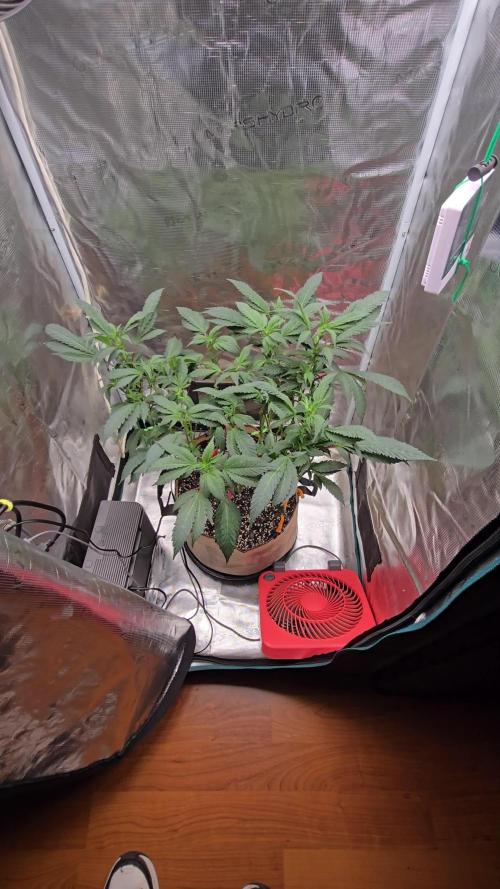
As you can see, she is stretching, showing sex and is going to be a decent plant , hopefully.. i hope everyone is doing well. I'm kind of over this site. To be honest with you, they do not make it phone friendly and I know I'm not the only one that feels his way... They just keep changing the site for absolutely no reason and make it harder and harder to navigate...smh .. God bless and happy grown guys


Likes
9
Share


@Ineed_cannabis
Follow
All looking healthy except for i found a couple of thrips defoliating can anyone recommend anything
Likes
11
Share


@TerpToad
Follow
Nothing new to report but some stretching :)
looks like we maybe are already in week 2 of flower?

Likes
17
Share


@SpaceHaze123
Follow
Start of week 2 flowering. Put the triple cheese in my other tent under the spider famer SE3000 instead of the Sf2000 to give her that extra boost in flower. Because she is quite a biggie, she can use al the light I can give her. Gonne let her ride for another few days to a week before doing a heavy defoliation.
30 march. Defoliation time

Likes
45
Share


@Ultraviolet
Follow
2nd net is up. Early bud formations are promising. holding up to the extremes pretty well, some leaves taking minor damage, but overall, she is holding up, gave her 1 night at 50F see how she would react, stressful. Not advised as it messes with her metabolism, but I want to see if it triggers any anthocyanin response. Love to see her purp up but no signs yet.
My homework.
Rubisco regeneration is intrinsically linked to nitrogen supply because Rubisco is a major sink for nitrogen in plants, typically accounting for 15% to over 25% of total leaf nitrogen. The regeneration phase itself consumes nitrogen through the synthesis of the Rubisco enzyme and associated proteins (like Rubisco activase), and overall nitrogen status heavily influences the efficiency of RuBP regeneration.Structural Component: Nitrogen is an essential building block for all proteins, and the sheer abundance of the Rubisco protein makes it the single largest storage of nitrogen in the leaf.
Synthesis and Activity: Adequate nitrogen supply is crucial for the synthesis and maintenance of sufficient Rubisco enzyme and Rubisco activase (Rca), the regulatory protein responsible for maintaining Rubisco's active state. Nitrogen deficiency leads to a decrease in the content and activity of both Rubisco and Rca, which in turn limits the maximum carboxylation rate, Vmax, and the rate of RuBP regeneration Jmax, thus reducing overall photosynthetic capacity.
Nitrogen Storage and Remobilization: Rubisco can act as a temporary nitrogen storage protein, which is degraded to remobilize nitrogen to other growing parts of the plant, especially under conditions of nitrogen deficiency or senescence.
Nitrogen Use Efficiency (NUE): The allocation of nitrogen to Rubisco is a key determinant of a plant's photosynthetic nitrogen use efficiency (PNUE). In high-nitrogen conditions, plants may accumulate a surplus of Rubisco, which may not be fully activated, leading to a lower PNUE. Optimizing the amount and activity of Rubisco relative to nitrogen availability is a target for improving crop NUE.
Photorespiration and Nitrogen Metabolism: Nitrogen metabolism is also linked to the photorespiration pathway (which competes with carboxylation at the Rubisco active site), particularly in the reassimilation of ammonia released during the process.
To increase RuBisCO regeneration, which refers to the process of forming the CO2 acceptor molecule Ribulose-1,5-bisphosphate (RuBP) during photosynthesis, the primary methods involve optimizing the levels and activity of Rubisco activase (Rca) and enhancing the performance of other Calvin-Benson-Bassham (CBB) cycle enzymes.
Biochemical and Environmental Approaches:
Optimize Rubisco Activase (Rca) activity: Rca is a crucial chaperone protein that removes inhibitory sugar phosphates, such as CA1P (2-carboxy-D-arabinitol 1-phosphate), from the Rubisco active site, thus maintaining its catalytic competence.
•Ensure optimal light conditions: Rca is light-activated via the chloroplast's redox status. Adequate light intensity ensures Rca can effectively maintain Rubisco in its active, carbamylated state.
•Maintain optimal temperature: Rca is highly temperature-sensitive and can become unstable at moderately high temperatures (e.g., above 35°C/95F° in many C3 plants), which decreases its ability to activate Rubisco. Maintaining temperatures within the optimal range for a specific plant species is important.
•Optimize Mg2+ concentration: Mg2+ is a key cofactor for both Rubisco carbamylation and Rca activity. In the light, Mg2+ concentration in the chloroplast stroma increases, promoting activation.
•Manage ATP/ADP ratio: Rca activity depends on ATP hydrolysis and is inhibited by ADP. Conditions that maintain a high ATP/ADP ratio in the chloroplast stroma favor Rca activity.
Enhance Calvin-Benson-Bassham (CBB) cycle enzyme activity: The overall rate of RuBP regeneration can be limited by other enzymes in the cycle.
•Increase SBPase activity: Sedoheptulose-1,7-bisphosphatase (SBPase) is a key regulatory enzyme in the regeneration pathway, and increasing its activity can enhance RuBP regeneration and overall photosynthesis.
•Optimize other enzymes: Overexpression of other CBB cycle enzymes such as fructose-1,6-bisphosphate aldolase (FBA) and triose phosphate isomerase (TPI) can also help to balance the metabolic flux and improve RuBP regeneration capacity.
Magnesium ions, Mg2+, are specifically required for Rubisco activation because the cation plays a critical structural and chemical role in forming the active site: A specific lysine residue in the active site must be carbamylated by a CO2 molecule to activate the enzyme. The resulting negatively charged carbamyl group then facilitates the binding of the positively charged Mg2+ion. While other divalent metal ions like Mn2+ can bind to Rubisco, they alter the enzyme's substrate specificity and lead to dramatically lower activity or a higher rate of the non-productive oxygenation reaction compared to Mg2+, making them biologically unfavorable in the context of efficient carbon fixation. The concentration of Mg2+ in the chloroplast stroma naturally increases in the light due to ion potential balancing during ATP synthesis, providing a physiological mechanism to ensure the enzyme is activated when photosynthesis is possible. At the center of the porphyrin ring, nestled within its nitrogen atoms, is a Magnesium ion (Mg2+). This magnesium ion is crucial for the function of chlorophyll, and without it, the pigment cannot effectively capture and transfer light energy.
Mg acts as a cofactor: Mg2+ binds to Rubisco after an activator CO2 molecule, forming a catalytically competent complex (Enzyme-CO2-Mg2+). High light + CO2) increases demand: Under high light (60 DLI is a very high intensity, potentially saturating) and high CO2, the plant's capacity for photosynthesis is high, and thus the demand for activated Rubisco and the necessary Mg2+ cofactor increases. Mg deficiency becomes limiting: If Mg2+ is deficient under these conditions, the higher levels of Rubisco and Rubisco activase produced cannot be fully activated, leading to lower photosynthetic rates and potential photo-oxidative damage.
Optimal range: Studies show that adequate Mg2+ application can enhance Rubisco activation and stabilize net photosynthetic rates under stress conditions, but the required concentration is specific to the experimental setup.
Monitoring is key: The most effective approach in a controlled environment is to monitor the plant's physiological responses e.g., leaf Mg2+ concentration, photosynthetic rate, Rubisco activation state, and adjust the nutrient solution/fertilizer to maintain adequate levels, rather than supplementing a fixed "extra" amount.
In practice, this means ensuring that Mg2+ is not a limiting factor in the plant's standard nutrient solution when pushing the limits with high light and CO2.
Applying Mg2+ through foliar spray is beneficial to Rubisco regeneration, particularly in alleviating the negative effects of magnesium (Mg) deficiency and high-temperature stress (HTS). While Mg can be leached from soil, within the plant it is considered a mobile nutrient, particularly in the phloem. Foliar-applied Mg is quickly absorbed by the leaves and can be translocate to other plant parts, including new growth and sink organs.
Foliar application of: NATURES VERY OWN MgSO4 @ 15.0g L-1 in a spray bottle.
Foliar sprays are often recommended as a rapid rescue measure for existing deficiencies or as a supplement during critical growth stages, when demand for Mg is high. Application in the early morning or late evening can improve absorption and prevent leaf burn.
The starting point [of creativity] is curiosity: pondering why the default exists in the first place. We’re driven to question defaults when we experience vuja de, the opposite of déjà vu. Déjà vu occurs when we encounter something new, but it feels as if we’ve seen it before. Vuja de is the reverse—we face something familiar, but we see it with a fresh perspective that enables us to gain new insights into old problems. Come walk in the enchanted forest.
Likes
23
Share


@Piorkeed
Follow
Week 1 (16/03 - 22/03)
D1: prepared a 14 liters pot with a layer of gravel at bottom surronded by light-mix soil by BioBizz. Given her a glass of tap water. At the moment she will stay in the living room near a window prior to move her outside on the balcony.
D2: added a support to avoid drop, hoping it will be useless... Given her a glass of tap water in the morning, covered at night.
D3: glass of tap water in the morning; out on the balcony in the afternoon for her first sunbath; inside for the night.
D4: glass of tap water in the morning. Living room all day.
D5: -
D6: glass of tap water.
D7: -


Likes
36
Share


@Bread_n_Buds
Follow
And here we are facing a beauty that is maturing, you probably miss a week or a little more, I think I gather next weekend.
The colors are there, I'm flushing, she is really beautiful she swelled well and we're sure it will be very good. Odor: paradise
LIGHT >> MARSHYDRO SP3000 AT 100% OF POWER ..
TENT >> MARSHYDRO 120x60x180
CHECK IG >> https://www.instagram.com/marshydro_aliexpress2/
Buy >> marshydroled.aliexpress.com
TENT >> MARSHYDRO 120x60x180
CHECK IG >> https://www.instagram.com/marshydro_aliexpress2/
Buy >> marshydroled.aliexpress.com


Likes
114
Share


@TheFoxFarmer
Follow
Week 1 Flower
The twins are finally in flower and looking extremely happy and healthy. They were thrown into flower on day 55 veg (day 0 flower). They we're lollipopped towards the end of the week, on day 6. I also pinch the tops of the main stems of each branch that is growing taller than the rest, to slow it down. This not only allows the other tops to keep up, but it will also thicken the stem and make the branch stronger.
Their base nutrients were changed to a 1:1:1 (G:M:B) ratio throughout transition. Silicon is increased while they're stretching, as they are growing at a much faster rate. Cal-Mag and Epsom Salts were also increased slightly, and will be kept at this level until they're stopped later in flower.
You can clearly see the difference in structure between these two pheno's, now they're in flower. Unexpectedly, Twin2 hasn't stretched as much as Twin1 in this early stage in stretch, and is sidebranching like mad. With that being said, I think Twin1 is looking slightly better and a more beautiful plant. Time will tell... 🌹
Slo Mo vid of Twin1 on Day 7 📽️
Thanks for following and happy growing! 🐺

Likes
10
Share


@ACMPRgrow
Follow
Lollipoping 5 or 4 nodes down on main branch and all branches. Going into flowering this Sunday!
Stay tuned!


Likes
28
Share


@MrGrowthSpurt
Follow
What's up Growmies🤟🏽. Week # 8 is in the books🙌🏾
Hello week #9💪🏾
I went a little overboard on pictures this week, they are so happy and healthy that I got carried away. I know we are supposed to post pictures with the lights off, however it's something about the contrast it gives with the lights on that makes it look sexy to me😁.
I have had to tie the stalks of both White LSD plants due to heavy sagging. I'm noticing with this strain the stalks seem to topple over even though the buds are far from fully developed. A trellis net probably would be ideal however I hate them. They are easy to put on but very difficult to take off come harvest. I use garden wire and string them as if they are puppets being controlled by the puppet master🤪.
I continue my feeding schedule with the recommended "bloom" concoction using general hydroponics Flora series trio. I give them 1 liter every 3 days. I have them on a 2 to 2 cycle (feed them twice with nutes and then twice with plan water) I keep the p.h. around 6.1 to 6.6.
Temps and humidity are in the perfect range I'm enjoying it while it last because spring and summer in VA makes it difficult to keep the humidity in check.
All in all everything is going well for me and my ladies. I hope the same for all of you.
Until next week my friends Happy Growing 🤟🏽 and may the grow goddesses bless you all with a bountiful harvest 💪🏾


Likes
33
Share


@SkunkyDog
Follow
Hallo zusammen 🤙.
Sie wächst sehr schön und macht keine Probleme.
Sie bekommen 20 % Rabatt bei Zamnesia und der Code lautet ZAMMIGD2023.


Likes
20
Share


@DaddyPrime2
Follow
5/29 plants are healthy.
6/2 they've definitely been stretching this week. Pistils have shown and the calyx of plant #2 are already showing definite purple. Its obvious even with how little of it showing. #2 was the first to show sex and progression of transitioning. Plant #1 has shown sex but only on half of her node? Plant #3 is still the tallest, with the most stretching happening. She's a lighter green than the rest and she hasn't quit shown a full pistil yet


Likes
13
Share


@Northern_Ent
Follow
June 6: cool and rainy today. Bigger one is tall enough to tie down so I did. Used a piece of wire to hold apical tip below the other growth tips. Will do this for about week and will release once the lower sites are bigger and apical dominance has been broken.
June 8: adjust tie down but a couple hours later I noticed the stem had shifted and folded. Patched this unintended supercropping using green floral tape which you can barely see on the stem. Floral tape is great and readily available at florists at the local mall. Breathable, flexible, very helpful for this kind of thing.