


Likes
Comments
Share


@eldruida_lamota
Follow
Que pasa familia, otra vez actualizamos la última semana de crecimiento, estás zkittalizious de Exotic seeds están bastante sanas van con un color verde potente y de 2 , 1 desarrollo varias puntas en la parte central. Si sigue así esto va ser proyectazo.
Agrobeta:
https://www.agrobeta.com/agrobetatiendaonline/36-abonos-canamo
Mars hydro:
Code discount: EL420
https://www.mars-hydro.com/
Bueno las maximas de temperatura no superan los 25 grados y las mínimas no bajan 19, así que no me puedo quejar.
Los niveles de humedad también son los correctos van entre 50%/60% de humedad relativa.
Por supuesto el Ph lo estamos dejando alrededor de 6.
Hasta aquí es todo poco más la verdad ya con ganas de empezar la floración , buenos humos 💨💨💨

Likes
18
Share


@Chubbs
Follow
420Fastbuds
Gelato Auto
Week 3
What up grow fam. Weekly update for these three beautiful girls. All are growing absolutely amazing. Showing no signs of any issues at all. I'll introduce nutes this week using General Hydroponics Flora 3 part flora series. Will continue the same routine as they seem to be responding great.
All in all Happy Growing

Likes
7
Share


@Easy_does_it
Follow
Sorry I missed a so many weeks folks. Just distilled water up until last week. then they got a small shot of gh flora duo b(1Tbs/gal). Back to just water due to the small amount of burning on lady on the left

Likes
2
Share


@Ninjabuds
Follow
Ive got two Skunk Apple Runz plants(tossed 1 when I repotted the plants) with exotic-looking leaves and some great genetics. These are seeds I made and both the parents were top notch. They're both about five inches tall and growing strong they both seem to have the growth strength from the ricky bobby Unfortunately, one of them might not make it because of some damage or mutation im not sure, it just seems to have stop growing upward correctly but the other one's looking really healthy.
Happy late turkey day grow diaries world!!!! It's now day 24 from seed for all the seedlings I have going. The past few days the plants have really started to take off. There roots have really started to dig in. Every other water I am still giving 2ml per gal of fox farm grow big. I keep having to tell myself not to add any more nutes other than that. I don't want to fry my plants but I also want they to start jumping. I'm quite excited for the coming week, I think the next 7 days or so is when the plant really starts to transform and look more like a pot plant than just some random little green thing.
A few days ago I decided to move the plants from under my 55w cheep amazon light to under my spider farmer 100w newer version light with the good leds in it. The plants will hopefully be ready to up pot them here soon and get them in the large tent.
Sometimes when growing multiple different strains it can be really hard to balance giving to much or to little light. You don't want the faster growing plants to get to stretched out waiting on the slower plants to catch up
I spend Thanksgiving day morning transplanting the plants into 2gal pots. I am useing spme promix potting soil it's my 1st time tring this soil. It is actually doing really well the roots were all white and nice looking. I think next time I'm going to add some worm casting, kelp, granular mycos, and a little bit extra perlite. I just didn't have the money with christmas coming to splurge for all the extra stuff. I got rid of 2 plants 1 of the bubble og and 1 skunk apple runtz. There is only room for 10 pots in the 2x4 tent. I will peob only bring 8 of them to flower, always good to have back ups. Yesterday I also stuck the plants back under the 500w medicgrow mini sun 2 in my 2x4 tent. They did great under it the 2nd half the day I was happy they didn't get stressed. I had put them under that light a little early about 10 days ago or so. I am expecting in a week these plants will ge going crazy with growth


Likes
11
Share


@Madman2020
Follow
Plants reacted very nice to being in a controlled environment.
Giving them more time to see if a longer veg will give bigger buds.
Day 32 defoliated for the first time(Should have LST’d same day.
I will still be heavy on the lollipopping
Burned the White wedding. The other cultivars didnt burn.
All plants are getting hut with plain ph water….and silicate,
Day 34
Stalks were already to dense to LST. Defoliation went well
Topped the main stalks(about 4 per plant). Tis was my second time topping this grow.
I topped this time so that i can control stretch.
They need one more week so they can rebound from the stress before i flip to flower on day 42
Noticed that 20klux+ was stressing my plants. I brought it down to 10-18klux
I have failed to use tricantonol or any SST yet. These are usually crucial parts of the grow. I wonder whats going to happen

Likes
17
Share

@Miketama
Follow
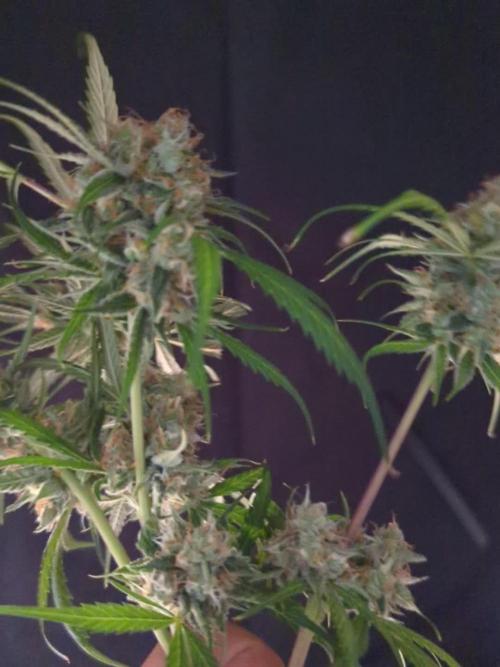
Fast & Chunky: 460g Wet for the Heat-Resistant Colombian Sativa
She reached full maturity in just 70 days (10 weeks) instead of the breeder's estimated 15 weeks. When the intense late-summer heatwave hit the tent, her tropical Colombian Sativa heritage allowed her to handle it like a total champ. Instead of panicking or losing density, her metabolism went into overdrive and accelerated the trichome ripening.
Structurally, she threw a massive curveball: while she kept her native Sativa leaves, her flowers completely leaned into the "touch of Afghan" in her lineage, packing on incredibly dense, chunky Indica-style bud spheres.
Paradoxically, because she resisted the heat, she ended up looking way more compact and uniform than her Indica-dominant tent mate (which completely stretched out due to the thermal stress). You can see that comparison and the weight difference in my Purple Opium Auto Diary.
Key Lesson: Sativa-dominant strains are definitely my ultimate choice for summer runs. Getting a clear-headed Colombian daytime buzz from buds this chunky, fast, and heat-resistant is a massive win! 🚀

Likes
262
Share


@TheBudWhisperer
Follow
Week 8 Summary - Not much to say except what's in the video. This girl is a beast and just takes whatever you throw at er! She's looking good and could flip any time, but we'll wait until end of week 9 I think. I continue to be impressed with the consistency of coco as a growing medium and the botanicare nute sched. appears to be fully on point. 3:1 ratio full strength nutes to calmag only. I know it's early and I've certainly learned my lesson before (#countingchickensbeforehatch) but I'm pretty sure I'm gonna smash this one dudes. There's simply no stopping this plant. Thanks as always for the support and comments. Stayed tuned - flower show ain't far off👌👊✊
Background
After the batshit nonsense with this years outdoor grows getting jacked, I need some kush and I need it fast! This girls an indoor grow in the cabinet and she'll be manifolded and defo'd for 8-10 fat ass colas. They’ll spend a first week or so under a cfl assembly while the last harvest dries out in the cabinet. This grow is going to be nute sched. heavy and will hopefully test the limits of my smaller grow space (2sq/ft). Ive had my eye on a critical & kush cross for awhile and really looking forward to seeing this one grow out. Thanks for take'n a peek, stayed tuned, and happy grow'n folks! 👊

Likes
27
Share


@adam_pawloski87
Follow
This grow was so amazing!! The purple punch’s came out super sticky dense nugs, super frosty , an a huge smell of blueberry muffins! Super fun grow along with the Forbiddin Runtz definitely one of the sweetest berry smelling strains of ever grown, highly recommend everyone to try out the purple punch’s, you will be highly satisfied!! Stay tuned for next grow!!
Likes
5
Share

@Organic_G
Follow
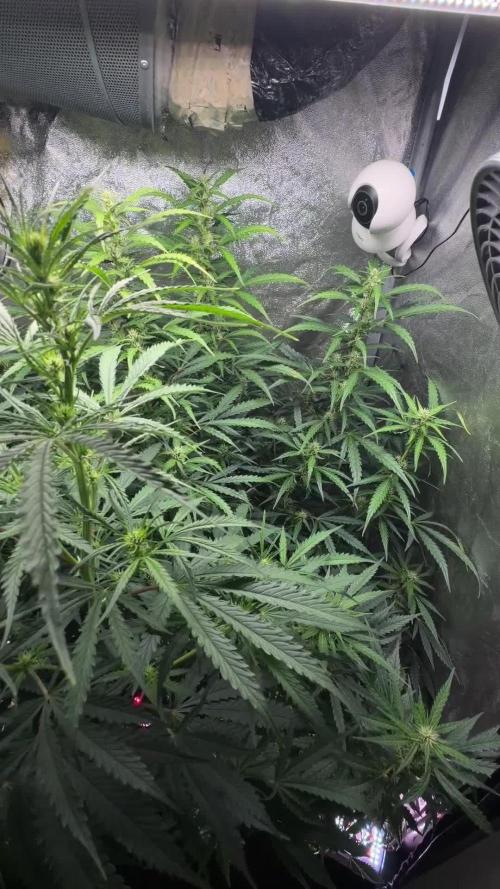
Woche 3 der Blüte kommt morgen zum Ende… 🌷🌺
Soweit haben sie sich extrem gut gestreckt und Bio Masse aufgebaut.
Stamm kommt photoperiodischen am Ende der Blüte nah, deutet darauf hin, dass es der Pflanze super geht, sieegr als genügend Nährstoffe zur Verfügung hat und anstatt Stämme bauen zwei der Ladys einfach Rohrsysteme auf 😆 die angezeigten Äste sind teilweise so dick wie bei anderen die ganze Pflanze 🌱
Terps sind super Candy, eine Streckt sich komischerweise immer noch, war ein Spätzündung, dafür meiste Bio Masse von allen.
3 blühen bereits gut, eine davon lässt tatsächlich mit der Trichomproduktion auf sich warten, wieso keine Ahnung aber interessant zu beobachten 😄
Likes
24
Share


@POTent
Follow
The girls are ready soon! Leaves of the Royal Gorilla are completely yellow, don't know why but I think it's because it's time to harvest. Take a look at the trichomes, I'm waiting for a few more amber ones.
How many days should I let them live? (I have to harvest them all at once)
▄▄▄▄▄▄▄▄▄▄▄▄▄▄▄▄▄▄▄▄▄▄▄▄▄▄▄▄▄▄▄▄▄▄▄▄▄▄▄▄
▌My setup:
▌Growbox: Secret Jardin Hydro Shoot 80
▌Lights: Selfmade 184W LED Panel w/ Samsung Q-Series Strips
▌Ventilation: Ventilution Mixed In-Line 145/187m³/h
▌Fan: Taifun FT-18 oscillating fan
▌Heating fan: Trotec TFC 1 E
▌Substrate: 50% BioBizz All-Mix & 50% Perlite (& BioTabs Starterbox)
▌Nutrients: BioTabs Starterbox & tapwater
▌Irrigation: AutoPot 4Pot System
▄▄▄▄▄▄▄▄▄▄▄▄▄▄▄▄▄▄▄▄▄▄▄▄▄▄▄▄▄▄▄▄▄▄▄▄▄▄▄▄
Likes
11
Share


@Young_agronomist
Follow
35.08.23-проведена масштабная дефолеация (примерно 40% листьев )
Продолжаю делать лст .
Из проблем пш Корневой зоны 4 … вход 6.2 выход стабильно 4 пш и ниже (
Было принято решение промыть растение раствором слабой концентрации 20 литров и это не исправило ситуацию .
Засола нет так как сток после промывки стал таким как и вход 960 ппм,
Незнаю как исправить ситуацию с кислым дренажом и просто продолжаю работать как и раньше .
Растение выглядит здоровым поэтому нет повода для сильных беспокойств

Likes
10
Share


Likes
8
Share


@DonPerion1983
Follow
So it’s 33 days since germination! I’ve still got massive fan leafs in the space pot! All seem to be growing well! Is it time to switch to flowering mode now? What ph level do I need for flowering? Do I need to move my light closer than 2 feet away? Been looking online at canna coco nutrients and there seems to be so many! My babies as I call them now have come this far and I want to hopefully get the best results I can get!! Am I over feeding as giving them around 600/800 ml of water with canna coco a and b also cal mag! But unsure on when to feed during flowering mode any help is welcome cheers

Likes
20
Share

@TrickzCutz
Follow
Servus Moin!
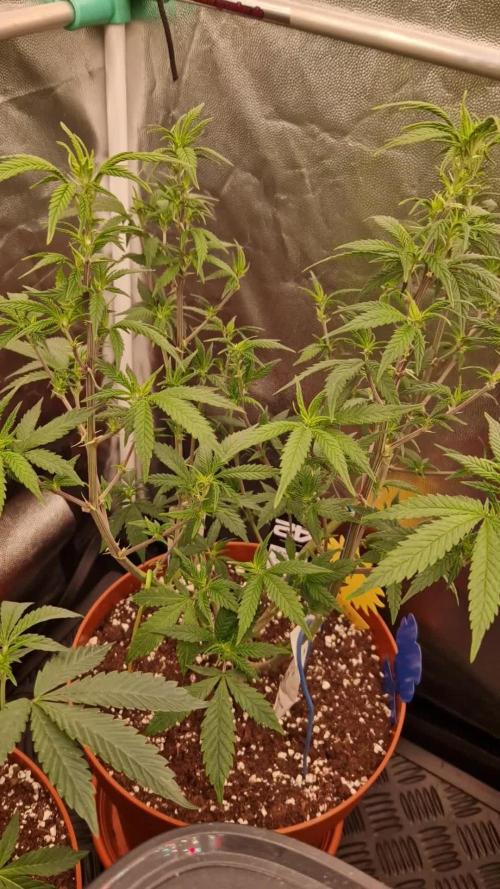
Die Sun of a Peach macht sich richtig gut. Sie war wieder so stark Buschig, dass ich sie stark Entlauben musste.

Processing
Likes
3
Share


@CityFarmer
Follow
Hello everyone,
The girls are finally outside in 20 gallon fabric pots. This season I have a greenhouse for them and I hope it goes good. Still have to build the first cages around them and start stretching them. 🎊🎉 finally, summer is here 🎉🎊
See you guys next week 🤞🤞🤘🤘👊👊👊
Likes
2
Share


@Mondolibero
Follow
Le piante crescono bene anche se ho avuto un problema di consegna con il corriere per i fertilizzanti della Advance Ph perfect, quindi sono a secco e le piante cominciano a dare i primi segni di carenze, spero in settimana di risolvere anche perché voglio travasare le piante nei vasi definitivi alcune in vasi da 8Litri altri in vasi un po' più grandi. Cercherò di tenere aggiornato il diario il più possibile. Pace 🙏💚💜🏴☠️🆓🇵🇸🇵🇸🆓🌱
Processing
Likes
15
Share


@ThePotFactory
Follow
The plants have now started to flower and exploded with some more growth. Ive added canna boost now amd increased the dosage of A and B until growth slows down. Looks like the one on the left might take a bit longer to finish. We'll see. Im not goint to do any more training for now other than defolliating. The next week ill trim back any grpwth underneath that i dont think will give me any decent buds.
Peace
Charliezard
Likes
198
Share


@DevilsBud
Follow
New week in supported marshydro grow
FLOWERING TIME
last run i did it under a TS-1000
But this time it will be under the amazing FC-4800 i am so excited to boost up everything and see what i can approve from last run 🤘🏻🤘🏻
Starting to put them in 12/12 schedule they have bin put in darkness for 12 hours and now hopefully let the flowering Begin fucking love this stage 🤘🏻😎🤘🏻
27/10/21
All plants Transplanted in 11L fabric pots added 5gram Easy Roots - Mycorrhiza Mix to soil
Have some ideas for my grow tent
I have my plants on hard plastic pallet
And i ordered plateau with ball bearing
So i can turn my plants around with one spin 😎 basically a huge turntable wikiwki
Will be updated soon happy growings Growmies
visit www.marshydro.eu
for your best gear and use the PROMO CODE: DEVILSBUD
Some info about the Marshydro FC-4800
Superb Quality LED Chips: The whole light is composed of 1206 pcs Samsung lm301b and Osram 660nm chips. More than two times as many LEDs are used to drive the grow lights at low currents and to avoid overdrive. Quality is guaranteed and efficiency is up to 2.8 μmol/j.
Even PAR Distribution and High PPFD Output: The multi-light bar design and the densely distributed light chips enable the LED grow lights to achieve the optimum PPFD required for plant growth over the entire effective coverage area.
Specifically Designed Spectrum: To ensure even plant growth, blue and red light are enhanced on the basis of a full spectrum combination. Not only does this accelerate plant growth, but it also improves the yield and quality of the plants at the same time.
Dimming Daisy Chain Function: The dimming function saves on electricity costs and enables brightness from 10% to 100% for the different stages of plant growth. A single master light can connect up to 30 lights in a daisy-chain system.
Business LED Grow Light: The light's wavy heat sink dissipates heat quickly and the IP65 waterproof allows the light to operate in humid conditions. 180° collapsible feature for easier installation. All these features provide favorable assistance for commercial cultivation.
And some tent info
●【Lock All Light Insid】MARS HYDRO Grow Tent Interior is made of diamond mylar. Non-toxic to the environment, no harm to plants. High-quality 1680D canvas being double stitched, (ALL OTHERS BRAND grow tent is 601D canvas) which is tear-proof for perfect light locking, No light leaks or rips at all.
●【Durability Grow Tent】Stable Metal corner adapters and poles are the trustful supporters of the tent. No rusting nor paint-falling. Quick easy tool-free installation. Carries strong heavy-duty SBS zippers, double layer lining to create a light-proof seal.
●【Easy Observation of your Plants】Special peeks window made by double layers of cloths. Observe the growing conditions of your plants without opening the tent and avoid disturbing plants. The peek window also serves to dissipate heat and ventilate air.
●【Removable Tray Keep Clean】The package includes a removable waterproof floor tray to hold soil and fallen leaves. The tray can be taken out easily to wash. Removable and water-proof makes cleaning easy.
●【Good Ventilation&Fast Assembly】 Circular double-sleeved vent holes with adjustable nylon strap for air circulation by exhaust fan, ducting, carbon filter, or reflector. Better allows proper light, heat, and airflow. Quick tool-free installation. Reinforced by a sturdy metal frame to ensure security and stability, supports up to 140lb. Perfectly safeguard your plants to thrive even in winter

Likes
12
Share


@HighOhioAn
Follow
Absolutely an amazing run each plant had its own unique trait that I loved cannot wait to see All the testers released and Thriving in everybody’s garden Fastbuds really has outdone themselves Don’t think you can get much better than this some of the most dense dankest nugs I’ve ever grown🔥💯
Likes
13
Share


@Herbz_Unkraut
Follow
what a resin monster! such beautiful plants! one of the 2 phenos had straight peanutbutter flavor!