


Likes
Comments
Share


@Naujas
Follow
I'm happy :) I couldn't do it as it should have been, my ph meters broke and ruined everything :( well, but I'm very, very satisfied with the result :) a big thank you to my teacher :)@AsNoriu you are super :) without you it wouldn't have been possible :) I learned a lot of useful information from you :) the house is full of lemon aroma :)


Likes
Comments
Share


@Piro420
Follow
End Week 8 a lil light burn.
Still shocked 14day veg at 14inches went over 65 inches(lights max is 63). I bent tucked topped and folded still in the lights.
Other then some cooked tops it looks to be a good harvest soon.
Stinky and sticky af.
Likes
7
Share


@Famtreez
Follow
Just because i realized im not really providing info about my potted grow but I have been using Mother Earth coco plus perlite i added worm castings, bat guano, n vegetable garden 4-4-4. just p.h'd water at 6.50. once in flower i would water with a diluted solution from my dwc and PPM under 200PPM.

Likes
2
Share


@Ultraviolet_
Follow
We become aware at such times of man's wonderful ability to bring seemingly unrelated elements into harmonic balance, and receive a glimpse into a world where everything exists in conscious sympathetic attunement to everything else. When we listen to a piece of music that seems to strike a beautiful chord somewhere inside us, or view a painting that simply glows with harmonic awareness well executed, we probably do not spare much time to contemplate the wonderfully intricate combination of vibrations that our sensors make it possible for us to perceive. We tend to appreciate the relationship between the parts of something by an awareness of the harmony or dissonance of the whole. This ability enables us to say "what a beautiful house!" instead of "analysis has proven that this collection of building materials exhibits certain elements of harmonic proportion." While this ability to instinctively appreciate the beauty of true harmony has an important role to play in evolution, a more analytical understanding of the laws involved can be most useful. This is especially so if we wish to create works of art where each part exists in true harmony, not only with the other part of that particular whole, but with the universe within which the creator and the created exist.
Everything vibrates. From the most dense matter to the most subtle cosmic rays, everything which our senses allow our thoughts to become aware of, can be specified in terms of wavelength or frequency of vibration. These two terms define the same thing, but from different points of view.
The following are the approximate wavelengths of various energy carriers:
Cosmic rays 0.000,000,001 mm
Gamma rays 0.000,000,1 mm
X rays 0.000,500 mm
Ultraviolet rays 0.003 mm
Visible light 0.006 mm
Infrared 0.01 mm
Sound waves 1 meter
Radio waves 300 meters
Violet light 400 nm to 450 nm
Blue light 450 nm to 500 nm
Green light 500 nm to 570 nm
Yellow light 570 nm to 590 nm
Orange light 590 nm to 610 nm
Red light 610 to 700 nm
1 nanometer (nm) = 0.000,000,1 cm = 1/10,000,000 cm
If a guitar string is plucked and we hear a sound, it is not too difficult for the human mind to associate this sound with the vibration of the guitar string. With color it is quite different. It is difficult for us to conceive that the color of a substance is not an inherent property of the substance itself, but an indication picked up by our senses of that substance's ability to absorb or reflect the light which happens to be shining on it at that moment. Neither the matter nor the light is colored. What happens is that the brain learns to differentiate between the frequencies reflected or transmitted by the substance the eyes are focused on. The same thing happens with sound. When we say "Oh! Listen, they're playing my favorite song," what we really mean is: "My brain has stored within it a particular pattern of frequencies. I have compared the new information being received with this stored pattern and have deduced the answer that the two patterns are similar within certain specified tolerances." The 'pleasure' involved could have something to do with our running the pre-recorded pattern at the same time, in 'sympathy' with the new pattern as it is received.
The word sympathy describes very well our ability to appreciate color and sound. It also describes the reason behind certain elements of harmony. For instance, if a substance vibrating at 100 cycles per second (tone 1) is in the proximity of another substance vibrating at 200 cycles per second (tone 2), we could perceive, if we had the right equipment, a certain sympathetic relationship between the two.
We will see from this that there is a uniform doubling of the first tone seen in the second. At various points along the waves, the two are the same in amplitude. At other points, they are at opposite poles to each other. This doubled frequency has more points of similarity to the original than any other frequency except the original itself. If the equipment we had available for measuring these two frequencies was a soundboard amplifier and a pair of ears, then we would hear what would sound to us like one tone. If we had the opportunity to hear one at a time, we would hear that although they sound the same, one is higher in pitch than the other. This characteristic of 'the same but different in pitch', musicians have called the octave. Any two tones produced where one has exactly doubled the frequency of the other is called an octave. Speaking in ratios, an octave would appear then as the ratio 2:1 or 1:2, depending on whether we are talking of an octave up or down.
A single note produced by almost any instrument will contain more than one wavelength or frequency. It will have a dominant frequency, the wavelength of which we would call the note's 'fundamental' or 1st harmonic. It will also have a varying number of upper harmonics, gradually fading in intensity into infinity or silence.
Natural harmonics always have the same pattern of intervals between them. The interval between the 1st and 2nd harmonic is a perfect octave; between the 2nd and 3rd a perfect fifth; between the 3rd and 4th a perfect 4th; and so on, the intervals becoming smaller and smaller until they lose any relationship with the western 12 tone scale as it exists at the moment. Just as an octave has certain elements of sympathy with its fundamental, so some intervals have been noted to be more perfectly in sympathy with the fundamental than others. The ratio of the 'perfect 5th' or interval of 7 semitones, as it occurs in the harmonic series, is 3:2 or 2:3, while that of the 'perfect fourth" is 4:3 or 3:4. All the tones in the western 12 tone scale can be expressed in terms of the ratio between the upper tone and its fundamental. This would seem to be an ideal way of generating a scale from any given fundamental and several attempts have been made to do this, the Pythagorean system being probably the most well known. Although when working with a single tone instrument playing on its own, the Pythagorean formula works wonderfully well, if we had several instruments tuned this way together and asked them to play almost any western music, we would find that at times they sounded quite out of tune to each other.
The lack of flexibility of the various scale systems based on the harmonic series has led to what is known as the 'tempered' scale. This uses as its primary unit of interval the ratio of the octave or 2:1. It then proceeds to divide the interval between any fundamental and its upper octave into 12 smaller intervals by applying the ratio: two to the one-twelfth power, to one (21/12:1). This equals 1.059463094, so by multiplying any frequency by this number, we will obtain the tempered semitone next up from our fundamental. We will also find that any tone twelve semitones up from any other tone, in a scale generated in this way, will have exactly double the frequency.
If we took the note middle C on a piano and halved the wavelength, we would have the note C one octave above. If we halved this, we would have the C above, and so on. However, within about 6 octaves, we would find that although a 'sound' was being produced, no human ear could perceive it. If we kept on going, halving and producing upper octaves of our fundamental C, we would proceed through the infrared band, into the visible light spectrum. If we happened to be outside during the day, we would, for one octave only, see the note C with our eyes. The next octave above would already be in the ultraviolet band, and outside the eye's sensitivity range. If we can think of color as being an indication of a substance's vibratory rate or wavelength, we may begin to see a relationship that could exist between the color and sound spectrums.
The logical extension of what has so far been said is that there exists a scale in the color spectrum that corresponds exactly to the scale in the sound spectrum, each color tone being an octave of the equivalent note in the sound range.
This is not the end of the story but only the beginning. If we can for the moment accept that any wavelength in one band has upper and lower octave stretching out to infinity, then the next question is 'fine, but what shall we use as our fundamental? A particular color? A particular sound frequency?' The musicians among us will probably say 'A 440'. This means that the note A should vibrate at 440 Hertz, or 440 times per second. They would tell us that this is standard pitch has been adopted by most orchestras around the world; pianos are tuned to it, instruments are constructed to formulas based on it, and so to them it would probably seem the most appropriate place to begin. Some of these musicians may know of the battle that is still raging with regards to this being the standard, but few would know why A = 440 Hz was chosen except that it worked when it was set to be a suitable compromise between the many different pitches in use at the time.
432 Hz is said to be mathematically consistent with the patterns of the universe. Studies reveal that 432 Hz tuning vibrates with the universe’s golden mean PHI and unifies the properties of light, time, space, matter, gravity, and magnetism with biology, the DNA code, and consciousness. When our atoms and DNA start to resonate in harmony with the spiraling pattern of nature, our sense of connection to nature is said to be magnified.
Another interesting factor to consider is that the A=432 Hz tuning correlates with the color spectrum, while the A=440 Hz is off. Audiophiles have also stated that A = 432 Hz music seems to be non-local and can fill an entire room, whereas A=440 Hz can be perceived as directional or linear in sound propagation.
Once you adopt the idea that sound (or vibration in general) can have an equalizing and harmonizing effect (as well as a disturbing effect), the science of harmony can be applied to bring greater harmony into one's life or tune to specific energies. There is a form of absolute and relative harmony. Absolute harmony can, for example, be determined by the tuning of an instrument. The ancients tuned their instruments at an A of 432 Hz instead of 440 Hz - and for a good reason. There are plenty of music examples on the internet that you can listen to in order to establish the difference for yourself.
Attuning the instrument to 432 Hz results in a more relaxing sound, while 440 Hz slightly tenses up the body. This is because 440 Hz is out of tune with both macro and micro cosmos. On the contrary, 432 Hz is in tune. To give an example of how this is manifested microcosmically: our breath (0,3 Hz) and our pulse (1,2 Hz) relate to the frequency of the lower octave of an A of 432 Hz (108 Hz) as 1:360 and 1:90.
It is interesting to note that 432 Hz was the standard pitch of many old instruments and that it was only recently (19th and 20th century) the standard pitch was increased. This was done in order to be able to play for bigger audiences. Bigger audiences (more bodies) absorb more of the lower frequencies, so the higher pitch was more likely to “cut through”. One of the oldest instruments of the world is the bell ensemble of Yi Zeng (dated 423 BC), tuned to a standard F4 of 345 Hz, which gives an A= 432 Hz. The frequency of 345 Hz is that of the platonic year! Similarly, many old organs are tuned in A=432 as well; for example, St. Peter’s Capella Gregoriana, St. Peter’s Capella Giulia, S. Maria Maggiore in Rome.
Maria Renold’s book “Intervals Scales Tones and the Concert Pitch C=128 Hz” claims conclusive evidence that 440 Hz and raising concert pitch above scientific “C” Prime=128 Hz (Concert A=432 Hz) disassociates the connection of consciousness to the body and creates anti-social conditions in humanity.
The difference between concert pitch A=440 Hz and Concert A=432 Hz is only 8 cycles per second, but it is a perceptible difference of awareness in the human consciousness experience of the dream we share called existence.
Likes
4
Share
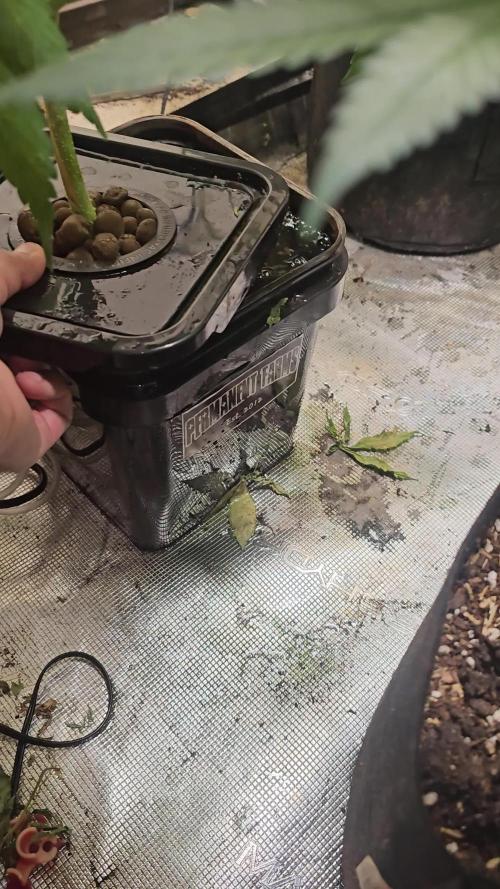

@Samsationalseeds
Follow
Most of the autos are being moved into my dad's garden or the backyard.
Likes
7
Share


@Daniel_Tri95
Follow
i’d say another two weeks on these girls and they are about done one of the other phenos of this finished up quite quickly and it’s already drying Can’t wait to give you the full results and numbers 🔥 and remember
It’s 420 somewhere

Likes
13
Share

@Chubbs
Follow
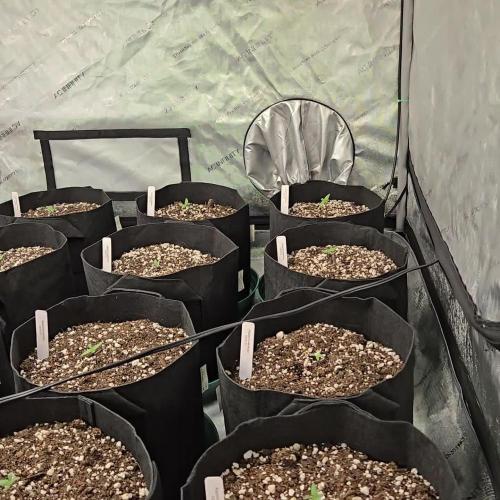
Excited to start these ladies. This strain has the temps that make you want to keep going back for more. The flowers come out super dense and covered in trichs. Let's see if they come out as good if not better then the last time I've grown it. Got 10/10 to sprout so where already off to a great start. All In all Happy Growing
Likes
11
Share


@SonomaSungrown
Follow
Can't stress enough how blown away I am by these Lion Claw genetics.
They've been vigorous as hell, and have been taking some VERY hot super soil in stride.
Up to 29" tall.
Exicted to see how much taller these get over the next few weeks, given they are only in 5-gallon pots.
Likes
5
Share


@Rizza78
Follow
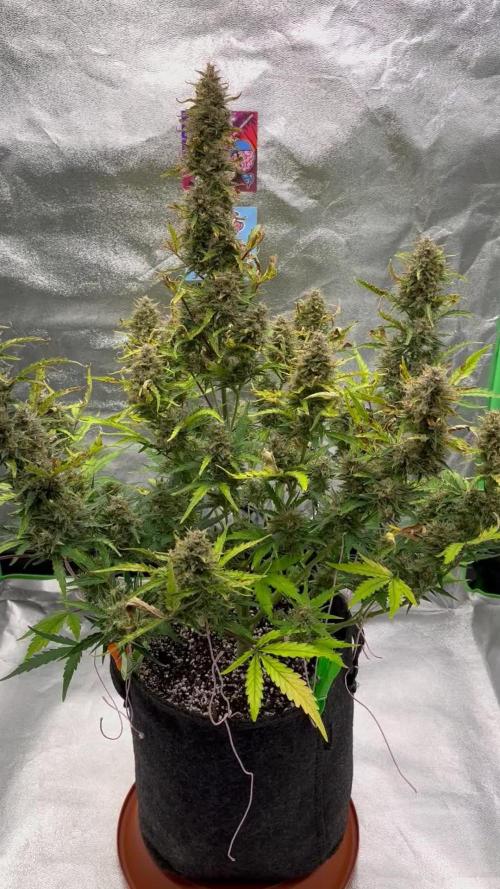
Made it to harvest w 2 so far! Oozecake is a couple extra days. Boy she tastes amazing! Will ice her tomorrow and put her in 48 hrs of dark before I harvest. What an experience it has been! Can’t wait to try after the cure.


Likes
2
Share

@Lvnsource
Follow
Feeding log pasted below 👇
#1: D: 66 - 8.5L - [ph 6.2] SI[6ml] ,Vega[7ml] , Flores[25ml],Ca/Mg[4.5g & 2.5g ] INPUT; [1.77 EC] OUTPUT; 2.5L ,6.2 pH , 3.0 EC
———————————————————————————
#2: D: 65 - 7.5L - [ph 6.2] Si[6ml] ,Vega[6.2ml], Flores[22ml], Ca[4g]/Mg[2.2g] INPUT; [1.58 EC] OUTPUT; 2.5L pH 6.3 [2.398 EC]
———————————————————————————
Aiming to lower the EC for these 2 plants as well 🌱
Once the root zone sits at (1.9-2.0) I’ll resume my normal feeding of (2.0-2.1)
Other than that (#1) is starting to throw out some purple which is neat
Number #2 proves to be very resilient; she’s still got time left

Likes
12
Share


@HerbalBlazer
Follow
Now finished stretching and starting to put weight on, they smell very very potentially and are nice and sticky


Likes
28
Share


@cheetah844
Follow
Hasn't done much vertical growth, seems to be more horizontal growth now.
I topped and defoliated every plant. I'm trying to form them into canna-bushes. Hopefully I'm doing the correct training procedures to make them all grow that way both indoors and out.
Likes
141
Share


@Ganja4Show
Follow
Update 14/03/2022 (Day 29)
Nothing much to say. plants looking happy and Healthy. and they kinda exploded with growth the past week.
I've done some defoliation 3 days ago and it really opened up the lower site of the plants.
Will stretch the Veg time maybe till week 6 or 7. it depends on how fast they will grow.
Update 17/03/2022 (Day 32)
Plants looking nice.. did some defoliation 2 days ago and they respond with so much growth every time.
I've made a little shortclip video. If you like the sound make sure to check out https://www.instagram.com/dutchdogg/
Update 18/03/2022 (Day 33)
I figured I check out the actual EC value of my water in order to know how much Calmag i should add.
So I had to add double the amount of Calmag in order to reach EC value of 0.4. let's see if this will change the colours of the leaves in to more deep green.
Overall PPM sits around 1320 now. Filled the Reservoir with 5 gallons at 15:00.
let's see how much time it takes for it do empty up so we can check how much these Ladies are actually drinking.


Likes
15
Share


@SmokingTiki
Follow
The plant has continued the stretch this week and the first flowers and trichomes have appeared :) The weather is still very sunny and hot but the plant looks good!
Likes
10
Share


@CordersGreen
Follow
👉DIA : 13/12/21👈
Metodo de germinacion: 👉<< VASO DE AGUA >>👈
seleccionamos las cantidades deseadas de semillas y en un pequeño vaso con agua opmotizada insertamos las semillas para nutrirlas durante 12H, situada en un lugar sin luz, apropiadamente tapada con un trapo.😉
__________________________________________________________________________________________________________________________________________________________________________________
👉DIA : 14/12/2021👈
👇👇👇👇👇👇👇👇👇👇👇👇
una vez pasada las 12 H de germinacion en vaso de agua , depositamos las semillas bien colocadas en un recipiente con papel de cocina humedecido con agua y 1ML de estimulador de raices (TOPCROP).
Esperamos de 1 a 2 días a que salga la raiz de la semilla y ser transportada a los Jiffy😉
___________________________________________________________________________________________________________________________________________________________________________________
👉DIA 17/12/2021👈
👇👇👇👇👇👇👇👇👇👇👇👇
Pues pasados los 3 dias de germinacion en el metodo de papel, vemos que ya salieron a luz las raices y con sorpresa😱 NUNCA habia visto una cosa asin!!
An salido GEMELAS, sii sii !!😵 de una misma semilla an salido dos raices una cosa impresinante!
y damos paso a colocarlas en los Jiffy.
👉Instrucciones:👈
- Colocación de los jiffy en un recipiente con 2L de agua y 2ML de enraizantes de top Crop.
- Dejamos actuar durantes varios minutos hasta que el jiffy se extienda.
- Abrimos un pequeño orificio en los Jiffy para introducir la semilla con el cáliz dejandolo hacia afuera.
- Colocamos en un pequeño invernadero para que tengan la suficiente humedad.
- Ayudandonos de unos foco de pocos waltios, le damos a luz necesaria para esta face de germinacion dejandolas 24 horas de luz.
________________________________________________________________________________________________________________________________________________________________
DIA 22/12/2021
Colocacion de Jiffy en Maceta de 3,25L
👇👇👇👇👇👇👇👇👇👇👇👇
👉Instrucciones👈
-Pasados varios dias vemos que el periantio(semilla) ya se rompió y empezo a salir los cotiledones con una hermosa raiz blanca por debajo del jiffy.
-rellenamos macetas de 3,25L con sustrato de top crop(anterior cultivo).
-introducimos los jiffy en las macetas dejando la plantula bien colocada.
-regamos con 3L agua opmotizada y 1ML/L enraizante Voodoo ADVANCED NUTRIENTS
- Permanecemos con las 24 horas de luz con foco led.
_________________________________________________________________________________________________________________________________________________
👉DIA 25/12/2021👈
👇👇👇👇👇👇👇👇👇👇👇👇👇👇👇
pasados 3 dias desde que se plantó en maceta. A dado unas respuestas increibles !!👍
las volvemos a regar y a cambiar las horas de luz que se pasarian a 18H
Likes
12
Share


@Amboss
Follow
Sie trinken fleißig und Blätter verfärben sich langsam … geht dem Ende zu
Werde danach nochmal einen Run starten mit 6 Cookies oder Skittelz, also nur 1 Sorte.
Ich hab mehr als genügend Fehler bei diesem Grow gemacht …umso mehr davon gelernt und werde es beim 2ten Lauf versuchen alles fehlerfrei zu wiederh
Likes
Comments
Share


@Fat_Olsh_Farms
Follow
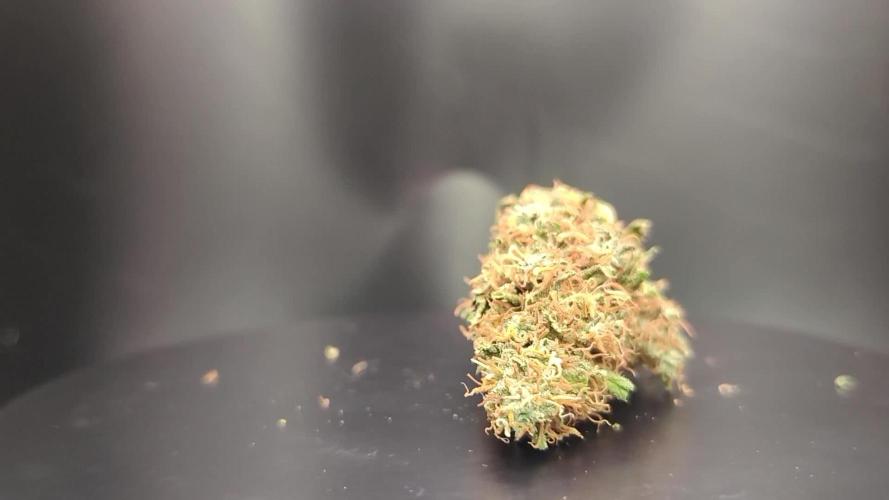
Came out looking beautiful purple and yielded alot. Will def be running again.

Likes
5
Share

@Xpie77
Follow
🌿 Kweekverslag – Amerikaanse Patriot (Weedseedsexpress)
Opstelling: Mars Hydro 450W LED | 11L potten | Potgrond
Duur: 8 bloeiweken
---
🌱 Overzicht groei (week 1–5)
Ontkieming & start: Snel en consistent, sterke zaailingen
Vegetatieve groei: Compacte, stevige planten met brede indica-bladeren
Opleiding: LST en topping uitgevoerd voor veelvuldige kroon
Voeding: Lichte Bio-Grow dosering, gezonde donkergroene kleur
Resultaat: Krachtige, bossige planten – klaar voor bloei
---
🌸 Overzicht bloei (Week 1–8)
Stretchfase: Eerste 2 weken bloei een nette rek, hoogte eind ±65–70 cm
Topvorming: Vanaf week 3 snelle knopontwikkeling, compacte toppen
Harsproductie: Vanaf week 5 schijnbaar trichomen, suikerblaadjes plakkerig
Voeding: Bio-Bloom 2,5–3 ml/L + Top Max 1–1,5 ml/L
Luchtvochtigheid: Rond 40%, geen schimmel van stress
---
💧 Doorspoelen en bloeien (week 7–8 bloei)
Laatste 10 dagen gespoeld met water pH 6,3
Bladeren begonnen lichtgeel te kleuren → perfect rijping
Toppen werden harder en geur intenser
---
🌾 Oogstresultaat
Oogsttijd: Week 8 bloei
Trichomen: 80% melkwit, 10% amber, 10% helder
Droogtijd: 10 dagen op 20°C, 50% RV
Cure: 3 weken in weckpotten
Eindgewicht (droog): ±110–130 gram totaal (afhankelijk per plant)
Structuur toppen: Compact, harsrijk
Aroma: Zoet, kruidig en skunky
Smaak: Aards met lichte citrus en kruidige nasmaak
Effect: ontspannend, euforisch en lang aanhoudend – typische indica-dominantie
---
🏆 Eindoordeel
De American Patriot van Weedseedsexpress is een sterk, betrouwbaar soort met uitstekende structuur en indrukwekkende harsproductie.
Ze reageert goed op training en voeding, blijft compact, en levert dichte, geurige toppen.
Cijfer: ⭐ 9/10
Pluspunten: Sterke groei, compacte toppen, dikke harslaag
Minpunten: Geur erg sterk tijdens bloei (filter noodzakelijk)
