


Likes
Comments
Share


@Ultraviolet
Follow
Green light is radiation with wavelengths between 520 and 560 nm and it affects photosynthesis, plant height, and flowering. Plants reflect green light and this is why they appear green to our eyes. As a result, some growers think that plants don’t use green wavelengths, but they actually do!
In fact, only around 5 – 10% of green light is reflected from leaves and the rest (90 – 95 %) is absorbed or transmitted to lower leaves [1].
Green wavelengths get used in photosynthesis. Chlorophyll pigments absorb small amounts of green wavelengths. Light that doesn’t get absorbed is transmitted to leaves that are shaded out from direct light. This means that leaves at the bottom of the canopy get more green light than leaves at the top. A high proportion of green wavelengths compared to other colors tells lower leaves that they are being shaded out, so they are able to react accordingly. Lower leaves may react by opening or closing their stomata or growing longer stems that help the leaves reach brighter light [1, 2, 3].
When it comes to growing cannabis, many cultivators are interested in the quality of light used for the flowering stage. In many plants, flowering is regulated by two main photoreceptors: cryptochrome and phytochrome. Both photoreceptors primarily respond to blue light but can also respond to green, although to a lesser extent. Green can accelerate the start of flowering in several species (although cannabis has yet to be tested) [1, 4, 5]. However, once flowering has begun, it’s important to provide plants with a “full spectrum” light that has high amounts of blue and red light, and moderate amounts of green, in order for photosynthesis to be optimized.
Green light mediates seed germination in some species. Seeds use green wavelengths to decide whether the environment is good for germination. Shade environments are enriched in green relative to red and blue light, so a plant can tell if it is shady or sunny. A seed that senses a shaded environment may stay dormant to avoid poor growing conditions [1]. Some examples of plant species where researchers have documented this response are: ryegrass (a grass that grows in tufts) and Chondrilla (a plant related to dandelion) [1, 6].
Although green wavelengths generally tell plants NOT to germinate, there are some exceptions! Surprisingly, green wavelengths can stimulate seed germination in some species like Aeschynomene, Tephrosia, Solidago, Cyrtopodium, and Atriplex [1, 6, 7].
Of course, light is not the only factor affecting seed germination – it’s a combination of many factors, such as soil moisture, soil type, temperature, photoperiod, and light quality.
When combined with red and blue light, green can really enhance plant growth [1, 8]. However, too much green light (more than 50% of the total light) can actually reduce plant growth [8]. Based on the most current research, the ideal ratio of green, red, and blue light is thought to be around 1:2:1 for green:blue:red [9]. When choosing a horticultural light, choose one that has high amounts of blue and red light and moderate amounts of green and other colors of light.
Not many studies can be found about the effect of green light on cannabis growth or metabolism. However, if one reads carefully, there are clues and data available even from the very early papers.
Mahlberg and Hemphill (1983) used colored filters in their study to alter the sunlight spectrum and study green light among others. They concluded that the green filter, which makes the environment green by cutting other wavelengths out, reduced the THC concentration significantly compared to the daylight control treatment. It has been demonstrated that green color can reduce secondary metabolite activity with other species as well. For example, the addition of green to a light spectrum decreases anthocyanin concentration in lettuce (Zhang and Folta 2012).
If green light only reverses the biosynthesis of some secondary metabolites, then why put green light into a growth spectrum at all? Well, there are a couple of good reasons. One is that green penetrates leaf layers effectively. Conversely red and blue light is almost completely absorbed by the first leaf layer.
Green travels through the first, second, and even third layers effectively (Figure 2). Lower leaf layers can utilize green light in photosynthesis and therefore produce yields as well.
Even though a green light-specific photoreceptor has not yet been found, it is known that green light has effects independent from the cryptochrome but then again, also cryptochrome-dependent ones, just like blue light. It is known that green light in low light intensity conditions can enhance far red stimulating secondary metabolite production in microgreens and then again, counteracts the production of these compounds in high-intensity light conditions (Kim et al. 2004). In many cases, green light promoted physiological changes in plants that are opposite to the actions of blue light. In the study by Kim et al. blue light-induced anthocyanin accumulation was inhibited by green light. In another study it has been found that blue light promotes stomatal opening whereas green light promotes stomatal closure (Frechilla et al. 2000). Blue light inhibits the early stem elongation in the seedling stage whereas green light promotes it (Folta 2004). Also, blue light results in flowering induction, and green light inhibits it (Banerjee et al., 2007). As you can see, green light works very closely with blue light, and therefore not only the amount of these two wavelengths separately is important but also the ratio (Blue: Green) between these two in the designed spectrum. Furthermore, green light has been found to affect the elongation of petioles and upward leaf reorientation with the model plant Arabidopsis thaliana both of which are a sign of shade avoidance symptoms (Zhang et al. 2011) and also gene expression in the same plant (Dhingra et al. 2006).
As mentioned before, green light produces shade avoidance symptoms which are quite intuitive if you consider the natural conditions where the plants grow. Not all the green light is reflected from the highest canopy leaves in nature but a lot of it (50-90%) has been estimated to penetrate the upper leaves at the plant level ((Terashima et al., 2009; Nishio, 2000). For the plant growing in the understory of the forest green light is a signal for the plant of being in the shade of a bigger plant. Then again, the plants growing under unobstructed sunlight can take advantage of the green photons that can more easily penetrate the upper leaves than the red and blue photons. From the photosynthetic pigments in higher plants, chlorophyll is crucial for plant growth. Dissolved chlorophyll and absorb maximally in the red (λ600–700 nm) and blue (λ400–500 nm) regions of the spectrum and not as easily in the green (λ500–600 nm) regions. Up to 80% of all green light is thought to be transmitted through the chloroplast (Terashima et al., 2009) and this allows more green photons to pass deeper into the leaf mesophyll layer than red and blue photons. When the green light is scattered in the vertical leaf profile its journey is lengthened and therefore photons have a higher chance of hitting and being absorbed by chloroplasts on their passage through the leaf to the lower leaves of the plant.
Photons of PPFD (photosynthetic photon flux density) are captured by chlorophyll causing an excitation of an electron to enter a higher energy state in which the energy is immediately passed on to the neighboring chlorophyll molecule by resonance transfer or released to the electron transport chain (PSII and PSI). Despite the low extinction coefficient of chlorophyll in the green 500–600 nm region it needs to be noted that the absorbance can be significant if the pigment (chlorophyll) concentration in the leaf is high enough.
The research available clearly shows that plants use green wavelengths to promote higher biomass and yield (photosynthetic activity), and that it is a crucial signal for long-term developmental and short-term dynamic acclimation (Blue:Green ratio) to the environment. It should not be dismissed but studied more because it brings more opportunities to control plant gene expression and physiology in plant production.
REFERENCES
Banerjee R., Schleicher E., Meier S. Viana R. M., Pokorny R., Ahmad M., Bittl R., Batschauer. 2007. The signaling state of Arabidopsis cryptochrome 2 contains flavin semiquinone. The Journal of Biological Chemistry 282, 14916–14922.
Dhingra, A., Bies, D. H., Lehner, K. R., and Folta, K. M. 2006. Green light adjusts the plastic transcriptome during early photomorphogenic development. Plant Physiol. 142, 1256-1266.
Folta, K. M. 2004. Green light stimulates early stem elongation, antagonizing light-mediated growth inhibition. Plant Physiol. 135, 1407-1416.
Frechilla, S., Talbott, L. D., Bogomolmi, R. A., and Zeiger, E. 2000. Reversal of blue light -stimulated stomatal opening by green light. Plant Cell Physiol. 41, 171-176.
Kim, H.H., Goins, G. D., Wheeler, R. M., and Sager, J. C. 2004.Green-light supplementation for enhanced lettuce growth under red- and blue-light emitting diodes. HortScience 39, 1617-1622.
Nishio, J.N. 2000. Why are higher plants green? Evolution of the higher plant photosynthetic pigment complement. Plant Cell and Environment 23, 539–548.
Terashima I., Fujita T., Inoue T., Chow W.S., Oguchi R. 2009. Green light drives leaf photosynthesis more efficiently than red light in strong white light: revisiting the enigmatic question of why leaves are green. Plant & Cell Physiology 50, 684–697.
Zhang, T., Maruhnich, S. A., and Folta, K. M. 2011. Green light induces shade avoidance symptoms. Plant Physiol. 157, 1528-156.
Wang, Y. & Folta, K. M. Contributions of green light to plant growth and development. Am. J. Bot. 100, 70–78 (2013).
Zhang, T. & Folta, K. M. Green light signaling and adaptive response. Plant Signal. Behav. 7, 75–78 (2012).
Johkan, M. et al. Blue light-emitting diode light irradiation of seedlings improves seedling quality and growth after transplanting in red leaf lettuce. HortScience 45, 1809–1814 (2010).
Kasajima, S., et al. Effect of Light Quality on Developmental Rate of Wheat under Continuous Light at a Constant Temperature. Plant Prod. Sci. 10, 286–291 (2007).
Banerjee, R. et al. The signaling state of Arabidopsis cryptochrome 2 contains flavin semiquinone. J. Biol. Chem. 282, 14916–14922 (2007).
Goggin, D. E. & Steadman, K. J. Blue and green are frequently seen: responses of seeds to short- and mid-wavelength light. Seed Sci. Res. 22, 27–35 (2012).
Mandák, B. & Pyšek, P. The effects of light quality, nitrate concentration and presence of bracteoles on germination of different fruit types in the heterocarpous Atriplex sagittata. J. Ecol. 89, 149–158 (2001).
Darko, E. et al. Photosynthesis under artificial light: the shift in primary and secondary metabolism. Philos. Trans. R. Soc. B Biol. Sci. 369 (2014).
Lu, N. et al. Effects of Supplemental Lighting with Light-Emitting Diodes (LEDs) on Tomato Yield and Quality of Single-Truss Tomato Plants Grown at High Planting Density. Environ. Control Biol. 50, 63–74 (2012).

Likes
3
Share


@Lovemabud
Follow
First grow since 2020, with around 250 grams for an outdoor which has kept me going as I'm not a big smoker. No option for outdoor this year so with summer coming to an end indoor it will be in my tin garden shed. Bit of a heat wave this week but likely to cool down by the time I plant. Then just hoping the weather gods are nice for the next 4 months. Not too hot. Not too cold...just right🙄 Soaked seeds last night and now in paper towels.
Planning on 5 plants anyhow, will veg for 4 weeks and flower for 9 to 10 or whenever ready. Hoping to harvest early winter before it gets really cold. Coco coir perlite mix this time and using the whole Mills range. Should be fun anyhow. Not expecting the same rewards of my last outdoor, but anything over 100 grams I'll be happy with. Anyhow, as far as germination goes I have 5 seeds to play with. In a glass of water for 8 hours, then paper towel in a zip lock bag in a warm location, including my pocket and next to me sleeping. Within 24 hours 3 of the 5 had germinated. I have doubts that 1 of the 2 remaining will germinate at all as it's a small mongrel seed but who knows.
Update...all seeds germinated even the last mongrel seed. I like keeping em warm, in bed with me, in my pocket when cold and not in bed. The last seed that I didn't think had a chance from the start popped 2 days after the rest, after I put the zip lock bag with the paper towel in my pocket for a couple of hours. 100% ain't bad that's for sure. Every time I grow I do the same thing, no u may not see this method recommended but it works for me. Last few grows I've germinated them in my underwear, while wearing of course. Nice and warm thats for sure, maybe its the fluctuation 🤣 Go on, do a google search on the underwear germination method, doubt any hits will be found 🤣


Processing
Likes
12
Share


@2Stones1Bird
Follow
Checkout my Instagram @smallbudz to see the Small budget grow setup for indoor use, low watt, low heat, low noise, step by step.
17/02/2020 - Fed her 1.5l of 6.4PH water with 0,2ml of each: Cal Mag (Atami), Grow, Bloom and Max, and 0,5ml of each: Heaven, Alga-mic and Vera, noticed some run off, I use about 1/4 of the nutrient dosage on the chart, to achieve about 100/150PPM (500 scale).
She's starting to smell like smelly feet.
22/02/2020 - Last feed, gave her 1.5l of 6.5PH water with 0,2ml of each: Cal Mag (Atami), Grow, Bloom and Max, and 0,5ml of each: Heaven, Alga-mic and Vera, noticed some run off, I use about 1/4 of the nutrient dosage on the chart, to achieve about 100/150PPM (500 scale).


Likes
9
Share


@TheGreenGroomer
Follow
🌿 Grow Update: Week 6 of Flower 🌸
Hey growers,
We're cruising through Week 6 of flowering, and I gotta say, things are looking solid in my grow setup. This being my first rodeo, I'm pretty stoked with how it's all turning out.
The plant's rocking a deep green, which could be a bit of nitrogen overload or just her natural vibe. Regardless, she's thriving, Ive been so stupid letting her get so big in a 5gallon i wouldn't be surprised if she is rootbound..
Got a bit of a snag with some lower bud sites getting overshadowed by the top canopy. Didn't want to push my luck with more defoliation i cant really at this point of flower, but hey, it's all a learning experience next round, I'll be more surgical.
Already thinking about the next grow — tossing in a couple of plants in 5-gallon pots, keeping veg short and sweet at 4-5 weeks. Gonna tighten up the training game for sure.
Despite the lower buds not getting as much love, the top ones are coming along nicely. She's a thirsty one, so I'm hitting her with 4 liters at lights on and another 2 liters a few hours before lights off to keep that coco from drying out.
Got about 3-4 more weeks to go, and I'm itching to see how it all pans out. Can't wait to see the final yield and taste the goods. Here's to a killer harvest ahead! 🌿💧✂️🌸 #GrowLife #Week6 #FirstTimer #HarvestCountdown

Likes
16
Share


@osmrducks
Follow
Day 36: Girls looking pretty happy. Still some discoloration going on. Doesn't look to be spreading though.
Day 37: Ok, the girls obviously were not happy this morning. I watered with quite a good amount of runoff and measure the PPM at 3200!!!!!!!!!!!!!!!!!!!!! I'm surprised they are still alive! Had to make a quick run to get some water for a flush as I only have 5 gallons worth. Ran 2 gallons through each of them at a ph of 6.4 around 9:30 this morning. It's now 5pm and they have pulled through great. These OG Kush are extremely resilient.
Day 38: The girls look way better today after flushing yesterday. Two of the pots were almost completely dry already. Went ahead and fed at 500ppm with runoff.
Day 39: I think it's dialed in now. They are looking amazing and still stretching pretty good. Went ahead and pulled off a handful of leaves between the 5 of em.
Day 40: Did a little more defoliation and opened them up a bit. I am super worried about getting any type of mold or any issues in particular for this first round. One of the girls needs a touch more but ran out of time. Girls are looking super healthy! 💪
Day 41: They are looking super awesome. Got the runoff dialed in. 750 going in and roughly 800 coming out. May up it in a week or so.
Day 42: Nothing new to update. Girls still looking amazing. I think the stretch may be slowing just a tad.

Likes
28
Share


@GodZilla_Owner
Follow
So far, everything is developing well. The Bruce Banner has been lollipopped, perhaps a little too much, but let's wait and see.
I trained the S.A.D. #4 with plant clips, as three shoots became too dominant. This worked very well so far and the other shoots caught up well.
I also noticed that the Bruce Banner was getting slightly yellow leaves. I don't know the exact reason, but it may have been due to the low CalMag dosage in the previous weeks.
I also noticed an infestation of fungus gnats, nothing serious, but today I watered with nematodes and this problem should have disappeared.
Likes
11
Share


@TheThiccBud
Follow
Today was the day I gave the plants the last nutrient cocktail 💤 next week i'll only give you water to rinse the plants😙 But the smell of this beauties are awsome i love the toxic smell from the amnesia but you can smell the sweet Bananna too but the amnesia is wayy stronger XD😊
Likes
2
Share

@MandaleApical
Follow
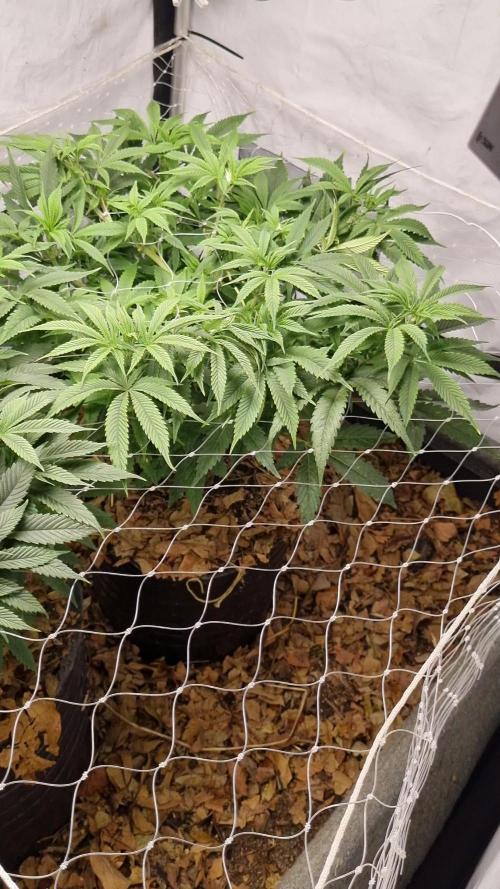
Buena ahora si agarraron viaje. Recuperaron muy bien. Ademas estaba faltando riego, cosa q debo mejorar, debo leer mas. Estoy regando 100% a ojo. Necesito medidores de humedad para próximos cultivos.
Hice defoliacion y fui tejiendo la mata por toda la red. Estan estirando a buen ritmo y se estan volviendo frondosas.
Banco con genéticas excelentes.

Likes
13
Share



Likes
2
Share


@CannaIGrow
Follow
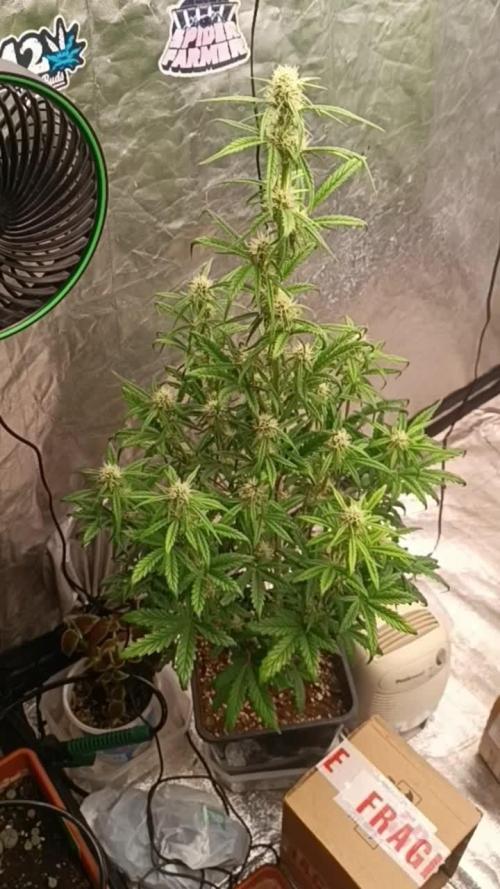
Transplant week! Some of the girls in the tent started to droop but this one didn’t! She’s looking pretty good to me
Come hang out with us in the discord!
Likes
Comments
Share

@Growfather1
Follow
Hello everyone,
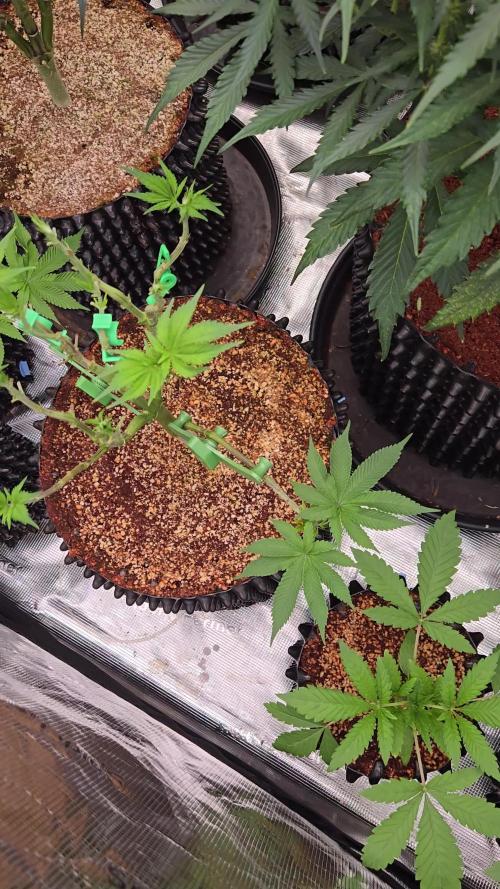
Going into week 7 of veg everything looks fine the girl is doing okay and will get her first hours of darkness this week and expect to go into flower within 7 days from now.
Thanks for stopping by and have a nice day.
Growfather


Likes
21
Share

@Michijardinero
Follow
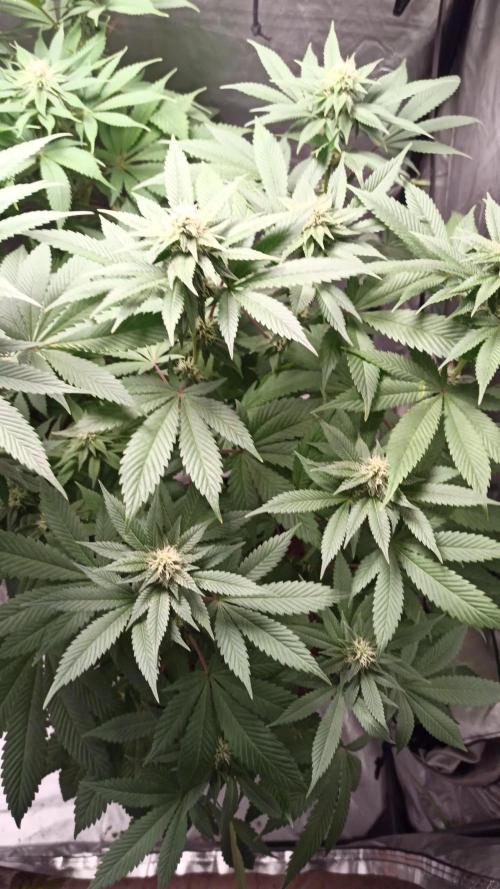
Muy buenas familia aqui estamos una semana más con mis niñas más gorditas 😁😁😁en este último riego sólo le he puesto atazyme le medi el pH y la EC todo está en su punto en el próximo riego le pondré de todo ahora ya tengo trabajando al 100% el foco en ventilador lo subí al 2 la temperatura ahora que el foco está el 100% ha subido a 25.5 26 grados lo tengo a 30 más o menos de las puntas ya saben familia si ven algún fallo algo en lo que pueda mejorar para que salgan al 100 los escucho un abrazo muy fuerte nos vemos en 7 días paz

Likes
9
Share


@Growlecule
Follow
Hi buddz and buddettez how is it growing?😁👍
So another week ended into the greenhouse, fall is kicking in hard and temps dropped to 17 celsius daytime.
The tomatoes are almost done, did it extremly well and what a taste and colours this year it was amazing.
The Runtz is full into flowering, producing some very decent buds.
I am very impressed by her, the canopy is looking great, nice evenly spread, and hopefully by having her lollipopped al the way up to 1 meter, the mold will back off this time🤙
To really go in war with this bud eating sucker, i added a fan to keep the air flow maximized. Lets hope for the best, the days are getting colder and wetter and so is the inside of the greenhouse😁🙌
The Santa Maria Auto doesnt want to grow up, stuck in her dwarfish bubble, i planted her to late into the season, better of next year. She will be one of the first to pop cause she needs to be finished mid summer were the climate is the most dry.
The Blue Gelato 41 Clone is doing fine, after she rooted she could only grow/acclimate 2 weeks befor going into flower, top bud seems to be a fatty little one😋
Last water feeding was about 5 weeks ago, they never complained, the tomatoes burst when you water to much, beside that the ground is kinda slope towards my greenhouse, so they pick up alot of water from underneath😁🤙
Have a great week all, enjoy life to the fullest and happy growing


