




Likes
7
Share


@JayBane
Follow
Day 58 - Started on making a natural intake box
Day 59 - Isolated and sealed the natural intake box + added beter sealing on grow cabin doors & cabin
Day 60 - Semi-automated intake.

Processing
Likes
28
Share


@Salgeezi
Follow
This week the smell and bud sites are starting to show. I had to cut out the hygrozyme as it fouls the reservoir no matter what I do. I hand water it when I remember which isn't often. Bumped the EC to 1000 per feeding still at 5x a day with just Floraflex B1 and B2 with CalMag and Drip Clean. Wattage is at 120. Distance is around 16 to 18". Guna do a MAJOR defoliation early next week

Likes
2
Share

@5fingeredgrower
Follow
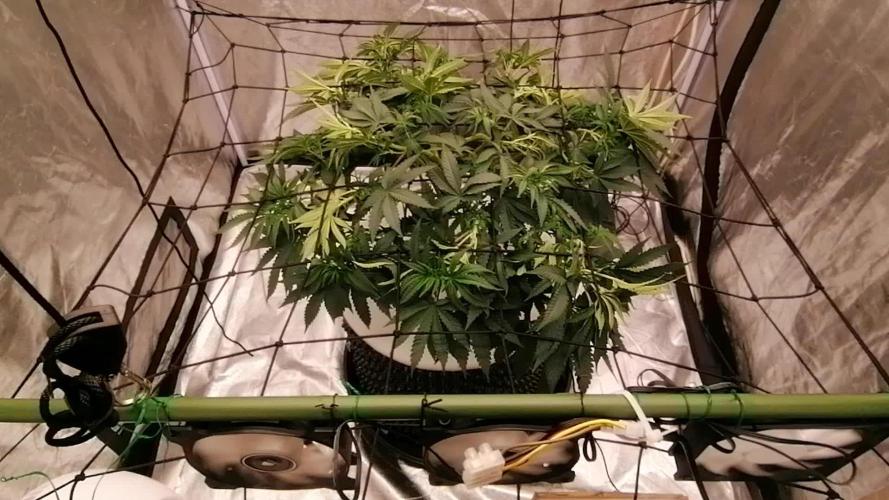
18.03.2026 Wednesday: flower time !
20.03.2026 Friday: 6L Rainwater + nutes - 1.25L Run off so will stick to 4L in future. Defoliated to improve airflow.
22.03.2026 Sunday: 4L Rainwater + nutes. drinking about 2L a day. Another big defoliation. LST with adjustable clips - these are great and way better than the fixed ones that only do 90' bends.

Likes
21
Share


@Felloffthegrid420
Follow
One week down looking they're very good I can see a lot trikos on the got a new camera coming the smell is seeking out having hard time try stay stealth I belive starting to stay on my clothes my whole house 😷

Likes
34
Share


@PapaNugs
Follow
A more difficult week. I've been battling the water consumption on two of the girls. I ordered and hooked up the Blumats auto watering system. I followed the instructions to a T but they don't work on those settings for this type of plant. They must be recommending for succulents cause the girls dried out right away with the settings. So I've been slowing dialing it in the get the proper amount to release.
This girl is doing fine with the water. Prolly because she was stunted and doesn't need as much. Getting bigger
Dimmed to 80%
Here are the lights details:
Medic Grow Mini Sun-2 150W LED
Model: MN150-022
Spectrum mode: V1
Efficacy: 2.8 umol/J
Thanks for stopping by!
You can find the light on Grow Diaries:
https://growdiaries.com/grow-lights/medic-grow/mini-sun-2-150-watts
You can find the light on Medic Grow's website:
https://medicgrow.com/
Likes
6
Share

@Sobreruedas
Follow
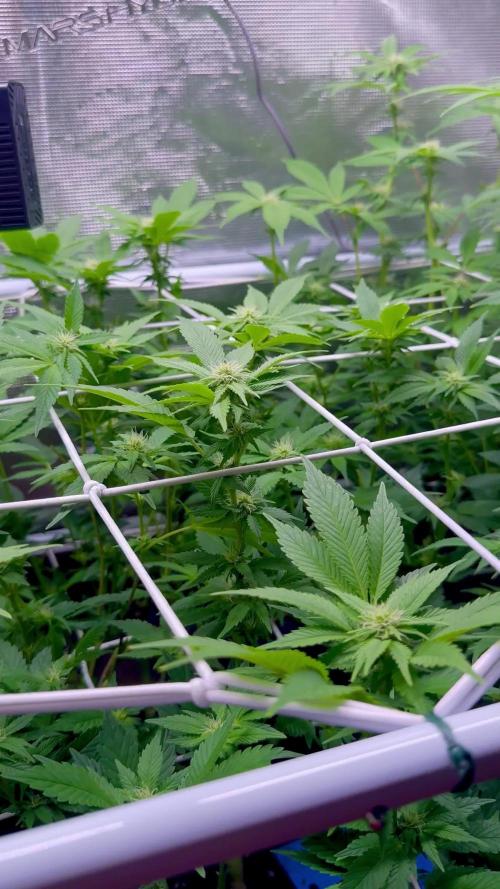
This week I performed a good defoliation to clean up the canopy and improve light penetration and airflow.
I also added a second scrog net to help support and organize the branches as the plant continues developing in flower.
On the positive side, I haven’t seen any more signs of the thrips since the treatment, so hopefully the issue is under control now 🌱💪


Likes
36
Share


@Ganjagrandaddy
Follow
Day 63 flowering: Well here we have it Growmies. 63 days of Marsian sunshine and plenty of enriching feeds and we have reached the crux point.
The Strawberry Cola finished beautifully and was taken out 4 days ago. She has been in the dark along with the Monster mash who went in yesterday. Both girls had begun to show amber trichromes with the scope so we're ripe for pulling . More on those with ther harvest reports .
Herz Og looks so edible right now . she still has clear trichromes around and no real signs of amber ones to concern me.yet. A few more days should see her finish perfectly I hope. She isnt a huge plant but the quality on close up is amazing. I am now only using water until she finished to leech through the Dragon force to avoid any after taste in rhe buds.
We are getting to the best bit now but also the hardest part . The waiting to dry and not rushing it is always the most difficult part for me.lol
Enjoy the pics and I will catch you on the harvest reports. Be safe and free growmies
UPDATE #####
The final lady is now hanging with her stable mates for a low and slow dry. The dark period had her sweating more oils for sure too so she needs to benleft alone to dry them into her buds now as she dries. shebfinishwd perfectly. Next update will be harvest hopefully soon. watch this space!!!!

Processing
Likes
81
Share


@NugLife420
Follow
Things are going pretty well. 🙂 I am just about to start flushing. Buds are swelling up and getting denser every day. Getting close to the finish line. 😎 I'll update throughout the week.

Likes
57
Share


@Salokin
Follow
Hello Growmies,
Week 12 with our Epic Buzz is showing us just how remarkable this plant truly is. The development has been nothing short of amazing, and there's an electric sense of anticipation for what's to come, not only with this beauty but also with the future Epic Buzz cultivars.
The plant has fully embraced its flowering stage, with the buds stretching along the colas and starting to display a frosty coat of trichomes. These sticky crystals are not just limited to the buds; some of the larger fan leaves are getting their share of the sparkle too. The buds themselves are clustering so tightly around the colas that they're beginning to fill in the gaps, giving rise to the hope that they might just form those perfect, gapless spears we all aim for.
Observing the plant, we see a thriving, verdant structure; a tapestry of green that stands tall and proud under the glow of the grow lights. The canopy is dense, the stems are sturdy, and the overall health of the plant is exemplified by the vibrancy of its leaves and the rapid development of its buds. The setup, with its careful arrangement of lights and ventilation, creates an ideal micro-environment for growth—a harmonious space where Epic Buzz can express its genetic potential to the fullest.
Each picture is a snapshot of a different angle, revealing the uniformity of the growth and the care that's been put into maintaining such a healthy grow. The close-ups of the buds show the trichomes starting to build up, hinting at the potency and flavor that await.
It’s clear that the Epic Buzz is on a stellar path, and with the diligent care, it’s receiving—regular feedings, reservoir top-ups to prevent any more lockouts, and the optimal light schedule—it's all set to continue on this trajectory.
Stay Lifted,
Salokin

Likes
28
Share


@SmokingTiki
Follow
The sun was there this week. Despite the yellowing of the lower leaves, the Gorilla Punch and the Pound Cake look good. The Apricot and the Orange Sherbet are not so good.
Parameters :
-------------------------------------------
Humidity range : 30-65% depending on the sun
Temperature range : 20-30°C depending on the sun
SUN Average : very sunny
Plants heights at the end of the week :
-------------------------------------------
Apricot : 20,5 cm
Gorilla Punch : 25 cm
Orange Sherbet : 25.5 cm
Pound Cake : 33 cm


Likes
15
Share


@Venabr96
Follow
Começando a semana 4 com o lollipopping para dar força aos tops buds. Planta com otimo desenvolvimento. Adcionarei 6ml.l de mel para a cura dos cortes feitos.
4 dias depois de fazer o lollipopping a planta começou a desenvolver polem.

Likes
77
Share


@KingSalomonsWeed
Follow
17.11. Day 50 Blüte 11
Hallo Leute.
Pflanze kam in die Mitte des Zeltes und wurde gedreht um 180°.
Bald sollte ich etwas lollipoppen.
Alles sehr zufriedenstellend.
Der Duft ist unbeschreiblich. Soo deep Haschisch Ketama.
Noch 75 Tage bis zum Ende des Wettbewerbs.
Noch 59 Tage ca für die Blüte.
18.11. ? Es waren nur 24 h. Doch jetzt kann ich bereits von Knospen sprechen.
19.11. Siehe Photos. Was das? Egal ,waren nur zwei 2. Sind jetzt entfernt.
20.11. day 14 Flower. Ich müsste auf jeden Fall lollipoppen.
Normal mache ich das nicht, aber es ist ein Contest. 👍
Und ich hätte nix gegen größere Knospen.
Nach dem lollipoppen hängt ein Geruch nach Original Gewürz nelken und Piment an meinen Händen. Ohh😊.
21.11. Invasion der Thirpse Teil 4..
Die Antwort: Arnold Pyrolitenegger.
Und noch 55 Tage Blüte.
22.11. Pyrolitenegger.

Likes
4
Share


@Staffedition
Follow
Привет друзья.
Наше знакомство продолжается с новым фотоцветущим растением от Smail_Seeds сорт TROPICANNA POISONZKITTLEZ XXL F1 reg.
Сегодня растению 99 дней.
Шишки наливаются, уже прям тяжело ей стоять) очень плотные
Перевёл на 12/12 1.10.2023
Растение очень хорошо развивается, ни каких сбоев в генетике не наблюдается😀
Сорт выводим сами.
Смотри мой профиль, у нас всегда есть что то интересное.
Не забудь поставить лайк❤️, если понравилась как прошла неделя
И читайте наш TELEGRAM: https://t.me/smail_seeds
#Smail_Seeds 😀
Likes
175
Share


@love_2_grow
Follow
Day 22 Flower (Day 64)
Today is the first day of week four of flower.
I gave the right girl 3 liters of pH 6.2 water, but the left girl didn't need any. She doesn't drink much since the light is turned way down not to fry her canopy more than it already has. Unfortunately, her new tent didn't show up today — hopefully, tomorrow.
I also put half of an avocado on top of the soil in each pot to feed my worms. It should be a nice little treat for my worm buddies.
Most of my cover crop has died now when the girls are blocking out all the lights, and I really should cover the soil in mulch, but as I'm changing to larger pots next run, I would have to remove it again in about a month, so I haven't bothered.
Day 23 Flower (Day 65)
Yay! The new tent finally arrived today. It is still a tiny 40x40 cm tent as that is all I can fit inside the wardrobe, but the new tent is 40 cm taller. The plant really needed the extra height since she was pressing against the light and roasting the top buds.
It was a bit tricky to get the left girl out of the old tent, but by combining some McGyverism with a bit of brute force, I got her out in mostly one piece. The damage from the light wasn't as bad as a feared, although three tops were fried and a few fan leaves. Not great, but it could have been worse.
I took the opportunity when she was between tents and did some defoliation/lollipopping before moving her into her new space and giving her 1.5 liters of ph 6.7 water to help her deal with the shock of being manhandled.
It is lovely to have some space again, and I was finally able to turn up the light to 100%. Now those buds can start to fatten up!
All I did with the right girl today was to give her 3 liters of pH 6.5 water.
Day 24 Flower (Day 66)
The left girl loves her new home and looks to be bouncing back nicely. She didn't need any water today, but it was the first time a tiny weed smell came out of the tent as I opened it.
The right girl in my main tent is further along in flower and technically should smell more than the small tent, but the CO2 bag still overpowers everything with its sh*t smell. lol
I gave the right girl 3 liters of pH 6.4 water today, and I also "shaved her legs" by removing some pointless leaves and branches low down on her.
Finally, I started brewing some compost tea with the same recipe as last week (worm castings, rock dust, biochar, lime, bentonite, neem meal, kelp meal, alfalfa meal, and molasses). Still, this time it will be filtered as it is too soon for additional topdressing. The tea will brew for 24 hours, and I'll feed it tomorrow.
Day 25 Flower (Day 67)
All I did today was to feed each girl 3 liters of pH 6.6 compost tea as well as rearranging the main tent (moved the CO2 bag so I could move the clip fan, attached the ratchet hangers to the lights differently, and did some LST to get a branch out of the way) so I could raise the lights another 5 cm.
Day 26 Flower (Day 68)
Today was a really easy day. I just gave the right girl 3 liters of pH 6.1 water. That was it.
Day 27 Flower (Day 69)
I gave each girl 3 liters of pH 6.6 water today. I also took out my proper camera and tried a few quick bud shots. Just as an experiment though - handheld, no tripod, just the grow lights so no proper lighting, etc. Would love some feedback on these photos though as I'm completely new to bud photography and am looking to improve.
Day 28 Flower (Day 70)
The last day of the fourth week of flower and all is well in the tents.
The left girl is 97 cm tall (12 cm increase in a week), and the right girl is 120 cm tall (a 3 cm increase in a week). The left girl has been stretching this week since she got her new tent (which allowed me to turn up the light.) She certainly is loving those extra photons! On the other hand, the right girl seems done with stretching and is working on fattening up the buds.
All I did today was to snap some pics and videos and give the right girl 3 liters of pH 6.2 water.

Likes
4
Share


Likes
10
Share


@Bakeryguy420
Follow
Filling in nicely through week 6 going start flushing her down to harvest in next few days excited to smoke this one :) coming out amazing
