


Likes
Comments
Share


@Troxx
Follow
Clones are coming around they was shocked being up in Maine we had a light out for 3 days got too 40° in the cloner etcetc sooo trying to get them to root just gave them some clonex ✌️


Likes
22
Share


@LSDMan
Follow
(EN) The plants are in a wooden planter to protect them from strong winds (they remain in their 3.6L pots for now). Watering with clear water on day 21. Some plants have slightly tipped but nothing serious. Meteorological change from day 23, with a drop in temperature and rainy, cloudy and windy weather (but this does not prevent the plants from growing, on the contrary). Watering with root fertilizer at 1mL/L and growth fertilizer at 1mL/L on day 25.
(CAN) Les plants sont dans une jardinière en bois afin de les protéger des vents violents (ils restent pour l’instant dans leur pots de 3,6L). Arrosage à l’eau clair le jour 21. Quelques plants ont légèrement tigé mais rien de grave. Changement météorologique a partir du jour 23, avec une baisse de température et un temps pluvieux, nuageux et venteux (mais cela n’empêche pas les plants de croître, au contraire). Arrosage avec l’engrais racinaire à 1mL/L et l’engrais de croissance a 1mL/L le jour 25.


Processing
Likes
17
Share


@Totogrowuk
Follow
Second week of flush and the girls are looking ready. I’m always learning though and will definitely have to be more savage with my lollipoping in the future as I’ve got a fair bit of larf on lower branches. Almost harvest time 😍😍

Likes
13
Share


@SzkolaZiola
Follow
Last days for most of them - only Strawberry Cough will stay longer - she is super hungry and I can not keep up with feeding her - most of leaves are yellow now. 😱
The rest - four plants will be harvested on the weekend - 2-3 days from now and frozen - I'll be making bubble hash and fresh frozen live resin from them in the following weeks 😈
Trichomes are mostly milky with some amber starting - ideal ripeness and time to freeze those glands


Likes
8
Share


@luisantas2009
Follow
Chop 3 bubble kush, so amazing strain from weed express, heasy and very fast


Likes
5
Share


@Manes420
Follow
Buon 420 ragazzi e scusate se nn ho messo foto delle og gaucho e glueberry, le mettero il prossimo aggiornamento.


Likes
17
Share


@Naujas
Follow
She is much prettier than she was a week ago :) I remembered that I have my first grow light, which is more compact and it will give me more space, so I changed my light, now the girl's side branches get light too:) I add a lot of video memes, because I really want to win Iphone16 pro ;) and those who don't take risks don't drink champagne:) good luck to everyone.
Likes
47
Share


@rhodes68
Follow
11/3 Week 6
Watered roughly one gal each @6.5PH, Fish Sh!t 5ml - Karo 1 tps /gal
Flower Girl still in the pot, no deficiencies I can see, well new ones :)
Mag-Sulfur Foliar spray (Epsom Salt 1tbs/gal) on all as leaving cal-mag out this time
Moved the two healthy plants to the center of the light, they can use it, the others might respond well to lower levels.
11/4 Better pics uploaded
Placed Brandy on a block of coco coir to bring her canopy up to Layla's level.
Moved Maggie to the corner she has a stretch going that I HOPE is ending and I dont want to set the lights to her.
Watching that plant carefully
Considering a PK boost watching only Layla for that as the other two ... well hell what can they tell me?
11/5 Working to getting the canopy under control with one stunted plant and another stretching like crazy.
Put a block under Brandy to move her up level with Layla.
Trained down Maggie this growth needs to end, it was already stressed.
Still giving light pref to healthy plants.
11/6 Raised lights three clicks, increased extraction, showing some heat stress in those edges.
11/7 Good results on the heat stress curling has ended.
Noticed some improvement also in the tops of Brandy and Maggie, so raised lights another couple of clicks.
See if it continues, coming up on a make or break feeding in couple of days.
update
Foliar Feed All - Epsom Salt 1tbs/gal
Well Maggie's came today -
To runoff- 1% peroxide - 5ml CalMag - PH 6.8 Hitting Sulfur as hard as I can.
Before pics posted
Brandy not dry enough waiting
Layla just got fed but she got pics too as there are signs of Mag deficiency
1 gal 6.5 PH - CalMag 5ml - Fish Sh!t 5ml - Bio_Bloom 5ml as a PK booster JIC
11/8 Video of plants 24hrs after giving Maggie the h2o2 1% , think she looks better lets see how it goes
11/9 48 hrs after treatment and Maggie is showing great improvement, serious improvement in leaf structure and coloring.
Pics at lights out tomorrow new week anyway.
Brandy showing some improvement but its early.
Canopy is level now so lights set to Maggie being slightly taller
***Last update before the new week.***
May have found ONE of my problems,certainly not THE problem, but one.
I have been using lemon juice as a PH UP since we went organic late last spring.
Because of all the problems I have been looking into a lot of things further and found that lemon juice begins to degrade as a PH up after as little as an hour.
A 6.0 PH water gallon can go to 6.5ish in 24 hours simply sitting in a dark corner in a jug.
One can imagine the variances in soil.
Why I dont know but I am going back to chemical PH additives post haste in fact its already done.
Processing
Likes
68
Share


@Joni2017
Follow
Day 54, defoliation of the lower parts😎🌼 she continues to grow very healthy 🙌 size 63 cm👏🏻👏🏻 temperature 26º C ☀️, humidity 65% 💧 watering 750 ml alternating one day with nutrients and another without nutrients with osmotized water 💦💦 Session 45 min. of binaural sounds for growth and healing 🎼 and music 😉👍
Likes
21
Share

@World_Breeders
Follow
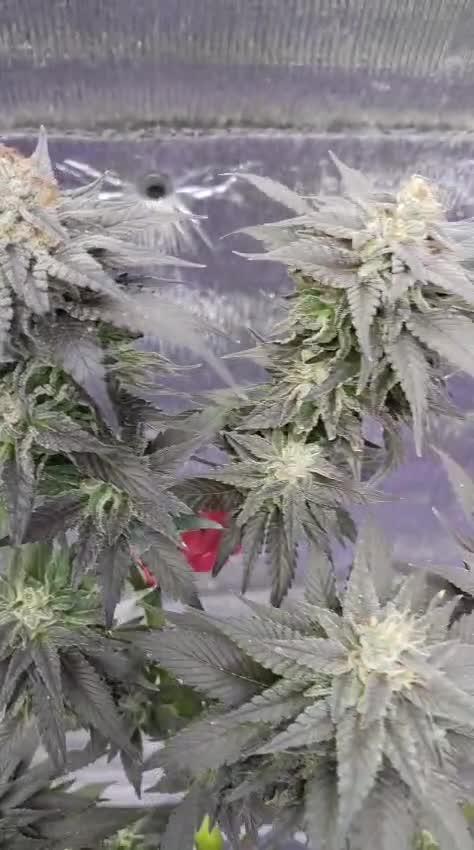
Week 9 marks the final stretch for Pink Truffle, and she's looking exceptional. Buds have continued to swell, stacking tightly along every branch while developing a thick blanket of resin that now coats both the flowers and sugar leaves. The contrast between the frosty trichomes and the dark purple tones is becoming one of this phenotype's standout traits.
The plant has responded very well to training, creating an open canopy with uniform light distribution and excellent airflow. Calyxes are still expanding, but the flowers are already noticeably denser and heavier than last week. The terpene profile is becoming richer every day, combining sweet creamy notes with earthy undertones and a subtle fruity finish.
Nutrient uptake has remained stable throughout the ripening phase, and the plant is naturally beginning its finishing fade without showing any significant deficiencies. At this point, the focus is on monitoring trichome maturity and allowing the genetics to reach their full potential before harvest.
Seeds by World Breeders
Cultivated by Piperoots 🇲🇦 🌱🔥
Likes
Comments
Share


@KovaiGrows
Follow
Day 3 of seedlings in soil.
Only 2 survive in the end.
Still looking for better materials for fans and heating and light timer.
Processing
Likes
2
Share


@mojogrow
Follow
Is a low budget Indoor, with 50x50x1.40 cm made by me :P
idem the leds, are COB 50w each one
Likes
5
Share


@whenindoubtsmokeitout
Follow
found a small bud rot site, we had to remove the whole cluster around, and sanitise with alcohol.

Likes
2
Share


@JoExotic
Follow
Week 9 - Close to harvest the smell on these is Straight gassy with a strong strawberry smell What a mind blowing strain !!! Not sure when I’m gonna harvest yet but they seem very close
Likes
23
Share


@SonomaSungrown
Follow
9/22 Chem Brulee is all finished up.
Just waiting a few days until the French Macaron is fully dried and out of the drying tent.
The plan is to trip about 25% of it to be headstash flower, and then to fresh freeze the remainder of the "would-be-marketable" buds so as to make hash with them.
Trim will be going to the worms.


Likes
45
Share


@Ultraviolet
Follow
My homework.
Rubisco regeneration is intrinsically linked to nitrogen supply because Rubisco is a major sink for nitrogen in plants, typically accounting for 15% to over 25% of total leaf nitrogen. The regeneration phase itself consumes nitrogen through the synthesis of the Rubisco enzyme and associated proteins (like Rubisco activase), and overall nitrogen status heavily influences the efficiency of RuBP regeneration.Structural Component: Nitrogen is an essential building block for all proteins, and the sheer abundance of the Rubisco protein makes it the single largest storage of nitrogen in the leaf.
Synthesis and Activity: Adequate nitrogen supply is crucial for the synthesis and maintenance of sufficient Rubisco enzyme and Rubisco activase (Rca), the regulatory protein responsible for maintaining Rubisco's active state. Nitrogen deficiency leads to a decrease in the content and activity of both Rubisco and Rca, which in turn limits the maximum carboxylation rate, Vmax, and the rate of RuBP regeneration Jmax, thus reducing overall photosynthetic capacity.
Nitrogen Storage and Remobilization: Rubisco can act as a temporary nitrogen storage protein, which is degraded to remobilize nitrogen to other growing parts of the plant, especially under conditions of nitrogen deficiency or senescence.
Nitrogen Use Efficiency (NUE): The allocation of nitrogen to Rubisco is a key determinant of a plant's photosynthetic nitrogen use efficiency (PNUE). In high-nitrogen conditions, plants may accumulate a surplus of Rubisco, which may not be fully activated, leading to a lower PNUE. Optimizing the amount and activity of Rubisco relative to nitrogen availability is a target for improving crop NUE.
Photorespiration and Nitrogen Metabolism: Nitrogen metabolism is also linked to the photorespiration pathway (which competes with carboxylation at the Rubisco active site), particularly in the reassimilation of ammonia released during the process.
To increase RuBisCO regeneration, which refers to the process of forming the CO2 acceptor molecule Ribulose-1,5-bisphosphate (RuBP) during photosynthesis, the primary methods involve optimizing the levels and activity of Rubisco activase (Rca) and enhancing the performance of other Calvin-Benson-Bassham (CBB) cycle enzymes.
Biochemical and Environmental Approaches:
Optimize Rubisco Activase (Rca) activity: Rca is a crucial chaperone protein that removes inhibitory sugar phosphates, such as CA1P (2-carboxy-D-arabinitol 1-phosphate), from the Rubisco active site, thus maintaining its catalytic competence.
•Ensure optimal light conditions: Rca is light-activated via the chloroplast's redox status. Adequate light intensity ensures Rca can effectively maintain Rubisco in its active, carbamylated state.
•Maintain optimal temperature: Rca is highly temperature-sensitive and can become unstable at moderately high temperatures (e.g., above 35°C/95F° in many C3 plants), which decreases its ability to activate Rubisco. Maintaining temperatures within the optimal range for a specific plant species is important.
•Optimize Mg2+ concentration: Mg2+ is a key cofactor for both Rubisco carbamylation and Rca activity. In the light, Mg2+ concentration in the chloroplast stroma increases, promoting activation.
•Manage ATP/ADP ratio: Rca activity depends on ATP hydrolysis and is inhibited by ADP. Conditions that maintain a high ATP/ADP ratio in the chloroplast stroma favor Rca activity.
Enhance Calvin-Benson-Bassham (CBB) cycle enzyme activity: The overall rate of RuBP regeneration can be limited by other enzymes in the cycle.
•Increase SBPase activity: Sedoheptulose-1,7-bisphosphatase (SBPase) is a key regulatory enzyme in the regeneration pathway, and increasing its activity can enhance RuBP regeneration and overall photosynthesis.
•Optimize other enzymes: Overexpression of other CBB cycle enzymes such as fructose-1,6-bisphosphate aldolase (FBA) and triose phosphate isomerase (TPI) can also help to balance the metabolic flux and improve RuBP regeneration capacity.
Magnesium ions, Mg2+, are specifically required for Rubisco activation because the cation plays a critical structural and chemical role in forming the active site: A specific lysine residue in the active site must be carbamylated by a CO2 molecule to activate the enzyme. The resulting negatively charged carbamyl group then facilitates the binding of the positively charged Mg2+ion. While other divalent metal ions like Mn2+ can bind to Rubisco, they alter the enzyme's substrate specificity and lead to dramatically lower activity or a higher rate of the non-productive oxygenation reaction compared to Mg2+, making them biologically unfavorable in the context of efficient carbon fixation. The concentration of Mg2+ in the chloroplast stroma naturally increases in the light due to ion potential balancing during ATP synthesis, providing a physiological mechanism to ensure the enzyme is activated when photosynthesis is possible. At the center of the porphyrin ring, nestled within its nitrogen atoms, is a Magnesium ion (Mg2+). This magnesium ion is crucial for the function of chlorophyll, and without it, the pigment cannot effectively capture and transfer light energy.
Mg acts as a cofactor: Mg2+ binds to Rubisco after an activator CO2 molecule, forming a catalytically competent complex (Enzyme-CO2-Mg2+). High light + CO2) increases demand: Under high light (60 DLI is a very high intensity, potentially saturating) and high CO2, the plant's capacity for photosynthesis is high, and thus the demand for activated Rubisco and the necessary Mg2+ cofactor increases. Mg deficiency becomes limiting: If Mg2+ is deficient under these conditions, the higher levels of Rubisco and Rubisco activase produced cannot be fully activated, leading to lower photosynthetic rates and potential photo-oxidative damage.
Optimal range: Studies show that adequate Mg2+ application can enhance Rubisco activation and stabilize net photosynthetic rates under stress conditions, but the required concentration is specific to the experimental setup.
Monitoring is key: The most effective approach in a controlled environment is to monitor the plant's physiological responses e.g., leaf Mg2+ concentration, photosynthetic rate, Rubisco activation state, and adjust the nutrient solution/fertilizer to maintain adequate levels, rather than supplementing a fixed "extra" amount.
In practice, this means ensuring that Mg2+ is not a limiting factor in the plant's standard nutrient solution when pushing the limits with high light and CO2.
Applying Mg2+ through foliar spray is beneficial to Rubisco regeneration, particularly in alleviating the negative effects of magnesium (Mg) deficiency and high-temperature stress (HTS). While Mg can be leached from soil, within the plant it is considered a mobile nutrient, particularly in the phloem. Foliar-applied Mg is quickly absorbed by the leaves and can be translocate to other plant parts, including new growth and sink organs.
Foliar application of: NATURES VERY OWN MgSO4 @ 15.0g L-1 in a spray bottle.
Foliar sprays are often recommended as a rapid rescue measure for existing deficiencies or as a supplement during critical growth stages, when demand for Mg is high. Application in the early morning or late evening can improve absorption and prevent leaf burn.
The starting point [of creativity] is curiosity: pondering why the default exists in the first place. We’re driven to question defaults when we experience vuja de, the opposite of déjà vu. Déjà vu occurs when we encounter something new, but it feels as if we’ve seen it before. Vuja de is the reverse—we face something familiar, but we see it with a fresh perspective that enables us to gain new insights into old problems.
Likes
86
Share


@Tropicannibis_Todd
Follow
Alright Then
REMINDER I DO 2 UPDATES PER WEEK 👉WEEKLYROUNDUP👈👉MIDWEEKLY UPDATE👈
We just hit week 3 and all is well , have to admit she's showing great , Growth in just 21 days😃 .......
Middle of last week I have decided to start a little training by pulling her over to the side 👌 And will continue to LST this week👈 And she's looking fantastic add to the fact she's already begun next faze by preflowering 😲
Pheno #2 Is about 9-10 behind buts its playing catch up and I should be doing some LST on her later this week 😛
Very little water given ,so far and rain water to be used entire growth👍
Lights being readjusted and chart updated .........👍
I GOT MULTIPLE DIARIES ON THE GO 😱 please check them out 😎
👉I WISH GD HAD DISCORD SERVER SO GROWMIES COULD HAVE A PLACE TO HELP AND TALK THINGS RELATED TO GROWING IN REAL TIME .....👈
👉SO I CREATED ONE ALL YOU NEED IS TO JOIN THE GROWDIARIES DISCORD SERVER !!!!!!!!!!!👈
LINK IS 👉
https://discord.gg/zQmTHkbejs
AND SEE HOW IT PLAYS OUT !!!!!!!