


Likes
Comments
Share


@Stickygreens420
Follow
1/16/2023 - Day 14: not much new to report. All 6 plants are continuing to look healthy. The Grand Prix seem to be a bit smaller than the Frozen White Runtz and Ice Bath. They all look good though.
1/18/2023 - Day 16: clipped a leaf off each Grand Prix to send it in for a genetic test to determine the sex. I used Farmer Freeman. Nothing else to report at this time.
1/20/2023 - Day 18: watered all 6 plants and foliar fed with the same water. Ph was 6.6, and mixed with ThermX-70, FishShit, Rootwise Micro Complete, Pure Protein Dry organic fish fertilizer, BuildASoil Big 6, Rootwise Enzyme Elixer, Fermented Comfrey Extract, and Yah-Whey Thrive. I know I went crazy, but might as well use it if I have it.
1/21/2023 - Day 19: Plants are looking happy. They obviously loved the feeding yesterday

Likes
41
Share


@BOMbolenath
Follow
The plant is developing well despite the high temperature.
During the week the weather got better, the plant is growing well.

Likes
20
Share


@Dunk_Junk
Follow
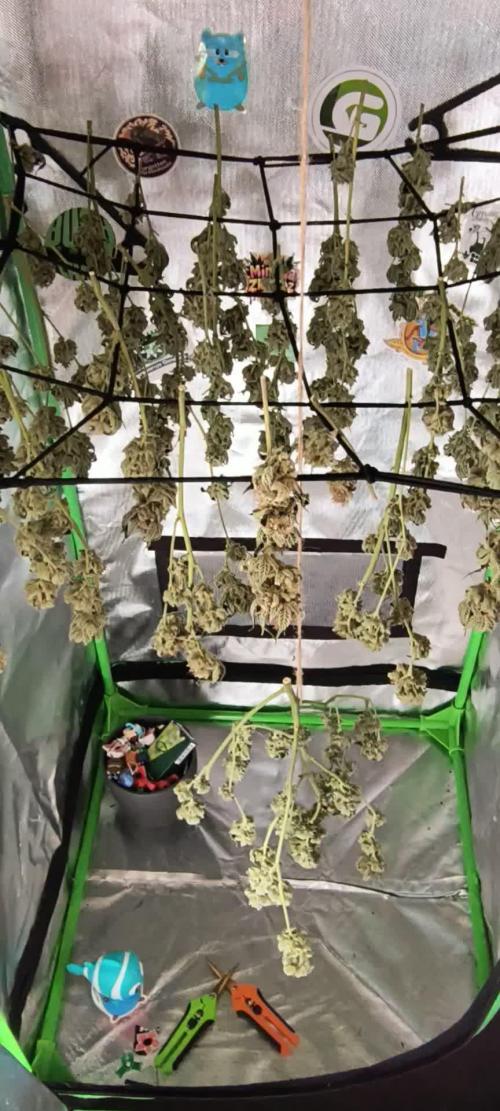
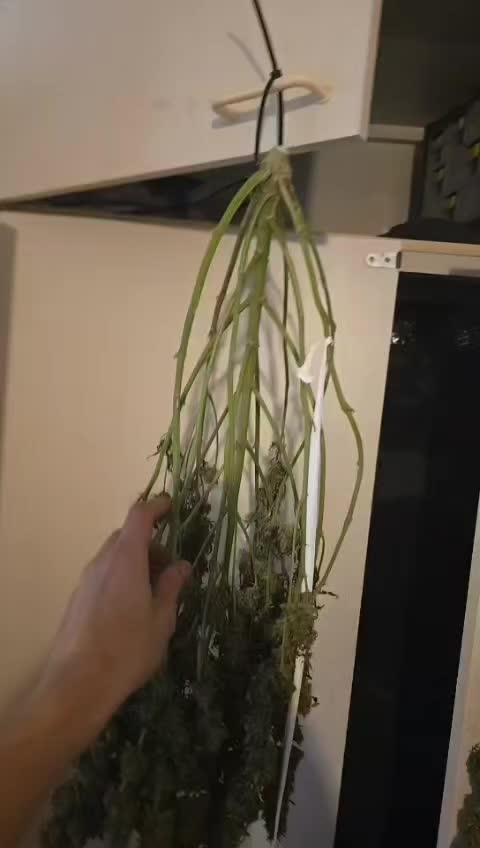
Chopped during the week and drying now............ The first pics are taken just before harvest.
Video is as it is drying out.
Dry weight 140 g!!!!!!!!! Very pleased with this. Nice genetics, I'm excited to do more strains for Barneys Farm.

Likes
3
Share

@Growfather1
Follow
Hello everyone,
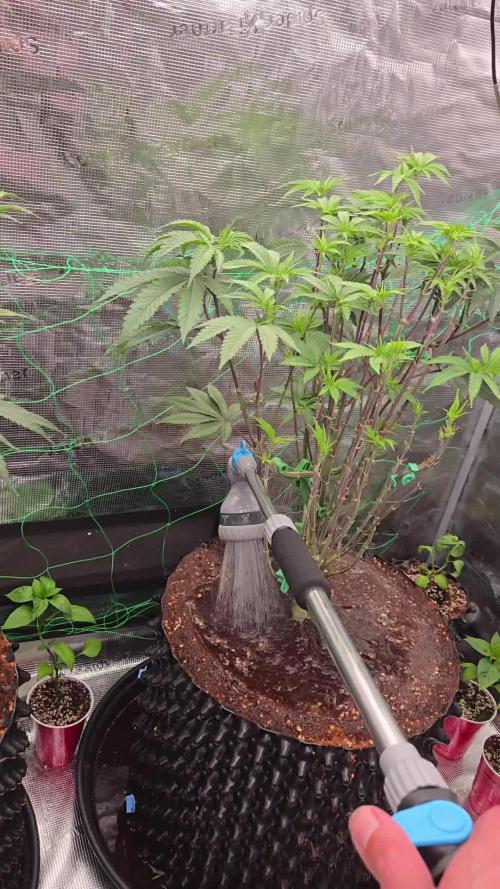
Week 10 of veg started yesterday and think 7 to 14 days more in veg is enough.
1 plant stretched perfectly to fill a 120x120cm tent the other one needs about 14 days maximum and the last one is a dwarf plant and i don't expect a big yield from this plant I'm regretting putting her in a 10 gallon pot totally disappointed.
My ph meter was 0,3 ph to high so when i was watering thinking the ph was 5.7 in fact it was 5.4 so gave them a good feeding with a ph of 6.0 and 30 procent runoff.
Thanks for stopping by and have a good one.
Best regards,
Growfather



Likes
199
Share


@CRiSPrGrow
Follow
These came down 11 weeks to the day from seed , this is them on their last day here. Wet weight is 😂 😂 😂 😂 😂 😂 was not expecting so much, it will last me HOURS ! these got wet trimmed now they're on the mat drying , the smell is typical american sweet candy ... was it fun? yes , yes it was fun ! what a plant this one is, my tallest one at 100cm, averaging 85cm , wet weight is.... gonna wait for dry weight, before i jinx it could be dense could be loose ! looks dense + not expecting to loose more than 50% it's all in the cure now ! 🚀

Likes
6
Share


@eldruida_lamota
Follow
Que pasa familia, vamos con la segunda semana de floración de estas Papaya sherbet feminizadas de fastbuds.
Vamos al lío, de las 3 plantas, me quede con 2 por espacio, siempre pongo alguna semilla de más por si no abriese alguna por no perder ese hueco del indoor.
También se trasplantaron a su maceta definitiva, en este caso de 7 litros, que el mismo trasplante provocó un shock, que también fue solucionado inmediatamente.
El ph se controla en 6.2 , la temperatura la tenemos entre 20/22 grados y la humedad ronda el 50%.
Hasta aquí todo, Buenos humos 💨💨💨

Likes
1
Share

@CptnNugz
Follow
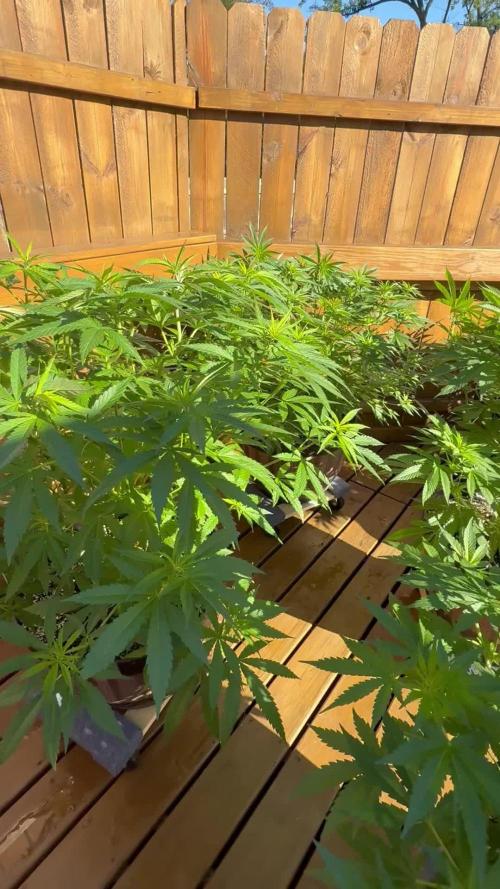
Plants are doing well! Great genetics so far and easy to grow! The 2 gorillas that went into flower weeks ago I’m not 100% sure if they were photos. Should have been but they are still budding. Full of tons of leaves so I’m hoping for a reveg but not sure if that’s because of the worm castings giving that nitrogen or if they are in reveg. I’m gonna let them ride and we shall see what happens. I’ve done some lower defoliation along with removing some really huge leaves to open it up and let light in. These plants are seriously really Hardy! Super thick stalks and healthy leaves. Really happy with these seeds so far!

Likes
5
Share


@Jays_Not_Here_Man
Follow
10 weeks from seed to harvest. The nutrient line I was using didn’t give me optimal growth, for this strain and my level of experience. Had some great growth and veg time, about 4 weeks, but when flower kicked in they got beastly. I would say I had two different phenos of this strain, and the one pheno that is unique, had slightly looser buds than the other two. This could be because of the LST/super cropping of the main cola. The other two had nice rock hard frosty buds and have similar smells and profile. The other one has more citrus, and was a bit lanky, more sativa in looks. Overall, easy enough to grow, no major surprises, and decent enough yield for 10 weeks. This is a strain that could have been better had I not had some issues with either lockout/deficiencies.
Likes
124
Share


@Legendaryseedthumb
Follow
Insane growth and super quick flower development.
Feels like I’ll have some pretty huge buds from these plants.

Processing
Likes
15
Share


@MG2009
Follow
06/02/2020
Gonna feed them today 1tbls of blood meal.
I snapped a branch on #2 (see video) her stems, I don't like break to easy so I will give some micro nutrients to help stems from breaking. Unless she is the HOLY GRAIL. I will cull her clone.
All others handed super cropping well. 🙏
#4 in hydro is in it's own diary called Small Batch Seed making some F1
#1 showed her sex today, clones well took cut on 05/20/2020 is rooting well outside in coco coir, in humidity dome just cut and scrape the stem,once rooted I cut off yellowing leaves i hope her smoke is as good as she looks.
5 days into week 10 and #2, and #4 are male so indoors they go for pollen collection. Will dust one bud of each female with each male and hunt for what I want. Also see what each passes on in the cross.
Likes
6
Share


@Yeyup
Follow
Stopped keeping track of everything and just let it do its thing
Dec 6
Dec 9


Likes
18
Share


Likes
11
Share


@Hawkbo
Follow
Most of them made it only 1 six shooter definitely didnt make it and a cream cookies is a lil stuck. I threw a mexican airlines in the old six shooter cup but just letting it germinate in the soil I havnt done that in a while. They are going to get another feed tmm. The medium is a 50/50 coco/soil mix since I'm using the green buzz and its organic I figured a little soil might be beneficial. Day 7 from germination they should be ready to go into their final pots in the next few days.
Likes
5
Share


Likes
110
Share

@Natrona
Follow
Divine Seeds Auto V.2 Contest
👉Sponsored Grow👈
Auto Black Opium
W8F3 7/20-26
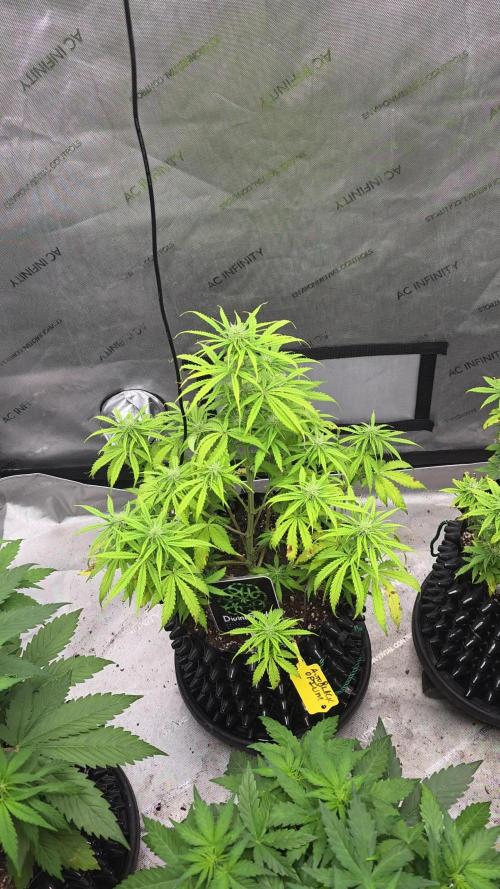
My Black Opium shows signs of distress with pale green/yellow leaves and spots. The damage, while less severe than Big Demon’s nutrient issues, continues to spread. Last week I asked a question to what was happening to my Divine Girls. Many indicated the soil was now depleted as it is now in flower with higher PK (phosphorus and potassium) demands. I immediately sprayed with banana juice 2x per day for 3 days while continuing to dry the soil with a fan. Leaves continue to show more spots in the leaves.
Another responder indicated I overwatered creating a lock out. How could this happen? I followed the same watering schedule every 2 or 3 days. The only change in this grow is adding the super soil to the base. Further research on living soils indicates that living soils like super soil, ancient soil and other nutrient dense mediums need less frequent waterings as the organic matter holds moisture while still allowing proper drainage. Lesson learned With living soils water once per week and monitor for additional water needs. She will not produce as well as one would expect due to my negligence.
I discovered that super soil naturally balances PH of water, eliminating the need for manual adjustments. This simplifies the growing process and ensures healthier plants. Yes, I like the water only with super soil.
As I learn more about organic growing hopefully, I will learn to identify what problems are before they get unmanageable. Autos have a shorter lifecycle and are less forgiving of mistakes. In the future, I might try a photo run where I can train High-stress-Training (HST) techniques and have more flexibility to correct errors.
Thank you all for your continued support and encouragement. Your likes and comments motivate me to keep sharing my journey. Let’s continue to learn to grow together!
Stay green, growers love 💚🌿
💫Natrona💫

Processing
Likes
4
Share


@420keef
Follow
First week of flowering! There are already small hairs coming out, so that's the third female i got from some bagseeds
Likes
Comments
Share

Likes
2
Share


@Ultraviolet_
Follow
18 hours in seconds, 60x60x18 = 64,800 seconds, now multiply by the 833μMol/s reading off the PAR metre. μMol/s (micromol) is the unit in which P.A.R. is expressed.
64,800x833=53,784,000μMol
53,784,000μMol = 54 Mol
54 DLI @ 800ppm, powerful combination. Pushing photosynthesis to peak capacity, accelerated growth and increased biomass. Applied net, stretching her around for a week. Maintaining a minimum air velocity of 0.3m/s within the inner canopy.
E=MC2 looks like a simple multiplication problem; it describes a fundamental physical truth: mass and energy are the same thing. The equation doesn't just calculate a value; it reveals that mass is effectively "congealed" energy. Energy is just numbers. Energy isn't a physical "substance" you can hold or touch. It is essentially an abstract, calculated number that we assign to a system to predict how it will change, interact, or move. A numerical label we attach to matter to track how it behaves. Because the universe runs on laws of symmetry (specifically, that the laws of physics don't change over time), a single global number must be conserved. We call that number "energy".
How well a seedling grows is down to how much knowledge one can acquire to increase the level of conversion to occur. Applying knowledge effectively requires intuition, which comes from hands-on experience. A seasoned stoner learns to read subtle signs—like a slight change in leaf turgor (stiffness), subtle color shifts, or the specific texture of the soil—before a textbook diagnosis can be made. Ultimately, growing is the application of botanical science blended with active observation. Knowledge dictates your potential, but adaptability and attentiveness to the plant's immediate environment determine your results. The human eye is capable of distinguishing more shades of green than any other color in the visible spectrum.
1.618
Nature mathematically optimizes quantum energy transfer and light absorption efficiency within the photosynthetic machinery, as it naturally dictates energy scaling hierarchies and resonance dynamics. External vibration or electromagnetic wave that perfectly matches a plant's natural frequency directly influences plant growth. Low-frequency sound waves and targeted electromagnetic fields stimulate cellular processes and boost photosynthetic efficiency. An angular frequency aligned with the Golden Ratio is often used in wave mechanics and quantum physics to optimize energy transfer. .
Does it produce better yields? All I know is the IVM loves being aligned with it.
"Frequencies utilizing this ratio naturally minimize resistance (or impedance) and allow for highly efficient resonance, which can facilitate an increase in Electron Transfer Reactions (ETR) or energy pathways in molecular structures."
Quantum coherence in photosynthesis occurs when a photon of sunlight strikes a leaf; the energy it carries must travel to a reaction center to be converted into chemical energy. This process operates at nearly 100% efficiency. If the energy moved in a traditional "bunching" or random hopping manner, a large portion of it would be lost as heat. Instead, plants utilize quantum superposition. The energy particle (exciton) doesn't just take one path; it exists in a wave state and explores multiple pathways simultaneously. It essentially "chooses" the most efficient route to the reaction center simultaneously.
Research shows that molecular vibrations and the specific network arrangements of chlorophyll molecules (like the naturally evolved Chlorophyll A & B ratios) actively protect against energy overflow, optimizing light capture across different light intensities. Enzymes are the biological catalysts that speed up chemical reactions within a plant's cells, allowing them to grow, metabolize, and repair. Rather than relying solely on the classical kinetic energy of molecules colliding, plants use quantum tunneling. Subatomic particles like electrons and protons (hydrogen ions) can literally "teleport" through energy barriers that they normally wouldn’t have the energy to climb over. This makes vital metabolic reactions happen far faster than classical physics could ever explain!
Chloryphyll b has peak absorption at 460nm (Blue) and at 647nm(Red). If we take the blue peak wavelength 460nm and a UV-B, UVR8 peak absorption wavelength 285nm, Tryptophan-285 (W285) Sensing protein. 460/285=1.618 Φ If we take chlorypyhll b's Red absorption peak 647nm and a UV-A of 400nm, we get 647/400=1.618 Φ. "Structure of light". The cryptochrome photoreceptor (CRY) is a UV-A/blue light receptor that shares this dual sensitivity with several other biological structures and functions, including significant sequence similarity and a common evolutionary ancestor with DNA photolyase enzymes. These are light-activated enzymes that use blue/UV-A light to repair DNA damage caused by UV-B radiation in plants. Synergistic.
Effective quantum efficiency of photosystem II, often denoted as ΦPSII, represents the proportion of light absorbed by Photosystem II (ΦPSII) that is actually used in photosynthetic electron transport. It is a key indicator of how efficiently a plant is using light for photosynthesis, as opposed to losing it as heat or fluorescence. ΦPSII (effective quantum yield of photosystem II) functions primarily as a "multiplier" (a coefficient of efficiency) rather than an additive factor when estimating the overall photosynthetic electron transport rate (ETR). Multipliers are considered far more beneficial than additions because they generate exponential growth, leverage existing resources to their full potential, and create sustainable, self-multiplying capacity, rather than just incremental, linear increases. This fascinating observation is rooted in the intersection of subatomic geometry, fractal scaling, and quantum dynamics. In specific molecular arrangements—such as in conjugated polymer networks or biomolecular architectures—the Golden Ratio (PHI) naturally dictates energy scaling hierarchies and resonance dynamics. Mathematically tied to the fine-structure constant, which defines the strength of the electromagnetic interaction. The Golden Ratio can be mapped geometrically as the Golden Angle (137.5 degrees) in atomic structures, linking the charge of the electron to fundamental quantum constants like Planck's constant.
An electromagnetic wave is neither electric nor magnetic, but a combination of both. 137.5
The Golden Angle (137.5) This angle is derived from the Golden Ratio (1.618). It is the smaller of two angles created when a circle is divided such that the ratio of the arcs equals the Golden Ratio.
An electromagnetic wave (like light or radio waves) is not a static electric field or a static magnetic field, it is a self-propagating combination of both. An oscillating electric field creates an oscillating magnetic field, which then regenerates the electric field. They feed off each other and travel together through space at the speed of light, carrying energy without needing a material medium.
The Fine-Structure Constant Alpha (Α/α): In quantum physics, is the approximate denominator of the fine-structure constant (often represented by the Greek letter Alpha (Α/α). It is a fundamental, dimensionless number that dictates how strongly charged particles (like electrons) interact with the electromagnetic field. Its value has puzzled physicists for over a century, as it bridges quantum mechanics, electromagnetism, and relativity.
In quantum mechanics, Omega (Ω/ω) usually represents angular frequency. When applied to "quantum coherence"—the ability of particles to exist in overlapping states without immediately degrading—is key to calculating how long these states last.
The Golden Angle, the value 137.5° is the geometric Golden Angle. It is derived from the Golden Ratio (1.618) and is famously responsible for the beautiful, mathematically optimized spiral patterns found in nature (such as sunflower seeds, pinecones, and leaf arrangements). Because of this, theoretical physicists and mathematicians have long speculated about why nature relies so heavily on the number 137 and the golden angle to govern everything from subatomic light interactions to the macroscopic geometry of the universe.
Quantum coherence allows particles to maintain superposition and entanglement. In realistic, open environments, interactions with a noisy background typically cause decoherence, destroying the system's quantum information. A major challenge in quantum physics and quantum computing is preventing this decoherence at large scales. In quantum optics and driven systems, the Greek letter Omega (Ω/ω) often represents the Rabi frequency, which dictates the strength of the coherent driving laser or electromagnetic field interacting with the quantum system.
The interaction of light and water generates specific Coherent Domains. Trapped electromagnetic fields cause water molecules to vibrate in unison at a coherent frequency, separating the liquid into structured quantum areas and an unstructured phase. When water interacts with hydrophilic (water-attracting) surfaces, the energy from UV and Infrared light can drive the formation of larger, structured layers known as Exclusion Zone (EZ) water. Exclusion Zone (EZ) water represents a structured, negatively charged phase of water critical to cellular biology. Driven by light energy and hydrophilic surfaces, this ordered state acts as a natural biological battery, with far-reaching implications for cell function and human health. In this domain, water molecules arrange themselves into a highly ordered, negatively charged lattice that excludes solutes and particles. At higher energy levels, UV light acts as a catalyst for photochemical reactions. Photons can provide enough energy to break the hydrogen and oxygen bonds in molecules, resulting in free radicals and a plasma of quasi-free electrons. This transfer of electrons forms the fundamental basis for redox reactions and energy metabolism in ALL biological systems.
