


Likes
Comments
Share


@Luxus15
Follow
I had encountered some problems with my homemade potting soil suddenly my plants suffered.I changed potting soil to go to plagron light mix, it's starting to get back in shape, so I left on the same occasion, changed fertilizer, I went to hesi.
I wanted to try to make my own substrate but I shouldn't have because between the ph and the earth it didn't go at all.Now I'm happy because she's better. Sorry I don't have my photos I will put them in the following days.apex cut on 01/17/23 at the 4 node.

Likes
4
Share


@Yessi_squeeze
Follow
This girl is beautiful and dense. She developed hints of purple during her last weeks of flowering and we are looking for a great smoke.
Likes
6
Share


@Mackorodoo
Follow
Day-1 put 41 blue dream seeds which i beleive are non gendered autos into pellets to grow as backups, I am primarily trying to grow a white widow autoflower from crop seed kings and 3 of a peyote strain unspecified gender and flowering style.
Day-2 humidity and temperature are sitting at 98up to +100 and 23-31 degress celsius will be leaving top more open after about 6 today to lower humidity just wanted it cranked up for a day or so
Day-3 things are looking good many seeds are starting to show taproots between a quarter inch and five eights of an inch popping through the bottom of the seeds.
Day-4

Likes
12
Share


@GrowGuy97
Follow
Have seen a lot of good diary’s on these had to get some for myself to see how it goes! Hopefully we get some super purple buds! Stay tuned & happy growing friends!🤙🏼✌️🏼🌱
Day 1 - Finally got them planted & water with fox farm big bloom (6tsp per gal)
Day 2 - all 5 have sprouted & doing great!
Day 3 - 2 out of 5 seeds have fallen off but they are all still growing & looking good! Watered them a little more this morning👍🏼
Day 4 - Looking great🙏🏼
Day 5 - Grow babies Grow!!
Day 6 - Plain PH water 6.4

Likes
16
Share


@sunshinegroww
Follow
Starting week 3 with some nice buds formation realy nice and compact plant need very little att

Likes
16
Share


@Phillycash
Follow
Well what can I say.i absolutely love doing this. I just wish that I would of started a long time ago.all of my plants are doing amazing.one of them has been producing a significant amount of bud sites even thought I think it is going to end up much shorter then the outher two.i think that it is still going to produce a good amount of flowers.the outher two northern lights are stacking very nicely.so far the only problem I seem to have is trying not to go sneak a peak at my plants.lol.i cant help it.i actually find the whole prossess extremely therapeutic. It has even inspired me to start a garden this spring. Anyways this week was awesome and I cant wait to bring you next weeks progress report.best of luck to everyone on here and as always HAPPY GROWING!!!

Likes
7
Share


@MadeInGermany
Follow
Harvest day 72
since time switch
to 12 / 12 h
Hey guys :-)
Finally it's time 💚
The lady is done the large leaves have been removed and hung upside down to dry in the dark drying room.
You can now stay there for 13-15 days at a temperature of 18-20 degrees and 55-62% humidity.
After 13-15 days it is neatly trimmed by hand and placed in jars with boveda packs 62.
After 4 weeks Boveda 58% come in and are ready for testing ;-).
After everything has been cut cleanly, the last update comes with the smoke report and the finished pictures.
Let's get to the plant 💚.
Unfortunately, the rating system at Growdiaries is a bit strange because I have to give the stars before the Smoke Report and in the end it might have led to more stars in terms of taste.
The growth was great from start to finish.
She had no problems at all and also had no problems with animals 👍.
I'm amazed at the great smell the beautiful buds give off😀.
Of course I cut cuttings and if the taste is as good as the smell it will be grown again ☺️.
A final report comes with the Smoke Report.
Have fun and stay healthy 💚🙏🏻
👇🏼👇🏼👇🏼👇🏼👇🏼👇🏼👇🏼👇🏼👇🏼👇🏼👇🏼👇🏼
‘Powered by GreenHouse Feeding’
Copy the link for 10% off all Nutrients 👇🏼
http://shop.greenhousefeeding.com/
affiliate/madelngermany_passiongrower/
👇🏼👇🏼👇🏼👇🏼👇🏼👇🏼👇🏼👇🏼👇🏼👇🏼👇🏼👇🏼
Water 💧 💧💧
Osmosis water mixed with normal water (24 hours stale that the chlorine evaporates) to 0.2 EC. Add Cal / Mag to 0.4 Ec Ph with Organic Ph - to 5.8 - 6.5
MadeInGermany

Likes
11
Share


@musashi_miyamoto
Follow
Minor leaf miner activity, but dont feel like treating it with neem this late. i just remove those leaves or the infected finger. such a resilient plant. the hailstorm definitely did some damage but she healed nicely. definitely going to have a lot of popcorn nugs but whatever, the yield should still be great barring mold/rot/mildew. wish she'd finish in about 2 weeks because the nights are getting colder and humidity/rain will only increase from here, but she has at least 3 weeks left - pistils arent even turning brown yet. no signs of bud rot, had a scare last week but it was just a tiny feather

Likes
14
Share


@pifflestikkz
Follow
Day 65
Day 30 Flower
Seeing nice stretching and spacing on nodes are still kept tight, strong but small structure.
Nice hues coming through on the tops fans.
Minor lollipopping and defoliating done today.
Not much else to say,
Stay high my growmie ✌️🚀💚
Day 68
Day 33 F - Final lollipopping and defoliating today. She really is starting to develope. Node spacing is nice, bud sites forming, nice hues and glistening.
Applied feed today.
Small compact looking plant, but hoping to see them top shelf grade dense nuggets with this technique and strain 😍- we can hope

Likes
2
Share


@Ultraviolet_
Follow
We become aware at such times of man's wonderful ability to bring seemingly unrelated elements into harmonic balance, and receive a glimpse into a world where everything exists in conscious sympathetic attunement to everything else. When we listen to a piece of music that seems to strike a beautiful chord somewhere inside us, or view a painting that simply glows with harmonic awareness well executed, we probably do not spare much time to contemplate the wonderfully intricate combination of vibrations that our sensors make it possible for us to perceive. We tend to appreciate the relationship between the parts of something by an awareness of the harmony or dissonance of the whole. This ability enables us to say "what a beautiful house!" instead of "analysis has proven that this collection of building materials exhibits certain elements of harmonic proportion." While this ability to instinctively appreciate the beauty of true harmony has an important role to play in evolution, a more analytical understanding of the laws involved can be most useful. This is especially so if we wish to create works of art where each part exists in true harmony, not only with the other part of that particular whole, but with the universe within which the creator and the created exist.
Everything vibrates. From the most dense matter to the most subtle cosmic rays, everything which our senses allow our thoughts to become aware of, can be specified in terms of wavelength or frequency of vibration. These two terms define the same thing, but from different points of view.
The following are the approximate wavelengths of various energy carriers:
Cosmic rays 0.000,000,001 mm
Gamma rays 0.000,000,1 mm
X rays 0.000,500 mm
Ultraviolet rays 0.003 mm
Visible light 0.006 mm
Infrared 0.01 mm
Sound waves 1 meter
Radio waves 300 meters
Violet light 400 nm to 450 nm
Blue light 450 nm to 500 nm
Green light 500 nm to 570 nm
Yellow light 570 nm to 590 nm
Orange light 590 nm to 610 nm
Red light 610 to 700 nm
1 nanometer (nm) = 0.000,000,1 cm = 1/10,000,000 cm
If a guitar string is plucked and we hear a sound, it is not too difficult for the human mind to associate this sound with the vibration of the guitar string. With color it is quite different. It is difficult for us to conceive that the color of a substance is not an inherent property of the substance itself, but an indication picked up by our senses of that substance's ability to absorb or reflect the light which happens to be shining on it at that moment. Neither the matter nor the light is colored. What happens is that the brain learns to differentiate between the frequencies reflected or transmitted by the substance the eyes are focused on. The same thing happens with sound. When we say "Oh! Listen, they're playing my favorite song," what we really mean is: "My brain has stored within it a particular pattern of frequencies. I have compared the new information being received with this stored pattern and have deduced the answer that the two patterns are similar within certain specified tolerances." The 'pleasure' involved could have something to do with our running the pre-recorded pattern at the same time, in 'sympathy' with the new pattern as it is received.
The word sympathy describes very well our ability to appreciate color and sound. It also describes the reason behind certain elements of harmony. For instance, if a substance vibrating at 100 cycles per second (tone 1) is in the proximity of another substance vibrating at 200 cycles per second (tone 2), we could perceive, if we had the right equipment, a certain sympathetic relationship between the two.
We will see from this that there is a uniform doubling of the first tone seen in the second. At various points along the waves, the two are the same in amplitude. At other points, they are at opposite poles to each other. This doubled frequency has more points of similarity to the original than any other frequency except the original itself. If the equipment we had available for measuring these two frequencies was a soundboard amplifier and a pair of ears, then we would hear what would sound to us like one tone. If we had the opportunity to hear one at a time, we would hear that although they sound the same, one is higher in pitch than the other. This characteristic of 'the same but different in pitch', musicians have called the octave. Any two tones produced where one has exactly doubled the frequency of the other is called an octave. Speaking in ratios, an octave would appear then as the ratio 2:1 or 1:2, depending on whether we are talking of an octave up or down.
A single note produced by almost any instrument will contain more than one wavelength or frequency. It will have a dominant frequency, the wavelength of which we would call the note's 'fundamental' or 1st harmonic. It will also have a varying number of upper harmonics, gradually fading in intensity into infinity or silence.
Natural harmonics always have the same pattern of intervals between them. The interval between the 1st and 2nd harmonic is a perfect octave; between the 2nd and 3rd a perfect fifth; between the 3rd and 4th a perfect 4th; and so on, the intervals becoming smaller and smaller until they lose any relationship with the western 12 tone scale as it exists at the moment. Just as an octave has certain elements of sympathy with its fundamental, so some intervals have been noted to be more perfectly in sympathy with the fundamental than others. The ratio of the 'perfect 5th' or interval of 7 semitones, as it occurs in the harmonic series, is 3:2 or 2:3, while that of the 'perfect fourth" is 4:3 or 3:4. All the tones in the western 12 tone scale can be expressed in terms of the ratio between the upper tone and its fundamental. This would seem to be an ideal way of generating a scale from any given fundamental and several attempts have been made to do this, the Pythagorean system being probably the most well known. Although when working with a single tone instrument playing on its own, the Pythagorean formula works wonderfully well, if we had several instruments tuned this way together and asked them to play almost any western music, we would find that at times they sounded quite out of tune to each other.
The lack of flexibility of the various scale systems based on the harmonic series has led to what is known as the 'tempered' scale. This uses as its primary unit of interval the ratio of the octave or 2:1. It then proceeds to divide the interval between any fundamental and its upper octave into 12 smaller intervals by applying the ratio: two to the one-twelfth power, to one (21/12:1). This equals 1.059463094, so by multiplying any frequency by this number, we will obtain the tempered semitone next up from our fundamental. We will also find that any tone twelve semitones up from any other tone, in a scale generated in this way, will have exactly double the frequency.
If we took the note middle C on a piano and halved the wavelength, we would have the note C one octave above. If we halved this, we would have the C above, and so on. However, within about 6 octaves, we would find that although a 'sound' was being produced, no human ear could perceive it. If we kept on going, halving and producing upper octaves of our fundamental C, we would proceed through the infrared band, into the visible light spectrum. If we happened to be outside during the day, we would, for one octave only, see the note C with our eyes. The next octave above would already be in the ultraviolet band, and outside the eye's sensitivity range. If we can think of color as being an indication of a substance's vibratory rate or wavelength, we may begin to see a relationship that could exist between the color and sound spectrums.
The logical extension of what has so far been said is that there exists a scale in the color spectrum that corresponds exactly to the scale in the sound spectrum, each color tone being an octave of the equivalent note in the sound range.
This is not the end of the story but only the beginning. If we can for the moment accept that any wavelength in one band has upper and lower octave stretching out to infinity, then the next question is 'fine, but what shall we use as our fundamental? A particular color? A particular sound frequency?' The musicians among us will probably say 'A 440'. This means that the note A should vibrate at 440 Hertz, or 440 times per second. They would tell us that this is standard pitch has been adopted by most orchestras around the world; pianos are tuned to it, instruments are constructed to formulas based on it, and so to them it would probably seem the most appropriate place to begin. Some of these musicians may know of the battle that is still raging with regards to this being the standard, but few would know why A = 440 Hz was chosen except that it worked when it was set to be a suitable compromise between the many different pitches in use at the time.
432 Hz is said to be mathematically consistent with the patterns of the universe. Studies reveal that 432 Hz tuning vibrates with the universe’s golden mean PHI and unifies the properties of light, time, space, matter, gravity, and magnetism with biology, the DNA code, and consciousness. When our atoms and DNA start to resonate in harmony with the spiraling pattern of nature, our sense of connection to nature is said to be magnified.
Another interesting factor to consider is that the A=432 Hz tuning correlates with the color spectrum, while the A=440 Hz is off. Audiophiles have also stated that A = 432 Hz music seems to be non-local and can fill an entire room, whereas A=440 Hz can be perceived as directional or linear in sound propagation.
Once you adopt the idea that sound (or vibration in general) can have an equalizing and harmonizing effect (as well as a disturbing effect), the science of harmony can be applied to bring greater harmony into one's life or tune to specific energies. There is a form of absolute and relative harmony. Absolute harmony can, for example, be determined by the tuning of an instrument. The ancients tuned their instruments at an A of 432 Hz instead of 440 Hz - and for a good reason. There are plenty of music examples on the internet that you can listen to in order to establish the difference for yourself.
Attuning the instrument to 432 Hz results in a more relaxing sound, while 440 Hz slightly tenses up the body. This is because 440 Hz is out of tune with both macro and micro cosmos. On the contrary, 432 Hz is in tune. To give an example of how this is manifested microcosmically: our breath (0,3 Hz) and our pulse (1,2 Hz) relate to the frequency of the lower octave of an A of 432 Hz (108 Hz) as 1:360 and 1:90.
It is interesting to note that 432 Hz was the standard pitch of many old instruments and that it was only recently (19th and 20th century) the standard pitch was increased. This was done in order to be able to play for bigger audiences. Bigger audiences (more bodies) absorb more of the lower frequencies, so the higher pitch was more likely to “cut through”. One of the oldest instruments of the world is the bell ensemble of Yi Zeng (dated 423 BC), tuned to a standard F4 of 345 Hz, which gives an A= 432 Hz. The frequency of 345 Hz is that of the platonic year! Similarly, many old organs are tuned in A=432 as well; for example, St. Peter’s Capella Gregoriana, St. Peter’s Capella Giulia, S. Maria Maggiore in Rome.
Maria Renold’s book “Intervals Scales Tones and the Concert Pitch C=128 Hz” claims conclusive evidence that 440 Hz and raising concert pitch above scientific “C” Prime=128 Hz (Concert A=432 Hz) disassociates the connection of consciousness to the body and creates anti-social conditions in humanity.
The difference between concert pitch A=440 Hz and Concert A=432 Hz is only 8 cycles per second, but it is a perceptible difference of awareness in the human consciousness experience of the dream we share called existence.
Likes
7
Share


@EduardoLV885
Follow
Feliz con los resultados de la hidroponia cultivar plantas autoflorecientes en hidro da resultados increibles en comparacion a cultivar en sustraro

Likes
97
Share


@AsNoriu
Follow
Day 85. Plants are flying !!!
Wonderful frost, structure, health - pure joy !!!
Lights are tied to the sealing and I can't drop intensity, photos are crap, plants are way better !
Last week they got bacterial feed and BioBizz without BioGrow, this week is full blast :
Next watering - max pk boost , will push first watering without N and hope to bump 800 ppm , next will be last BioGrow use and 1500 ppm maybe ;)))
Hope they won't burn !
I see some bottom leaves decoration and think they could eat MORE ;))))
Btw they STINK, heavily ;)))))))
P.S. I am a stoner !!! At the begining of naming A was a taller plant, now last week and this I called them WRONG ;) will follow current lay out. A is smaller plant, B will be taller one.
Happy Growing !!!

Likes
7
Share


@hooolian
Follow
04/02/22: Had some mishaps - I visited the grow room and various branches had fallen over due to the weight of the buds - big problem with large sativa breeds. I managed to use large garden sticks, cable ties and plastic clamps to secure them. Other than this plants all looking fine fine fine - large colas throughout - some are even starting to show brown pistils. smell is strong.

Likes
25
Share

@TrickzGrowz
Follow
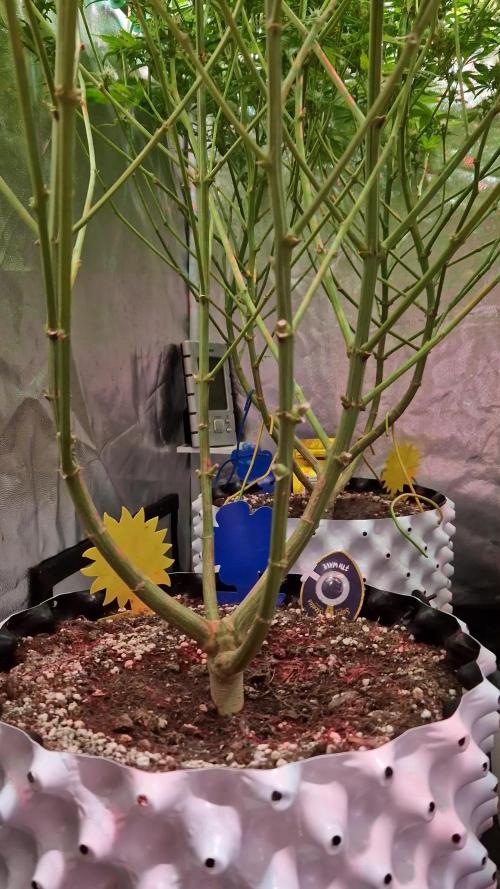
Wird langsam richtig prall und dick die Lady. Obwohl Sie sehr viele Triebe hat, bilden sich echt dicke Buds.


Likes
21
Share


@PeterSage
Follow
wonderfull colours and smell, plant is looking fine, i see another 2/3 weeks from now, for a full development of the buds.
heavy and frequent rain occurring, didn't have to water so much, hope it get better from here to the cut.
i am gonna decrease on the nutrients, to make them disappear in 10-15 days and a have a full week on just pure water.
the quality of the smell is incredible, very sugar-candy like, not so citric.

Likes
1
Share


@pareto
Follow
Clearly got dominated by her pot mate. Looks and smells awesome though.
She got planted about a week after her pot mate. Maybe thats why she got the short end of the stick.
These plants are not mine. I am just documenting them.
--------------------------------------------------------------------------------------------------------------------------------------------------------------------------------
Set up cost (fixed costs)
-Lamp: 40€
-Timer: 3,5€
-Pot: 4€
-Total fixed costs: 47,5€
Given 5 years (or 15 grows) usage time translates to around 3,17€ per grow in materials.
Variable costs:
-Seeds: 13,17€
-Soil: 6€
-Fertilizer: 3,50€
-Power (100 days 18h/day): ~25,92€ (exact figure after harvest)
-Total variable costs: ~48,59€
-Total costs per grow: ~51,76€

Likes
38
Share


@gottagrowsometime
Follow
Was a difficult week, because the plant was at the very back. I got some small % of bud rot. Very small. Buds are very dense. Dripping in trichomes. Colorful, and very stinky. What a beauty.
Likes
6
Share


@Naujas
Follow
shit, the snail got to her, even though I try to protect myself from them with special pellets, out of the 4 girls she chose the biggest one :( ... it's a pity, I let her grow further. she doesn't touch the other girls, this one is probably the tastiest :).
Likes
40
Share

@MadeInGermany
Follow
Info:
Unfortunately, I had to find out that my account is used for fake pages in social media.
I am only active here on growdiaries.
I am not on facebook instagram twitter etc All accounts except this one are fake.
Have fun with the update.
Hey everyone ☺️.
This week she has developed beautifully ☺️.
I have already started training (topping) :-).
Otherwise the tent was cleaned and the humidifier filled up.
Until then, I wish you a lot of fun with the update.
Stay healthy 🙏🏻 and let it grow 👍
You can buy this Strain at :
https://sweetseeds.es/de/cream-caramel/
Type:
Cream Caramel
☝️🏼
Genetics:
Blue Black
x
Maple Leaf Indica
x
White Rhino
👍
Vega lamp:
2 x Todogrow Led
Quantum Board 100 W
💡
Bloom Lamp :
2 x Todogrow Led
Cxb 3590 COB 3500 K 205W
💡💡☝️🏼
Soil :
Bio Bizz Coco
☝️🏼
Fertilizer:
Green House Powder Feeding
☝️🏼🌱
Water:
Osmosis water mixed with normal water (24 hours stale that the chlorine evaporates) to 0.2 EC. Add Cal / Mag to 0.4 Ec Ph with Organic Ph - to 5.8 .
Likes
20
Share


@Santica_Garden
Follow
So this is how things are looking for the ladies at the end of Week 4 of Veg, I have uploaded a video for you guys with all the information, any questions just ask away 👍🏾🔥😎
