Likes
Comments
Share
@Rinna
Follow
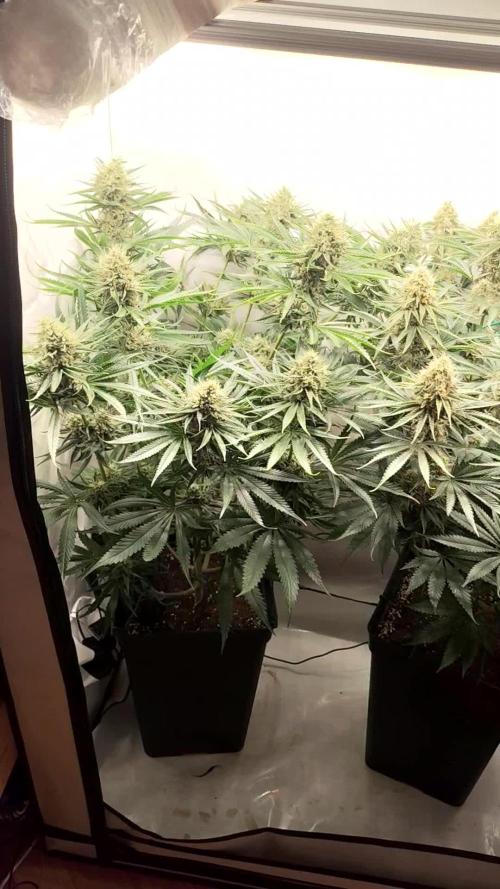
As said before, I'm incredibly happy that I got to harvest a little bit. Never expected her to make it, but she kind off did! The smell was pungent and sweet like an amnesia haze should be, hoping that will be even better after drying and curing!
Processing
Likes
2
Share
Likes
3
Share
Looks promising…she got high levels of moisture from the past days rain…no watering for her this week…her leaves started to curl so I have to get her dry off hopefully no humidity spike.
Likes
5
Share
@Element
Follow
>Sorry for this bad quality video and the absence of photos this last phase of flowering, they are doing great, putting in a lot of weight and still increasing trichome production! About 2 weeks left for harvest
Likes
19
Share
Bueno , este es el segundo cultivo que realizó del la cepa "Waka" , el anterior lo tengo igualmente documentado en otro diario . en esta ocasión cultivamos los clones que habíamos recolectado del cultivo pasado , guardando los fenotipos que nos gustaron más y los clones restantes los pasamos a floración que fueron los que se le hizo seguimiento en este diario. El crecimiento fue bastante explosivo y reaccionaron muy bien a cada trasplante realizado . pude observar que los clones de cada fenotipo seleccionado se desarrolló con mucha similitud al de sus madres . El olor en vegetación es bastante discreto y en floración se pone un más intenso El desarrollo en floración fue explosivo generando bastante resina y se vieron muy hambientras . Al fumar se puede sentir un rico toque cítrico en las N° 4 se siente un fuerte sabor a limón en algunas flores mucho mas marcado que en otras, N° 3 y 13 un agradable toque a naranjas muy rico de sentir en el paladar , La N° 8 con pizcas dulces bastante interesantes. El humo al fumar es muy suave lo que permite sentir mejor el sabor de cada fenotipo.- saludos y buenos humos😉 Al momento de cosechar se cortaron los clone y se dejo secando en oscuridad a temperatura ambiente por cerca de 16 días posterior a eso se pasó a curar en frascos
Likes
141
Share
Ок, начинаем битву двух якодзун 😁 В этот раз я не буду никуда спешить, хочу всё сделать идеально. Присаживайтесь поудобнее, полёт будет долгим. В помещении, где находится бокс, сейчас довольно сухо, поэтому у меня появился увалажнитель воздуха, объема резервуара хватает как раз на сутки. К концу первой недели подсыпал кокос в горшочки - мне не нужны слишком вытянутые растения, и так мне будет легче их доставать при пересадке, которую планирую на следующей неделе. Тогда же и начну давать базовое питание. Пока всё хорошо. Спасибо, что заглянули, и будьте здоровы! 🙏 Продолжение следует ...😶
Likes
1
Share
11/13 Was the last night I kept the dome in the tent, started getting too crowded! But here on 11/15....lol i got bored and wanted to give it some more nutes! 😏 So I made a gallon up of some warm tap water PH'd down to 6.1, 8ml of FoxFarms Big Bloom, 5ml Boomerang, 5ml Wholly Mackerel, and 2ml of Power Si followed up with a very low dosed foliar spray of Xtreme Gardening's CalCarb before it was lights out. 11/17 I did some topping including the main stem. In the video (its off my Instagram story @SoilBGood) there's one that I'm not too happy about, the taller one with the stretched out spacing. But I don't doubt that its gonna give me some dank buds 👊 11/20 The plants are looking sharp....I foliar fed them with some Calmag / Power Si and they blew up over night lol B: Is a shot of the node growth NOTE: I ALWAYS DEFOLIATE EVEN IF I FORGET TO MENTION IT. NOTE NOTE: I swear I smell them already :D
Likes
2
Share
@Aleks555
Follow
Humboldt - Golden Sands And so we begin the grow! We germinated the seed in a damp sponge, and it sprouted within a day. We've planted it in a 100-gram plastic cup, and now we wait for it to start growing. A huge thanks to Humboldt Seed Company Europe for providing us with such amazing genetics. We're excited to see how this beauty develops and are grateful for the opportunity to grow such a top-quality strain!
Likes
4
Share
60x60 cm tent in a 1920's peek-in-closet Oversized vent for silence High power DIY LED True SoG 12/12 from seed with 15 plants in 2L pots Watering all plants in bottom tray with 30% of total pot size (10L) WEEK 1 DAY 1 - Germinated in paper towel DAY 3 - Planted into pots + Lights ON at 125w DAY 5 - All plants have broken soil DAY 7 - Slight stretch - Light at 185w WEEK 2 Two of the Iced Out are lagging behind, others are on point - I'm trying to push light and nutes to the max. Extraction fan (AC infinity Cloudline T6) on level 2. DAY 13 - First full watering (10L) with 20 ml Canna Terra Vega DAY 14 - Circulation fan turned on (low) during lights on WEEK 3 Good growth, two Iced Out still lagging DAY 18 - Light at 225w, Extraction fan on level 3 during lights on DAY 20 - 2nd watering, 8L with 30ml Vega + Light at 250w DAY 21 - On point, mostly :) Could've pushed nutes a bit more from the go
Likes
18
Share
Green light is radiation with wavelengths between 520 and 560 nm and it affects photosynthesis, plant height, and flowering. Plants reflect green light and this is why they appear green to our eyes. As a result, some growers think that plants don’t use green wavelengths, but they actually do! In fact, only around 5 – 10% of green light is reflected from leaves and the rest (90 – 95 %) is absorbed or transmitted to lower leaves [1]. Green wavelengths get used in photosynthesis. Chlorophyll pigments absorb small amounts of green wavelengths. Light that doesn’t get absorbed is transmitted to leaves that are shaded out from direct light. This means that leaves at the bottom of the canopy get more green light than leaves at the top. A high proportion of green wavelengths compared to other colors tells lower leaves that they are being shaded out, so they are able to react accordingly. Lower leaves may react by opening or closing their stomata or growing longer stems that help the leaves reach brighter light [1, 2, 3]. When it comes to growing cannabis, many cultivators are interested in the quality of light used for the flowering stage. In many plants, flowering is regulated by two main photoreceptors: cryptochrome and phytochrome. Both photoreceptors primarily respond to blue light but can also respond to green, although to a lesser extent. Green can accelerate the start of flowering in several species (although cannabis has yet to be tested) [1, 4, 5]. However, once flowering has begun, it’s important to provide plants with a “full spectrum” light that has high amounts of blue and red light, and moderate amounts of green, in order for photosynthesis to be optimized. Green light mediates seed germination in some species. Seeds use green wavelengths to decide whether the environment is good for germination. Shade environments are enriched in green relative to red and blue light, so a plant can tell if it is shady or sunny. A seed that senses a shaded environment may stay dormant to avoid poor growing conditions [1]. Some examples of plant species where researchers have documented this response are: ryegrass (a grass that grows in tufts) and Chondrilla (a plant related to dandelion) [1, 6]. Although green wavelengths generally tell plants NOT to germinate, there are some exceptions! Surprisingly, green wavelengths can stimulate seed germination in some species like Aeschynomene, Tephrosia, Solidago, Cyrtopodium, and Atriplex [1, 6, 7]. Of course, light is not the only factor affecting seed germination – it’s a combination of many factors, such as soil moisture, soil type, temperature, photoperiod, and light quality. When combined with red and blue light, green can really enhance plant growth [1, 8]. However, too much green light (more than 50% of the total light) can actually reduce plant growth [8]. Based on the most current research, the ideal ratio of green, red, and blue light is thought to be around 1:2:1 for green:blue:red [9]. When choosing a horticultural light, choose one that has high amounts of blue and red light and moderate amounts of green and other colors of light. Not many studies can be found about the effect of green light on cannabis growth or metabolism. However, if one reads carefully, there are clues and data available even from the very early papers. Mahlberg and Hemphill (1983) used colored filters in their study to alter the sunlight spectrum and study green light among others. They concluded that the green filter, which makes the environment green by cutting other wavelengths out, reduced the THC concentration significantly compared to the daylight control treatment. It has been demonstrated that green color can reduce secondary metabolite activity with other species as well. For example, the addition of green to a light spectrum decreases anthocyanin concentration in lettuce (Zhang and Folta 2012). If green light only reverses the biosynthesis of some secondary metabolites, then why put green light into a growth spectrum at all? Well, there are a couple of good reasons. One is that green penetrates leaf layers effectively. Conversely red and blue light is almost completely absorbed by the first leaf layer. Green travels through the first, second, and even third layers effectively (Figure 2). Lower leaf layers can utilize green light in photosynthesis and therefore produce yields as well. Even though a green light-specific photoreceptor has not yet been found, it is known that green light has effects independent from the cryptochrome but then again, also cryptochrome-dependent ones, just like blue light. It is known that green light in low light intensity conditions can enhance far red stimulating secondary metabolite production in microgreens and then again, counteracts the production of these compounds in high-intensity light conditions (Kim et al. 2004). In many cases, green light promoted physiological changes in plants that are opposite to the actions of blue light. In the study by Kim et al. blue light-induced anthocyanin accumulation was inhibited by green light. In another study it has been found that blue light promotes stomatal opening whereas green light promotes stomatal closure (Frechilla et al. 2000). Blue light inhibits the early stem elongation in the seedling stage whereas green light promotes it (Folta 2004). Also, blue light results in flowering induction, and green light inhibits it (Banerjee et al., 2007). As you can see, green light works very closely with blue light, and therefore not only the amount of these two wavelengths separately is important but also the ratio (Blue: Green) between these two in the designed spectrum. Furthermore, green light has been found to affect the elongation of petioles and upward leaf reorientation with the model plant Arabidopsis thaliana both of which are a sign of shade avoidance symptoms (Zhang et al. 2011) and also gene expression in the same plant (Dhingra et al. 2006). As mentioned before, green light produces shade avoidance symptoms which are quite intuitive if you consider the natural conditions where the plants grow. Not all the green light is reflected from the highest canopy leaves in nature but a lot of it (50-90%) has been estimated to penetrate the upper leaves at the plant level ((Terashima et al., 2009; Nishio, 2000). For the plant growing in the understory of the forest green light is a signal for the plant of being in the shade of a bigger plant. Then again, the plants growing under unobstructed sunlight can take advantage of the green photons that can more easily penetrate the upper leaves than the red and blue photons. From the photosynthetic pigments in higher plants, chlorophyll is crucial for plant growth. Dissolved chlorophyll and absorb maximally in the red (λ600–700 nm) and blue (λ400–500 nm) regions of the spectrum and not as easily in the green (λ500–600 nm) regions. Up to 80% of all green light is thought to be transmitted through the chloroplast (Terashima et al., 2009) and this allows more green photons to pass deeper into the leaf mesophyll layer than red and blue photons. When the green light is scattered in the vertical leaf profile its journey is lengthened and therefore photons have a higher chance of hitting and being absorbed by chloroplasts on their passage through the leaf to the lower leaves of the plant. Photons of PPFD (photosynthetic photon flux density) are captured by chlorophyll causing an excitation of an electron to enter a higher energy state in which the energy is immediately passed on to the neighboring chlorophyll molecule by resonance transfer or released to the electron transport chain (PSII and PSI). Despite the low extinction coefficient of chlorophyll in the green 500–600 nm region it needs to be noted that the absorbance can be significant if the pigment (chlorophyll) concentration in the leaf is high enough. The research available clearly shows that plants use green wavelengths to promote higher biomass and yield (photosynthetic activity), and that it is a crucial signal for long-term developmental and short-term dynamic acclimation (Blue:Green ratio) to the environment. It should not be dismissed but studied more because it brings more opportunities to control plant gene expression and physiology in plant production. REFERENCES Banerjee R., Schleicher E., Meier S. Viana R. M., Pokorny R., Ahmad M., Bittl R., Batschauer. 2007. The signaling state of Arabidopsis cryptochrome 2 contains flavin semiquinone. The Journal of Biological Chemistry 282, 14916–14922. Dhingra, A., Bies, D. H., Lehner, K. R., and Folta, K. M. 2006. Green light adjusts the plastic transcriptome during early photomorphogenic development. Plant Physiol. 142, 1256-1266. Folta, K. M. 2004. Green light stimulates early stem elongation, antagonizing light-mediated growth inhibition. Plant Physiol. 135, 1407-1416. Frechilla, S., Talbott, L. D., Bogomolmi, R. A., and Zeiger, E. 2000. Reversal of blue light -stimulated stomatal opening by green light. Plant Cell Physiol. 41, 171-176. Kim, H.H., Goins, G. D., Wheeler, R. M., and Sager, J. C. 2004.Green-light supplementation for enhanced lettuce growth under red- and blue-light emitting diodes. HortScience 39, 1617-1622. Nishio, J.N. 2000. Why are higher plants green? Evolution of the higher plant photosynthetic pigment complement. Plant Cell and Environment 23, 539–548. Terashima I., Fujita T., Inoue T., Chow W.S., Oguchi R. 2009. Green light drives leaf photosynthesis more efficiently than red light in strong white light: revisiting the enigmatic question of why leaves are green. Plant & Cell Physiology 50, 684–697. Zhang, T., Maruhnich, S. A., and Folta, K. M. 2011. Green light induces shade avoidance symptoms. Plant Physiol. 157, 1528-156. Wang, Y. & Folta, K. M. Contributions of green light to plant growth and development. Am. J. Bot. 100, 70–78 (2013). Zhang, T. & Folta, K. M. Green light signaling and adaptive response. Plant Signal. Behav. 7, 75–78 (2012). Johkan, M. et al. Blue light-emitting diode light irradiation of seedlings improves seedling quality and growth after transplanting in red leaf lettuce. HortScience 45, 1809–1814 (2010). Kasajima, S., et al. Effect of Light Quality on Developmental Rate of Wheat under Continuous Light at a Constant Temperature. Plant Prod. Sci. 10, 286–291 (2007). Banerjee, R. et al. The signaling state of Arabidopsis cryptochrome 2 contains flavin semiquinone. J. Biol. Chem. 282, 14916–14922 (2007). Goggin, D. E. & Steadman, K. J. Blue and green are frequently seen: responses of seeds to short- and mid-wavelength light. Seed Sci. Res. 22, 27–35 (2012). Mandák, B. & Pyšek, P. The effects of light quality, nitrate concentration and presence of bracteoles on germination of different fruit types in the heterocarpous Atriplex sagittata. J. Ecol. 89, 149–158 (2001). Darko, E. et al. Photosynthesis under artificial light: the shift in primary and secondary metabolism. Philos. Trans. R. Soc. B Biol. Sci. 369 (2014). Lu, N. et al. Effects of Supplemental Lighting with Light-Emitting Diodes (LEDs) on Tomato Yield and Quality of Single-Truss Tomato Plants Grown at High Planting Density. Environ. Control Biol. 50, 63–74 (2012).
Likes
36
Share
Info: Unfortunately, I had to find out that my account is used for fake pages in social media. I am only active here on growdiaries. I am not on facebook instagram twitter etc All accounts except this one are fake. Flowering day 22 since the time was changed to 12/12 h. Hi everyone :-) . This week she has had extreme growth :-). In the next 5-10 days she gets 1 g GHSC Powder Feeding to 1 l coco. It is poured every 2 days with 1.2 l per pouring. Otherwise everything was cleaned and refilled. Have fun with the update stay healthy . You can buy this Strain at https://www.barneysfarm.com/blue-cheese-34 Type: Blue Cheese ☝️🏼 Genetics: Blueberry X Original Cheese 👍 Vega lamp: 2 x Todogrow Led Quantum Board 100 W 💡 Bloom Lamp : 2 x Todogrow Led Cxb 3590 COB 3500 K 205W 💡💡☝️🏼 Soil : Bio Bizz Coco ☝️🏼 Fertilizer: Green House Powder Feeding ☝️🏼🌱 Water: Osmosis water mixed with normal water (24 hours stale that the chlorine evaporates) to 0.2 EC. Add Cal / Mag to 0.4 Ec Ph with Organic Ph - to 5.5 - 5.8
Likes
4
Share
@Erich2025
Follow
The smell that comes out of the tent is absolutely insane. The buds are starting to swell and you can absolutely see the difference every day. I do feeding- feeding- watering. They seem to like it and responded well to the nutrients. The 2 bigger plants also started to be purple. They are beautiful. 🌴🍪⛽️🌲🍊
Likes
15
Share
This girl has been one of my favorites. Pineapple express is true to it name looking like a pineapple once it fades the yellow, and the green are very beautiful together smells gassy with pineapple busting out of every tone
Likes
18
Share
Eccola!!! La rossa pianta bellissima da odore favoloso ti fa venire l’acquolina in bocca. Sicuramente la riproporrò in quanto davvero è fantastica come genetica!! Grazie a tutti per il supporto e a @Sweet_Seeds per la collaborazione ❤️🔥🌲
Likes
Comments
Share
La planta que se quebró ya está terminando de soldar y parece que entrará a floración antes que las demás. - Luz: Bestva Pro 1000W / 18 h/d -FloraNova Grow G.Hydroponics: 0.6ml/l - Armour SI G. Hydroponics 0.4ml/ - Rhizotonic Canna : 4 ml/l - Everest: 0.5 ml/l Control biológico: -Solution (bioinsecticida generalista: Beauveria, Metarhizium, Lecanicillium y Cladosporium + esencia de ajo y chile). -Acaridox (bioacaricida: Metarhizium e Hirsutella + esencia de canela) - Scamin (control escama y cochinilla) Cladosporium Herbarum - Diatomea
Likes
15
Share
We have made it to day 42! 31/12/20 All the girls have started flowering now! I'm super keen to see them start to thicken up. Feeding as usual, nothings changed. Update - day 46 04/01/21 I'm a little concerned about the 2 runts that were laggin behind the rest, all of a sudden theyve decided they want to take up most of the room in the tent. I've never grown autos so big.. I was contemplating putting the runts outside but it's just going to make more problems as my outdoors are under attack from some kind of bug. I will keep the diary updated on the runts, other than that the other girls are doing just great, flowering is really coming along. Thanks for stopping by!
Likes
7
Share
Weeks 15 - It’s Ready - The 1st Gorilla Glue Is Ready To Be Havrest, I Gave It 3 Weeks Of Flushing And The Trichomes Of The Top Heads Are Most Cloudy With A Few Clear And A Little Amber Trichomes And The Bottom Buds Are Mostly Cloudy With A Few Clear And The Sceny Is Still At It’s Peak But You could Tell It Was About To Head Over The Morning And Start To Take A Downright Spiral I Will Be Hanging It To Dry For 7-9 Days At A Temperature Of 70 Degrees and 60% Humidity. The Slower It Dries The Better.