


Likes
Comments
Share


@Sativ_420
Follow
Tuvieron dos dias de lluvia intensa y para prevenir plagas le hice una buena poda. Hasta el momento vienen creciendo sin carencias.

Likes
15
Share


@Chubbs
Follow
420Fastbuds
FBT2313/Week 6
What up growmies. Weekly update on these beautiful ladies. This week we've had some temperature swings and wow did they not like getting down into the high 50's. They both bounced back but won't be letting it get that cold again if I can help. Flower sites are all over with pistols. No signs of any major issues so will keep the same routine. All in all Happy Growing


Likes
76
Share


@BB_UK
Follow
Took a while to get there but OMG little note quick! So I started her in a 1 litre pot and stuck her on top of a 1.5L Pepsi bottle with the top chopped off! And she yielded heavily for that amount of soil a whopping! 224.63 wet weight so can’t wait to see what she holds dry because them buds were like boulders! So dense! I will be back to document her dry weight and then a couple of weeks later with the update on the smoke report! But I know it’s going to be so loud! She has deep pungent aromas like gassy and sweet! She’s going to be a powerhouse! She was a little over as today a banana developed but that just tells me “well done” timing just right! She’s a little long for my taste of auto but I do suggest anyone grow her she’s amazing! In the end!


Likes
29
Share


@Smokwiri
Follow
Almost finished, flushing
10% discount on Zamnesia seeds with code GROWITGD

Likes
143
Share


@Roberts
Follow
Number 7 is smelling great and has 1 more week of flush left before it is harvested. Starting to show signs on leaves as plant is using stored energy. Thanks again fast buds.
Thank you grow diaries community for the likes,follows, and subscriptions on my YouTube. 🌱🤜🤛

Likes
18
Share


@MeaRea
Follow
Heidi is fine. She grew 4cm the last few days and is now taller than Simone, her elder cousine. Though she germinated days after Susi, she is about twice as big her her.
Processing
Likes
3
Share


@Kushizlez
Follow
Day 33-40 (May 24th-May 31st)
(Day 34) I just found a herm branch on the tight blueberry pheno. It looks like a random pollen sack opened right above a lower branch. I removed the sack but I saw a small amount of dust fall onto one of the lower branches. I’m going to leave it to see if it will pollinate that small branch at all. I spent a good 5 minutes looking closely for bananas or claws but couldn’t find anymore. The main bud is clearly unaffected so I will just leave it unless it is visibly seeding itself. Too bad because I’m really excited for this plant.
(Day 36) Not a lot has happened since I flushed them. Growth actually looks healthy and I don’t see any deficiencies on anything yet.
(Day 37) Both of these badazz cheese phenos are picture perfect and easily hold up against Canadian and California quad grade. I might try to reveg them at the end and take some clones. They have this unique pungent, grassy, sour milk smell that is just wonderful. The density and bud structure is looking great too. This whole plant will probably take 3 minutes to trim if that.
(Day 38) Just found a banana on the shitty blueberry pheno. This pheno is trash and I would honestly throw it away if it didn’t mess up the 3 perfect rows. It has almost no frost, no smell, is airy and has bad structure. I’ve actually never seen a plant with such little frost. Even outdoors.
(Day 39) I think most of this tent will be done by day 60 but I will probably ride it out until day 70+. I don’t think the blueberries or the jacks will fill out very much either way but taking it too day 70 will ensure maximum production from each plant.


Likes
10
Share


@BelgianBudtender
Follow
Hey Farmers.
Another successful harvest! Let's start off with the weigh in.
This time around we got 207 grams of bud, none of which I would qualify as top shelf.
We also got 47 grams worth of larf, which is a lot, and lastly we have 22 grams of frosty trim.
I will be more specific about the taste and feel of the plant in the smoke comment below.
I dried her in cardboard boxes, the total dry time ended up taking 10 days.
I got a very nice rootball, especially when compared to my early days. I'm using Calcium hypochlorite to combat pythium growth in my growbucket, as well as providing free chlorine for the plant to uptake. It's a very cheap and effective way to run a "Sterile" DWC run, although you have to be very careful when handling and dosing, if you want to know how I calculate my dose, check below. It's a great and cheap alternative to UC Roots.
for Calcium Hypochlorite I use HTH Pool shock, its 67% Chlorine, don't just buy HTH pool shock, as its contents vary by country, try and buy pure Calcium Hypochlorite with 70% chlorine from an online Lab supply store, its dirt cheap and 1 KG will last you a lifetime for less than 40 bucks,
i aim for 2ppm of free Chlorine in my reservoir, this will slow down growth of bacteria, and is still relatively low in dose so our root hairs don't take too much damage.
ALWAYS Check the chlorine of your Calcium Hypochlorite, Mines 67%
the following is the calculations I use, feel free to adjust the formulas to your needs:
2 ppm chlorine from 67% strength Calcium Hypochlorite and I want to fill an empty 2 litre bottle with 0.5% Chlorine which will serve as my stock solution
(2000x0,5) / 67 = 14,9
14,9 grams of 67% strength Calcium Hypochlorite to get a 2L Chlorine bottle with 0.5% strength
!! Be careful with this Stock bottle. 0.5% Doesn't sound like a lot, but it is HIGHLY corrosive and will give you chemical burns !!
I then want to turn that stock bottle with 5000mg Chlorine per litre into 2mg/litre which is 2 ppm.. (There are 1,000,000 milligrams (mg) in 1 litre (L))
(0,0002x1000) / 0,5 = 0.4
which is 0.4, so 0.4 ml of the stock solution per litre of water then gets me 2mg/l total chlorine in my plant buckets
note that I don't use this in late flower once I start feeding Green sensation. mainly because Green sensation is 80% bio and I'm not sure how well the two would work together and at this point, roots no longer grow anyway and pythium is unlikely if you're a little smart in the final weeks

Likes
20
Share


@Alpha_Green
Follow
@ the beginning of week 8:
As usual, I alternate Biotab's fermented compost tea in the generative phase, alternating weekly with Bio PK Booster and regular Cannazymes to clean up the gears of my ladies again and again... 😁
Likes
1
Share


@Ninjabuds
Follow
Little Soaptini is hanging in there. It's definitely not the biggest plant in the bunch, but there's something so cute about it. The leaves have this adorable little curve to them, almost like tiny martini glasses. I'm excited to see how this underdog develops.
Last week was awesome! I finally got around to giving all my plants a little upgrade – I repotted them into some bigger homes. They're all looking so happy and healthy now, it's crazy. I can't wait to see how much they grow this year!

Likes
27
Share


@RDWCGrowing
Follow
6/13/2023
Week 10- Day 1 of Flower (Day 131 overall) (Day 70 of Flower)
Auto Pilot Day 6.. Checked the Trichomes and the bud density and both are looking good.. Definitely needs a little more time for the Trichomes to be where I like, so based on my check I think we are still looking right around the end of the competition 22June to be done and ready for harvest. I do like that the fade is coming in the leaves nicely, so my chart I think is dropping off the Nitrogen exactly like it is supposed to.
6/14/2023
Week 10- Day 2 of Flower (Day 132 overall)
Auto Pilot Day 7.. Decided I would take some contrasting pics today with my light up to 100 and my light all the way on Dim. I hope you enjoy the pics.
6/15/2023
Week 10- Day 3 of Flower (Day 133 overall)
Auto Pilot Day 8.. Decided to take a look at the Trichome's today and Check to see where they are at and honestly if I might ho ahead and start my flush tomorrow and harvest on Sunday.
6/16/2023
Week 10- Day 4 of Flower (Day 134 overall) (Day 74 of Flower)
Today I pulled an Armageddon however instead of darkness they are going to get 48 hours of light. The reason why they are going to get light instead of dark is when I was taking out the netting a lot of the buds were so heavy they fell over and exposed some areas I really want to get some light to... so 48 hours of light at 40% while I watch what should be a beautiful final fade as the plant eats up the last Nutes. If anything goes wrong I can abort take the photos and cut so will pay really close attention to how it is looking over the next 48 hours.
Added 30 Gallons of PH only Water.
Reduced Lighting to 40% removed program time off. 48 hours of light.
6/17/2023
Week 10- Day 5 of Flower (Day 135 overall) (Day 75 of Flower)
I had someone tell me that a few growers had done as I did and Gone Armageddon on the plants. Filling it with PH only and said the plants did not respond well and they were taken out of the comp at the very end because they felt like the pictures just wouldn't come out right. Even though I did go Armageddon, The PPM is at 353PPM with the residue of what was left in the buckets after draining as well as what I am getting from the TAP so I think they are doing good but I am checking them every few hours to see how they seem to be doing and I think they are doing good still and are on track.
I also started prepping the area for the pics tomorrow
T-24 Hours until Chop
6/18/2023
Week 10- Day 6 of Flower (Day 136 overall) (Day 76 of Flower) (Harvest Day)
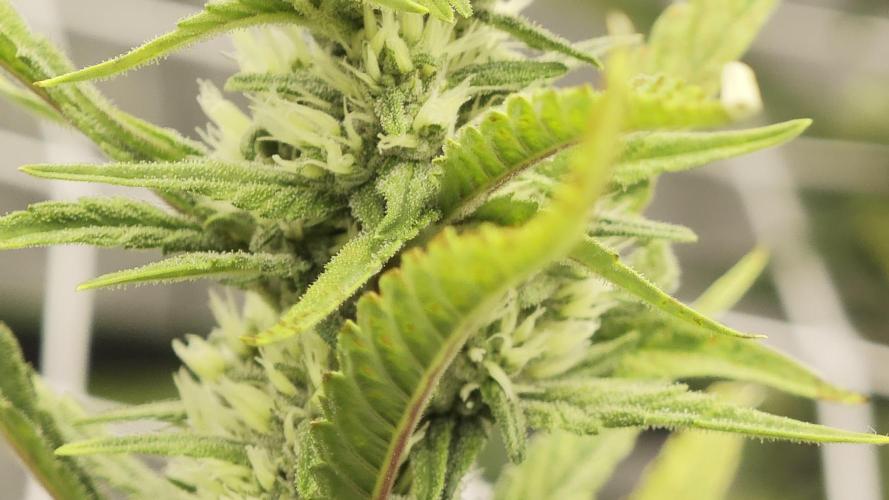
What a day.. what a day.. what a day.. as I was setting up and trying to figure out how I was going to get my pics #3 stems started breaking, it fell over and other stems broke.. So no really stunning competition photo for her, she had such a nice purple fade.. #2 stayed up in the Tent so that is the one I had to go with to submit for the contest. I wet trimmed them as they went into the tent and they took up three rows hanging in tent. I also decided I wanted to try some so I put a little in the freeze dryer for a 48 hour smoke test.. I will weigh it and add that to my total weight for the plants when it is all done.



Likes
2
Share


@TheSurfBud
Follow
Ganja Farmer Seeds
Caramel Auto
In @highpoweredorganics new ISLAND-BLEND.
Fed water soluble powders.
AQUA-MARINE Grow Formula 5.1.4 paired with OCEAN-POTION and RHIZO-MOJO in dechlorinated water.
Alternating ANTI-MATTER & DARK-MATTER feds weekly.
Foliar fed GREEN-SUPREME daily
Following High Powered Organics Island-Blend Feed Guide.
https://www.highpoweredorganics.com/
Happy growing friends 🇦🇺🇦🇺🇦🇺

Likes
121
Share


@NuggetPawn
Follow
So they’re still stretching, I thought they were slowing down a couple days ago, but then I walked in today and realised shit, they’re still going, must have grown another 3 inches since yesterday.
They have almost filled out the whole 6x4ft space, a little space by the door and in the corners, the floor is looking well shaded which I am happy about, as that means I am not wasting too many photons.
I have an maybe another 10/15cm of spare vertical capacity before I’m going to have to start some emergency super-cropping. Starting to get a little anxious
I still haven’t changed out the reservoir from 16 days ago, although my top ups have been the same composition as noted above. I think I will drain her out tomorrow which has a drastically lower ratio of nitrogen. I have to say, this Botanicare range is incredibly stable and forgiving once you get past mid veg.
As for the genetics, she knows how to grow without little fuss. Maybe I have been very lucky, time will tell once I finish my next grow with a different strain. The plant at the back of the room is a little squat compared to the other two but maybe she will catch up.
Waffled on a bit here, thanks for stopping by, have fun all!

Likes
45
Share


@KrautFabrik
Follow
Day 46: nutrients like plan
Pictures are taken on day 47
---------------------------------------------
I really love the way she's growing, defenitly one of the best strains 💪🍌
Happy growing 🍌🌱
Likes
179
Share


@StarLorr
Follow
Welcome to my Øpium diary.
In this diary:
Seeds: sponsored by Ðivine Șeeds
Media: Promix HP
Nutrients: Advanced Nutrients, Diablo Nutrients, Gaia Green Power Bloom.
Light and Weather: Şun☀️and Mother Earth.🌎
___________________________
Feeding:
Mon 26Aug: 4L water not pH'd
Tue 27Aug: 4L water not pH'd
Wed 28Aug: 4L water not pH'd
Thu 29Aug: 4L supplements Monster Blaster, Flower, K. Not pH'd
Fri 30Aug: 4L water not pH'd
Sat 31 Aug: Rain Showers🌧️
Sun 01Sep: 4L nutrients pH'd 6.5 with a micro tropical storm mid afternoon😬
___________________________
*please note that most watering are from top now since topping with Gaia Green Power Bloom*...... and since i smashed the saucers with the weed wacker🤦🏻♂️
______________________________
Øpi is "still"on autopilot. We had a warm humid week but Sunday's micro storm⛈️brought us cooler temperatures as today (sept 2nd)we maxed out a 17°C and this morning we had 12°C.
______________________________
Started using Diablo Nutrients's supplements for the blooming phase.
Monster Blaster, Monster Flower and Monster K.... for good mesures😉
______________________________
Thanks for stopping by, likes and comments are appreciated!👊🏻😎
Keep on growin!
Keep on tokin!!!
😙💨💨💨💨💨
Likes
7
Share


@Andres
Follow
she grows healthy ... and her flowering begins ... she is small because I change her very late to a bigger pot ... I hope she delivers something
Likes
19
Share


@Alice_in_Wonderland
Follow
Ladies are smelling strong and ready to be harvested. Chopping Venezia to be hung out to be dried tonight. Cheech can still go another day or two under the light with the lower pistols still a little blush.