Check the winners The Grow Awards 2026 🏆
Likes
Comments
Share
Likes
18
Share
A los 21 dias se realizó transplante definitivo a maceta de 7 litros a las 25 plantas,ya todo el cultivo mas homogéneo va tomando mas fuerza y mejor forma.
Likes
10
Share
MIMOSA ZKITTLEZ FF / GANJA FARMER WEEK #13 OVERALL Week #3 FLOWER This week she's done stretching just in time she's almost touching the light. She's starting to fill in and get some weight to her buds additionally you can see the trichomes starting to form on her buds! She's absolutely starting to smell good also! Stay Growing!! Thank you for stopping by and taking a look it's much appreciated!! THANK YOU GANJA FARMER!! BUDTRAINER.COM BUD CLIPS MIMOSA ZKITTLEZ FF / GANJA FARMER
Likes
38
Share
@F42: Watered today and everything is looking good, plants were super thirsty and the pots are feeling much heavier again. Looks good so far, think that the buds are gonna chunk up a lot these next few weeks. Very excited about the quickly approaching bulk. Continue to bend the larger fan leaves to the sides to help the lower buds get light. Update @F46: Getting very aromatic in the tent, nugs are looking super frosty and my hands get really sticky after touching them. Soil is still damp, but the pots weight is getting a bit lighter again. 3 more days till the next watering. Update@ F48- Week 6 of flower is done and has it ever been a good one, the plants are doing so much better than I ever could have imagined for my first grow. Starting to research the best time to start my flush. Was planning on harvesting around mid february, so that means I have just three weeks to go before they get chopped and hung to dry for a week.
Likes
15
Share
We broke big cola on central plant and cried a lot. Also we continued partial defoliation time to time. It should be noted that plants began to drink much more, we watered them every three days, but in five to six litres per watering. Girls showed their gender. Next week we expect all plants to bloom, otherwise we'll have to change the light mode.
Likes
28
Share
[First time on this diary? => Read "GERMINATION" tab to understand what I'm doing ] 03/01/2022 - Day 91 - First day of the 15th week. Yoooo, anyone here? We back after one month of silence! Yes, she's still alive, very slowly but she's fighting cold and doing her stuff 🔥 Happy new year everyone! Wish me good luck and let's hope in sunny mild days 🤞☀️ - DD
Likes
10
Share
Likes
26
Share
Notfallprotokolle treten in Kraft. Grund? Gelato 41fast UNKONTROLLIERTE GEWALT. Obwohl ich sie einige male sehr zärtlich dazu überredet habe (ok, es knackte einige male) in andere wuchs richtung zu wachsen, nimmt sie ¾ des grow room an platz ein. Und, das ist keine Beschwerde. Sieht von oben fast aus wie ein sea of green (zufall). Und überall, diese watte Bällchen. Ich bin entzückt! Update. Es wird wasser mit Wasser gegossen, welches ich aus einiger Entfernung per Hand aus einem wasserlauf hole.. 😛 Die Phylaxien der Gelato 41 fast sind anders. Heftig. Sind superdick lang und schnell wieder braun. Bud Körper bilden sich und sind hart. Und das überall. Ok tiefer gleich kleiner. Am 001.009.021 wird sie 71 tage alt. 35 in Blüte. And, what the phylaxien! I mean they re unnormal. Never seen phylaxien growing so massive (i mean pls look at one phylaxie., i think theyre big,) and then as FAST they go brown. Boah difficult to explain. I checked the soil. Wet enough. Looking my Gelato 41 FAST. She is everywhere healthy. I read this is a monster genetic But to see, how it grows! This strain is (so far) different from all the others i made with before. First its a photo. (accidently because I'm a idiot) Than 2 weeks untrained growing. Than not vey lovefull i showed her her new grow direction. And the smell. Of Gelato 41 fast is.. The smell of Gelato, 41 fast. Heavy smell on your fingers from everywhere. Steam, sheet,,, buds are becoming sticky. I mean i smell vanilla schololade. My Next noise means she smells like an gelateria. And YES! SHE IS! FAST! GREAT! WORK(till now).👍🏻 👊 I tried to make some defoliation... You wont see on the photos. Just 3 leaves and 8 little buds somewhere i found. O8. Oo9. I cut off 2 side branches. I knewed it before that they will take only energy from the GELATO 41 FAST. But holy mother earth, she got enough of this.POWER! And its me a little ankward, because im the only one till now, who got an growdiary of this FABULOS HEAVY SWEET SMELLING STRAIN! And., the BREEDER SEEDSTOCKER, himself is watching this GROWDIARIE!!! And holy mother earth... Im so a noob. First I thought it was business, advertising. The contact, i mean. Than, after i joined the original website of SEEDSTOCKERS, and i read what i really bought! THE PENNY FALLS.. Its the FLAGSHIP.! ( . So im the advertising? Oh je oh je. I do my best, but remember, please, (and because of some little mistakes i did) . . . OK OK ok ok, big mistakes! It is not the yield another grower can go for it, what i expect i will harvest. But HiGHEST Quality! This is what i expect. And dont get me wrong, I build an joint of some fast dried micro buds. Brought to a friend. After the third time Jonny goes out(because after one or two breathes he forgotten jolly Rogers). He Realized it. "Hey i hold the joint now all the time (15 min). Why don't you say a word?" "I knewed it. But i just smiled. Looking about how long it takes till you notice it!" He thought a few seconds "Longer"… Both began to laugh. So the quality i try will be heaven! DID YOU REMEMBER THE SEED WHEN I FELL IN LOVE? SMARAGDGREEN. 10.09 Everday you can see the buds go with more flesh. And sticky as nothing i had before. Smelly? Yes. It is! It seems that i had an Sativa dominant phenotype Like the leaves form. (and from some fresh harvested i smoked, with 75 % milky trychomes, and the rest clear... 😛 Heavy uplifting, motivated you start to do something! As you start to moving you discover that you re really stoned). And my 0.36 m² tent is from the GELATO 41 FASTer as i never seen any Cannabis so quick blooming, sticky everywhere. ABNORMAL! in a great way. And i think, soo small arent they. Or?
Likes
25
Share
ANTHOCYANIN production is primarily controlled by the Cryptochrome (CR1) Photoreceptor ( !! UV and Blue Spectrums are primary drivers in the production of the pigment that replaces chlorophyll, isn't that awesome! 1. Diverse photoreceptors in plants Many civilizations, including the sun god of ancient Egypt, thought that the blessings of sunlight were the source of life. In fact, the survival of all life, including humans, is supported by the photosynthesis of plants that capture solar energy. Plants that perform photosynthesis have no means of transportation except for some algae. Therefore, it is necessary to monitor various changes in the external environment and respond appropriately to the place to survive. Among various environmental information, light is especially important information for plants that perform photosynthesis. In the process of evolution, plants acquired phytochrome, which mainly receives light in the red light region, and multiple blue light receptors, including his hytropin and phototropin, in order to sense the light environment. .. In addition to these, an ultraviolet light receptor named UVR8 was recently discovered. The latest image of the molecular structure and function of these various plant photoreceptors (Fig. 1), focusing on phytochrome and phototropin. Figure 1 Ultraviolet-visible absorption spectra of phytochrome, cryptochrome, phototropin, and UVR8. The dashed line represents each bioactive absorption spectrum. 2. Phytochrome; red-far red photoreversible molecular switch What is phytochrome? Phytochrome is a photochromic photoreceptor, and has two absorption types, a red light absorption type Pr (absorption maximum wavelength of about 665 nm) and a far-red light absorption type Pfr (730 nm). Reversible light conversion between the two by red light and far-red light, respectively(Fig. 1A, solid line and broken line). In general, Pfr is the active form that causes a physiological response. With some exceptions, phytochrome can be said to function as a photoreversible molecular switch. The background of the discovery is as follows. There are some types of plants that require light for germination (light seed germination). From that study, it was found that germination was induced by red light, the effect was inhibited by subsequent far-red light irradiation, and this could be repeated, and the existence of photoreceptors that reversibly photoconvert was predicted. In 1959, its existence was confirmed by the absorption spectrum measurement of the yellow sprout tissue, and it was named phytochrome. Why does the plant have a sensor to distinguish between such red light and far-red light? There is no big difference between the red and far-red light regions in the open-field spectrum of sunlight, but the proportion of red light is greatly reduced due to the absorption of chloroplasts in the shade of plants. Similar changes in light quality occur in the evening sunlight. Plants perceive this difference in light quality as the ratio of Pr and Pfr, recognize the light environment, and respond to it. Subsequent studies have revealed that it is responsible for various photomorphogenic reactions such as photoperiodic flowering induction, shade repellent, and deyellowing (greening). Furthermore, with the introduction of the model plant Arabidopsis thaliana (At) and the development of molecular biological analysis methods, research has progressed dramatically, and his five types of phytochromes (phyA-E) are present in Arabidopsis thaliana. all right. With the progress of the genome project, Fi’s tochrome-like photoreceptors were found in cyanobacteria, a photosynthetic prokaryotes other than plants. Furthermore, in non-photosynthetic bacteria, a homologue molecule called bacteriophytochrome photoreceptor (BphP) was found in Pseudomonas aeruginosa (Pa) and radiation-resistant bacteria (Deinococcus radiodurans, Dr). Domain structure of phytochrome molecule Phytochrome molecule can be roughly divided into N-terminal side and C-terminal side region. PAS (Per / Arndt / Sim: blue), GAF (cGMP phosphodiesterase / adenylyl cyclase / FhlA: green), PHY (phyto-chrome: purple) 3 in the N-terminal region of plant phytochrome (Fig. 2A) There are two domains and an N-terminal extension region (NTE: dark blue), and phytochromobilin (PΦB), which is one of the ring-opening tetrapyrroles, is thioether-bonded to the system stored in GAF as a chromophore. ing. PAS is a domain involved in the interaction between signal transduction-related proteins, and PHY is a phytochrome-specific domain. There are two PASs and her histidine kinase-related (HKR) domain (red) in the C-terminal region, but the histidine essential for kinase activity is not conserved. 3. Phototropin; photosynthetic efficiency optimized blue light receptor What is phototropin? Charles Darwin, who is famous for his theory of evolution, wrote in his book “The power of move-ment in plants” published in 1882 that plants bend toward blue light. Approximately 100 years later, the protein nph1 (nonphoto-tropic hypocotyl 1) encoded by one of the causative genes of Arabidopsis mutants causing phototropic abnormalities was identified as a blue photoreceptor. Later, another isotype npl1 was found and renamed phototropin 1 (phot1) and 2 (phot2), respectively. In addition to phototropism, phototropin is damaged by chloroplast photolocalization (chloroplasts move through the epidermal cells of the leaves and gather on the cell surface under appropriate light intensity for photosynthesis. As a photoreceptor for reactions such as escaping to the side of cells under dangerous strong light) and stomata (reactions that open stomata to optimize the uptake of carbon dioxide, which is the rate-determining process of photosynthetic reactions). It became clear that it worked. In this way, phototropin can be said to be a blue light receptor responsible for optimizing photosynthetic efficiency. Domain structure and LOV photoreaction of phototropin molecule Phototropin molecule has two photoreceptive domains (LOV1 and LOV2) called LOV (Light-Oxygen-Voltage sensing) on the N-terminal side, and serine / on the C-terminal side. It is a protein kinase that forms threonine kinase (STK) (Fig. 4Aa) and whose activity is regulated by light. LOV is one molecule as a chromophore, he binds FMN (flavin mononucleotide) non-covalently. The LOV forms an α/βfold, and the FMN is located on a β-sheet consisting of five antiparallel β-strands (Fig. 4B). The FMN in the ground state LOV shows the absorption spectrum of a typical oxidized flavin protein with a triplet oscillation structure and an absorption maximum wavelength of 450 nm, and is called D450 (Fig. 1C and Fig. 4E). After being excited to the singlet excited state by blue light, the FMN shifts to the triplet excited state (L660t *) due to intersystem crossing, and then the C4 (Fig. 4C) of the isoaroxazine ring of the FMN is conserved in the vicinity. It forms a transient accretionary prism with the tain (red part in Fig. 4B Eα) (S390I). When this cysteine is replaced with alanine (C / A substitution), the addition reaction does not occur. The effect of adduct formation propagates to the protein moiety, causing kinase activation (S390II). After that, the formed cysteine-flavin adduct spontaneously dissociates and returns to the original D450 (Fig. 4E, dark regression reaction). Phototropin kinase activity control mechanism by LOV2 Why does phototropin have two LOVs? Atphot1 was found as a protein that is rapidly autophosphorylated when irradiated with blue light. The effect of the above C / A substitution on this self-phosphorylation reaction and phototropism was investigated, and LOV2 is the main photomolecular switch in both self-phosphorylation and phototropism. It turns out that it functions as. After that, from experiments using artificial substrates, STK has a constitutive activity, LOV2 functions as an inhibitory domain of this activity, and the inhibition is eliminated by photoreaction, while LOV1 is kinase light. It was shown to modify the photosensitivity of the activation reaction. In addition to this, LOV1 was found to act as a dimerization site from the crystal structure and his SAXS. What kind of molecular mechanism does LOV2 use to photoregulate kinase activity? The following two modules play important roles in this intramolecular signal transduction. Figure 4 (A) Domain structure of LOV photoreceptors. a: Phototropin b: Neochrome c: FKF1 family protein d: Aureochrome (B) Crystal structure of auto barley phot1 LOV2. (C) Structure of FMN isoaroxazine ring. (D) Schematic diagram of the functional domain and module of Arabidopsis thaliana phot1. L, A’α, and Jα represent linker, A’α helix, and Jα helix, respectively. (E) LOV photoreaction. (F) Molecular structure model (mesh) of the LOV2-STK sample (black line) containing A’α of phot2 obtained based on SAXS under dark (top) and under bright (bottom). The yellow, red, and green space-filled models represent the crystal structures of LOV2-Jα, protein kinase A N-lobe, and C-robe, respectively, and black represents FMN. See the text for details. 1) Jα. LOV2 C of oat phot1-to α immediately after the terminus Rix (Jα) is present (Fig. 4D), which interacts with the β-sheet (Fig. 4B) that forms the FMN-bound scaffold of LOV2 in the dark, but unfolds and dissociates from the β-sheet with photoreaction. It was shown by NMR that it does. According to the crystal structure of LOV2-Jα, this Jα is located on the back surface of the β sheet and mainly has a hydrophobic interaction. The formation of S390II causes twisting of the isoaroxazine ring and protonation of N5 (Fig. 4C). As a result, the glutamine side chain present on his Iβ strand (Fig. 4B) in the β-sheet rotates to form a hydrogen bond with this protonated N5. Jα interacts with this his Iβ strand, and these changes are thought to cause the unfold-ing of Jα and dissociation from the β-sheet described above. Experiments such as amino acid substitution of Iβ strands revealed that kinases exhibit constitutive activity when this interaction is eliminated, and that Jα plays an important role in photoactivation of kinases. 2) A’α / Aβ gap. Recently, several results have been reported showing the involvement of amino acids near the A’α helix (Fig. 4D) located upstream of the N-terminal of LOV2 in kinase photoactivation. Therefore, he investigated the role of this A’α and its neighboring amino acids in kinase photoactivation, photoreaction, and Jα structural change for Atphot1. The LOV2-STK polypeptide (Fig. 4D, underlined in black) was used as a photocontrollable kinase for kinase activity analysis. As a result, it was found that the photoactivation of the kinase was abolished when amino acid substitution was introduced into the A’α / Aβ gap between A’α and Aβ of the LOV2 core. Interestingly, he had no effect on the structural changes in Jα examined on the peptide map due to the photoreaction of LOV2 or trypsin degradation. Therefore, the A’α / Aβ gap is considered to play an important role in intramolecular signal transduction after Jα. Structural changes detected by SAXS Structural changes of Jα have been detected by various biophysical methods other than NMR, but structural information on samples including up to STK is reported only by his results to his SAXS. Not. The SAXS measurement of the Atphot2 LOV2-STK polypeptide showed that the radius of inertia increased from 32.4 Å to 34.8 Å, and the molecular model (Fig. 4F) obtained by the ab initio modeling software GASBOR is that of LOV2 and STK. It was shown that the N lobes and C lobes lined up in tandem, and the relative position of LOV2 with respect to STK shifted by about 13 Å under light irradiation. The difference in the molecular model between the two is considered to reflect the structural changes that occur in the Jα and A’α / Aβ gaps mentioned above. Two phototropins with different photosensitivity In the phototropic reaction of Arabidopsis Arabidopsis, Arabidopsis responds to a very wide range of light intensities from 10–4 to 102 μmol photon / sec / m2. At that time, phot1 functions as an optical sensor in a wide range from low light to strong light, while phot2 reacts with light stronger than 1 μmol photon / sec / m2. What is the origin of these differences? As is well known, animal photoreceptors have a high photosensitivity due to the abundance of rhodopsin and the presence of biochemical amplification mechanisms. The exact abundance of phot1 and phot2 in vivo is unknown, but interesting results have been obtained in terms of amplification. The light intensity dependence of the photoactivation of the LOV2-STK polypeptide used in the above kinase analysis was investigated. It was found that phot1 was about 10 times more photosensitive than phot2. On the other hand, when the photochemical reactions of both were examined, it was found that the rate of the dark return reaction of phot1 was about 10 times slower than that of phot2. This result indicates that the longer the lifetime of S390II, which is in the kinase-activated state, the higher the photosensitivity of kinase activation. This correlation was further confirmed by extending the lifespan of her S390II with amino acid substitutions. This alone cannot explain the widespread differences in photosensitivity between phot1 and phot2, but it may explain some of them. Furthermore, it is necessary to investigate in detail protein modifications such as phosphorylation and the effects of phot interacting factors on photosensitivity. Other LOV photoreceptors Among fern plants and green algae, phytochrome ɾphotosensory module (PSM) on the N-terminal side and chimera photoreceptor with full-length phototropin on the C-terminal side, neochrome (Fig. There are types with 4Ab). It has been reported that some neochromes play a role in chloroplast photolocalization as a red light receiver. It is considered that fern plants have such a chimera photoreceptor in order to survive in a habitat such as undergrowth in a jungle where only red light reaches. In addition to this, plants have only one LOV domain, and three proteins involved in the degradation of photomorphogenesis-related proteins, FKF1 (Flavin-binding, Kelch repeat, F-box 1, ZTL (ZEITLUPE)), LKP2 ( There are LOV Kelch Protein2) (Fig. 4Ac) and aureochrome (Fig. 4Ad), which has a bZip domain on the N-terminal side of LOV and functions as a gene transcription factor. 4. Cryptochrome and UVR8 Cryptochrome is one of the blue photoreceptors and forms a superfamily with the DNA photoreceptor photolyase. It has FAD (flavin adenine dinucle-otide) as a chromophore and tetrahydrofolic acid, which is a condensing pigment. The ground state of FAD is considered to be the oxidized type, and the radical type (broken line in Fig. 1B) generated by blue light irradiation is considered to be the signaling state. The radical type also absorbs in the green to orange light region, and may widen the wavelength region of the plant morphogenesis reaction spectrum. Cryptochrome uses blue light to control physiological functions similar to phytochrome. It was identified as a photoreceptor from one of the causative genes of UVR8 Arabidopsis thaliana, and the chromophore is absorbed in the UVB region by a Trp triad consisting of three tryptophans (Fig. 1D). It is involved in the biosynthesis of flavonoids and anthocyanins that function as UV scavengers in plants. Conclusion It is thought that plants have acquired various photoreceptors necessary for their survival during a long evolutionary process. The photoreceptors that cover the existing far-red light to UVB mentioned here are considered to be some of them. More and more diverse photoreceptor genes are conserved in cyanobacteria and marine plankton. By examining these, it is thought that the understanding of plant photoreceptors will be further deepened.
Likes
3
Share
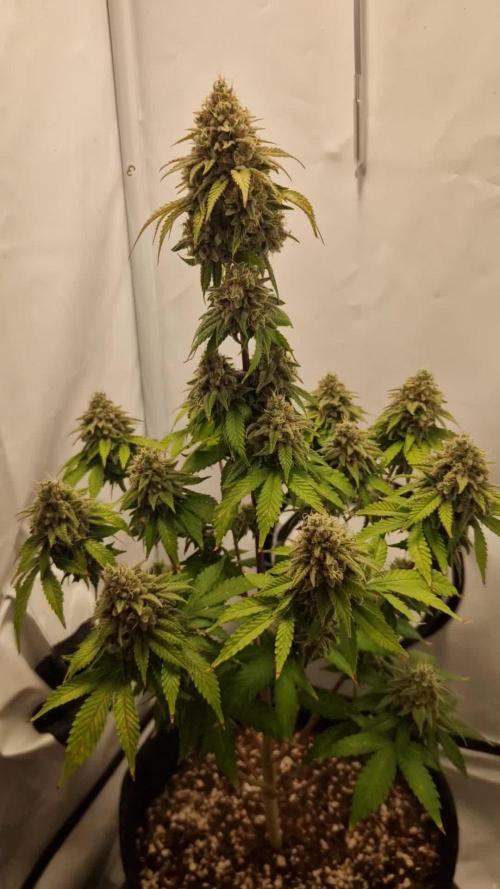
papaya cookies has now completed her stretch. typical for papaya, she develops purple/pink pistils. such a beauty. hopefully the weather will stay good enough for her bulk.
Likes
58
Share
@Rap_a_cap
Follow
Dramatic weather here, 2 violent storms have hitted my tent without mayor damages. I've bought a high density polyethylene film from farmer supplier, God blessed for this choice. Strong. But I've made a great mistake on Thursday because I was very busy cropping and curing Royal Gorilla that I've forget to water the sisters. I've watered them on Friday just before I started putting up the tent and the storm started with 90% humidity. It has become a tropical greenhouse, so to avoid mold disasters I drilled some side holes and raised the lower edge. Fortunately, on Saturday my little ones managed to dry themselves well thanks to a little sun and a dry wind. I've learned the lesson. Now that weather is a little bit better but colder I've realised that my plants now love to live under a greenhouse, flowering is accelerating. Saturday check after the storm, bud by bud, revealed to me a single rot spot on minor side branch completely obscured by upper buds and fully soaked by water. I've removed the affected part carefully, no metastases around. Some branches start to bend down by weight, buds are enormous. Now under the greenhouse plant is restarting to flower well, as notorious Special Kush don't like too much sudden changes of temperature. Do not want to repeat mistakes done with Royal Gorilla so the plant will be cropped only when 100% ready, not a minute before, not a minute, I think on Wednesday or Thursday if dry. We are talking about of more than a pound of shit! P. S. need some help from you guys to trim Royal Gorilla, need to smoke less, that shit has no respect! 😁😎
Likes
3
Share
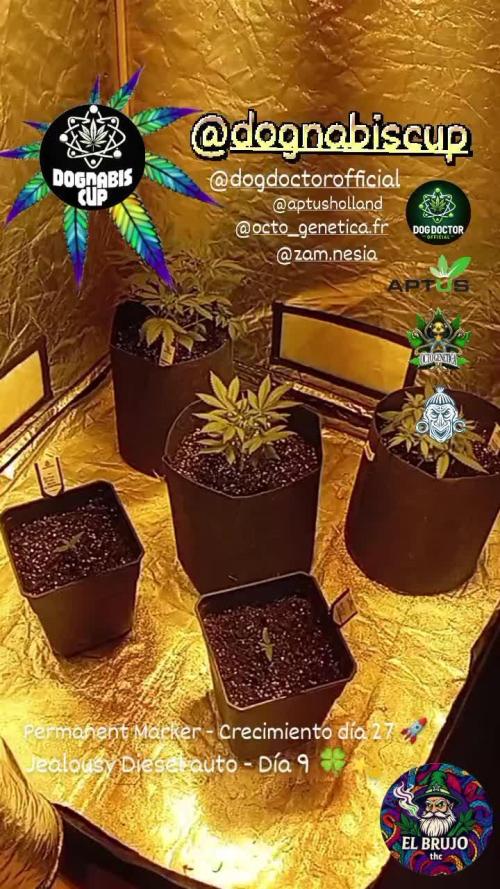
Our Permanent Markers are promising and we can't wait to taste one of the most famous strains of the moment. Remember that we are growing 1 Plant worked with the techniques and one left to grow without cutting techniques only with a little LST. She has been in bloom for two days, we consider these days vegetative and from the next we will narrate the exploits of the buds that form. Comparison is the salt of experience so the plant in the other diary will be worked very differently go and see it to compare them. We have started the Plagron fertilization program, we are in 100% organic configuration, the soil is recycled Promix + 1/3 fresh soil + 10% Perlite + RQS Mycorrhiza Mix (4 g in the mix, 1 g under the small fiber pot). We are administering // 1 ml/l Power Roots - 1 ml/l Pure Zym - 1 ml/l Sugar Royal - 3 ml/l Alga Grow We sprayed Vita Race Foliare 3 ml/l. https://plagron.com/en The doubts about the compatibility between Pure Zym and mycorrhizae have been dispelled, they can get along according to Plagron experts. If someone tells you that enzymes eat mycorrhizae, which in principle may seem possible, explain to them that it is not true. https://www.royalqueenseeds.it/growing/452-easy-roots-mix-di-micorrhize.html Try this variety, it is a top strain of recent years very high level of thc ---- // https://www.zamnesia.io/it/12508-zamnesia-seeds-permanent-marker.html Brief description of Zamnesia // Here is a good opportunity to enrich your genetic library with another award-winning variety: Permanent Marker was crowned Strain of the Year 2023 by Leafly, thanks to its intense aromas, high levels of THC and its physical vivacity. Originally created by JBeezy and Seed Junky Genetics, our team managed to secure a cutting of this modern top cultivar, so you can grow it comfortably at home, whether indoors, outdoors or in a greenhouse. Permanent Marker fits perfectly in any environment! --- // www.zamnesia.com
Likes
4
Share
These cali genetics are blowing my mind 🤯 super sticky, very frosty rock dence buds with extra strong smells. All 3 strains are 10 out of 10, very impressed. Done last defoliation few days ago, preparing for the harvest so it's much easier. Stalks are super fat, same as buds. Got big surprise from Atami, plant food, and many extras. Crazy. Thanks a lot guys. 💚 Start adding you Bloombastic food already. They love it. Smell is mad. I think most of plants ready in week or so.
Likes
20
Share
@meity2312
Follow
Tag 1 von Blüte Woche 6 . Alles läuft nach Plan die Pflanzen sehen immernoch sehr gesund aus die Blüten legen jeden Tag an Volumen zu. Es bleibt spannend. 👽 vpd 1.6 ppfd 1000- 1200
Likes
10
Share
The one that survived was only inside a 2 litre, unfortunately, so didn't produce no where near as bud as I would've liked to. It's definitely not stable from 2/3 hermies, no issues with the other strains I had going alongside these.
Likes
14
Share
@Sadhus
Follow
Les fleurs arrivent , lumière a 75 % , 27 °c 70%RH , vpd ≈ 1 , température de l'eau 22.9°C , EC 2,2 , ph 5,9 , augmentation du délais entre marée et du temp de marré pour 5 min toutes les 30 min au lieu de 4 min toute les 20 min
Likes
36
Share
Get ready for another thrilling update on our magnificent Triton Biscotto Lime in Week 6 of veg. This girl is on fire, and we're taking her journey to new heights. Buckle up and prepare for some green-thumb adventures! This week, we embarked on an important mission: Integrated Pest Management, or IPM for short. Now, before you imagine tiny superhero capes on mites and nematodes, let me explain. We introduced beneficial nematodes into the soil to combat unwanted pests and keep our garden in tip-top shape. These microscopic warriors wage a battle against harmful critters, defending our beloved Triton Biscotto Lime like true heroes. But that's not all! We called in reinforcements in the form of Spical Ulti Mite and Swirskii. These beneficial mites are like our garden's own special forces, launching a full-scale assault on any unwanted pests that dare to enter our domain. It's like a botanical warfare with a twist of camaraderie and a sprinkle of microscopic excitement. Now, picture this: Triton Biscotto Lime, surrounded by her nematode army and mite squad, ready to defend her green kingdom. It's a battle of epic proportions, where our fierce defenders work tirelessly to protect our plant from any unwanted intruders. And hey, who knew mites and nematodes could be such amazing allies in the quest for a thriving garden? In addition to our IPM efforts, we continued to pamper Triton Biscotto Lime with love and care. We ensured she received the optimal lighting she deserves, with a mighty 500 PPFd (Photosynthetic Photon Flux Density). It's like giving her a VIP pass to a cosmic light show, fueling her growth and setting the stage for botanical greatness. As we revel in the wonders of IPM and provide Triton Biscotto Lime with the best possible care, we can't help but marvel at the magic unfolding before our eyes. The harmony between our plant and these tiny defenders is like a cosmic dance, showcasing the power of nature's intricate balance. And here's a fun little joke for you: Why did the mites and nematodes form a rock band? Because they knew how to harmonize and strike a chord with their garden audience! In summary, Week 6 of veg has been a week of pest-fighting heroics and cosmic collaborations. Our Triton Biscotto Lime stands strong, backed by her nematode army and mite squad. Together, they create a force to be reckoned with, ensuring a healthy and thriving garden environment. As we continue this green-thumb journey, let's celebrate the power of beneficial allies, the wonders of IPM, and the magic that happens when we join forces with nature. May Triton Biscotto Lime grow stronger with each passing day, and may our garden be a haven of harmony and botanical bliss. Stay tuned for more thrilling updates, my fellow gardeners. Until next time, keep those mites and nematodes rocking and rolling, and may your green thumbs continue to flourish! As always thank you all for stopping by for the love and for it all, hope you all surrounded with love , health and blessing of all kinds <3 <3 <3 Genetics : TRITON BISCOTTO LIME - @SeedstockersOfficial All info and full product details can be find in can find @ https://aptus-holland.com/ https://seedstockers.com https://autopot.co.uk/ https://lumatek-lighting.com/ #aptus #aptusplanttech #aptusgang #aptusfamily #aptustrueplantscience #inbalancewithnature #trueplantscience #growerslove #dogdoctoofficial With true love comes happiness <3 <3 <3 Always believe in your self and always do things expecting nothing in return and with an open heart , be a giver and the universe will give back to you in ways you could not even imagine so <3 <3 <3 More info and updates @ https://growdiaries.com/grower/dogdoctor/official https://instagram.com/dogdoctorofficial https://youtube.com/channel/UCR7ta4DKLFMg2xxTMr2cpIg <3 <3 <3 Growers love to you all <3 <3 <3 <3<3<3 have a bunch of other journey going on, fell free to stop by and say hi, don be shy <3<3<3 Strain info : Triton Biscotto Lime Fem seeds You are standing before a feminised weed seed that comes blessed from the cradle, as she’s born from the cross of two genetics that are all the craze in the current cannabis scene. On the one hand, Oreoz Mintz, one of the winning horses of the new generation of the Girl Scout Cookies family; on the other, Lemon Tree. This is an epic parental lineage that results in a hybrid with a slight sativa dominance and dazzling qualities, with a short flowering of just 8 weeks and THC levels that can reach up to 22%, causing a very energetic and euphoric effect which is perfect for social events or if you’re looking for top creativity. Triton Biscotto Lime is a feminised strain that’s very easy to grow indoors, although she reaches her maximum potential when grown outdoors bathed by the sun of warm climates like the Mediterranean. She loves light and an aerated substrate, which allows for good oxygenation of the roots and helps the plant absorb the maximum number of nutrients. In return you will get dense and compact marijuana buds in a neon green colour which are sprinkled with amber pistils and covered in a glaze of beautifully crystallised trichomes. As her name suggests, her aroma and flavour are a subtle mix of earthy sweetness with a citrus touch, calling to mind a tasty cookie dessert with a lemon base and some hints of Diesel. A highly addictive flavour that you’ll be happy to taste free of any guilt for wanting to repeat the experience over and over again. So if you’re looking for a feminised marijuana seed that represents the best of the current cannabis scene, with high-calibre properties that contribute to her excellent reputation, then Triton Biscotto Lime has arrived on the market to meet your expectations. Try her now and become hopelessly devoted to her - Friendly reminder all you see here is pure research and for educational purposes only -
Likes
2
Share
@Dimakos
Follow
I was about to start crying ahahah when I got my main stem splited in the half something like the 1/3 of it , i respont straight and tied it up with a fabric materiaal instant of duktaping it and then spraing it with the revive solutions from A.D some time per day also non stop praying 😂😁 it was 1week of flowering so its kinda but, hope it will go well , untill now 24hours later looks like it never happent