


Likes
Comments
Share


@Herbinski
Follow
As you can see she is in full flowering mode right now.
She has slowed down the vertical growth and I can see “hairs” everywhere.
During this week I took off some fan leaves as advised by the breeder and I will probably do it again in week 5 of flowering.
Despite feeding her with solid dosages of BAC nutrients some of the lower leaves have turned a bit yellow so I will increase the amount of “food” she gets from now on.
I have ramped up the power on the Bilberry lamp to 80%. I must say this lamp is out of this world. I hope the end product will reflect it.
Hope she keeps going good.

Likes
2
Share

@L8bloomr1008
Follow
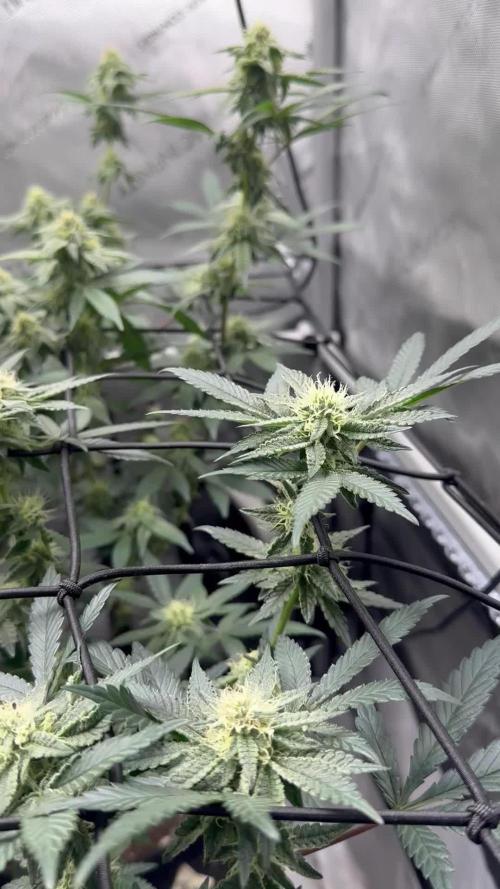
Did a bigger defol. Adjusted the trellis. May or may not have been watering with too high of ph (7.2) so hopefully microbes have been doing their job.
Likes
20
Share


@Xabii
Follow
Ran into some Calcium/Phosphorus trouble !?
First deficiency in the grow.
Topped up with new nutrient solution, added some CalMag and Universol Yellow 12/32/12.
Raised PH to 6.1 and EC to 1850.
Added 100ml 12% H2O2 to make sure no PH trouble occurs.
Switched the Carbon filter around so that I can lift my light a little more.
Orion F1 is getting really frosty ~2 more weeks?
The Northern Lights take some more time.

Likes
91
Share


@THcHunteR23
Follow
Super couleur qui commence à sortir!! Les trichromes sont majoritairement laiteux.
Quelque endroits avec un début de moisissure. Je part un feu inspecté enleve et brûle les parties toucher !
Elle résiste bien encore 2 jours de pluie et après le beau temp revient pour plusieurs jours.je lui donne encore 2 semaines si tout va bien

Likes
123
Share


@MrHightimes
Follow
Well My friends gave me a bigger tent so I got a little more time to let them develop!
I'm very ready to take them down just waiting a bit longer for a few more amber trichomes.
I'm still feeding them ripen but i wish last week i'd given them a feed in addition too.
They look nice in the new tent, there is loads more room, and while the lighting didn't go up as much as I'd like,
They have a nice big fan oscillating on them now and room to stretch.
________________________________________________________________
I suppose I'm glad I waited. I wanted to take a few more pics and get one last video in! I'm def seeing a bit more amber in the trics and
i think it will make em a bit better for these 2 extra waterings! Probably gonna chop them soon!!!!

Processing
Likes
16
Share


@Dunk_Junk
Follow
She is at the far back. She is growing well this week, but she is not as big as her other three tentmates. She has the thinnest stem and she actually fell over for a couple of days before I got to her! 😕 I have now remedid the situation.

Likes
2
Share


Likes
78
Share


@Basementganja
Follow
On cruise control until harvest!
She's very sticky, and smelly!
2.5 gallons dosage of the above listed nutes, every 4 days!
Flush next watering, and then just water 'till harvest.
Likes
14
Share


@GoldenWeedGrower
Follow
D36/V32 - 06/05/23 - SCROG net added. Some LST
D37/V33 - 07/05/23 - LST on SCROG
D38/V34 - 08/05/23 - LST on SCROG
D39/V35 - 09/05/23 - LST on SCROG
D40/V36 - 10/05/23 - LST on SCROG
D41/V37 - 11/05/23 - 👉 Water Change - Pure water for 2 days she's going to bloom
D42/V38 - 12/05/23 - 👉 second day of flush
Likes
1
Share


@vonlantz
Follow
Well she grows pretty tall with a a big internodes distance. Started to flower.
Wedding Cheesecake seems to like hot weather as she endured +40C like a boss!
SHe also handles pests pretty well. While her neighbors are filled with spider mites, she's doing quiet well.
I really like how she thrives in hot temperatures without any LST - a pretty big girl.
Likes
3
Share


@Kushizlez
Follow
Day 40-47 (May 31st- June 7th)
(Day 41) For the first time in this grow these plants are looking halfway decent. Smell is ramping up too. I finally feel optimistic about this grow.
(Day 42) The two jacks and the chunky blueberry are showing early signs of N/Mg deficiencies. I know it’s late in flower but since I’m experimenting with this tent, I’m going to give them one final feeding of nature’s pride 2-5-5.5 (tbsp) along with a teaspoon of oyster shell flour and some rock dust. Everything else I’m going to give a teaspoon of rock dust and oyster shell. There is no way these amendments will fully break down in time to be used by the plant but they could at least use the pH buffering and trace amounts of minerals after their recent leach.
Everything but the BAOGC is covered in pistils that don’t really match their bud size. I hope they fill into their pistils because an over abundance of hairs drops the bag appeal like crazy.
Over the last few cycles, indoor and outdoor, I’ve definitely learned that different strains and phenotypes mature at different times. Sometimes really radically too.
(Day 43) None of the plants are fading at all but they’re still looking good. Black garlic I know should be fading but remains dark green and toxed. I popped a developing seed out of the main bud too. I wonder if that blueberry herm branch pollinated it at all. It seems like plants don’t really like that Destiny dark matter soil by itself. I find it works better mixed with coco or promix 1:1.
(Day 44) I’m starting to think I might be mixing up the TWOG and BAOGC. BAOGC took forever to fatten up last round and the 2 phenos I suspected already look done. I was thrown off by the similar terps. The beauty phenos are definitely TWOG
(Day 45) God these Jack Herer’s smell good. Nothing but fruity funk. Almost like a vanilla or blueberry yogurt. I would say this stuff has the most overpowering smell in the tent now. I’ve noticed they’re starting to foxtail like crazy. Blueberry#1 too.
I’m watering a final low strength feeding of seaweed extract on everything.
(Day 47) Everything really fattened up this week. Even at the beginning of the week I was saying I didn’t think they would fill out. Jack Herer and BAOGC specifically made some big gains and nearly doubled their density and still have quite a way to go on them too! The smell has ramped up and finally, everything is looking happy and healthy.


Likes
Comments
Share

@Pipokush
Follow
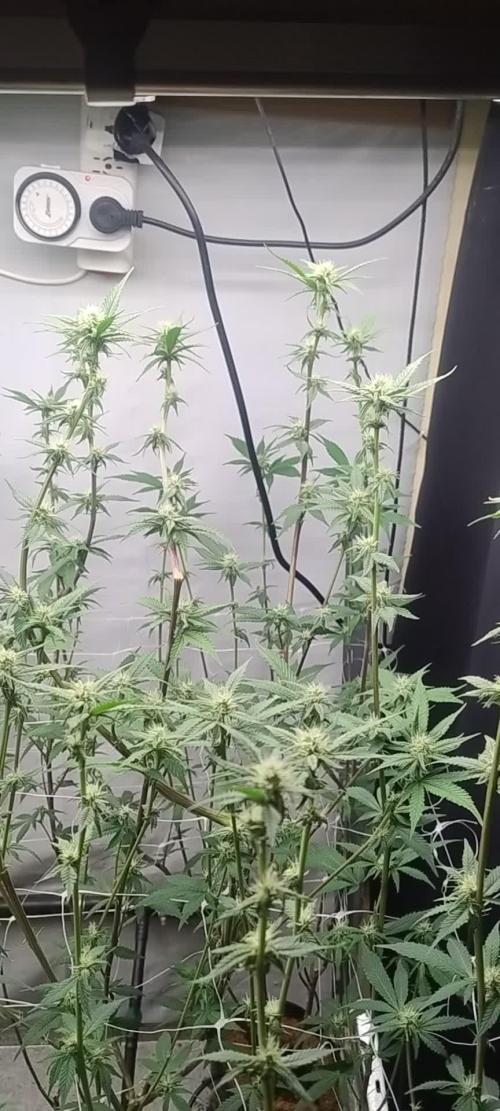
Tercera semana de flora.
Bueno llegando al dia 21 aplique la tecnica Schwazzing.
Subi la ec a 2.15 mS/cm y volvi a cambiar el esquema de riego a uno vegetativo tirando 600ml (aprox) de agua en 9 pulsos de 1m. Espero emepzar a volver a ver runn off y saber si funciono bien la estrategia de riego.
Las plantas siento que stackearon bien los meristemas florales asique me voy contento. Se viene el engorde.
La solucion nutritiva que arme fue:
130L aproximadamente
A:350ml
C:350ml
D:350ml
Likes
7
Share


@MicroHidroGrow
Follow
Arranco el cultivo directamente en flora. Dos de los esquejes no agarraron bien, pero me corre el tiempo. Además aproveché para cortar el sistema y poner a la madre de los esquejes en tierra a florar en lugar de los otros 4 esquejes que solía poner. Por lo cual van 6 esquejes en hidroponia (de los cuales dos no están en la mejor) y una madre en 10 litros de tierra, para aprovechar mejor el espacio. Conseguí nutrientes de mejor línea para esta ocasión, pero no voy a poder hacer plantas grandes porque no tengo tiempo para crecimiento. De todos modos tengo mucha fé con esta genética.
Día 04. El estirón es notorio. Dos de los esquejes no agarraron bien. El problema fue que el apuro me hizo sacarlos antes de tener un buen enraizado. Pero tomando en cuenta el apuro, no me preocupa. Espero que el ritmo de crecimiento siga constante, así puedo obtener plantas relativamente grandes. No espero demasiado, ya que los pasé a flora con 10 cm. Pero tengo mucha fé en los nutrientes y la atención que pueda darles.
Día 06. El estirón es muy interesante. Las dos chiquitas quedaron ahí. Pero no me preocupa. La planta de tierra va creciendo bastante también. Tuve una fuga se solución, por eso tuve que reponer. Pero más allá de eso, por el momento voy conforme. No apliqué ninguna técnica, pero una vez que termine la preflora, voy a cortar todo lo que quede chico. Espero obtener un rendimiento moderado.

Likes
2
Share


@GoodTimesOrganics
Follow
Die Pandora entwickelt sich langsam aber stetig weiter. Es sind viele weitere Stigmen dazu gekommen und der Geruch wird intensiver.
Die Pflanze entwickelt eher ein erdiges bis Skankiges Aroma. Aber sie wird noch eine Weile brauchen.

Likes
2
Share


@Altitonans_Fulmen
Follow
For most crops, a slightly acidic soil pH between 6.0 and 6.8 is ideal because it optimizes nutrient availability. When soil pH rises above 7.0 (alkaline), the concentration of hydrogen ions H+ drops significantly, and they are replaced by calcium, magnesium, or sodium ions on the clay colloid exchange sites. To naturally lower alkaline soil pH, you can add organic matter (carbon-rich materials), which produces weak organic acids as it decomposes. Maintaining this slightly acidic range stimulates a highly active, diverse microbial community; these microbes decompose organic matter and release carbon dioxide CO2, which plants absorb through their roots and leaves to boost photosynthesis and sugar production. Furthermore, the added organic carbon acts like a sponge, drastically improving the soil's water-holding capacity.
While soil biological activity does involve cellular electron transport, electrical conductivity (EC) in soil is actually a measure of dissolved mineral salts, not a voltage carried by individual microbes. Soil microorganisms secrete organic acids and chelate metallic and non-metallic minerals, transforming locked-up inorganic compounds into bioavailable organic complexes. Unlike harsh synthetic fertilizers that can dehydrate soil life in high concentrations, these naturally chelated nutrients safely nourish the plant, creating a thriving, self-sustaining ecosystem where plants can efficiently synthesize their own food.
Metal-based: Could include elements like iron, manganese, copper, or zinc, which are essential nutrients for plants but can exist in forms not readily accessible.
Non-metal-based: Examples like calcium carbonate, phosphate, or sulfur are also important for plant growth and potentially serve as building blocks for the organic salt.
Chelation in a plant medium is a chemical process where a chelating agent, a negatively charged organic compound, binds to positively charged metal ions, like iron, zinc, and manganese. This forms a stable, soluble complex that protects the micronutrient from becoming unavailable to the plant in the soil or solution. The chelate complex is then more easily absorbed by the plant's roots, preventing nutrient deficiency, improving nutrient uptake, and enhancing plant growth. Chelation is similar to how microorganisms create organic salts, as both involve using organic molecules to bind with metal ions, but chelation specifically forms ring-like structures, or chelates, while the "organic salts" of microorganisms primarily refer to metal-complexed low molecular weight organic acids like gluconic acid. Microorganisms use this process to solubilize soil phosphates by chelating cations such as iron (Fe) and calcium (Ca), increasing their availability.
Added sugars stimulate soil microbial activity, but directly applying sugar, especially in viscous form, can be tricky to dilute. Adding to the soil is generally not a beneficial practice for the plant itself and is not a substitute for fertilizer. While beneficial microbes can be encouraged by the sugar, harmful ones may also be stimulated, and the added sugar is a poor source of essential plant nutrients. Sugar in soil acts as a food source for microbes, but its effects on plants vary significantly with the sugar's form and concentration: simple sugars like glucose can quickly boost microbial activity and nutrient release. But scavenge A LOT of oxygen in the process, precious oxygen. Overly high concentrations of any sugar can attract pests, cause root rot by disrupting osmotic balance, and lead to detrimental fungal growth. If you are one who likes warm tropical high rh, dead already. Beneficial, absolutely, but only to those who don't run out of oxygen. Blackstrap is mostly glucose, iirc regular molasses is mostly sucrose. Sugars, especially sucrose, act as signaling molecules that interact with plant hormones and regulate gene expression, which are critical for triggering the floral transition. When sucrose is added to the growth medium significantly influences its effect on floral transition.
Probably wouldn't bother with blackstrap given its higher glucose content. Microbes in the soil consume the sugar and, in the process, draw nitrogen from the soil, which is the same nutrient the plant needs. Glucose is not an oxygen scavenger itself, but it acts as a substrate for the glucose oxidase (GOx) enzyme, effectively removing oxygen from a system. Regular molasses (powdered if you can), as soon as she flips to flower or a week before, the wrong form of sugar can delay flower, or worse. Wrong quantity, not great either. The timing of sucrose application is crucial. It was more complicated than I gave it credit for, that's for sure. When a medium's carbon-to-nitrogen (C:N) ratio reaches 24:1, it signifies an optimal balance for soil microbes to thrive, leading to efficient decomposition and nutrient cycling. At this ratio, soil microorganisms have enough nitrogen for their metabolic needs, allowing them to break down organic matter and release vital nutrients like phosphorus and zinc for plants. Exceeding this ratio results in slower decomposition and nitrogen immobilization, while a ratio below 24:1 leads to faster breakdown and excess nitrogen availability.
Carbon and nitrogen are two elements in soils and are required by most biology for energy. Carbon and nitrogen occur in the soil as both organic and inorganic forms. The inorganic carbon in the soil has minimal effect on soil biochemical activity, whereas the organic forms of carbon are essential for biological activity. Inorganic carbon in the soil is primarily present as carbonates, whereas organic carbon is present in many forms, including live and dead plant materials and microorganisms; some are more labile and therefore can be easily decomposed, such as sugars, amino acids, and root exudates, while others are more recalcitrant, such as lignin, humin, and humic acids. Soil nitrogen is mostly present in organic forms (usually more than 95 % of the total soil nitrogen), but also in inorganic forms, such as nitrate and ammonium. Soil biology prefers a certain ratio of carbon to nitrogen (C:N). Amino acids make up proteins and are one of the nitrogen-containing compounds in the soil that are essential for biological energy. The C:N ratio of soil microbes is about 10:1, whereas the preferred C:N ratio of their food is 24:1 (USDA Natural Resource Conservation Service 2011). Soil bacteria (3-10:1 C:N ratio) generally have a lower C:N ratio than soil fungi (4-18:1 C:N ratio) (Hoorman & Islam 2010; Zhang and Elser 2017). It is also important to mention that the ratio of carbon to other nutrients, such as sulfur (S) and phosphorous (P) also are relevant to determine net mineralization/immobilization. For example, plant material with C:S ratio smaller than 200:1 will promote mineralization of sulfate, while C:S ratio higher than 400:1 will promote immobilization (Scherer 2001).
In soil science and microbiology, the C:S ratio helps determine whether sulfur will be released (mineralized) or tied up (immobilized) by microorganisms.
A carbon-to-sulfur (C:S) ratio smaller than 200:1 promotes the mineralization of sulfate, when the C:S ratio is low, it indicates that the organic matter decomposing in the soil is rich in sulfur relative to carbon. Microorganisms require both carbon and sulfur for their metabolic processes. With an excess of sulfur, microbes take what they need and release the surplus sulfur into the soil as plant-available sulfate
A carbon-to-sulfur (C:S) ratio higher than 400:1 will promote the immobilization of sulfur from the soil. This occurs because when high-carbon, low-sulfur materials (like sawdust) are added to soil, microbes consume the carbon and pull sulfur from the soil to meet their nutritional needs, temporarily making it unavailable to plants.
200:1 C:S 400:1: In this range, both mineralization and immobilization can occur simultaneously, making the net availability of sulfur less predictable.
This dynamic is similar to how the carbon-to-nitrogen (C:N) ratio regulates the availability of nitrogen in soil. Just as microbes need a certain amount of nitrogen to process carbon, they also require a balanced amount of sulfur. Both mineralization and immobilization are driven by the metabolic needs of the soil's microbial population.
Sulfur is crucial for protein synthesis. A balanced ratio is particularly important in relation to nitrogen (N), as plants need adequate sulfur to efficiently use nitrogen. A severely imbalanced C:S ratio can hinder the efficient use of nitrogen, as seen in trials where adding nitrogen without balancing sulfur levels actually lowered crop yields.
Maintaining a balanced carbon-to-sulfur (C:S) ratio is highly beneficial for plant growth, but this happens indirectly by regulating soil microbial activity. Unlike the C:N ratio, which is widely discussed for its direct effect on nutrient availability, the C:S ratio determines whether sulfur in the soil's organic matter is released (mineralized) or temporarily locked up (immobilized).
Glucose will hinder oxygenation more than sucrose in a solution because glucose is consumed faster and has a higher oxygen demand, leading to a more rapid decrease in oxygen levels. When cells respire, they use oxygen to break down glucose, and this process requires more oxygen for glucose than for sucrose because sucrose must first be broken down into glucose and fructose before it can be metabolized.
In a growth medium, glucose is a more immediate and universal signaling molecule for unicellular and multicellular organisms because it is directly used for energy and triggers a rapid gene expression response. In contrast, sucrose primarily acts as a signaling molecule in plants to regulate specific developmental processes by being transported or broken down, which can be a more complex and slower signaling process.
Critical stuff.
Likes
13
Share


@Growbody
Follow
Herzlich willkommen zu meinem neuen Grow mit der Orange Sherbet Auto von 2Fast4Buds. Die Eltern sind Cookies Auto F5 x Tangie´matic, der Typ ist F3 Feminized Polyhybrid Autoflower. Der Strain war Winner of the American Autoflower Cup 2025, Kategorie Best Auto Hash. Die Aussicht auf frischen Orangensaftgeschmack macht mich wunderfizzig.
Wieder verwendet wurde für diesen Grow der 15Liter Stofftopf von ROOTiES, die Sonnenerde Bio Hanferde, BioBizz Wurmhumus, BIONOVA + zamnesias MonsterBud Mix Living Soil, zamnesias Smart Start Plugs und Plagrons Seedbooster Plus. Hat sich alles bestens bewährt.
Tag 43: 1,0 Liter Wasser.
Tag 45: 1,0 Liter Wasser.
Tag 46: Die Orange Sherbet Auto von 2Fast4Buds bekam diese Woche weniger Wasser, der Stofftopf trocknet unten wieder ab. Sie hat sich nochmal fast 20 cm gestreckt.
Tag 47: 1,0 Liter Wasser.
Schön, dass du dich für meinen Grow interessierst. Schau gerne wieder rein. 👋😎
Likes
22
Share

@MyLittleGarden
Follow
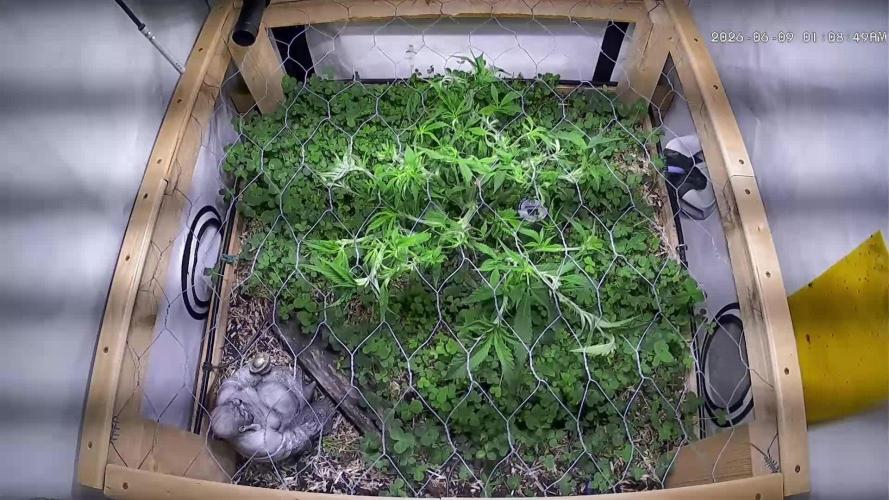
Vegetationswoche 9 - 05.06. – 12.06.2026
Diese Woche gab es eigentlich nur eine größere Aktion: Ich habe die Pflanze einmal recht stark entlaubt und die Triebe weiter unter dem Netz verteilt.
Im Nachhinein war die Entlaubung vielleicht etwas großzügig, aber die Utopia Haze hat sich davon gut erholt und mittlerweile wieder ordentlich Blattmasse aufgebaut. Sie sieht weiterhin sehr gesund und vital aus.
Auch das Klee-Cover-Crop wurde einmal gestutzt und ist inzwischen schon wieder kräftig nachgewachsen.
Ansonsten gab es nichts Besonderes. Das ist gerade die eher ruhige Phase des Grows: wachsen lassen, gelegentlich nachjustieren und beobachten.

Likes
12
Share


@Big0zGrower420
Follow
Plants are finishing up, maybe another week and I can wrap things up. Buds didn’t get as fat as I would have liked but everything looks really nice and frosty. cleaned up all the plants with some defoliation.
Likes
16
Share


@nerdz
Follow
57 to 63 Thursday
The last week. I am dropping the feed down low, might even just flush them entirely for the next week which I don't normally do but I want them to start dying naturally
These things are going to be very nice. Very tight and frosty buds in here!
Likes
11
Share


@Lahuertade_Bototo
Follow
🌱🌱🌱Continuamos este cultivo, con esta hermosa cepa de FastBuds, Girl Scout Cookies Auto, de lleno en el periodo de Floración .🌱🌱🌱
👨🍳👨🌾🏻 Nutrición y Bitácora 👨🌾🏻👨🍳
-Día 43. Sigue aumentando el engorde de las flores y el aroma es cada vez mas intenso 👌.
-Día 44. Se riega con 3 litros de una solución nutritiva NPK de Plagron Alga Bloom (6 ml) Plagron Sugar Royal (1.5 ml) y Plagron Green Sensation (1.5 ml).
-Día 45. Los aromas se intensifican, ya seco el sustrato.
-Día 46. Se riega con 3 litros de una solución nutritiva NPK de Plagron Alga Bloom (6 ml) Plagron Sugar Royal (1.5 ml) y Plagron Green Sensation (1.5 ml).
-Día 47. Sigue todo excelente 🙌.
-Día 48. Ya seco el sustrato.
-Día 49. Se riega con 3 litros de una solución nutritiva NPK de Plagron Alga Bloom (6 ml) Plagron Sugar Royal (1.5 ml) y Plagron Green Sensation (1.5 ml).
🚀Equipamiento🚀
Indoor de 60x60x159 cm y una iluminación BlackCob F320, se activa solo 1 modulo (160w) a 45 cm del canopy por el resto del cultivo. Intractor de 135mm, extractor de 135mm, filtro de carbón, ventilador "oscilofan", ventilador "clip fan", este ultimo ventilador se ajusta en la parte baja de la carpa para mejorar la circulación de aire bajo el canopy, 2 termohigrometros y una malla SCROG de kanovi a 15 cm de la maceta.
Acompáñenme para ver los resultados de este hermoso desafío, un saludo cultivadores 🔥🔥🔥
Likes
16
Share


@Dr_Rook
Follow
Ya casi un mes a 12/12 y entrando en su etapa más bonita.
Están resinando muy bien por todos lados y ya cada vez huelen más y mejor. Empiezan a coger color, demasiado pronto ya que a veces pasan más frío de la cuenta.
Esta semana les he alejado el foco unos centímetros. Estaban 3/4 centímetros por debajo de lo mínimo recomendado y no me fío de quemar mis primeras plantas de interior. (Ya habrá tiempo para experimentos)
La semana que entra ya deberían de entrar en la fase de engorde. Toca seguir atentos a ellas
