Likes
4
Share


Likes
97
Share


@Wastent91
Follow
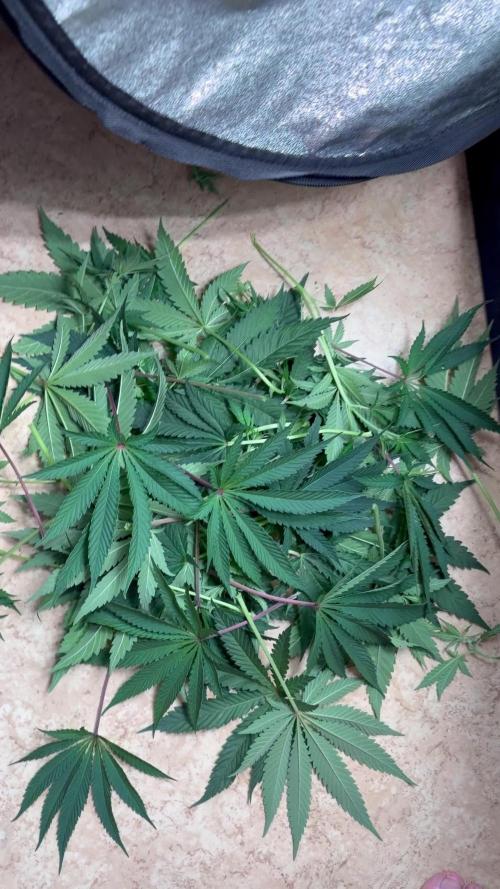
Ehi ragazzi come va tutto bene? Questa settimana la crescita è stata davvero esplosiva!!! La genetica XL della sweet seeds nonostante io l abbia toppata al 4 internodo è già 70 cm!!! Spero nn cresca di più xké ho paura poi di bruciare le foglie e i fiori come mi è già successo anche con l ultimo ciclo, apparte questo sta evolvendo tutto bene ,grandi foglie a ventaglio si moltiplicano e le cime iniziano già a intravedere il colore ,per fortuna,viola di questo splendido fenotipo!! 😽😋💪🍀 Che piacere vederla crescere e che la mia piccola grow box con pochi accorgimenti si è riempita di verde ! Forse grazie alla magia che fa la luce FC E3000 che diffonde la luce dappertutto uniformemente e si vede che le piante ne stanno beneficiando come non ho mai visto in vita mia ! Grazie a Mars Hydro e Sweet seeds che stanno rendendo possibile questo progetto!! Buon 420 a tutti!! 💪😼👍🧙♂️🌿✨🌲💨😂

Likes
9
Share

@TheCalyxLaboratory
Follow
The Gassy One - Flower Week 3 Update 🚀
Welcome to Week 3 of flower! Things are going absolutely crazy in the tent right now!🛸🐄
📊 This Week's Stats:
EC: 1.8 💧
pH: 5.7
Light (PPFD): 900 for the big lady / 650 for the smaller one ☀️
📏 The Challenge: The Crazy Stretch
Our biggest challenge this week is managing the massive height difference in our AutoPot setup. Our absolute favorite (the big plant) is stretching like a monster, pushing upwards by up to 5 cm (2 inches) per day! 📈 Because of this massive vertical growth, she is soaking up 900 PPFD, while the smaller girl is sitting at around 650 PPFD.
💨 Environment & Maintenance
The summer heat is hitting hard , and getting the humidity down has been quite a struggle. To tackle this, I installed a second fan to keep the airflow moving steadily under the canopy. 🌀 I also went in for another heavy round of defoliation ✂️ to open up the canopy, let the plants breathe, and help drop that RH.
💧 Setup Performance
I have to say, the setup is performing like a dream. The Athena nutrients are delivering outstanding results, and the pH/EC values in the 47-liter (12-gallon) reservoir remain rock solid. ? The combination of the Athena line and the AutoPot system is producing unbelievable, explosive growth. 🌱💥
Can't wait to see these buds swell up in the next few weeks! 🔥🌿
Likes
11
Share


@Ninjabuds
Follow
The Blackberry Moon Rocks are looking promising. One of them is growing into this beautiful little bush, and I think it's almost ready to harvest. The other plant is stacking up buds, but I'm thinking it's still a couple of weeks away.
The past few weeks have been so beautiful, watching the plants grow and change. It's amazing how something so small and fragile can turn into something so strong and vibrant. Now that they're getting ready to bloom, it feels a little bittersweet. I'm so excited to see the finished product, but I'll definitely miss having them around while they're growing.

Likes
44
Share


@I_and_I
Follow
All going well, week 10 flower, thinking of harvesting next weekend, would be around day 73~, I'll keep an eye on them and see how they look, but I'm definitely bringing down the sour diesel and one or two others :)
Likes
62
Share


@MeaCulpa
Follow
I get the first place among complete idiots!
EVERYTHING IS FULL OF SEEDS!!!
I completely freaked out and didn't even understand it. Apparently no lady had a hermaphrodite. No “yellow penis” or “scrotums.” I taped up my window and all the indicator lights for plugs, etc. The whole thing in a separate room. So how does it work? A good friend enlightened me. I slept at a colleague's house about 2 weeks ago. He also grows. Messy tent. Because he doesn't pay for electricity. And the tent was open all day long. Another friend told me that his whole grow was full of seeds. The idiot didn't even tape off his indicator light in the tent. Fat red irritating light all the time. This means the sperm is happily distributed around the apartment all day long. That's how I brought the plague into my house.
If I understood that correctly.
I'm really mad at him. He is not aware of any guilt. I can't eat as much as I want to vomit.
So I harvested them to stop the seeds from growing and maybe be able to smoke some. Accordingly, there are no trichome photos. It's too early anyway.
And now you can laugh your ass off and throw balls at me.


Likes
20
Share


@Elodin
Follow
Welcome back to week 3 of this grow diary!
Just like the other plant this one is unfortunately presenting with an interveinal chlorosis and also at the end of the week it started developing some brown spots mainly at the leave edges.
I’m not really sure what’s going on but I suspect it’s a magnesium deficiency that’s the only thing making sense to me.
I had slight problems with adjusting my watering volume and frequency to this new substrate. I overwatered a bit last week because the substrate apparently has a higher water holding capacity.
Immediate actions: Less watering, corrugated cardboard under planters for insulation from cold tiles, checked soil PH (slurry test), ordered Epsom salt (should take about a week to arrive) for foliar application.
I’m pondering flushing the substrate so that I can be sure it’s not caused by excess of other nutrients and lockout. But since I noticed that the substrate holds water a little bit to well for my taste this could also backfire and further worsen symptoms.
Unsure on how to proceed, guess I’ll have to wait for the Epsom salt and try if a foliar spray improves the status of my plants :(
Let me know if you have any input on the matter!

Likes
14
Share


@ZalySk
Follow
F39: still a leafy bud we're on the second half of flower now, finishing it up. The hairs have started to turn brown.
I feel like this would have looked really good outside as this looks kind of like a cheese strain I grew outside a year or two ago.
F45: I'm starting to like how thick the cola looks. Starting to wither as the lower leaves are turning yellow and the upper leaves are slowly changing from the tips down. Also a few brown hairs now.
Maybe two weeks or so left. Not entirely sure how fast it will ripen at the end.

Likes
8
Share


@Grow_for_Happiness
Follow
End of week 6 and the girls are looking great! Gave them a good defoliation first day of the week (day 41 from seed) because I couldn't get the humidity below 65%. Glad I did, they were so bushy and lots of little branches in the middle, now so much cleaner and much much more airflow. Not sure if because of trimming but they barely grew this week. Blueberry is typically a bit shorter though so may just be the strain. Three plants look very similar with one plant looking 5-7 days behind. Starting to see colour starting already might be some beauties coming!
Watering 3 liters a day per plant, just chugging along as the buds come in.
Light up to 90% at 18" hitting 700umol/s.
UV running 1 hour per day mid cycle
4" intake running around 60%
6" exhaust running 40%
Upper oscillating fan 40%
Lower oscillating fan on Low

Likes
3
Share

@Ninjabuds
Follow
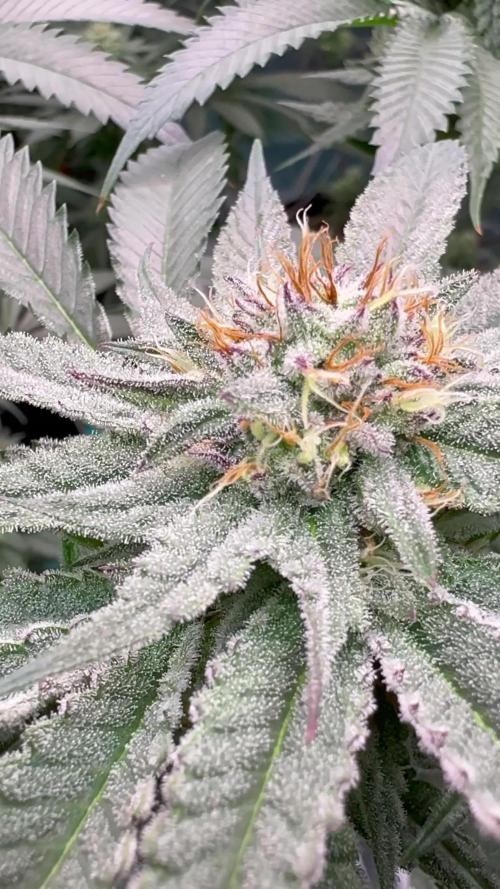
This little plant is turning out to be some really pretty looking stuff with a great fruit smell like pinnapple and some skunk smell on the back end. The pics don’t do it justice the colors in the calex of the buds is super strong
Likes
34
Share


@Mom74
Follow
Die Pflanzen haben sich auch in dieser Woche gut gemacht. Man kann den unterschied zwischen sativa und indika gut erkennen. Die beiden hinteren pflanzen sind Girl scout Cookie und Sweet Candy und die vorderen super Silver haze und Berry bomb . Der Weinballon blubbert noch mäßig vor sich hin und jeden zweiten Tag stelle ich ein Gefäß mit Wasser und 4 CO2 Tabletten mit ins Zelt. Ich bin sehr zufrieden mit dem gegenwärtigen Wachstum und Entwicklung der Pflanzen.
Ich spiele mit dem Gedanken ein zweites Zelt zu kaufen und im Wechsel auch Automatik anzupflanzen um die Wartezeit zur Ernte mit einem kurzfristigen Grow zu belohnen.
Dafür rauche ich nicht einmal. Dieses Hobby habe ich meinem Sohn zu verdanken. Er ist so selbstlos und testet die Ergebnisse für mich. Dann wird er sie bewerten ,da ich das leider nicht kann.
Habe überlegt vielleicht Edibles herzustellen. Candys, Pralinen oder Gebäck.
Wäre dankbar für Erfahrungen und Rezepte .
Aber bis dahin werde ich den Mädels noch beim Wachsen zusehen.
Ich wünsche euch noch eine schöne Zeit und halte euch weiterhin auf dem Laufenden.
Bis nächsten Sonntag.

Likes
32
Share


@Scandinavia
Follow
8/10 - Got around 50g per plant, very frosty and compact too for an autoflower. Wanted to share the final product and the whole journey in once. Hope you like it.
BTW:
why can i only make one harvest when i dont harvest all the same time? And ive seen others be able to harvest week after week.
Peace & Love

Likes
12
Share


@OGbros
Follow
Only the tropicanna left. In a week/ couple of day I will harvest the lady. I decreased the addition of nutrient and the last 2 days I will change all the water in the pot with pure water (ec 0.4-0.5. The smell is strong and juicy. Tropicanna is at least x2 bigger than the strawberry. If all 2 plants were big as the tropicanna I have had issue with the space in the box. Fortunately is all fine

Likes
Comments
Share

Likes
59
Share


@JeyGanesha
Follow
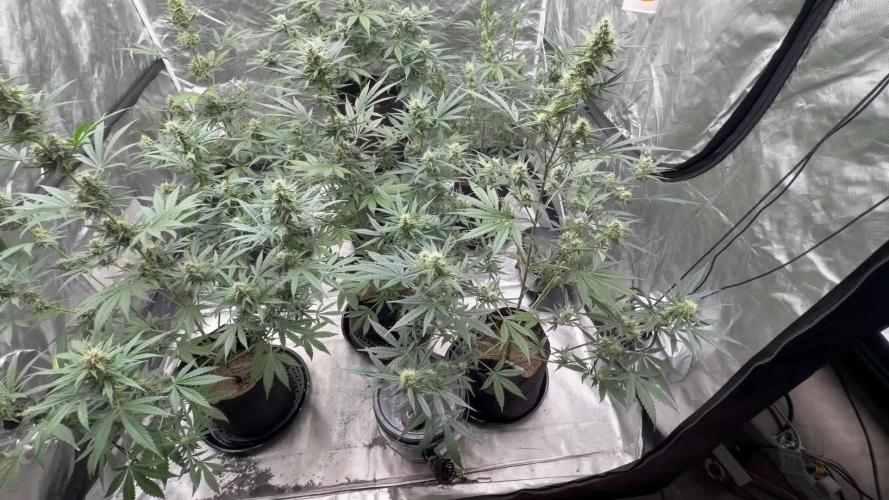
Gente!amici contadini eccoci arrivati all'ottava settimana di fioritura 💪 tutto procede come deve. La lotta biologica che sto facendogli con le mie care amiche coccinelle 🐞 funziona Super bene...fossero state tutte larve di coccinelle 🐞 era ancora meglio.si perché la voracità che ha la larva di coccis è incomparabile....poi le larve non volano aggirro. Stanno sulle foglie e mangiano tutto. Uova ragni rossi ecc....
Likes
14
Share


@TeaTime
Follow
Just an observation about nutrients one of the 3 pots is coco coir and another 2 pots are soil light mix from plagron . That is why I’m putting nutrients for coco and soil .
Likes
8
Share


@CannbellFarms
Follow
Monday 10/07
- front 2 plants finally beginning to bud
- extended last weeks nutrients for another week just to help the front 2 plants catch up
Thursday 13/07
- massive defoliation on all 4 plants
- great increase in light pen all the way to the floor
Friday 14/07
- removed bug bud coco from Nutes
- added overdrive to the Nutes
Likes
44
Share


@Cogollo_eu
Follow
**Encontrarás la traducción a español al final de la descripción**
From/Desde: 22/02/19 || To/Hasta: 28/02/19
From day/Desde día: 1 || To day/Hasta día: 7
-----INTRO-----
Hi Buds!!, this is my new diary, the first i made while growing, as the other diaries i have were made close or after harvest.
This is my second indoor grow, you can check my first indoor grow here (Auto BlueBerry Mazar x4):
- https://growdiaries.com/diaries/24700-auto-bbmazar-x-4-1rst-indoor-60-to-90
Also i have a couple of diaries of an outdoor grow series (my first grow experience) that i made this summer, there you will find Lemon Zkittle, Think Big, Auto GlueBerry, Critical + 2.0 Auto, Auto Girl Scout Cookies & Auto Mazar (some are in progress and some are to come), check my user page if you are interested: https://growdiaries.com/grower/abducted.
This time i'm going to grow 2 different Feminized Strains, 2 x Gorilla Glue @Dinafem & 2 x Money Maker @StrainHunters, i will make separate diaries as suggested by @GrowDiaries. You can find the Money Maker Diary here: https://growdiaries.com/diaries/25667-gorillamakingmoney-gorilla-vs-money-m
My expectations inspired by @TOTEM awesome Man-Linning Dr. Grinspoon plant (https://growdiaries.com/diaries/18090-dr-grinspoon-by-totem) are to try to perform a small Man-lining in both plants or in one of them, i'm still guessing. I'n not trying to reach the kind of monster TOTEM has, as i don't have equipment nor even place. Also i want a max 3,5 months grow, so i'm planning 4 or 5 weeks of growing, and my pots are just 8l, but i want to see where i reach with a feminized strain and with the equipment i have, trying to apply technics for first time. I just LST'ed a Lemon Zkittle, but i wasn't a really LST.
-----IMAGES & VIDEOS-----
Photo 1: Seeds stocked from summer
Video 5: Timelapsed planting non germinated seeds
Photo 9: Somangos at back, they've grown almost wild outdoors, tomorrow (02/03/19) i will harvest them. You can see the first weeks of that Somangos in this diary (weeks 1 to 7): https://growdiaries.com/diaries/24700-auto-bbmazar-x-4-1rst-indoor-60-to-90
Video 16: Timelapsed transplantation
-----WEEK SUMMARY-----
This week is the setting up medium week, the day 21 (22 already as were 4:40 a.m.) i prepared small pots with soil as seen on images and videos and buried the seeds at about 1 cm deep, in this case 2 Gorillas and 2 Money Makers. After buried i irrigated the pots with 2 syringes of 60 ml on each. And put them under a 50W Led (pink/purple light), you can see the process in video 5.
The first gorilla (A.Gorilla) showed itself few minutes past day 23, the day 24 at about 00:00, the second Gorilla (B.Gorilla) emerged the same day 24 at 15:44, the first Money Maker (B. Money) appeared the day 24 between 23:30 & 00:00 and the last money (A.Money) appeared the day 25 at 13:50.
The day 28 i transplanted the babies to 8 l pots (Root Poch), you can see the process in video 16.
-----WATERING CALENDAR-----
22/02/19 - 120 ml with all week nutrients @ 0.4~0.5 E.C. PH5.5
24/02/19 - 10 ml with all week nutrients @ 0.4~0.5 E.C. PH5.5 (over buried seed)
28/02/19 - 1.500 ml with all week nutrients @ 0.4~0.5 E.C. PH5.5 (Setting up the 8l pot)
*****ESPAÑOL*****
**Encontrarás la traducción a español al final de la descripción**
From/Desde: 22/02/19 || To/Hasta: 28/02/19
From day/Desde día: 1 || To day/Hasta día: 7
-----INTRO-----
¡Muy buenas compañeros!, este es nuevo diario, el primero que seguiré mientras se desarrolla la plantación, ya que los demás que he escrito lo he hecho con la cosecha a punto o ya realizada. Esta es mi segunda experiencia indoor, podéis ver la primera en este diario (Auto BlueBerry Mazar x4):
- https://growdiaries.com/diaries/24700-auto-bbmazar-x-4-1rst-indoor-60-to-90
También tengo unos cuantos diarios que forman una serie de cultivos correspondientes a lo que he plantado este verano, que ha sido mi primera experiencia. En ellos encontrarás las genéticas Lemon Zkittle, Think Big, Auto GlueBerry, Critical + 2.0 Auto, Auto Girl Scout Cookies y Auto Mazar (unos los estoy desarrollando ahora mismo y otros están por venir), si están interesado visita mi página de GrowDiaries: https://growdiaries.com/grower/abducted.
Esta vez voy a crecer 2 genéticas feminizadas diferentes, 2 Gorilla Glue de @Dinafem y 2 Money Maker de @StrainHunters, haré diarios separados como recomienda @GrowDiaries. Podéis encontrar el diario de las Money Maker aquí: https://growdiaries.com/diaries/25667-gorillamakingmoney-gorilla-vs-money-m
Mis expectativas para este cultivo son introducirme en alguna técnicas de cultivo, inspirado por la increíble Dr.Grinspoon de @TOTEM alineada desde el principio (https://growdiaries.com/diaries/18090-dr-grinspoon-by-totem). Voy a intentar hacer una alineación principal pequeña en una de las plantas o en ambas, aún estoy decidiéndome. Por supuesto no voy a intentar crear un monstruo como el de TOTEM, pues no tengo ni el espacio ni el equipo adecuados, además de que quiero que el cultivo no me sobrepase los 3 meses y medio, por lo que planeo hacer 4 o 5 semanas de crecimiento únicamente, también está el hecho de que mis tiestos son de 8 litros que no es demasiado, por lo que quiero ver hasta donde llego con una genética feminizada y el equipo que tengo, intentando aplicar las técnicas de cultivo principales por primera vez. Este verano le hice LST a una Lemon Zkittle, pero no fue un LST verdadero.
-----IMAGENES & VÍDEOS-----
Foto 1: Mi stock de semillas desde verano
Vídeo 5: Plantando las semillas en TimeLapse
Foto 9: En el fondo unas Somangos, han crecido medio salvajes en exteriores, mañana (02/03/19) haré la cosecha. Podéis ver las primeras semanas de estas Somangos en las 7 primeras semanas de este diario: https://growdiaries.com/diaries/24700-auto-bbmazar-x-4-1rst-indoor-60-to-90
Vídeo 16: Transplante en TimeLapse
-----SUMARIO SEMANAL-----
Esta semana es la de configuración del entorno de cultivo, el día 21 (22 ya pues eran las 4:40 a.m.), preparé unos tiestos pequeños con tierra como se ve en las imágenes y vídeos, y planté las semillas a aproximadamente 1 cm de profundidad, en este caso 2 semillas Gorilla y 2 Money Makers. Después de plantar las semillas regué los tiestos echando 2 jeringas de 60 ml en cada uno. Después dejé los tiestos bajo un foco led de 50W (rosa/morado), podéis ver este proceso en el vídeo 5.
la primera Gorilla (A.Gorilla) apareció unos minutos pasado el día 23, el 24 a las 00:00 +/-, la segunda Gorilla (B.Gorilla), salió el mismo día a las 15:44, la primera Money Maker en aparecer (B.Money) apareció también el día 24 entre las 23:30 y las 00:00 y la última que pareció fue la otra money (A.Money) el día 25 a las 13:50
El día 28 transplanté a lso tiestos definitivos de 8l de la marca (Root Poch), podéis ver el proceso en el vídeo 16.
-----CALENDARIO DE RIEGO-----
22/02/19 - 120 ml con todos los nutrientes semanales @ 0.4~0.5 E.C. PH5.5
24/02/19 - 10 ml con todos los nutrientes semanales @ 0.4~0.5 E.C. PH5.5 (sobre las semillas)
28/02/19 - 1.500 ml con todos los nutrientes semanales @ 0.4~0.5 E.C. PH5.5 (regado inicial del tiesto de 8l)

Likes
5
Share


@Kempy
Follow
We’ve been hit with more stormy weather she’s still going well smells amazing
Likes
19
Share


@DeepRootsGrowTrees
Follow
DREAM SHERBERT AUTO / KANNABIA
HARVEST This week she was harvested overall a easy plant to grow that produces some trichome coverage buds that have a sweet aroma to them. Enjoyed growing this strain!! Stay Growing!!
Thank you for stopping by and taking a look during the grow it's much appreciated!!
Thank you KANNABIA!!!
Kannabia.com DREAM SHERBERT AUTO