Likes
Comments
Share
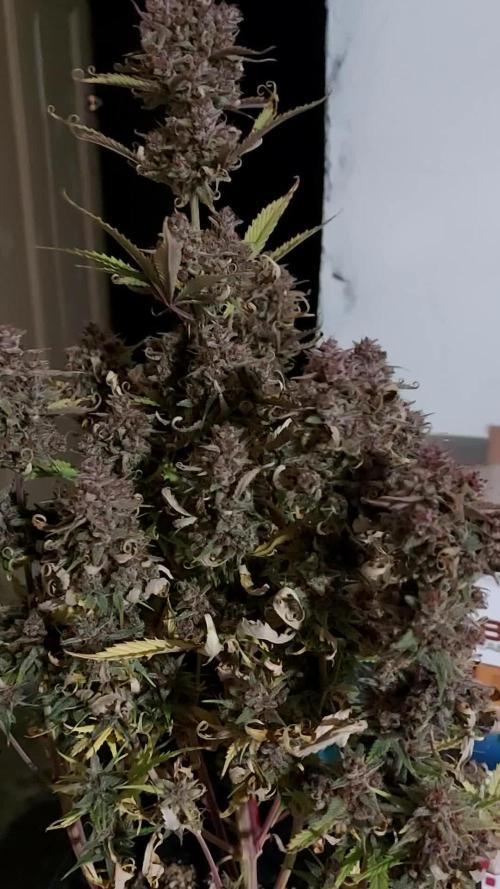
Plant b look like she is just about down I see alot of cloudy tricones and about 10% of that is turning red so by the end of this week I think it will be time to chop
Processing
Likes
1
Share
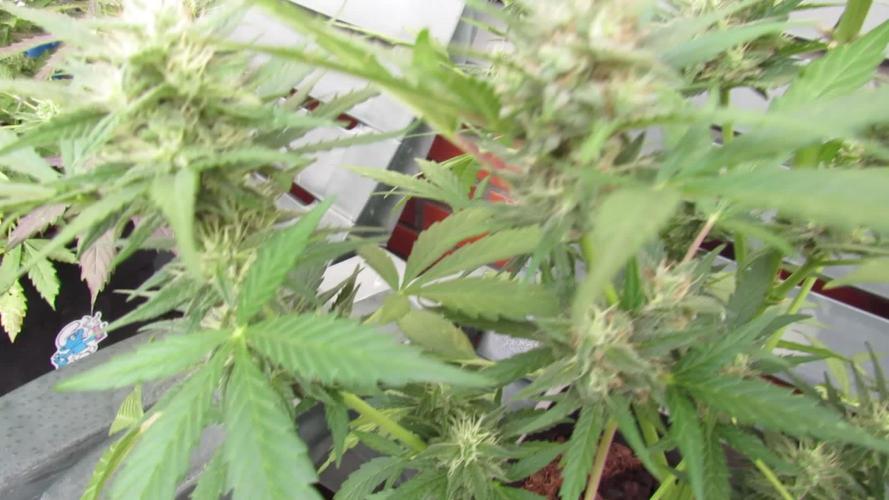
Not much has happened at all :( Very slow grow, feel like i am not doing something correct since i started using coco :/
Likes
3
Share
Die BlĂĽten werden fester und mittlerweile riechen die Ladys schon stark. Ab jetzt gibt es final Part.
Likes
7
Share
Likes
18
Share
@Mr420
Follow
Harvest was easy pulled all fan leafs off five days ago but left bud leafs on top to help drying process and it makes trimming easier as you can see I trim plant as it stands then I cut branches off or the whole plant. Only took 1hr to harvest.
Likes
17
Share
Hello Diary. It completed the last week of flowering, a total of three weeks of vegetation and seven weeks of flowering. A total of 80 days since Purple Punch # 1 sprouted, while Purple Punch # 2 I had to put on germination again because it didn’t sprout at first. In the end it was 5 days late but as you can see, the harvest was the same day. The conclusion in the end is that Purple Punch exceeded my expectations, although they look totally different, the height and build of the stems are the same, the flowers are totally different. It is well seen in the photos. While it doesn’t have the purple color I might have expected given the name, the flowers are hard, full of trichomes and have a strong sweet scent. We’ll see after drying what we made. There were only two waterings this week, I wanted him to consume all the water to make the drying faster. The condition in the growbox is satisfactory, the temperature is around 25 degrees while the humidity is below 40%. Here’s what the last week looked like. 31/04/2021 - Day 64. Watering. I regulated p.H. at 6.3 and with 7 liters of water I evenly watered all three plants on the “farm”. Temp / Humidity on the farm - 25 degrees and 37% humidity. 03/04/2021 - Day 67. Watering. The procedure is the same as three days ago. Temp / Humidity on the farm - 25.3 degrees and 38% humidity. 07/04/2021 - Day 71. Harvest. After I did the photography, first one plant and then another, I cut the plants at the bottom of the stalk and hung them upside down in a growbox to dry. The temperature in the Box is about 25 degrees and the humidity is slightly lower than 40%. I turned off the lights and left only the ventilation on while I also turned off the fans. And now all three plants are hanging upside down, two Purple Punch and their roommate Watermelon. They are preceded by about two weeks of drying, maybe a little less, so I call with one last review. See you soon.
Likes
2
Share
We become aware at such times of man's wonderful ability to bring seemingly unrelated elements into harmonic balance, and receive a glimpse into a world where everything exists in conscious sympathetic attunement to everything else. When we listen to a piece of music that seems to strike a beautiful chord somewhere inside us, or view a painting that simply glows with harmonic awareness well executed, we probably do not spare much time to contemplate the wonderfully intricate combination of vibrations that our sensors make it possible for us to perceive. We tend to appreciate the relationship between the parts of something by an awareness of the harmony or dissonance of the whole. This ability enables us to say "what a beautiful house!" instead of "analysis has proven that this collection of building materials exhibits certain elements of harmonic proportion." While this ability to instinctively appreciate the beauty of true harmony has an important role to play in evolution, a more analytical understanding of the laws involved can be most useful. This is especially so if we wish to create works of art where each part exists in true harmony, not only with the other part of that particular whole, but with the universe within which the creator and the created exist. Everything vibrates. From the most dense matter to the most subtle cosmic rays, everything which our senses allow our thoughts to become aware of, can be specified in terms of wavelength or frequency of vibration. These two terms define the same thing, but from different points of view. The following are the approximate wavelengths of various energy carriers: Cosmic rays 0.000,000,001 mm Gamma rays 0.000,000,1 mm X rays 0.000,500 mm Ultraviolet rays 0.003 mm Visible light 0.006 mm Infrared 0.01 mm Sound waves 1 meter Radio waves 300 meters Violet light 400 nm to 450 nm Blue light 450 nm to 500 nm Green light 500 nm to 570 nm Yellow light 570 nm to 590 nm Orange light 590 nm to 610 nm Red light 610 to 700 nm 1 nanometer (nm) = 0.000,000,1 cm = 1/10,000,000 cm If a guitar string is plucked and we hear a sound, it is not too difficult for the human mind to associate this sound with the vibration of the guitar string. With color it is quite different. It is difficult for us to conceive that the color of a substance is not an inherent property of the substance itself, but an indication picked up by our senses of that substance's ability to absorb or reflect the light which happens to be shining on it at that moment. Neither the matter nor the light is colored. What happens is that the brain learns to differentiate between the frequencies reflected or transmitted by the substance the eyes are focused on. The same thing happens with sound. When we say "Oh! Listen, they're playing my favorite song," what we really mean is: "My brain has stored within it a particular pattern of frequencies. I have compared the new information being received with this stored pattern and have deduced the answer that the two patterns are similar within certain specified tolerances." The 'pleasure' involved could have something to do with our running the pre-recorded pattern at the same time, in 'sympathy' with the new pattern as it is received. The word sympathy describes very well our ability to appreciate color and sound. It also describes the reason behind certain elements of harmony. For instance, if a substance vibrating at 100 cycles per second (tone 1) is in the proximity of another substance vibrating at 200 cycles per second (tone 2), we could perceive, if we had the right equipment, a certain sympathetic relationship between the two. We will see from this that there is a uniform doubling of the first tone seen in the second. At various points along the waves, the two are the same in amplitude. At other points, they are at opposite poles to each other. This doubled frequency has more points of similarity to the original than any other frequency except the original itself. If the equipment we had available for measuring these two frequencies was a soundboard amplifier and a pair of ears, then we would hear what would sound to us like one tone. If we had the opportunity to hear one at a time, we would hear that although they sound the same, one is higher in pitch than the other. This characteristic of 'the same but different in pitch', musicians have called the octave. Any two tones produced where one has exactly doubled the frequency of the other is called an octave. Speaking in ratios, an octave would appear then as the ratio 2:1 or 1:2, depending on whether we are talking of an octave up or down. A single note produced by almost any instrument will contain more than one wavelength or frequency. It will have a dominant frequency, the wavelength of which we would call the note's 'fundamental' or 1st harmonic. It will also have a varying number of upper harmonics, gradually fading in intensity into infinity or silence. Natural harmonics always have the same pattern of intervals between them. The interval between the 1st and 2nd harmonic is a perfect octave; between the 2nd and 3rd a perfect fifth; between the 3rd and 4th a perfect 4th; and so on, the intervals becoming smaller and smaller until they lose any relationship with the western 12 tone scale as it exists at the moment. Just as an octave has certain elements of sympathy with its fundamental, so some intervals have been noted to be more perfectly in sympathy with the fundamental than others. The ratio of the 'perfect 5th' or interval of 7 semitones, as it occurs in the harmonic series, is 3:2 or 2:3, while that of the 'perfect fourth" is 4:3 or 3:4. All the tones in the western 12 tone scale can be expressed in terms of the ratio between the upper tone and its fundamental. This would seem to be an ideal way of generating a scale from any given fundamental and several attempts have been made to do this, the Pythagorean system being probably the most well known. Although when working with a single tone instrument playing on its own, the Pythagorean formula works wonderfully well, if we had several instruments tuned this way together and asked them to play almost any western music, we would find that at times they sounded quite out of tune to each other. The lack of flexibility of the various scale systems based on the harmonic series has led to what is known as the 'tempered' scale. This uses as its primary unit of interval the ratio of the octave or 2:1. It then proceeds to divide the interval between any fundamental and its upper octave into 12 smaller intervals by applying the ratio: two to the one-twelfth power, to one (21/12:1). This equals 1.059463094, so by multiplying any frequency by this number, we will obtain the tempered semitone next up from our fundamental. We will also find that any tone twelve semitones up from any other tone, in a scale generated in this way, will have exactly double the frequency. If we took the note middle C on a piano and halved the wavelength, we would have the note C one octave above. If we halved this, we would have the C above, and so on. However, within about 6 octaves, we would find that although a 'sound' was being produced, no human ear could perceive it. If we kept on going, halving and producing upper octaves of our fundamental C, we would proceed through the infrared band, into the visible light spectrum. If we happened to be outside during the day, we would, for one octave only, see the note C with our eyes. The next octave above would already be in the ultraviolet band, and outside the eye's sensitivity range. If we can think of color as being an indication of a substance's vibratory rate or wavelength, we may begin to see a relationship that could exist between the color and sound spectrums. The logical extension of what has so far been said is that there exists a scale in the color spectrum that corresponds exactly to the scale in the sound spectrum, each color tone being an octave of the equivalent note in the sound range. This is not the end of the story but only the beginning. If we can for the moment accept that any wavelength in one band has upper and lower octave stretching out to infinity, then the next question is 'fine, but what shall we use as our fundamental? A particular color? A particular sound frequency?' The musicians among us will probably say 'A 440'. This means that the note A should vibrate at 440 Hertz, or 440 times per second. They would tell us that this is standard pitch has been adopted by most orchestras around the world; pianos are tuned to it, instruments are constructed to formulas based on it, and so to them it would probably seem the most appropriate place to begin. Some of these musicians may know of the battle that is still raging with regards to this being the standard, but few would know why A = 440 Hz was chosen except that it worked when it was set to be a suitable compromise between the many different pitches in use at the time. 432 Hz is said to be mathematically consistent with the patterns of the universe. Studies reveal that 432 Hz tuning vibrates with the universe’s golden mean PHI and unifies the properties of light, time, space, matter, gravity, and magnetism with biology, the DNA code, and consciousness. When our atoms and DNA start to resonate in harmony with the spiraling pattern of nature, our sense of connection to nature is said to be magnified. Another interesting factor to consider is that the A=432 Hz tuning correlates with the color spectrum, while the A=440 Hz is off. Audiophiles have also stated that A = 432 Hz music seems to be non-local and can fill an entire room, whereas A=440 Hz can be perceived as directional or linear in sound propagation. Once you adopt the idea that sound (or vibration in general) can have an equalizing and harmonizing effect (as well as a disturbing effect), the science of harmony can be applied to bring greater harmony into one's life or tune to specific energies. There is a form of absolute and relative harmony. Absolute harmony can, for example, be determined by the tuning of an instrument. The ancients tuned their instruments at an A of 432 Hz instead of 440 Hz - and for a good reason. There are plenty of music examples on the internet that you can listen to in order to establish the difference for yourself. Attuning the instrument to 432 Hz results in a more relaxing sound, while 440 Hz slightly tenses up the body. This is because 440 Hz is out of tune with both macro and micro cosmos. On the contrary, 432 Hz is in tune. To give an example of how this is manifested microcosmically: our breath (0,3 Hz) and our pulse (1,2 Hz) relate to the frequency of the lower octave of an A of 432 Hz (108 Hz) as 1:360 and 1:90. It is interesting to note that 432 Hz was the standard pitch of many old instruments and that it was only recently (19th and 20th century) the standard pitch was increased. This was done in order to be able to play for bigger audiences. Bigger audiences (more bodies) absorb more of the lower frequencies, so the higher pitch was more likely to “cut through”. One of the oldest instruments of the world is the bell ensemble of Yi Zeng (dated 423 BC), tuned to a standard F4 of 345 Hz, which gives an A= 432 Hz. The frequency of 345 Hz is that of the platonic year! Similarly, many old organs are tuned in A=432 as well; for example, St. Peter’s Capella Gregoriana, St. Peter’s Capella Giulia, S. Maria Maggiore in Rome. Maria Renold’s book “Intervals Scales Tones and the Concert Pitch C=128 Hz” claims conclusive evidence that 440 Hz and raising concert pitch above scientific “C” Prime=128 Hz (Concert A=432 Hz) disassociates the connection of consciousness to the body and creates anti-social conditions in humanity. The difference between concert pitch A=440 Hz and Concert A=432 Hz is only 8 cycles per second, but it is a perceptible difference of awareness in the human consciousness experience of the dream we share called existence.
Likes
29
Share
Welcome to my Slurircane Diary sponsored by MSNL & Spider-Farmer Week 7, early flip and attempt at reveg into early week 8 but decided I liked the look of her cola potential and decided to throw her into flowering. From the reveg attempt I thought a ratio on/off would be best if it leaned more on the off, so a 13-11 off / on was set for early week 8 and till fattening (when the stretch is over, 'pre flower) This is a bit of a weird one for me, well more a 1st. I'm not 100% sure. But I do remember this getting 3 13.5hr days as did my whole tent. As my cheap timer ran for an extra hrs off when it was meant to be on. So, put it into a flip. And I tried for over a week to reveg, I'm sure if I pushed on. I would of gotten to reveg. (I'm not sure how long it takes, am very pleased though with this spectrum even without the IR that the flip time is quick. So, after a week 7 was finished. I decided to push on to a 13-11 off/on to induce her. I'll increase it to 13-11 on/off in fattening. Sadly has the pre flip and then attempt at reveg make all her nodes very stiff. And near to LST. After pre flower I'll hard defol and attemp to distance the colas. Surprisingly with her been a dom indica her leafs are very Stavia style. Very thin. Would make an ideal candidate for scrog. She is very healthy and been the most responsive with co2/heat. Although growth was stalled from my reveg attempt, I'm sure i cut a good few CM from her Height by reversing it again. I should of looked up how long it takes to reveg 1st. Lessons learnt. I still have an amazing pheno. (I'm a few weeks ahead in Real Time) Defoliation So, this was done lots on this girl. As my plans for her were changed due to poor attention. So, start of wk 7, what I thought was still a few weeks out from me flipping. But, after my abandoned attempt of reveggin. She was in limbo and I decided to risk it with a hard defoliation. (Looks like it was done in pre flower, it wasn't, It was just coming back into veg, but would of taken weeks to get it growing fully again, and at looking I'm happy with it so I pushed again with my Defol to get colas. You can find this on grow weed easy "full tutorial for flowering") am gonna leave her now until she's out of pre flower, she's 35cm or so tall. I don't see putting on much height. As my reveg attempt will for sure hanmer her stretch. Diet Was planning on taking Alga Grow off for the last 10 days r so off grow. So, I only had a few days off it, and its on Alga Bloom now. Thanks to my sponsors from MSNL & SPIDER-FARMER. Just harvested the GranDaddyPurple Auto. (BEST AUTO I'VE EVER GROWN SO FAR, TASTE, SMELL & STRENGHT BEATS ALL PAST AUTOS, BUDS DOWN) will be uploading the weeks on that soon. I've too many diaries. I knew this. So, I plan to do 2 wk updates at a time for 70% of my diaries, so pics and info will be added as those it was a weekly update. Also, I don't put up a harvest wk for a month until the cure. Thanks to my sponsors from MSNL & SPIDER-FARME, look forward to working with your more. And trying a lot more of your products. #convert. Much appreciation to all ppl who stopped by and did your thing. Look forward to seen your work if I know you dropped by of course. Either way. Thanks for stopping by
Likes
16
Share
@GrowerGaz
Follow
Plain sailing this week , just water and sit back to watch the beautiful fade.
Likes
77
Share
I love the sativa shaped nug-towers! When my plants grow big, I like to grow them until the very end of their cycle! That's why the extended flower period. Video of Measurement of yield: T=Tops(92grams), M=Mids(59.1 grams), L=Lowers(58.6grams) Total: 209.7 grams (1-2 grams worth, was taste-tested prior to scaling.)
Likes
2
Share
@dubby_m
Follow
D101: harvested the plant! Very happy with the grow :) Wettrimmed all the buds and hung them for drying. i will report after drying and curing!
Likes
10
Share
@Reaper
Follow
she grew a lot during flower clones are better for rdwc
Likes
159
Share
Did not get up to see the plants this week, been watching the weather though. The weather was fine, next week looks a bit cooler and three day of rain, not great. First plant was hung a week and trimmed the first oz and a half. Looks like I may get five or six off this plant. The trimmed buds look fine. They were squished bringing them back. In my wisdom I bagged it inside five bags to avoid the smell and complaints driving back and that happened. Well I did not get any complaints though. Trimming is a bit of a chore now, oh well. Won't do that again. Buds look good and all is well. I may try to get up next week to see them. Cheers.
Likes
16
Share
Vamos familia, actualizo la novena semana de floración de estas Royal Gorilla de RoyalQueenSeeds. Se estropean un poco por el calor aunque se les ve sanas, están formándose las flores bastante bien. Y desprenden ya un aroma increíble. Hasta aquí todo bien el único suplicio que sufro son altas temperaturas por estar en pleno verano. Acabaré este proyecto y daremos parón unas semanas. Que avance algo más el verano. Máximas de 30 y mínimas de 27 ahora viene el calor y ando jodido en humedad ronda el 40%. Hasta aquí nada nuevo no sé si las dejaré más o que haré podría cortarlas ya o darles 5 - 7 días más, todavía no e decidido. Agrobeta: https://www.agrobeta.com/agrobetatiendaonline/36-abonos-canamo Mars hydro: Code discount: EL420 https://www.mars-hydro.com/ Hasta aquí es todo , espero que lo disfrutéis, buenos humos 💨💨
Likes
19
Share
The colors are showing on this lady! They are beautiful! I couldn't believe how much she came into her own. I started to flush her and she's been hungry anyway. I taper off the nutes like nature intended. So last week was probably less than I added on the site. I will go back and fix it.
Likes
11
Share
Likes
15
Share
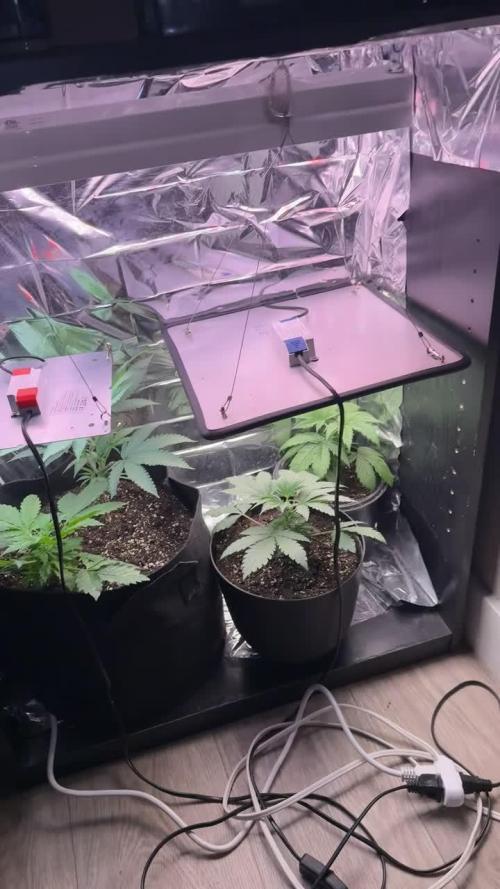
We've made it to day 28! - 17/12/20 The girls seem to be happy and healthy today. I won't be feeding/watering them as the pots are still heavy from yesterdays feed. A few of the girls have started to show sex & the smell has picked up a little bit(inside the tent), so I'm hoping to see some flowering begin this week sometime. (I've been using my iPhone as my only DSLR lens is useless for focusing on certain depths, but I hate the colour I get using the iPhone... I may be switching back to DSLR unless I can find a better camera app.) update - day 29 (18/12/20) Short update today. Fed the girls today and will probably be feeding/watering every day from here on out, we'll see though. veg growth has really taken off by now, I'm hoping to see some flowering this week. update - day 30 (19/12/20) I fed the girls today. I need to find a better way to hand water, the plants are so short and bushy its a pain getting in between all the branches. I wish i left my drip feed system up and running, I will definitely refine it and use it next run. Update - day 31 (20/12/20) Fed the girl's straight water today. I'm going to purchase the pieces I need tomorrow to reconfigure my drip feed system & hopefully have it running by mid-week! Update - day 32 I attempted to set up my drip feed system today but the plants are too thick around the base to place the halo around :( I will have to wait until next season to set it up, oh well, I guess its hand watering for the next 5-10 weeks Fingers crossed these girls start to flower ASAP. I fed the girls today, everything is looking good so far. I also moved the plants around to try to make hand watering easier, I had issues trying to water the whole pot instead of just one spot due to plants/branches being in the way. Update - Day 34 - 23/12/20 It definitely seems ill be watering the girls every day from here on out. All the girls look fairly happy and healthy, they're getting a bit big for the 5x5 they're in. It looks like flowering has begun on 2 of the girls, hoping to see some more progress on the others in the next few days. Thanks for stopping by! 🙏
Likes
16
Share
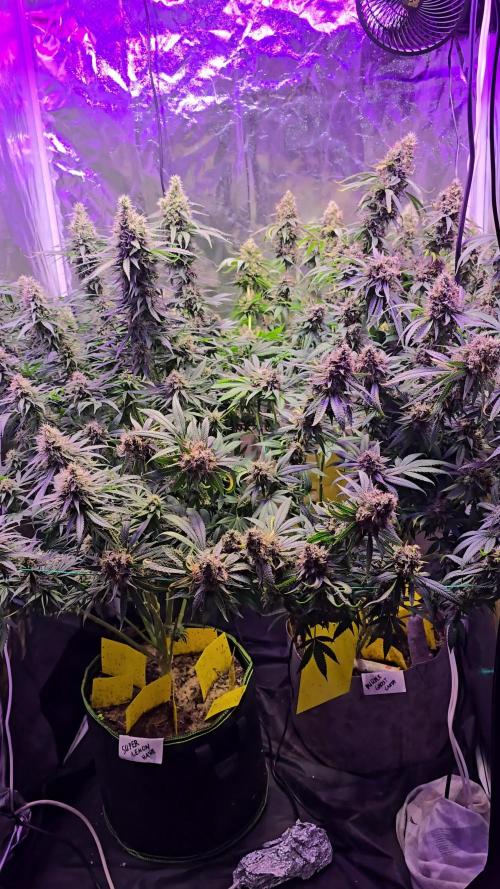
Aug 16: Lemon Cream Kush has stretched a bit and the buds are starting to fill in. Should be a decent yield and I’m looking forward to the tast of this one.