


Likes
Comments
Share


Likes
3
Share


@High_Grade_Dadli
Follow
Girls resting in their final home getting settled in before the decor

Likes
12
Share


@Preston22
Follow
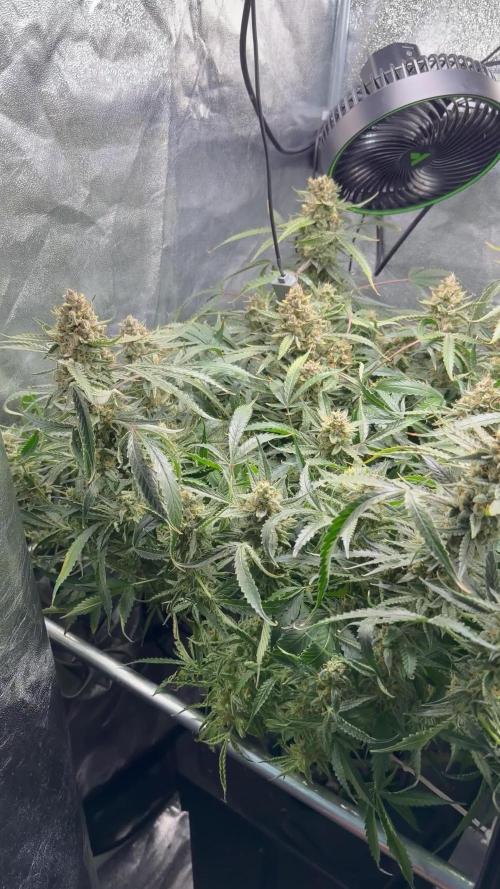
Still looking Good .. Buds Looking good
Added some big bloom in last week… got some yellow fan leaves on it.. believe the Ph is off
Sticking with 13-14 weeks before harvest time

Likes
47
Share


@Ultraviolet
Follow
The cannabis strain Grape Guava can be a purple strain, depending on its specific phenotype and genetic makeup. While not all phenotypes of Grape Guava are purple, some variations, such as the Zatix Grape Guava, are noted for their striking purple appearance due to the genetic expression of anthocyanin pigments.
https://www.youtube.com/watch?v=cKdVmdoKJ5k
In a garden of green, Grape Guava gleams,
With its fruity aroma, enchanting dreams.
Clusters of grapes, guava's sweetness ignite,
A strain so divine, in purple and white.
Euphoria whispers, a lush fruity haze,
Grape Guava's embrace, a tranquil daze.
Off and away.@1400ppm. The increased CO2 allows plants to thrive at higher temperatures, which in turn necessitates higher humidity to maintain the ideal VPD for healthy growth and transpiration. 80F -5F = 75F LST with 70% RH = 0.72 kPa. Higher temperatures and humidity promote rapid growth, nutrient uptake, and photosynthesis while maintaining a lower stress level. Temperature influences the rate of enzymatic reactions involved in aerobic respiration. Enzymes, such as those involved in glycolysis, the Krebs cycle, and the electron transport chain, work most efficiently at an optimal temperature range. In low temperatures, enzymatic activity will slow down, thus reducing the rate of aerobic respiration. In high temperatures, enzymes can become denatured, thus impairing their function and stopping the process of aerobic respiration. Glucose is the primary fuel for aerobic respiration. The rate of aerobic respiration increases with the availability of glucose, as it is the starting point for glycolysis. If glucose levels are low, cells may rely on alternative energy sources such as fatty acids or amino acids , but these processes may yield less ATP or be less efficient. To determine this effect, carbon dioxide volume was measured (as carbon dioxide is an output of aerobic respiration)
18/6 with the 6 being IR. The near infrared (IR-a) borders around 700nm up to 1400nm @ photon par flux density of 1.8 instead of darkness, keeping temps overnight a neat 77F-80F.
Think of my tent as a lung. What goes in must come out. When the rate of air going out exceeds the amount of air coming in, it creates a negative pressure. Tent concaves (bends in). If set up correctly, your RH will begin to drop slowly to the desired level you set, and the extraction turns off when it reaches desired% RH. The plant, as it performs cellular respiration, will always be releasing more water into the air, so the RH% of the tent overnight will always increase, so long as oxidative phosphorylation is occurring. As soon as the RH% creeps back up to 55%, the extraction turns back on, over and over. This creates a strong pressure differential which will work wonders on your grow. Replicating high and low-pressure fronts in nature. Critical for oxygen diffusion at the critical time of peak cellular respiratory function..
Moisture will not transfer from a saturated atmosphere to another if that air is already at or above its saturation point, meaning the air can't hold any more water vapor. Once I understood that water is produced as a by product during cellular respiration, specifically at the very end of the electron transport chain (ETC) where electrons are finally transferred to molecular oxygen, the higher the RH of the air, the more resistance there is for more moisture to be added to that environment, and effects the ease with which it does so. But none of that water comes from the pot; it's pulled from the air. If you run high daytime RH, your medium/pot is 100% reliant on transpirational root pull to move water. ZERO evaporation happens across the atmosphere if the tent air has high RH%, the medium cannot release its water through evaporation. Once a canopy develops, light no longer slowly wicks and evaporates from the topsoil. The Soil-Plant-Atmosphere Continuum (SPAC) describes the continuous pathway and process of water movement, driven by a gradient in water potential, from the soil, through the plant's roots, stem, and leaves, and finally evaporating into the atmosphere through transpiration. There is evaporation, there is transpiration, and then there is evapotranspiration; Evapotranspiration (ET) is the combined total of two processes: evaporation (water lost directly from soil and surface water into the atmosphere) and transpiration (water released from plants to the atmosphere through their leaves). Evapotranspiration represents the total amount of water that moves from the medium into the air. There is no such thing as a medium with too much water, only a medium that retains too much for too long.
The water must always flow efficiently from one atmosphere(Medium) to another(Air) in a timely manner. Moisture is a critical factor for bacterial growth and decay. Dictating how long it's allowed to sit in any one location for any given period is a key preferred control. To ensure a net reduction in a bacterial population, the rate of removal (ET) must exceed the rate of bacterial growth (decay rate), which is often modeled as a growth rate for the specific bacterium under the given conditions. By optimizing daytime VPD, we also optimize conditions for bacterial growth to explode exponentially above 77°F.. If water is allowed to sit in a medium without an escape within a timeframe, nothing good will happen. IF High RH is maintained overnight as well as during the day, placing 100% of water movement at the behest of daytime transpiration, roots can only pull where they can reach, and if soil is compressed above a certain point, moisture will become trapped in a medium with no way of moving day or night. This will begin the countdown for decay to take hold. When water stagnates in a medium, it loses oxygen, creating anaerobic conditions that foster the growth of harmful microorganisms like bacteria and fungi, which can produce toxins and disease vectors.
Thigmomorphogenesis, the process by which plants respond to mechanical stimuli like touch by altering their growth and development, results in significant morphological changes to improve survival against mechanical perturbations. This complex response involves sensing touch and initiating physiological and genetic responses, leading to changes in form and structure over days or weeks. The process is triggered by physical forces such as wind, rain, or touch. Plants adapt to these stimuli by changing their shape and structure, which may include slower growth, thickened stems, or altered leaf development. Plants possess sophisticated mechanisms to detect even subtle mechanical stimuli and initiate responses. A variety of molecules, including calcium ions, jasmonates, ethylene, and nitric oxide, are involved in signaling these mechanical inputs. Touch can induce the expression of genes that encode proteins for calcium sensing, cell wall modification, and defense mechanisms. A plant exposed to constant wind may become shorter and sturdier. A plant that is touched frequently might grow more slowly to conserve energy and develop thicker cell walls. These changes increase a plant's resilience and ability to survive in harsh environments.
Let's get Thiggy with it.
Likes
21
Share


@Stash074
Follow
This week was good. Its been a week since I made the flip..the ladies are already starting their stretch. Pistils are showing up all over the ladies, which is a good sign of stable genetics being that I used feminized seeds. Right now I am giving them the transition stage feeding schedule. This will be my 1st time using bloom booster, I intend to start adding kool bloom to the feedings this week. Also I increased the intensity of the grow light to 100% Yesterday. I will keep yall updated in my next upload 😎🍃
Likes
13
Share


@DeepSouthDank
Follow
Super happy with how everything is looking, conditions are perfect, and not an problem in sight! Should be an epic run ✊
Scrog and Fleunce Spydr 650watt are installed and we are intiating the flowering cycle on Sunday October 1st. Took 10 cuts this morning from some of the bigger girls to help shape canopy.
These girls flower fast! Big Budzzz in-coming 😁👌

Likes
46
Share


@Daweed83
Follow
Gave them nutrients for half of the week and started to flush. Want to have a good flush on them as my last plants were a bit harsh in taste. Super excited even tho I see now so deficencies but well... im flushing so i guess its normal. Let me know if not 🙏🏽🖖🏽


Processing
Likes
5
Share


@PETEROG
Follow
Hey guys everything is going great with these ladies all 6 germinated and popped up in 3 days after planting 1 of the six shooters is a lot smaller than its sisters so I've order LEMON PIE from FASTBUDS should be here tomorrow to take its place and I'm going to move the six shooter outside so if you would like to see its journey comment and like bellow ⤵️
The only thing I wish I did differently would of been starting these girls under a cfl or a cheap led to stop stretching but lesson learned if anyone has any question's please comment and thank-you all for your support ✌️


Likes
31
Share


@The_Doctor_Green
Follow
Como se puede ver al dia de la fecha (19/01) las plantas de macetas vienen creciendo con un problemita,que no sé cual es, pero las hojas algunas están tomando un color amarillo.
Pensando que puede ser una carencia, le suministre 2 ml x litro de agua de oro negro de namaste, en los próximos días tendré que ver los resultados para ver si mejoran.
Con respecto a la planta de la tierra, viene creciendo bien y fuerte, doble sus puntas principales para que crezca más horizontal.



Likes
47
Share


@GWSD82
Follow
First week into flower, and everything looking good :) She has transitioned and begun pre-flowering, just starting to stretch a little and throw pistils. Feeding MegaCrop currently @ 6g a gallon and Bud Explosion @ 0.5g a gallon. Will increase the BE to around 1g a gallon by the end of this coming week. EC is now sitting at 2.1.
I've increased the PH of the nutes ready for flowering - increased from 5.8 to 6.2, so it is better conditions for the uptake of the P and K that are now in the mix. Will reduce N levels eventually, once the stretch has finished.
The scrog net has filled out well, exposing plenty of bud sites which are now just beginning to become more prominent.
I have been slowly increasing the light power since she has been in the tent and we are now fully blazing at max. She is drinking around about 3 liters a day from the res. She is looking very vibrant and healthy, so fingers crossed for a nice smooth grow!
:)

Likes
15
Share


@the_big_pink_place
Follow
01/10/22 Everything is Going good, which means something bad is going to happen. Plants were 9 inches at the end of week 4 on day one of week 5 they were topped and defoliated which brought the height to 4.5 inches, So after the shock of having there tops removed they grew 4 inches in one week. Extremely happy I'm keeping track.01/13/22 Defoliated and LST'D the plants.01/14/22 Adjusted LST , removed all branches growing on the underside to allow for proper Growth of other branches. Fingers crossed this should be a decent harvest flipping on week 9.

Likes
Comments
Share


@chuggerguy
Follow
I'm too inexperienced to say for sure but to me, the colas seem to be thickening. The harvest will probably be more than I can smoke. Quality? I don't know anything about the strain. With naked eye, I can't see the snow/sugar like I could on my previous grow. Perhaps it's the color? Lack of contrast? Everything has a yellowish hue? Trying to use a magnifier, trichomes seem abundant though.
Hairs are still mostly yellow so I'm still going on the assumption that until the hairs darken, I don't have to worry about trichome color because it's not even close?
Although the plants have probably grown better, produced more than the autos in my first grow, I'm getting impatient.
Likes
5
Share


@Staffedition
Follow
Привет друзья!
Вот и прошла ещё одна неделя.
На мой взгляд растение развивается не много медленней, чем положено.
Вчера начал кормить, посмотрю на динамику.
Всем мира и добра!
Likes
19
Share


@emeraldlabs
Follow
Second topping on day 28! 1 more to go!
Will include all details once done with topping (going for mainline).
Photos/video taken 28 days after breaking soil.


