


Likes
Comments
Share


Likes
16
Share


@DrAnandamida
Follow
Esta semana se nota el estallido de la floración. Los pistilos van cogiendo vigor y tamaño. Las flores continúan oscureciendo e incluso las hojas y sus tallos van adquiriendo ese color rojizo/púrpura. 🌿 El tallo tiene un tamaño y consistencia considerable, lo que le está permitiendo resistir algunas rachas de viento sin excesivo problemas y sin necesidad de soportes o guías (por el momento). Se perciben un poco mejor los aromas de las floración, aunque siguen siendo débil. Una ya ha alcanzado los 36cm y la otra 40cm. Seguimos aumentamos la cantidad de agua, progresivamente, según van pidiendo/necesitando las plantas.
Sigo intentando no utilizar ningún tipo de "ayuda extra", salvo la tierra enriquecida de @BioBizz All-Mix donde están plantadas. Así que por ahora; agua mineral, luz solar, mucha paciencia y mucho amor!🤞😍

Likes
8
Share


@HowtoBubatz
Follow
The plants are doing amazing! Both are producing more and more trichomes, and the buds are noticeably thickening up.🌱
#1 (the tall one) continues to impress—it’s now giving off a strong tropical mango scent! The aroma is so sweet and fruity, it’s crazy.
Meanwhile, #2, despite being so small, has developed a surprisingly large main bud!
The smell is completely different, though—leaning more towards a hazy, complex scent that’s hard to describe.🤔
Super happy with the progress so far—let’s see what the next weeks bring!😊

Likes
12
Share


@420DeepGrow
Follow
Gracias al equipo de Sweet Seeds y XpertNutrients sin ellos esto no sería posible.
🍁💐 Permanent Jealousy XXL Auto:
Autofloreciente de tamaño extragrande que nace de la unión de dos genéticas excepcionales: Permanent Marker, ganadora de múltiples premios, y nuestra exquisita Jealousy Z XL Auto (SWS108). El resultado es una planta de gran tamaño, vigorosa y productiva, con cogollos densos cargados de resina, ideal para extracciones. El perfil terpénico de Permanent Jealousy XL Auto es complejo y cautivador, con matices cítricos, mentolados y amaderados. Prepárate para una experiencia sensorial única con un efecto equilibrado que te proporcionará euforia tranquila, felicidad y creatividad.
📆 Semana 1
Esta semana ha sido un poco difícil para su desarrollo debido a las condiciones climáticas. No ha acompañado mucho el tiempo y, aunque las temperaturas no han sido las ideales, he intentado mantenerla lo más estable posible. A pesar de esto, la planta muestra signos de adaptación y aunque el crecimiento no ha sido tan rápido como esperaba, confío en que mejorará cuando las condiciones se estabilicen.
Estaré atento/a a su progreso en las próximas semanas, espero que la cosa se ponga mejor pronto☀️🙏.
Processing
Likes
13
Share


@Cheesefarmer420
Follow
Another week done, finished up week 6 of flowering, week 10 of the whole grow. The buds are continuing to fatten up, inching closer and closer to harvest. Noticed the first few Amber tricombs on some of the upper buds, going to be leaning off the big bud and switching to overdrive to help aid in ripening and the final bulk. I’d like the run them another 4 weeks giving them a full 9-10 weeks in flower. But will judge harvest on a near 45/55 or 50/50, Cloudy/amber tricomb production.


Likes
6
Share


@MrPipi
Follow
Day 91: Tuesday , start of the 14th Week.
nothing crazy happened the last Days.
Day94: Gave her some Molasses. next watering maybe some liquid N , cause leafs start yellowing but i think she´s not close to harvest yet...so just a little bit, before we flush in about 1-2weeks
Likes
66
Share


@Earthling37
Follow
77 Days have passed.
Heatwave in my country, so im just relaxing and enjoying life.
- I hope you do too!
Did a heavy defoliation, gonna be making some nutritious fruit smoothies with that.
- 2 week ish before i switch to flower.
---1st time growing with FLO - Florian Living Organics.---
They claim that there is no need to pH when watering and that their living fertilizer is the only thing that i will need throughout the whole grow so i only need to mix with soil and just water with plain water.
If this stuff works then it can simplify my future grows ALOT!
Happy growing. 😎

Likes
12
Share


@Toohighbro
Follow
What can i say the grows going well, other than the CK bud being 2 weeks behind the haze and sad! :)


Likes
4
Share

@The_Doctor_Green
Follow
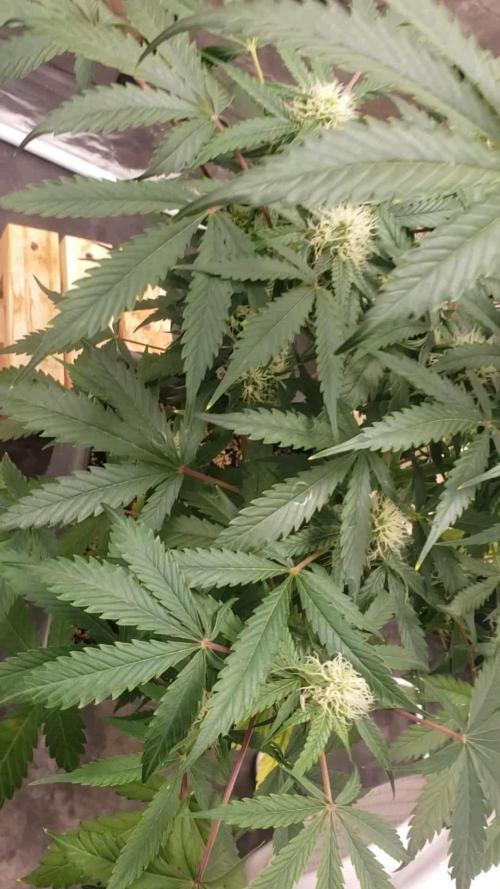
Hola a todos!!
Esta semana prácticamente no he fertilizado, ya que luego de un breve lavado note que los valores de ppm aun seguían siendo alto..(1700...1800), entonces segui regando solo con agua, con bajas ppm 500 ppm aprox.
Recien ayer logre bajar las ppm , no asi el ph, del drenaje, me viene dando 7.2, pero a pesar de todos estos inconvenientes, a la planta se la ve engordando los cogollos.En esta semana se estiro 1.5 cms solamente, pero los cogollos están creciendo de buena manera.
El lavado lo hice el día 44 con 7 litros de agua con ph 6 y ppm 500, luego de un buen rato de drenaje medi y en ese entonces parecían haberse corregidos, pero al siguiente riego dia 46( lo hice con 2lts de agua) me volvió a dar valores altos. Para no generar un mal ambiente para la planta, la deja descansar 2 días, y ayer (dia48) volvi a regar y al fin las ppm han bajado a 900, el ph aun sigue dando alto, pero como mencione antes la planta demuestra que cualquier inexperto la puede cultivar, porque se aguanta todo ese stress😅😅 .
Aun no sé distingue sus sabores, pero sus hojas ya se están cargando de resina..


Likes
26
Share

@Targona
Follow
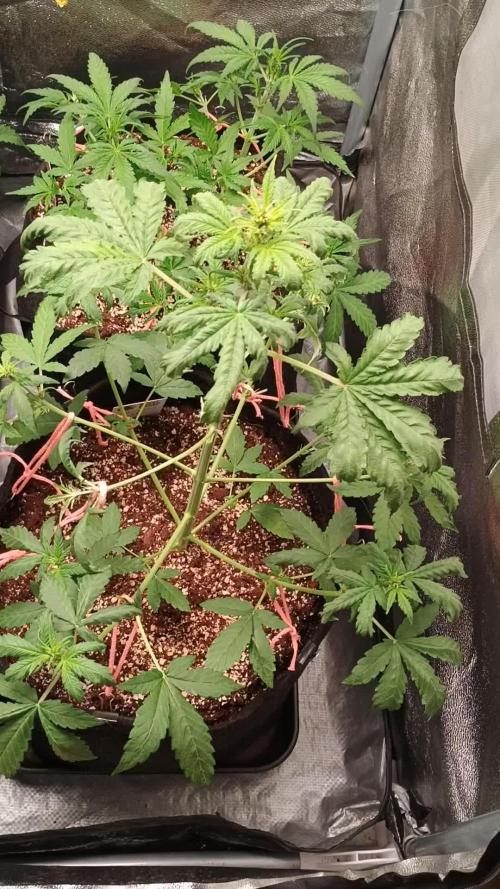
22 days since my little girl sprouted from a seed🌱
Third week of growth for my Purplematic CBD Auto ⚕️💚💜
Nutrients:
Plagron Alga Bloom is an organic flower fertilizer for growing in soil. The fertilizer is based on algae and contains amino acids, proteins and a balanced ratio of phosphorus and potassium 🌺
----------------------------------------------------------------------------------------------------
Plagron Green Sensation is a flower booster. Green Sensation is a 4-in-1 product, so you don't need to add additional fertilizers. Suitable for all types of substrates and systems 💚💜💚
-------------------------------------------------------------------------------------------------------------------
Bud Candy is a carbohydrate supplement from Advanced Nutrients that maximizes the growth and aroma of flowers. It supports strong root activity by providing food for beneficial microorganisms
-------------------------------------------------------------------------------------------------------------------
BioBizz Calmag is a 100% organic, but also vegan-friendly fertilizer with BIO certification. Biobizz Calmag was designed for professional growers and home growers who need an extra dose of calcium and magnesium. It contains added humic acid 💩☘️- I only apply it once a week.
---------------------------------------------
Biobizz Bio pH-/ Biobizz Bio pH+ is a 100% natural and vegan-friendly pH regulator. Suitable for all types of substrates and crop types. For use in growth and flowering. 💩🍋🌱
-------------------------------------------------------
PRO-MIX CONNECT MYCORRHIZAL POWDER - in the substrate
General:
Purplematic CBD Auto ⚕️💚💜
The plant is already strongly transitioning to flowering, beautiful white pistils are forming on the tops 🌺 Above I listed the nutrients I switched to during this period. Anyway, I stick to organics, except for the bloom booster, which is about half organic.
This week - the third week - in most cases, she does LST and defoliation twice 🍃 🌿
The girl has very curled leaves down, they practically grow like that. I have no idea how it could have happened. She is not even overwatered, there are no problems with nitrogen and I measure the ph and ec regularly and she is fine. All the other girls in the tent look good, only this one is like that 😢💚💜. It looks like there will not be much of a harvest, probably unstable seed, that happens. But I am sorry because I use pure CBD to make tinctures.
I use the new PH and EC meter Aqua Master Tools P110 PRO, the measurement is fast and accurate. So far I have managed to keep the PH and EC as they should be. I use Biobizz Bio +/- to correct. These are excellent products.
I think that the plants are definitely very well affected by the spraying of the Vita-Race preparation and the excellent PRO-MIX Connect Mycorrhizal powder to support the roots. All the girls are very strong and stable since they were little 💚
Training:
As I mentioned above, I did the first LST and defoliation, the plants usually quickly re-leaf, other branches will grow quickly. So in this third week I do two defoliations and two LSTs 🍃🌿 🌺
But I didn't cut this plant much, it doesn't have many leaves and I need it to go well for photo shoots
The girls grow in a tent:
Mammoth Pro+ 80, with reinforced reflective Mylar 600D foil
Lighting:
Mars Hydro TS1000, this light is sufficient for lighting in my growing space. The plants respond effectively and the light is technically very well managed - I try to have 50cm between the light and the plants, so I regularly move it up.
Mars Hydro TS1000 Quantum Board 💡💡💡
Power: 148W
Dimensions: 90 x 90 cm
Dimensions: 360 x 330 x 34 mm
Chip brand: Epistar
Thanks for the likes
See you soon 😍😻
Likes
45
Share


@chapadux420r
Follow
Hello guys!
So it’s the end of week 2 of flowering and all is going well. Been watering every 2 days and, as you can see, we have white pistils and small buds in every plant
Not much to say, the ladys are green, stretching and growing buds as it should
Yesterday i’ve defoliated one of the critical + 2.0 clone and next week I’m going to defoliate the rest of the plants. Just wanted to test when it is better to do the defoliation so it’s kind of an experiment
Tell me what do you think of how this is going


Likes
10
Share


@Big0zGrower420
Follow
Here we go, just about done now. Looking to harvest around the 30th. Smells great and is looking great as well
Likes
1
Share


@zzzzzzz064
Follow
On week 2 the woolrock got some mohoo, i fixed it by putting water mixed with "safe roots" from Hydrotek directly into the rockwool superfice.
After a couple days that problem was solved and the plant kept growing very well.
And also i started to train the plants (lst)
Likes
11
Share


@CanadianFillmore
Follow
Start of week 2 flowering. This girl is hungrier than her round 1 sister. Probably because of the extra veg time, she has developed more root and plant mass that needs more nutrients. The plant itself is growing nicely, stretching out too! Looks good so far!

Likes
72
Share


@Schnabeldino
Follow
_____ Week 7 | Day 49 - 56 ______
Day 49 🌞
- Install 2 LED BARS from Spider-Farmer.
Day 50 🌞💧
💧- 2 Liter each Plant....gluck, gluck, gluck....
Day 53 🌞✂️🌤️
🌤️ - light switch to 12/12
✂️- defoliation all leafs under the net
Day 55 🌞💧
💧- 2,5 Liter each plant
____________________________________________________________________________________________
Light - 18/6 h - 400 Watt 60% Dim.
PPFD - 600 - 650 µmol
Temp. avg. - 22,1°
Hum. avg. - 72 % RLH
Likes
33
Share


@Rollex420
Follow
Here we go!
Day 1
Kosher cake 15-05-21
Today for her, is the first day under the light 🙌🏻
I hope she grows up healthy and strong.
I added a quarter of Biobizz's recommended dose of Root-Juice (1ml / L)
I start to give less, and then increase in the next few days so as not to be aggressive with the baby. 👶🌱
I will be uploading new updates soon!
Day 2 16-05-21
..There is not much to say, the plant continues to grow and seems to like his little house 😋
Day 3 17-05-21
The girl is loving her life! 🌱💚
today I added (1g/1L) of Micro-vita to the recipe, to ensure that it is able to assimilate better nutrients and it has beneficial bacteria and fungi available for the protection of roots and for general plants growth.
I also added a quarter of the prescribed dose of bio-heaven (0.5ml/1L) to start with the amino acids ..
we are still at the beginning but surely he had a great start!
see you at the next update! 😊
Happy growing to everyone! ☮️💚
Day 5 19-05-21
Looking great 😊
She’s growing fast..
I also added some cal-mag (0.8ml/1L)
To start the prevention of calcium and magnesium deficiencies.
Positive vibes to everyone! ☮️💚
Day 6 20-05-21
The little Kosher is doing well.
she’s almost close to have spent a week in the grow tent..
Now the hypothesis would be to leave her inside another week and then move her outside, I still have to decide where she will go but I have various options to choose from..
We will see what to do on the next week
☺️
As always, Happy growing! ☮️💚
Day 7
Today is the last day of the first week for Kosher Cake, she spent it well and without problems.
I added Biobizz Acti-vera to the recipe
(1ml / 1L) to be used in foliar solution by spraying it above and below the leaves of the seedling.
For now there is nothing more to say ..
Have a good weekend, relieve yourself and relax. Peace to all ☮️💚
Likes
18
Share

@SundancerS
Follow
Die Pink Rozay von Zamnesia ist zurück und dieses Mal sind wir fest entschlossen, ihr den Regen zu ersparen! 2024 haben wir sie mit etwas zu viel Outdoor-Charme und leider etwas zu viel Regen gequält. Aber neues Jahr, neues Glück und diesmal geht's besser, und wir sind bereit, der Kämpferin die besten Bedingungen zu bieten. Sie hat uns 4 Tage warten lassen, um dann endlich zu keimen und das war, ehrlich gesagt, ein erleichternder Moment.
Mit 100% recycelter Erde und ein wenig Green House Pulver und Dünger für den einfachen Einstieg, wollen wir es diesmal richtig machen. Die ersten Hürden hat sie schon gemeistert. Die Pflanze hat zwar noch ein bisschen Schwierigkeiten, sich vom Samen zu befreien, aber wir wissen: Sie ist zäh! Eine echte Überlebenskünstlerin, die mit jedem Tag stärker wird.
Wir sind schon richtig gespannt, wie sie sich entwickelt und hoffen auf gutes Wetter und nicht zu viel Regen, ein bisschen Sonne, und dann steht unserem Erfolg nichts mehr im Weg! Die zweite Pflanze für unser Outdoor-Projekt 2026 ist also am Start und wir können es kaum erwarten, zu sehen, was sie drauf hat. Neues Projekt, neues Glück und wir sind mit voller Motivation dabei!😊


