





@deFharo
Volgen
Bienvenidos cultivadores de marihuana clandestinos, y también a los que tienen la fortuna de no serlo! 👨🌾💦💡🌞🌲
- Purple Shot es el resultado del cruce entre Purple punch, Do-si-dos y Exotic colors (75% Indica /25% Sativa). Variedad de floración rápida, terminando en 8 semanas, de porte robusto y flores muy densas, repletas de resina... completamente de acuerdo! 😋
3M Ω Ʈիҽ Ңɑppỿ ƓrѳωԵի, es una deuda que tenía con esta cepa, un cultivo predestinado al éxito, un diario de cultivo minimalista, no exento de ironía, pero también un auto tributo, porque no tengo abuela, al esfuerzo y concentración de mis 3 años de experiencias orgánicas, donde no faltaron enormes fracasos, y donde hoy, la inseguridad ha dado paso al sosiego... y todo esto, sin soltar el porro de la mano!😈✌️
Bienaventurada la quinta semana de floración, dichosas las diez semanas desde semilla, ella bebe mucho y yo le doy todo lo que necesita, estamos en la misma onda!... que suene la música!!
Y nada más...
SALUDOS A TODOS!!🖐️👨🌾💧💦🌞💡
=================================


@Beardacious_buds
Volgen
Packing it on. Starting to color up. Anvil already showing her beautiful colors. Aliens Berries is a shorty and not getting as much light and starting to get a little airy… way she goes.







@hinterhofgrower
Volgen
🌱 : Partial harvest on day 80
💧 : Flush with 5l H2O on Day 80, 4l
💡 : Dli: 45 mol/m²/d
🤔 :


@Ninjabuds
Volgen
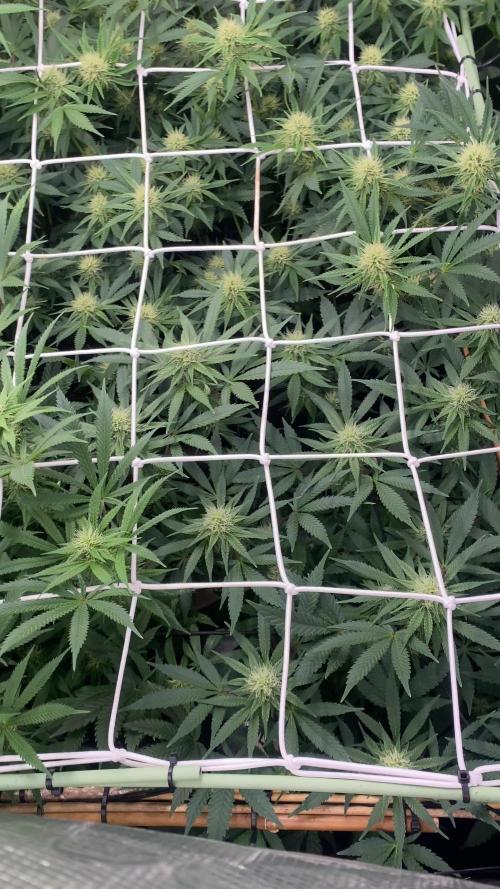
My Soaptini plant is looking amazing! The leaves are a really vibrant green, and they have this cool, almost waxy texture that makes them look super healthy. It's growing nice and bushy, and I'm loving the overall shape. This one's definitely a showstopper, and I can't wait to see how it blooms. Stay tuned for more updates on this beauty!
The weather has been absolutely gorgeous this past week! We've been hitting that sweet spot of 70 degrees during the day, perfect for getting outside and soaking up some sun. Then, it cools down to a comfy 50 degrees at night, which is ideal for sleeping with the windows open. I've been loving all the fresh air!
I finally got around to building that little wooden planter for my windowsill. It was a fun project, and now my regular plants have a nice new home. It really brightens up the room, and I'm thinking of adding some herbs to it soon. Maybe I'll even try growing some basil!




@Diips
Volgen
day 29 - 11/12/2025
all looking fine in the tent. didnt have time this morning to feed/water, but i will do it later today once i get home. they will take it, and leave less chance of mold.
stacking nicely, i will gradually raise the light intensity as the days go, to buildup for max intensity.
bless


@Hashy
Volgen
********************************************
Week 5 Veg.
********************************************
Light cycle=18/6
Light Power=120w 50%
Extractor controller settings
High temp= Day 25c, Night 20c
Low temp= c
Temp step=0c
High Rh= Day 58%, Night 62%
Low Rh= %
Rh step=0%
Speed max=9
Speed min=2
Smart controller settings (during lights on).
Lights on=4.00am
Top fan on=+23.5c
Top fan off=-23.0c
Dehumidifier on= +60%
Dehumidifier off= -55%
Smart controller settings (during lights off).
Lights off=10.00pm
VPD aim=0.6-1.3
DLI aim=30-40
EC aim=0.2-2.0
PH aim=6.0-6.8
NPK(26-8-17)
💧💧💧💧💧💧💧💧💧💧💧💧💧💧💧💧
Method= Autofeed 6 drippers.
Feed=Veg Nutes.
Neutralise=0.1ml/L
Grow=4.0ml/L
Roots=0.2ml/L
Silicon=1.0ml/L
Calmag=1.0ml/L
Volume=9L
Easy Ph down= 0.125ml/L
Ec=2.0 PH=6.4/6.1
Runs=13
Run times=4min (240ml each)
Gap times=16min
Total runtime=52mins (3.1L each)
Total flowrate= 120ml/min (60ml/min each)
Auto start time=5.00am
Auto stop time=9.04am
💧💧💧💧💧💧💧💧💧💧💧💧💧💧💧💧
********************************************
📅16/6/24 Sunday (day 29)
📋 Still thinking about removing lower nodes.
📅17/6/24 Monday (day 30)
📋 Looks like weather is getting warmer.
📅18/6/24 Tuesday (day 31)
📋 Remove lowest nodes and fan leafs. LST. Looks strong.
📅19/6/24 Wednesday (day 32)
📋 Got feeds out of sync this should have been a watering.
💧💧💧💧💧💧💧💧💧💧💧💧💧💧💧💧
Method= automatic
Feed=Nutes veg
Volume=9L
Ec=2.0PH=6.4/
Volume left=3.5L
Volume used=5.5L (120ml/min)
Volume each=2.75L (60ml/min)
Runoff.
Total runoff=0L
Ec= PH=
💧💧💧💧💧💧💧💧💧💧💧💧💧💧💧💧
📅20/6/24 Thursday (day 33)
📋 Lst
very hot day.
📅21/6/24 Friday (day 34)
📋 Hot again, I'm going to have to start prepping for summer.
📅22/6/24 Saturday (day 35)
📋 H=33cm D=37cm Dli=30.6 Ppfd=472
Got signs of stress on the tips probably overfed from 2 feeds in a row.
💧💧💧💧💧💧💧💧💧💧💧💧💧💧💧💧
Method= automatic (4 extra runs).
Feed=water
Volume=10L
Ec=0.2 PH=6.3/6.5 (PH D=0.012ml/L)
Volume left=1.5L
Volume used=8.5L (120ml/min)
Volume each=4.25L (60ml/min)
Runoff.
Total runoff=0L
Ec= PH=
💧💧💧💧💧💧💧💧💧💧💧💧💧💧💧💧
Then 0.75L manually.
Total 5L water with 100ml runoff.
EC 3.7 PH 5.9
********************************************
Weekly roundup.
📋 She's been trained this week and is looking very strong and ready to be flipped into flower. The only problem so far is the mix up in feed/water which she's showing with her tips, but she should be fine. I'm holding off flipping to flower until the other plant gets a little stronger. The weather shifted this week and temps have started to rise.
Take it easy.
Back soon.
********************************************


@MicroHidroGrow
Volgen
Día 36.
Estamos en 6ta semana. Los esquejes se atrasaron debido a que han sido días muy fríos y no he logrado enraizarlos. Decidí poner el extractor de aire junto con la bomba de aire, así solamente se prende 15 minutos cada hora. Así estoy logrando temperaturas mayores a 24°C en el indoor y así voy a lograr el enraizado. La planta ya tiene un tamaño que ocupa casi todo el indoor. Pero lo importante es que la voy guiando y ya estoy proyectando como va a ir cada rama. El tamaño va a exceder lo que esperaba, pero aún así creo que si logro lo que tengo en mente, voy a sacar muy buenos resultados. Igual no me voy a arriesgar demasiado, así que si contando 10 días desde ahora, no logro que los esquejes enraicen, voy a pasar la madre a floración sola. Cómo pueden ver, las ramas están bastante gruesas, y el la ramificaciones van ganando su lugar cada una. Las raíces son demasiado grandes, aunque sé que voy a poder poner la planta en el sistema de arriba igual, aunque me voy a tener que ayudar de algo para meterlas. Es importante no utilizar las manos, ya que se pueden transmitir muchos hongos.
Voy a seguir actualizando e ir viendo que pasa. Pero ya estamos en los últimos días de crecimiento, haya o no esquejes. Incluso puede que ya pase la planta al indoor de arriba para darle mayor libertad de crecimiento. Esto me va a servir para tlmar en cuenta en la próxima camada que se vendrá. La idea de esto es hacer las cosas rápido, y no en gran tamaño. Pero siendo que ya estoy en el baile, no me queda otra que bailar.
Día 40
Los esquejes no estaban enraizando, así que decidí cambiarlos de lugar y los puse arriba de la luz, donde les da calor y luz tenue. Espero que ahora si agarren.
Y hoy fue el gran día, pasé la planta madre al módulo de arriba. Pero lo voy a dejar una semana más creciendo. De esa forma veo si los esquejes llegan a agarrar a tiempo. Y además tuve un problema en el trasplante. Primero que la planta se hizo más grande que lo esperado, y la raíz también. Cuando la pasé, hubo contacto de la raiz con prácticamente todo lo que había cerca. Sumado a que se enredó en el oxigenador, así que quedó una pidra difusora en la raíz.
Dado el alto riesgo de haberla contaminado con algún hongo, le puse una solución de agua con agua oxigenada, recirculando continuamente, para lavar las raices y de paso bajar el stress de teansplante. Mañana veremos cómo arranca el día.
En el aprendizaje me llevo que en la madre, es mejor hacer un corte en el primer nudo, o dejar las ramas del segundo y quitar las del primero. Y así que queden sólo dos ramas, para luego dejar a los esquejes en el medio. Eso planeo hacer con la próxima variedad.
Entre tanto ahora sólo me preocupa que la raíz no se haya contaminado en el traspaso. Ya en 8 días estaré pasando a floración si no hay esquejes. Si llegan a agarrar, habrá que dar unos días de crecimiento hasta que alcancen a la madre en altura. Pero ya está todo en definición. Ahora sólo queda esperar y seguir guiando a la planta. Ya tengo ganas de poner la próxima, pero falta bastante para eso. Tengo 10 semanas de flora, así que recién en 5 semanas voy a poner la nueva madre.


@FrontRowAG_BrianG
Volgen
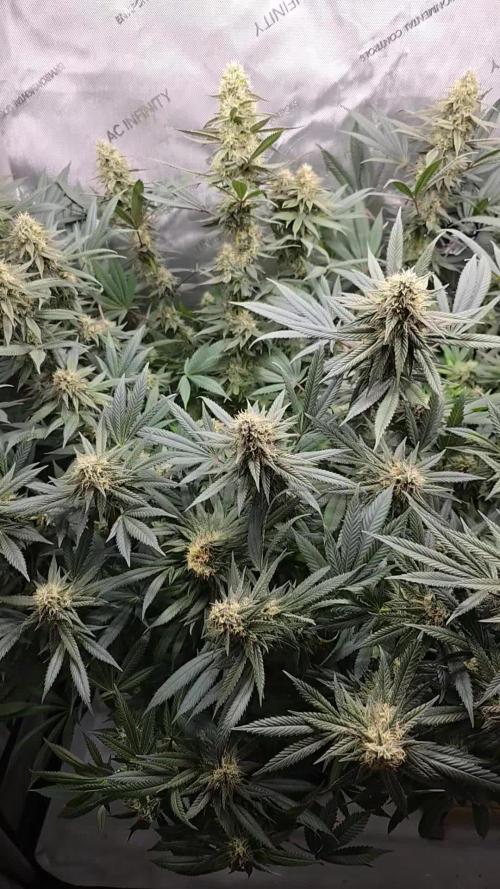
I apologize upfront for all the photos. It was hard to pick which ones to upload, so I picked a good variety.
There is gonna be between 4-6 pounds once dried/cured. These were all super dense and very little larf.
This was a higher temp/higher humidity run with lots of co2 and they blew up big. It’s been a minute since I’ve grown a cola or 2 that were bigger than my arm…this time there was dozens of them.
Each plant was only topped one time. The temps were usually mid 80’s and humidity in the mid 60’s during flower. This might seem high to some, but learning to apply VPD to a grow should not be trial and error, in other words, this was intentional. It’s not risky either. During the first 6 to 7 weeks of flower it is very important to not let your night time temps to go below 75 degrees. POWDERY MILDEW=LOW TEMPS AND HIGH HUMIDITY. Take one of these away and there will not be any powdery mildew! Do not let your temps go below 75! The last 2 weeks I dropped the humidity to 40% and my night temps to mid 60’s for resin production.
A couple of thing one should have to create large buds is a temperature gun(for leaf temp), a par meter and co2. Keep the stomata open and feed lots of co2=huge buds. Learn about VPD and not just a quick google search!
When it’s dry and cured I’ll be back for an update on weight, taste and effects. Currently the plants are drying in the room at 60 degrees and 60% humidity until I can get in there to trim them. Might be 2-3 weeks.
Thanks again for all the likes and comments!






@Smev1337
Volgen
hey all! these 2 ladys are giving really good power off 💪everything is going good and nothing is going bad so far hehe just the plant is developing so big buds that she is starting to tip over so i need to stabilize her before she goes all bendy downwards lmao 😂 happy growing all 😎💚✌️

@deseed_uy
Volgen
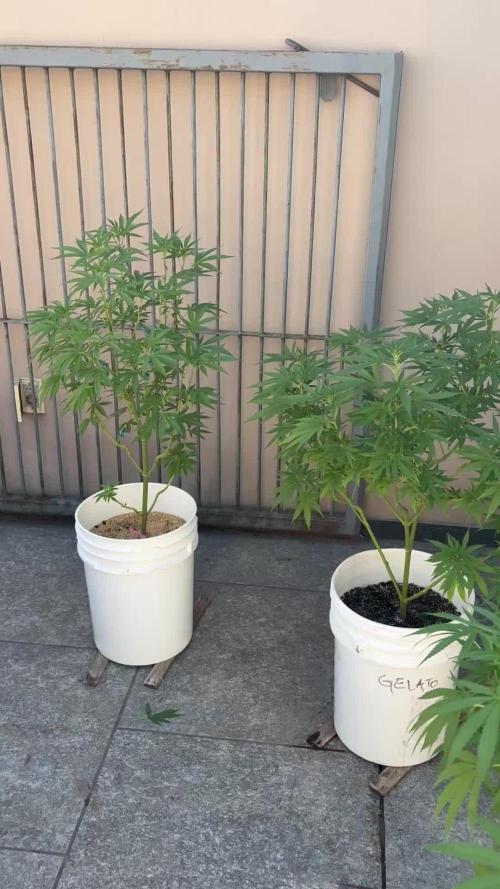
La hermosa bike😻 durante el vege fue todo un tema mantenerla feliz pero ahora es otra cosa, le hice defoliacion hace dos semanas cuando la pase a la oscuridad y hoy ya deberia hacerle de nuevo, ha estirado una locura para arriba 😏



@GoodTimesOrganics
Volgen
Hi liebe Community and Welcome Back! 🌿💚
Willkommen zur siebten vergangenen Blütewoche! Blütetag 57
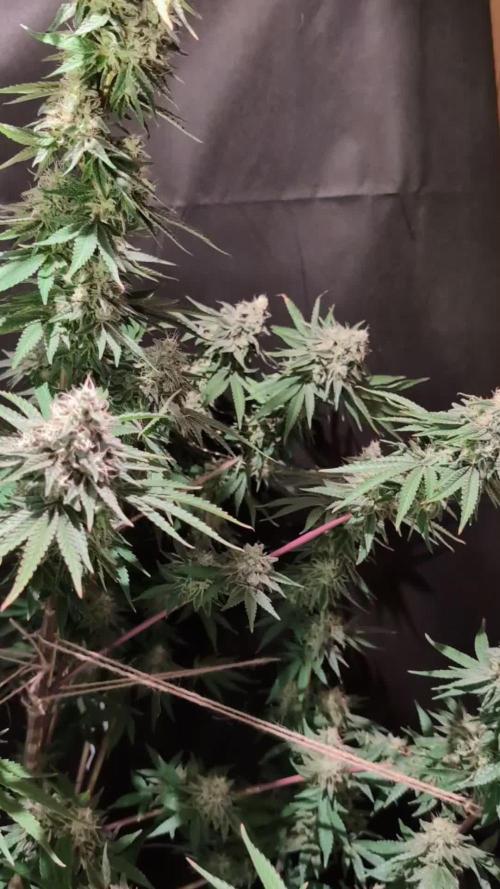
Insgesamt zeigt sich hier in diesem Grow eine stärkere Blütenausbildung, als bei der anderen Pflanze.
Auf jeden Fall zeigen sich Phenotypische unterschiede in der Gesamtstruktur.
Allmählich kommen wir auf die Zielgeraden. Sie zeigt eine richtig schöne Struktur und wir landen beim Ertrag sicherlich im XL Bereich.
Das Aroma hat bei dieser Pflanze einen stärkeren süsslichen Zitrustouch mit nun ausreifend fruchtigen Noten.
Die Umgebungsgegebenheiten sind aktuell gut:
—————
🌞 Temp: 26
🌚 Temp: 18°C bis 19°C
💨 RH: 56%
VPD: 1,10kPa
💡ppfd: 830 mpm
—————
Viele Grüße 👋


@Ultraviolet_
Volgen
18 hours in seconds, 60x60x18 = 64,800 seconds, now multiply by the 833μMol/s reading off the PAR metre. μMol/s (micromol) is the unit in which P.A.R. is expressed.
64,800x833=53,784,000μMol
53,784,000μMol = 54 Mol
54 DLI @ 800ppm, powerful combination. Pushing photosynthesis to peak capacity, accelerated growth and increased biomass. Applied net, stretching her around for a week. Maintaining a minimum air velocity of 0.3m/s within the inner canopy.
E=MC2 looks like a simple multiplication problem; it describes a fundamental physical truth: mass and energy are the same thing. The equation doesn't just calculate a value; it reveals that mass is effectively "congealed" energy. Energy is just numbers. Energy isn't a physical "substance" you can hold or touch. It is essentially an abstract, calculated number that we assign to a system to predict how it will change, interact, or move. A numerical label we attach to matter to track how it behaves. Because the universe runs on laws of symmetry (specifically, that the laws of physics don't change over time), a single global number must be conserved. We call that number "energy".
How well a seedling grows is down to how much knowledge one can acquire to increase the level of conversion to occur. Applying knowledge effectively requires intuition, which comes from hands-on experience. A seasoned stoner learns to read subtle signs—like a slight change in leaf turgor (stiffness), subtle color shifts, or the specific texture of the soil—before a textbook diagnosis can be made. Ultimately, growing is the application of botanical science blended with active observation. Knowledge dictates your potential, but adaptability and attentiveness to the plant's immediate environment determine your results. The human eye is capable of distinguishing more shades of green than any other color in the visible spectrum.
1.618
Nature mathematically optimizes quantum energy transfer and light absorption efficiency within the photosynthetic machinery, as it naturally dictates energy scaling hierarchies and resonance dynamics. External vibration or electromagnetic wave that perfectly matches a plant's natural frequency directly influences plant growth. Low-frequency sound waves and targeted electromagnetic fields stimulate cellular processes and boost photosynthetic efficiency. An angular frequency aligned with the Golden Ratio is often used in wave mechanics and quantum physics to optimize energy transfer. .
Does it produce better yields? All I know is the IVM loves being aligned with it.
"Frequencies utilizing this ratio naturally minimize resistance (or impedance) and allow for highly efficient resonance, which can facilitate an increase in Electron Transfer Reactions (ETR) or energy pathways in molecular structures."
Quantum coherence in photosynthesis occurs when a photon of sunlight strikes a leaf; the energy it carries must travel to a reaction center to be converted into chemical energy. This process operates at nearly 100% efficiency. If the energy moved in a traditional "bunching" or random hopping manner, a large portion of it would be lost as heat. Instead, plants utilize quantum superposition. The energy particle (exciton) doesn't just take one path; it exists in a wave state and explores multiple pathways simultaneously. It essentially "chooses" the most efficient route to the reaction center simultaneously.
Research shows that molecular vibrations and the specific network arrangements of chlorophyll molecules (like the naturally evolved Chlorophyll A & B ratios) actively protect against energy overflow, optimizing light capture across different light intensities. Enzymes are the biological catalysts that speed up chemical reactions within a plant's cells, allowing them to grow, metabolize, and repair. Rather than relying solely on the classical kinetic energy of molecules colliding, plants use quantum tunneling. Subatomic particles like electrons and protons (hydrogen ions) can literally "teleport" through energy barriers that they normally wouldn’t have the energy to climb over. This makes vital metabolic reactions happen far faster than classical physics could ever explain!
Chloryphyll b has peak absorption at 460nm (Blue) and at 647nm(Red). If we take the blue peak wavelength 460nm and a UV-B, UVR8 peak absorption wavelength 285nm, Tryptophan-285 (W285) Sensing protein. 460/285=1.618 Φ If we take chlorypyhll b's Red absorption peak 647nm and a UV-A of 400nm, we get 647/400=1.618 Φ. "Structure of light". The cryptochrome photoreceptor (CRY) is a UV-A/blue light receptor that shares this dual sensitivity with several other biological structures and functions, including significant sequence similarity and a common evolutionary ancestor with DNA photolyase enzymes. These are light-activated enzymes that use blue/UV-A light to repair DNA damage caused by UV-B radiation in plants. Synergistic.
Effective quantum efficiency of photosystem II, often denoted as ΦPSII, represents the proportion of light absorbed by Photosystem II (ΦPSII) that is actually used in photosynthetic electron transport. It is a key indicator of how efficiently a plant is using light for photosynthesis, as opposed to losing it as heat or fluorescence. ΦPSII (effective quantum yield of photosystem II) functions primarily as a "multiplier" (a coefficient of efficiency) rather than an additive factor when estimating the overall photosynthetic electron transport rate (ETR). Multipliers are considered far more beneficial than additions because they generate exponential growth, leverage existing resources to their full potential, and create sustainable, self-multiplying capacity, rather than just incremental, linear increases. This fascinating observation is rooted in the intersection of subatomic geometry, fractal scaling, and quantum dynamics. In specific molecular arrangements—such as in conjugated polymer networks or biomolecular architectures—the Golden Ratio (PHI) naturally dictates energy scaling hierarchies and resonance dynamics. Mathematically tied to the fine-structure constant, which defines the strength of the electromagnetic interaction. The Golden Ratio can be mapped geometrically as the Golden Angle (137.5 degrees) in atomic structures, linking the charge of the electron to fundamental quantum constants like Planck's constant.
An electromagnetic wave is neither electric nor magnetic, but a combination of both. 137.5
The Golden Angle (137.5) This angle is derived from the Golden Ratio (1.618). It is the smaller of two angles created when a circle is divided such that the ratio of the arcs equals the Golden Ratio.
An electromagnetic wave (like light or radio waves) is not a static electric field or a static magnetic field, it is a self-propagating combination of both. An oscillating electric field creates an oscillating magnetic field, which then regenerates the electric field. They feed off each other and travel together through space at the speed of light, carrying energy without needing a material medium.
The Fine-Structure Constant Alpha (Α/α): In quantum physics, is the approximate denominator of the fine-structure constant (often represented by the Greek letter Alpha (Α/α). It is a fundamental, dimensionless number that dictates how strongly charged particles (like electrons) interact with the electromagnetic field. Its value has puzzled physicists for over a century, as it bridges quantum mechanics, electromagnetism, and relativity.
In quantum mechanics, Omega (Ω/ω) usually represents angular frequency. When applied to "quantum coherence"—the ability of particles to exist in overlapping states without immediately degrading—is key to calculating how long these states last.
The Golden Angle, the value 137.5° is the geometric Golden Angle. It is derived from the Golden Ratio (1.618) and is famously responsible for the beautiful, mathematically optimized spiral patterns found in nature (such as sunflower seeds, pinecones, and leaf arrangements). Because of this, theoretical physicists and mathematicians have long speculated about why nature relies so heavily on the number 137 and the golden angle to govern everything from subatomic light interactions to the macroscopic geometry of the universe.
Quantum coherence allows particles to maintain superposition and entanglement. In realistic, open environments, interactions with a noisy background typically cause decoherence, destroying the system's quantum information. A major challenge in quantum physics and quantum computing is preventing this decoherence at large scales. In quantum optics and driven systems, the Greek letter Omega (Ω/ω) often represents the Rabi frequency, which dictates the strength of the coherent driving laser or electromagnetic field interacting with the quantum system.
The interaction of light and water generates specific Coherent Domains. Trapped electromagnetic fields cause water molecules to vibrate in unison at a coherent frequency, separating the liquid into structured quantum areas and an unstructured phase. When water interacts with hydrophilic (water-attracting) surfaces, the energy from UV and Infrared light can drive the formation of larger, structured layers known as Exclusion Zone (EZ) water. Exclusion Zone (EZ) water represents a structured, negatively charged phase of water critical to cellular biology. Driven by light energy and hydrophilic surfaces, this ordered state acts as a natural biological battery, with far-reaching implications for cell function and human health. In this domain, water molecules arrange themselves into a highly ordered, negatively charged lattice that excludes solutes and particles. At higher energy levels, UV light acts as a catalyst for photochemical reactions. Photons can provide enough energy to break the hydrogen and oxygen bonds in molecules, resulting in free radicals and a plasma of quasi-free electrons. This transfer of electrons forms the fundamental basis for redox reactions and energy metabolism in ALL biological systems.


@momothehobo
Volgen
Day 15 - Gave the girls 500ml of plain RO at 6.3(ish) PH. Watered in a ring around 'em to encourage the roots to spread out.
Day 16 - Didn't do anything today just monitoring grow environment Temp, RH, Leaf Temp, VPD etc.
Day 17 - Waterred 'em down again, 500ml plain RO at ~ 5.9 PH.
Days 18 &19 - Nothing done, just monitoring the grow environment Temp, RH, Leaf Temp, VPD, etc.
Day 20 - Waterred 'em down with around 700ml plain RO at ~ 6.1 PH.
Day 21 - Didn't do anything today just monitoring grow environment Temp, RH, Leaf Temp, VPD etc.
Notes:
I'm starting an Arduino project that automatically waters the plants based on the soil moisture and will calculate weekly water consumption. I already have one setup that does all of that and has a water level indicator that alerts me when the water level is low.
Automatic Watering Kit: https://www.adafruit.com/product/4746
Soil Moisture Kit: https://www.adafruit.com/product/4241