


Likes
Comments
Share


Likes
55
Share


@Max1973
Follow
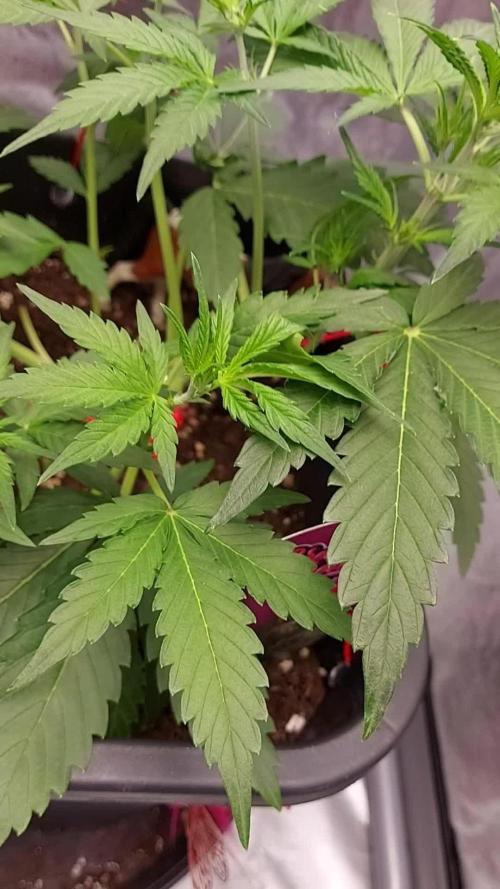
Day 29 - Things going along nicely .... i trimmed down some of the bigger bottom leaves, i didn't have enough soil to fill the pots, and the plants are short, bushy, weird little things, that filled out the inside of the pots..... they are only 15cm tall, but the leaves are 10+ cm .... really weird little plants.... haha....
i decided to trim the fk out of one of the ones in the double pot, and practiced topping on her.... i'll cut her down maybe trimmer her of the pot, and focus on just the 2........ they seem to be still growing upwards, so i'm not in a hurry to put em into flower mode......... on the main one i noticed some neut deficiencies ... so i upped the neuts.... should be ok, i put a good heavy neut and it stopped the spots etc..... i think some bug or something got in the double pot and is livin in there, but he doesn't eat much, haha....... the main stalks are as big as my thumb and under each canopy is all the branches..... it's really strange, to go in under all the growth and see it all .... they look kinda small, but the entire under canopy of leaves is all full .... i'm moving the huge sized leaves out and pulling each branch up over them as they grow..... this is 21 THC and 19 CBD, so it's all the good stuff for medicine ... the smell is getting abit noticable and i'm hoping the exhaust fan arrives from china soon.... just got positive ventilation into a carbon fil. ... and daily air out........ i think i had the led lights too low..... so i'll raise em abit more and see if i can get em to stretch ....
Day 30 -- added some video's...... daylight vids... worth watchin for a laugh ...... first grow, so idk what i'm doin, ... any help/comments appreciated
Day 32 -- added some pics of the late night trim and LST,... idk looks ok....
Day 34 -- added a video...
Likes
35
Share

@squalino
Follow
📖 Chroniques de l'Oasis : La Marque Blanche du Sahara
👑 Chapitre 4 : L'incroyable déploiement de la sultane
Date : 19 Mars 2026
Âge de la Sultane : Jour 28 (Fin de la 4ème semaine de croissance)
Taille : 27 cm
Je continue ma marche. Le sable glisse sous mes pieds de nomade, mais mon regard ne quitte plus cet horizon où la tache blanche semble m'appeler. Dans mon oasis, le temps s'accélère. La petite pousse que j'observais hier est devenue une Sultane impériale, prête à régner sur son royaume, son oasis.
🏹 Le Domptage de la Reine : Mon LST
Mes mains de jardinier-nomade ont travaillé avec patience. Grâce au LST (Low Stress Training), j'ai courbé la structure pour forcer le destin. Le résultat dépasse mes espérances : 10 branches secondaires vigoureuses ont jailli du tronc. Chacune d'elles se dédouble déjà, me promettant une canopée de 30 têtes. je lui ai débarrasser deux feuilles de sa robe qui frôlait le sol pour éviter tout problème de brulure ou de champignons pour que sa croissance rzste vertigineuse.
Je vois déjà le tableau final se dessiner : une armée de fleurs régulières, une géométrie sacrée qui portera bientôt ce givre légendaire . C'est une croissance incroyable, une explosion de vie que je guide jour après jour.
🏜️ État de l'Oasis
Le climat est celui des journées parfaites au pied du Rif, là où l'air est pur et la lumière généreuse.
Climat : 24°C - 25°C le jour / 20°C - 21°C la nuit.
Humidité : 55% (L'air s'assoit légèrement, parfait pour durcir la fibre).
Énergie : Intensité montée à 75% (La Lumatek tape fort, comme le soleil de midi).
Distance : Réglée à 87 cm de l'apex pour que chaque branche secondaire reçoive sa partie de lumière.
Nutriments Apportés (L'Élixir de vie)
Aujourd'hui, j'ai préparé l'élixir qui soutient cette croissance massive :
Hydratation : 0,5 Litre d'eau (Ajustée avec précision à un pH de 6,3).
Offrande : 5 ml d'Orgatrex.
Mon observation : En versant ce mélange, je sens que je nourris la terre et l'âme de la plante. Elle boit ce nectar organique pour transformer la lumière en branches solides.
📜 L'Anecdote du Rif : Le Secret des "Multiples Têtes"
Au Maroc, les anciens du Rif disent souvent que pour obtenir une résine "mielée" comme la Beldia, il faut que la plante "regarde le ciel par tous ses membres". À l'époque, ils ne connaissaient pas le LST moderne, mais ils inclinaient parfois les plantes avec des pierres pour que les branches latérales s'élèvent comme des minarets.
Aujourd'hui, mes 30 branches de têtes sont mes 30 promesses de richesse. Chaque nœud de la Sultane est une étape de plus sur ma route de nomade vers la Marque Blanche.
Note du cultivateur : "28 jours de voyage... La Sultane prépare son armure. Le chemin est long, mais le joyau est à portée de main."
à bientôt pour le suite de la chronique.
merci a tous pour vos commentaires.

Likes
11
Share


@GREENPHOENIX6262
Follow
Week 2 Flower 09/04
Bllimburn Apple Fritter - Seedsman Critical +2.0
39 - 40inches - Increased Raw NPK feed ( Phosphorus - Potassium ) 2 teaspoons per gallon on each with Cal Mag, Flower Fuel and Floranova Bloom.
Flowering processing accordingly.
*End of week update 09/09*
Both Apple Fritter and Critical are flowering accordingly.
3-4 Inch height increase
Budsites looking healthy - No signs of deficiencies from nute feeds
Main Colas were aggressively LST's to avoid light burn.


Likes
7
Share


@Reaper
Follow
the plants are not too leafy but still need a bit defoliation around week 3 and 6 of flower, depending on how u grow this ofcourse next time i would bend them more in the net. anyway the buds are rockhard even at the bottom where there was no light.


Likes
34
Share


@The_Bearded_Grower
Follow
Welcome to week 5 of flower. Things have gone very well so far a tiny amount of burning on a leaf text but I have corrected it before it became a real problem. I cut back the nutrient level to 2 mg of micro Bloom and flour as opposed to three and things seem to be going pretty good. The bud sites are fattening rather nicely considering it's only going into week 5.

Likes
2
Share

@THEFROZEN710
Follow
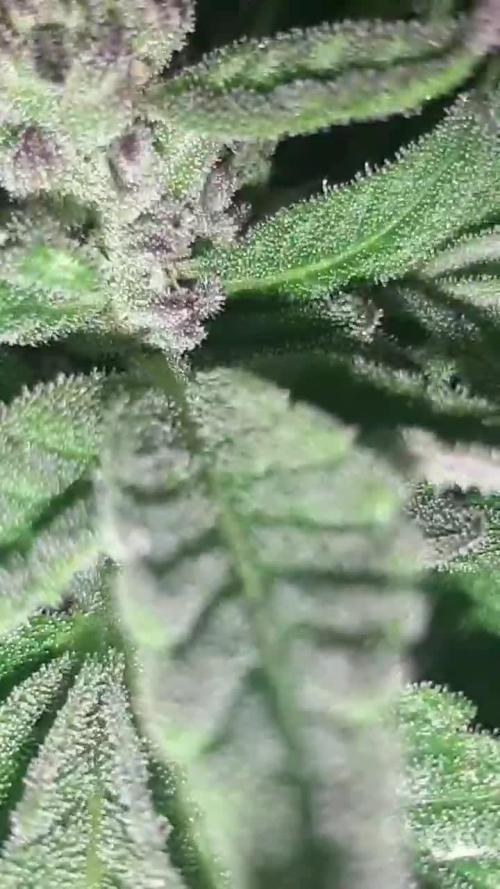
This phenotype #4 was removed from the grow tent after 2 weeks of veg due to a deficiency I'd never seen before. From what I've researched, it could be sulfur; it didn't seem to be a disease, but it produced excessive resin.

Likes
2
Share


@EtnoGrow
Follow
this is the beginning of the 4th week along with the publication of the end of the 3rd week, this is how the fourth week is received, another intensive pruning that has no choice but to do it due to the size of the indoor, which is working great for us and we believe that I will always work like this, I am happy, here then the pruning of its results a little before and after and how it is receiving this fourth week, with the threads I touch a little bit of hair I hope it does not affect much but all in favor of opening the field to all the branch buds alike.WE CHANGE THE MESH FOR A BETTER ONE AND OF THE IDEAL SIZE AND AGAIN WE USE THREADS THAT HELP US VERY WELL, WONDERFULLY


Likes
8
Share


@Mr_nugs_lover_David
Follow
She's looking stunning on her 2nd week, very healthy, no issues at all, developing perfectly, let's see how she keeps developing, this is gonna be very funny! I'm gonma enjoy a lot training this ak 420 phenos from seedstockers!

Likes
6
Share


@Black_Widow
Follow
Привет садоводы
Кажется цветок вырос отличный, просто красавица
и наверно он уже готов
еще несколько дней после полива и финиш

Likes
62
Share


@Chucky324
Follow
Hello.
I've harvested the Mega Mouth. WOW!!! I'm very impressed with this strain. Over 1.5 k for 5 plants. and it was finished by Aug 20 with the tents help.
I'm trying some new (for me) categories to add to my report.
Plant Stretch (PS) 1 to 5- 1 is hardly any stretch.
Bud Mutation (BM) 1 to 5- 1 is a beautiful normal bud- 5 is big weird growths like foxtails.
Trim- How easy or hard it was to trim up 1- you blow on the branch and hang it up. 5- Is very hard to trim takes a long time.
About- Best guess on the THC % (I've been smoking a long time)
Resin- 1 is super slippery 5- is very sticky like Gorilla Glue.
Size of Buds (SOB) 1- is very small 5- is the biggest buds
Dense- 1- is the lightest or fluffiest 5- is the rock hard buds your bud buster has trouble busting up.
Plant #1 Wet Trim 1647 g
PS. 3.5
BM 3.5
Trim 4
About 21%
Resin 4
SoB 4
Dense 4
Finished Dry Weight 289.5 g or 10.33 oz.
Plant #2 Wet trim 1606 g
PS 3,5
BM 3.9
Trim 4
About 22%
Resin 3
SoB 4.7
Dense 4.3
Finished Dry Weight- 302 g or 10.78 oz.
Plant #3 Wet Trim 1635 g
PS 3.7
BM 3
Trim 2.8
About 20%
Resin 2.8
SoB 3.7
Dense 4.5
Finished Dry Weight- 314 g or 11.21 oz.
Plant #4 Wet Trim 1753 g
PS 2.5
BM 2.5
Trim 3
About 22%
Resin 4 Falls off easily- Clumpy
Dense 2.5
Final Dry Weight- 343.5 g or 12.26 oz.
Plant #5- Wet Trim 1787 g
PS 3.5
BM 3.7
Trim 3
About 24%
Resin 2.5
Dense 2.5
Finished Dry Weight- 355.5 g or 12.69 oz.
The taste is sweet and smooth to go down with a nice balanced buzz. There was some pests around. I found thrips damage in veg and got some Spinosad to take care of that. Saw some fungus gnats around but they didn't do much damage. Easy to grow and trim. This is a recommended strain.
Chuck.

Likes
21
Share


@SupremeTimmy
Follow
the week passed splendidly, the bushes began to bloom and the smell was crackling
the plants develop very well, I continue to water them with clean water and do not use chemicals.
I removed the large leaves that were inside, on the sides I left now the light penetrates better in the middle

Likes
16
Share


@JohnnyBlaze
Follow
Week 7 of flower starting today for this amazing Green Gelato Auto and man she's fattening up fast these last weeks and she's stacked with trichomes ..
When opening the tent I can smell a gassy citrus smell with some sweet earthy tones too just like they describe thid strain on the site ..
So for now i will slow down feeding considerably and then flush this bad girl with ph'd water and flawless finish..
Really pleased to have this strain for Christmas time its going to be straight 🔥
Thanks everyone for passing by and showing love hope you have a great Sunday tomorrow and Happy Growing to you all!!!
Update Day 80: Hello everyone i inspected her with the lens and i saw even too many amber trichs on the buds this means the THC is already decreasing in favour of CBN so i decided to cut this baby tomorrow at night time so will post more pics after cut then going to make a final harvest update with the dry weight !!
She will be hanging drying after a nice wet trim at 60%rh and 20 C for 5-7 days or till the stems nearly snap..
Thanks for passing by and leaving a like my friends hope you have a lovely week!!

Likes
2
Share

@Nebuloso420
Follow
21.05.2026
What can I say?
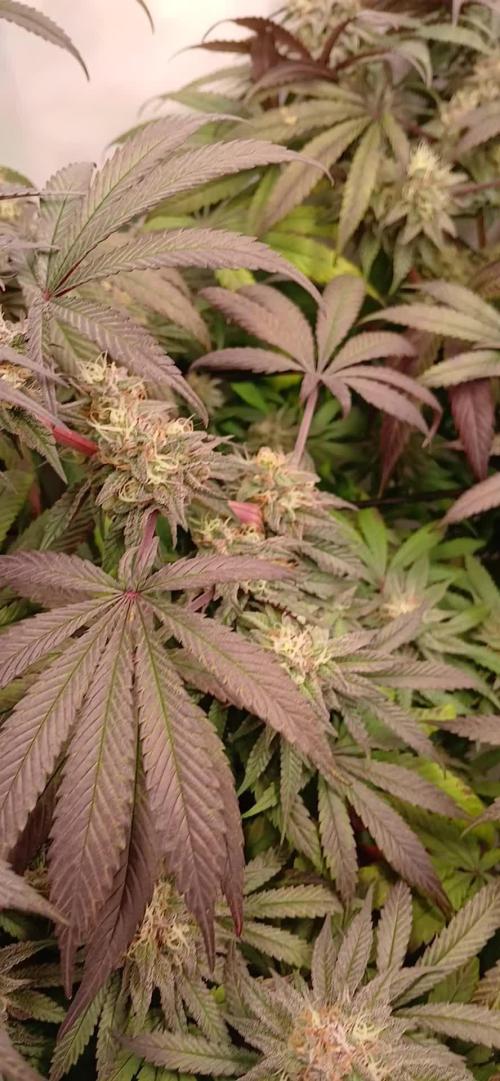
The SuperLemonHaze x Pink Candy is really a vigorous, strong growing plant with a great smell.
With beautiful colors. Its a pleasure growing this plant. Fuck I Missed Out, but it turned out great. She
is stacking up now and the best time begins. Asking myself if I should lower nitrogen already,
which means in my case stop using Biobloom, which also means lowering P/K from this source.
22.05.2026
Gave her 2 liters of water today with only 2g of CompactorBloom on 2.5liters water wich gave me an EC of 1.6
CompactorBloom is a powder wich contains 0-0-60 and is applicated 1 time a week.
Hope my microorganism soil life dont gets fucked and at this moment I think it would have been better to split up the amount on two waterings.
I never watered with an EC over 0.9 before.
Decided to finish Nitrogen at this point because she only has about 2weeks left and its comes from organic sources only.
wont flush this run.
Likes
7
Share

@Alex_mir_doch
Follow
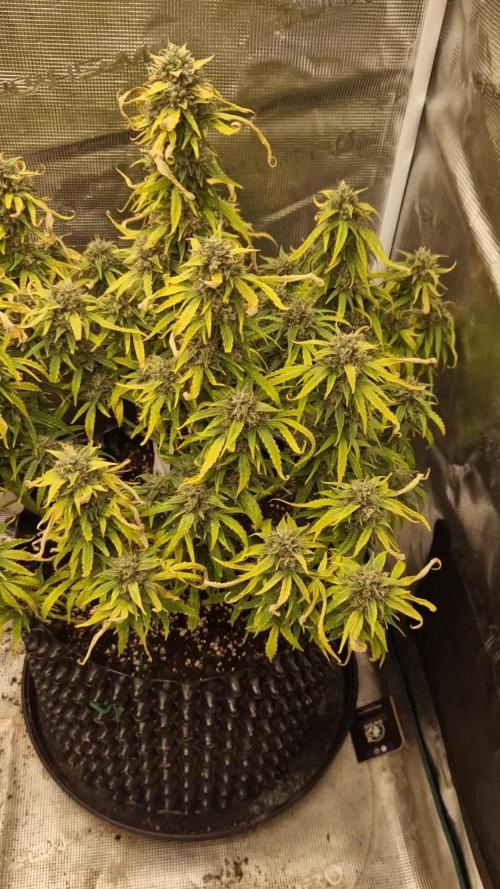
anfang blütewoche acht. es wird die letzte sein. ab jetzt gibt's nur noch ph reguliertes wasser. ein wenig dicker sind die buds noch geworden und die trichome sind durchgehend milchig.


Likes
83
Share


@yan420
Follow
More information and details later, look at previous week for full grow info
Likes
38
Share


@Green_Mountains
Follow
End of week 1. All 3 plants have their true leaves. The stems seem to be developing nicely but I was hoping for more leaf development. I still need to create more humidity. My exhaust fan still vents too much of it.
I added a second camera and I hope to start adding some time lapse videos.
Overall a good week! Still trying to learn my environment and tweak where I can!

Likes
118
Share


@Njanne
Follow
They are taller than me now... I think they stretched. I am insanely excited to see these ladies go to flowering. The veg stage is completely out of control!
You can see that I've added a soak hose to the garden to later the roots over night. I want to make sure the roots receive total saturation to bring nutes all the way down to the deep roots.