




Likes
6
Share


@MissSolasolita
Follow
End of week 1 of flower
Started LST today
She is doing very well
The other Bruce Banner in shared pot is in full flower by 1 week and measures 41 cm

Likes
13
Share


@Andres
Follow
a plant very resistant to everything highly recommended...uff .... a knock out plant an earthy taste and pine ... with a dense smoke ...... and of compact and abundant buds ... a 4x4 all-terrain plant ... 100% recommendable ... with their healthy roots....00


Likes
12
Share


@Lushbloomz
Follow
After a comeback, the train is in the station! Even though I broke the main stem, she was an easy grow. I just basically let her do her with great results. Buds are thick and dense. Time for the drying and curing.


Likes
19
Share


@Budha420
Follow
Oh boy my first ever harvest is making its way💜💚
Day 61: So these girls have been fattening their budsites and #3 isnt mad about how close the light is😅 these plants have really strong resistance and amazing genetics 🔥
On that note highly recommend Fastbuds seeds. First ever grow and these seed did not let me down. Amazing frost, incredible resistance againts overfeed and high temp (also low).
Plant #1 and #2 are further into flower than #3. 3 has still almost 90% white hairs and definitely non tris that are cloudy. 1 and 2 however have almost all hairs turned to beatiful dark orange🧡 They still have ways to go before harvest. Might start flushing soon.
Day 63: Morning fellow growers 🌅 💜
Checked trichomes this morning with my quite annoying small ass 30x lens. Almost impossible to see them but by the looks of it, atleast on lower buds almost all of em al clear. So imo they have still time to get fat 😎 i think ill start flushing when i see cloudy tris on top buds atleast 90% and chop down when 75/25 cloud/amber.
So far my first grow has gone very well all things considered! What to remeber to do for my cookies and runtz, is that i will keep the cannopy level so i dont have one 120cm plant and two 60cm plants😂 also i have doubts about my offbrand light. Prolly will see 2 harvests trough and see if both times i get skinny nugs i will switch it out😎 stay lifted💚
Day 66: harvest is getting closer but seems like trichomes are mostly glassy still. Been feeding normally but cut the gro out this week. So only calmabg bloom and micra. Ph round 6.1. It seems like buds wont get that much denser or wont do much anymore. Would love some opinions what to do at this point!
Edit: since growquestions are bugging, decided to harvest 1 top from 2 plants. Just to see hows the high and some closer looks. Seems like i might be a day or two early for my liking but opinions and comments are appreciated 💚


Likes
2
Share


@World_Breeders
Follow
Crunch — Week 3 | Vegetative Stage
Crunch is now entering her third week of vegetative growth, showing noticeable progress compared to last week.
The plant continues developing a strong vertical structure, with large fan leaves and increasingly active lateral branching. Several new growth sites are becoming more visible, giving her a fuller and more defined appearance.
The foliage shows a generally healthy green color, while the fresh growth at the top highlights her ongoing development.
Her internodal spacing remains relatively open, and the overall structure is starting to reveal some interesting characteristics.
Another week of progress, and Crunch is beginning to show her personality. 🔥
Seeds by World Breeders
Cultivated by Piperoots 🇲🇦 🌱🔥

Likes
4
Share


@Skinnytalls420
Follow
Day 32-26/08/22 these baby’s are looking good will start to give biobizz bloom on next watering tomorrow!! Can’t wait to smoke this!!! Really looking forward to it

Likes
5
Share


@BelgianBudtender
Follow
Hey growmies,
first week of flower and i pushed my comfort zone and defoliated a lot, I also taken off most lower nodes, as my previous plants have always had a bit too many popcorn buds.
Weaved most of the branches through a trellis, I need a better one but it still worked out okay.
I will probably be taking off the odd fan leaf every now and then for the next few weeks, aswell as ill try to keep her as even as possible
theres very little signs of flower yet, so i think she'll be stretching soon
That's it for this week Growmies,
I am looking for a reputable seedbank for Black Diamond Kush, a strain I fell in love with after I bought it in a Candy Store in Flatbush, NYC the week I met my Wife, I would really like to grow it myself and chase that nostalgia, If you know of any HMU

Likes
13
Share


@NuttyYeti
Follow
Well I was a little late to water this week and she was looking say. She perked back up but the leaves got a little crispy. She might not be the prettiest but the buds are looking good.
Likes
8
Share


@Eyesweedshot
Follow
Hello everyone. so the growth causes me some concerns from what I believe I have identified as a deficiency in calmag but I have trouble getting out of it despite a second spray with 1ml of calmag/li at ph 6.5. yesterday I watered adding 0.8 calmag/litre (biobizz) I'm waiting 2/3 days to really panic.
on the other hand, the stems are really big and suggest a robust plant and the well erected leaves reassure me about the overall health.
I take all your advice with great pleasure.
thank you all.
Likes
190
Share


@Ju_Bps
Follow
Hello growmies 👩🌾👨🌾🌲🌲,
👋 More and more frosty but I don't like how buds are turning, look a bit heat stress and turning too much foxtail, I don't like..
But ok, don't want said will be bad stuff.
Temperature are hot summer is there, sometimes I've peak to 32*C in box...
💧Give water each 2 or 3 days
1,5l Water + Nutri NPK Bloom
1,5l Water + Nutri NPK Bloom + Sugar Royal
PH @6
- Nutri NPK
Bloom
1/2 tsp for 1 gal.
💡Mars Hydro - SP 3000
100% 38 cm.
🔥 Thanks community for follow, likes, comments, always a pleasure 👩🌾👨🌾💚🌲.
Mars Hydro - SP 3000 💡💡
https://www.mars-hydro.com/sp-3000-samsung-lm301b-greenhouse-led-grow-light
NUTRI NPK 💥🔥
https://www.nutrinpk.com/product/npk-mix-pak-for-4-to-5-plants-cannabis-fertilizer/
Sweet Seeds - Mimosa Bruce Banner XL Auto 🌲🌲
https://sweetseeds.es/en/autoflowering-seeds/3232-mimosa-bruce-banner-xl-auto.html

Likes
5
Share


@Bigsmokes420
Follow
Another good week both strains are reacting well to the techniques I’m applying so far no problems and loving this grow.
Likes
2
Share


@TeamBudz
Follow
Small experiment just to see how much it’d yield , good fill in for the tent

Likes
1
Share

@Amboss
Follow
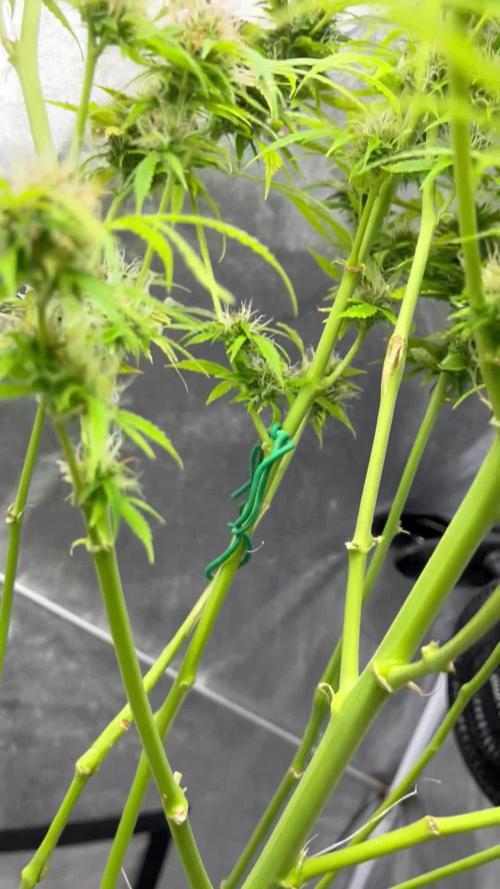
The Beast is growing… i give her another week
She is really big and Drinking Like in all inclusive Hotel💪💪💪only water

Likes
57
Share


@BudBoutique
Follow
Welcome to Bud Boutique Grow Diary - really appreciate all your love and support :)
Dont forget to check out my other current grows!
🗓️ This Week:
- Day 52: the end is near
- Day 53: Trichomes check from #1 and #2 - looking super good almost all cloudy, a few amber and clear. perfect point to chop
- Day 54: this one is finished, let's chop them both #1 & #2 !! ✂️✂️✂️
- both phenos got still super purple beautiful leaves
- now its time to dry inside the tent at about 60%rh and less than 20°C/68°F trying to get it even lower for the next 10-14 days
Thank you for still staying with me 💚
___________________________________________
--- 🌱 Strain (Sponsor) 🌱 ---
🏷️ PEACH GIRL by Art Genetix
https://www.artgenetix.world/product-page/peach-girl
--- 🥗 Nutrients and Feeding (Sponsor) - (APTUS Ambassador) ---
🍸 APTUS: full nutrient schedule extreme
-- Regulator, N-Boost, P-Boost, CaMg-Boost, K-Boost, Allin1 Liquid, Startbooster, Topbooster, Enzym+ every feeding
-- Fulvic-Blast, NutriSpray as Foliar each once a week
🔗 https://aptus-holland.com/
--- ♻️ Grow Control (Sponsor) ---
TROLMASTER: TENT-X + LM14 Light Adapter to dim/sunrise/sunset lights + Temp & rH Sensor all remote on App
🔗 https://www.trolmaster.eu/
--- 🚿 PetraGrow (Sponsor) ---
CannaFogger Foliar Spray
🔗 https://www.petratools.com/product/petragrow-cannafogger-atomizer-new-mini-fogger
--- 🏭 Grow Setup ---
💡LUMATEK Zeus Pro 600
* 🏠🌿 Indoor: Homebox 120x120x200cm (4x4)
* 📐🌀 PrimaKlima exhausting Fan 1180m3/h (running on 60-80%)
* 🌀 Can Light Filter 800m3/h & 1x Fanbox 1x Dyson fan for Air circulation
🔗 https://lumatek-lighting.com/zeus-600w-pro-29/
🔗 https://primaklima.com/de/shop/ventilatoren-de/ec-ventilatoren/pk160ec-tc/
🔗 https://canfilters.com/products/filters/
All Likes and comments are highly appreciated!!!
👨🌾 don't forget to check out my Instagram for daily educational content: budboutiquee
- Bud Boutique

Likes
23
Share


@RadDad
Follow
Manifold week 4 update.
Morning all,
Okay lets get the bad stuff out of the way. I think I'm having issues with my soil PH. My Northen Lights x Big Bid Auto has turned a shade of bright green but our girl Blu has some odd colouring in leaves so think the PH of little Blu may be out of wack as well. I've got a new PH meter coming today so I should be able to get a better picture of the problem. I'm hoping it's a minor issue and can be resolved with some neutral watering.
Alright on to the manifold. We're up to three nodes :) three more to go. I'm following Nebula Haze's manifold technique so I will need 6 nodes before I top our girl back to the third. So far I don't see any signs of stretching and shes enjoying the new Mars Hydro light. Shes in the tent with her sisters now so loneliness isn't a problem anymore.
This week we're going to give a little extra water to flush the soil and start monitoring PH and TDS more closely with my new meters.
Still a long way to go.
Happy Growing yall.

Likes
13
Share


@BB_UK
Follow
I’m not too happy with the rate of growth but I knew I would be as I didn’t put dynomyco in (purposely) I’ve been feeding every 2 weeks (top feed) with Phyco myco (started last feed) and am seeing some beneficial changes! But will see in time just how much! I was 1” ahead last time and 10” ahead the time before that! So will be running the organic fertiliser next time with dynomyco and just feeding water and seeing the outcome of that! Autos are my testing ground now! As I know exactly what to do with photos! 😉 plus I feel I wasn’t to go back to 19-5 or even 18-6