


Likes
Comments
Share


@AfroBlooming420
Follow
First medical marijuana grow ever.
I have gardened most of my life but marijuana is a whole different animal. I have organic bone and blood meal and tomato fertilizer (npk 4-3-8) that I was planning on using but my grow tent kit came with BioBizz Indoor Try Pack with Grow, Bloom and Top Max fertilizers. I think I may use my fertilizer on one and BioBizz on another to see which works best.
Wish me luck!

Likes
42
Share


@MrJoint
Follow
✌️🎃 Thank you for checking my cultivation.
😍 The fatter of all in growbox!
😬 I burned some leafs because of feeding, but she’s beautiful yet.
💧 Watering with Ripen for start roots wash.

Likes
2
Share
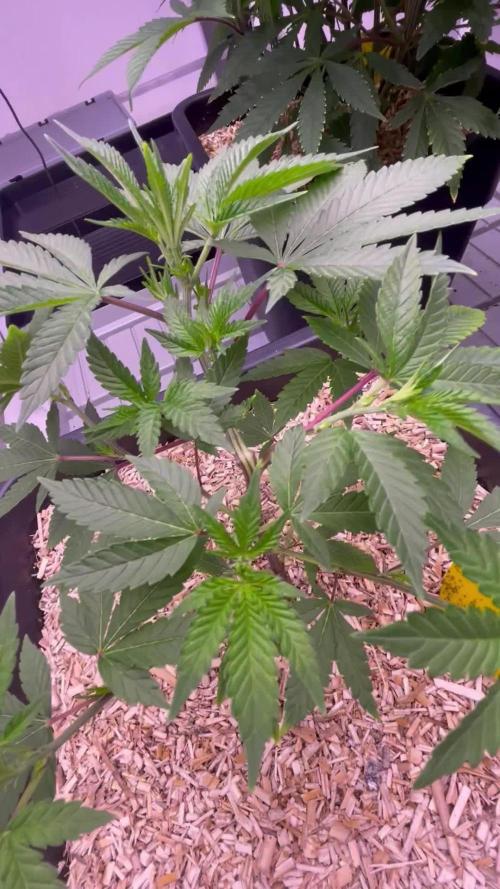

@LastinG
Follow
After the first update of the “Testrun of the new Setup!” grow, things have started to settle in nicely. The plants have recovered from the early establishment phase and are now putting their energy into building structure, stacking branches, and filling out the canopy. The differences between the genetics are already becoming very obvious.
The two larger plants are clearly taking control of the room:
* Rainbow Melon (top left in the overview)
* Nectar (bottom center)
Both are showing vigorous vegetative growth with strong lateral branching and healthy leaf development. The canopies are becoming increasingly dense, and the internodal spacing remains tight, which is exactly what I was hoping to see in this setup.
Meanwhile, Something Good (top right) is developing at a slower pace. While noticeably smaller than the others, it remains healthy and continues to push new growth. Sometimes the slower starters end up becoming the most interesting plants later in flower, so I’m curious to see how this one evolves.
Rainbow Melon
Rainbow Melon is currently showing the most balanced structure in the tent. The plant has developed a wide, bushy profile with multiple strong tops emerging across the canopy.
The leaves are broad and healthy with a rich green color, indicating that the living soil is doing its job. Branch development is strong, and the plant is responding well to the environment without showing signs of stress.
At this stage, the goal is simply to keep opening the canopy and allowing light to reach the interior growth sites. If she keeps this pace, she should become a serious producer once flowering begins.
Nectar
Nectar is proving to be the powerhouse of the run so far.
The plant has exploded with vegetative growth and is building a very dense canopy. The top-down view really shows how aggressively she is filling her space. New growth is vibrant and vigorous, and the branching structure suggests she will respond extremely well to further training.
Defoliation and canopy management will likely become more important over the next couple of weeks to maintain airflow and prevent overcrowding.
For now, though, she’s looking exactly like the kind of plant that can dominate a room if given enough space.
Something Good
The smallest plant of the group is still finding its footing.
Compared to Rainbow Melon and Nectar, Something Good is developing at a much slower pace, but the growth remains healthy and symmetrical. The leaf color looks good, the stem structure is strengthening, and fresh shoots continue to emerge.
Rather than chasing size, the focus here is simply maintaining healthy growth and allowing the root system to establish itself. There is still plenty of time for this plant to surprise me later in the cycle.



Likes
10
Share


@Dthebudguy
Follow
We got life and two are getting closer I’ll use this diaries for one only

Likes
16
Share


@NSABND
Follow
Day 66 ... the weather get´s more worst too cloudy and cold at night 😱😫😵... so i decide to harvest today 😃👍
Now "Hilde 2.0" is hanging in the dark in the basement and can dry... I'm curious to see how the harvest turns out 😃🙌🙏
Day 2 drying in the dark 😃👍
Day 3 still in the darkroom 😜👍
Day 4 drying out go on and i think 8 or 10 days to go 😉
Day 5 drying is not finished... darkroom romance 😂👍
Day 6 still darkroom vibes 😃👌
Today I trimmed the harvest and then weighed it, with a total weight of 122.9 grams. I'm happy with the result.😎👍👌...smoking report in 4 weeks 😃🙏
Likes
120
Share


@Hologram
Follow
OK, im doing an update now becouse my breakup cake is going tranny!!(hermie)
I already have noiticed she was not growing as strong .. but u can blame that on anything , especially when growing outdoor..
but this morning i saw that she was g(r)oing 'bananas'!😢
I have put her aside from the rest (in the back of garden) but think gonna have to terminate her asap!..(and i will, right after this post👍)
The weed she will give will be filled with seeds and those seeds will be hermies too, so wothless..
and if i dont throw her away quick she can infect the rest.
So goodbye breakup cake..😢
who wants to eat a cake when they are breaking up anyway..😒 (just hiding my pain with lame humour 😳)
happy growing for all ✊

Processing
Likes
12
Share


@GanjaFarmerGrow
Follow
She is Going GREAT!!
BIG Seedbank gave us a BIG auto plant...
the branches are bending and i have to hold them up...
feeding is very minimal as I said this is a BIO grow...
hope she goes good until the end...
fingers crossed...🙏

Likes
4
Share


@Wescoas
Follow
I thought the ladies would have another 2-3 weeks left in veg, but started to notice pistils forming within the last couple of days. So flower will most likely start to begin within the next week, I’m guessing I may see a couple oz per plant come harvest day. Not bad for first time grow & using autos, from what I’ve heard a lot of people do not recommend learning with autos due to how quickly their state can change depending on what you do with them. There are some things I wish now I would have done a bit different within the last couple of weeks, I can’t help but wonder how much bigger they’d be if I did not do any defoliation at all. But I have been combating flies bad and made the call to defoliate mainly for that reason. Started to cut back on veg foods and introduce flower foods and sugars to their diet. Humidity levels still at a steady decrease, aiming to have humidity down in the 30s come flower time. Will be going on vacation for a week soon, so fingers crossed that nothing goes wrong. Will be having a good friend of mine come by every couple of days to FaceTime me and make sure everything is handled as well as possible when the time comes.

Likes
3
Share


@drewnagy0510
Follow
Very well growth and very fast very strong Indica great taste around 11 oz yield four and a half months total good cannabinoids drying was a lot longer than normal

Likes
13
Share


@NanoLeaf
Follow
Started Training Late!
Was on summer holiday for a week and only started training now. Above are the plants during training as well as a few hours after training.
Autos are definitely more delicate and the two runts are growing slow but yet still showing some progress.
Changed my bulbs back to the CMH set to 400w each (2)
Also gave them a good amount of water as the FloraCaps aren’t covering the whole pot I felt like it was necessary to wet the entire grow medium well for a change.
Some of them were a bit far along for training but I did the best I could.
Also the Purple Lemonade and 2 other plants are showing signs of flowering.


Likes
14
Share


@Kendoda
Follow
Feed 1
Grow 1ml, bloom 3ml, topmax 3ml.
Feed 2
Alg-a -mic 3ml.
Feed 3
Grow 1ml, bloom 3ml, topmax 3ml.
Three feeds of 1 litre.


Likes
9
Share


@Knorke14
Follow
PH 5.8
EC 1.2
Everything is going very well. This week, defoliation and training were done for the first time.
I look forward to any feedback!

Likes
15
Share


@UDUDUDUDU
Follow
Planted de seed, usually I'll do a hard germanation, but I want this plant to just be natural.
When de sun set, pot & seed goes inside, dey come out for sunshine when it' is warm & bright enough.

Likes
31
Share


@SolitudeCorners
Follow
Can't wait to blazeeee
Feeding💪
10/17 Water30L+Cleanse80ml+calmag@190ppm
Ph6.3
Ebb 10.42/11.32/12.26/13
Clone 11.35/12.21/13.05/14
Average runoff ec1.5
Keeper 300ml per pot
10/18 Water26L+Flawless90ml+calmag@300ppm
Ph6.3
Ebb 11.38/12.24/13.17
Average runoff ec1.2 ph6.5
Clone 12.38/13.56/15.20/16.10
Average runoff ec1.5 ppm750
10/19 Water26L+Cleanse80ml+calmag@200ppm
Ph6.3
Ebb 11.12/11.48/12.24
Average runoff ec1.4
Clone 11.50/12.12/12.37/13.37/14.40
Average runoff ec1.3 ph6.6
10/20 Water30L+Cleanse30ml+Calmag@190ppm
Ph6.4
Ebb11.42/12.22/13.20/14
Clone 12.40/13.20/14.20/14.45/15.15
Average runoff 1.2ec ph6.4-6.7
10/22 last light day
10/23 2 Pm Cut and hang
Plan 21day at 23temp 55rh

Processing
Likes
113
Share


@PEAKYPLANTERS
Follow
my experience with these strains has not been one of the best .... in the last few weeks there has been a sharp increase in temperatures making things very difficult ...
very slow growth for coockies considering that in the same tent I had 3 other autoflows that had been ready for a few weeks.
discrete power .... almost light ... lighter flowers inside the buds ...
ABUNDANT HARVESTS FOR ALL OF YOU ... FRIENDS
PEAKYPLANTERS GREETS YOU
Likes
32
Share


@WhiteWidow
Follow
Tuning in kinda late as you can see they all trained down and spreaded around the pot.
Feeding regular water coz i put biotabs in the soil, going organic this time to try to seek that difference in the taste and aroma.


Likes
16
Share


@ButterfliesLittleFarm
Follow
Hello Diary,
Epsilon F1 is the fifth hybrid F1 strain from the Royal Queen Seeds lab that grows on my small farm.
This time, all three plants on the farm are Epsilon F1, but the soil mix in which they grow is different.
But before I describe the preparation, a few words about the strain itself.
EPSILON F1:
Epsilon F1 is the fastest of all of our F1 cannabis seeds, and combines genetic traits from some of the most notable cannabis varieties of the last decades, including Blue Dream, Blueberry, Amnesia Lemon Haze, and Black Domina.
She boasts delicious aromas, plenty of cannabinoids, and, like all RQS F1 seeds, unrivaled stability, resulting in a uniform crop that consistently produces buds of unwavering quality.
Plus, her autoflowering trait and extra-fast flowering time make Epsilon F1 an ideal choice for growers focused on getting to harvest as quickly as possible.
Epsilon F1 features a rich aroma that combines hints of fresh herbs and citrus with full-bodied earthy notes and touches of blueberries and lavender.
Epsilon F1 is a mid-strength variety, consistently producing solid levels of THC and a terpene profile dominated by myrcene, farnesene, ocimene, and limonene.
Not only do these terpenes impact Epsilon F1's delicious aroma, but also its effects,
endowing it with a long-lasting, physically relaxing stone that soothes the entire body (predominantly courtesy of myrcene, linalool, and farnesene), mixed with an uplifting, motivational kick (from limonene).
SET-UP ON MY LITTLE FARM:
Box - Secret Jardin DS120W 120x60x178
Lights - MIGRO 200+
Ventilation - TT Silent-M 100
Filter - Primaklima filter PK 100/125
Fan - Oscillating Koala Fan X 2
Humidifier - Beurer LB 45
Soil - BioBizz Light - Mix
Pot - 11L Air pots
Seed - Royal Queen Seeds
Nutrition - RQS Organic nutrition
Let's officially start the diary:
02/08/2023
Planting. I prepared a total of three pots, as usual.
And this time I used AirPots, which proved to be the best option. I've been using them since the beginning.
I used the soil from BioBizz Light-Mix.
Pot #1 - I first put Easy Boost Organic nutrition in the form of pellets into the ground, then I added SeaWeed and Mycorrhiz in the recommended doses and mixed everything well.
Pot #2 - I also put in Easy Bosst Organic nutrition, Seaweed and Trichoderma. Also in doses according to instructions.
Pot #3 - Along with Easy Boost Organic nutrition, I put Bat Guano and Trichoderma.
After I prepared the soil, I soaked all the pots well with water and made small holes in which I placed the seeds.
I then placed the pots in the Grow Box where the temperature was around 28 degrees and the humidity was around 55%.
05/08/2023
I sprinkled a little water on the surface of the soil. Not too much.
06/08/2023
All three plants sprouted.
07/08/2023
I watered the plants with a little water. Approximately 0.5 liters per each plant.
10/08/2023
Watering. Each 0.5 liters of water.
That's all for this stage, see you soon and thanks for your support.

Processing
Likes
19
Share


@michealangelo
Follow
Ventilation - Cloudline
Heating and fan - Ceramic heater
Aroma - Carbon Filter
Organic soil - includes 3 month of feeding just add water ONLY when the pot is dry otherwise you will be flooding the plant with nutrients.
Lights - LED 1000 Watts ( True Draw Power is 140watts). LED if you are worried about cost and heat, it does not emit heat like HPS.
PH meter and dry and wet meter for the soil.
Temperature and humidity gauges
PH Up and PH down to fix the tap waters PH to 6.2 before watering. (If your using tap water you must let it sit for 24 hours with lid open before watering plants.
Notes: Do NOT allow humidity to reach more than 60 percent in the room. Mold will grow on your soil.
Temperatures is high I need to bring it down to 71-75
Pots - 7 Gallon Pots
Growing two Auto seeds in one 7 gallon pot 🤞
Low stress straining
Likes
26
Share


@darb35
Follow
Day 57 - 660 ml water with calmag (ph 6.4)(92-97 cm)
Day 58 - 1L water with half dose according to biobizz schedule (ph 6.3)(93-97 cm)
Day 59 - No water (93-98 cm)
Day 60 - 1L water with calmag (ph 6.3)(93-98 cm)
Day 61 - 1L water with half dose according to biobizz schedule (ph 6.2)(93-98 cm)
Day 62 - 1L water with calmag (ph 6.3)(93-98 cm)
Day 63 - 1.3L water with half dose according to biobizz schedule (ph 6.4)(93-98 cm)


