


Likes
Comments
Share


@Weedganja420
Follow
Esta preciosa cepa ha crecido bastante rápido llegando a ser la más alta del armario, durante la floración ha creado unas increíbles flores llenas de resina que poco a poco se caían del peso de las mismas.
Una locura de genética que todos deberíamos de cultivar al menos una vez.
Espero que os guste estas bonitas fotos.

Likes
40
Share


@Ganja_Victoria_Aus
Follow
Growing Fast Finally. Almost Ready to cut few clones for friends! One friends lend me his growlush 600w Veg Led Light. 2.7umol 247 watt use.
Cruising Nicely!💪

Likes
11
Share


@Paradox_1ste1
Follow
Up to now they looking pretty good and strong, even tho some of the plants are not as dense and is maybe a bit late to date with the other ones. Ill have to give them another 1 or 2 other weeks until harvest. The trichromes look preety good even tho.in the picture dosent show well. They starting to consume less water and the leaf colour is starting to fade slightly .
Likes
6
Share


@hanspeter77
Follow
Ich hab aus dme meisten rosin geppresst, zuerst getrocknet dann bubble hash gewaschen.
Leider habe ich keinen freezedryer, würde sich auch nicht lohnen für so kleine mengen ^^
ich habe es im Tiefkühler getrocknet und danach im kühlschrank.
aber das nächste mal werde ich nur im tiefkühler trocknen dann wird es noch etwas hellerdas habe ich dann gepresst bei ca. 75 Grad für 2-3 minuten.
ich bin eher der freund von kalt pressen.

Likes
3
Share


@LittleBigTrees
Follow
Still only giving her water, still in the solo cup for now.
She's growing really nice with minimal effort 😎

Likes
28
Share

@GrowerMario
Follow
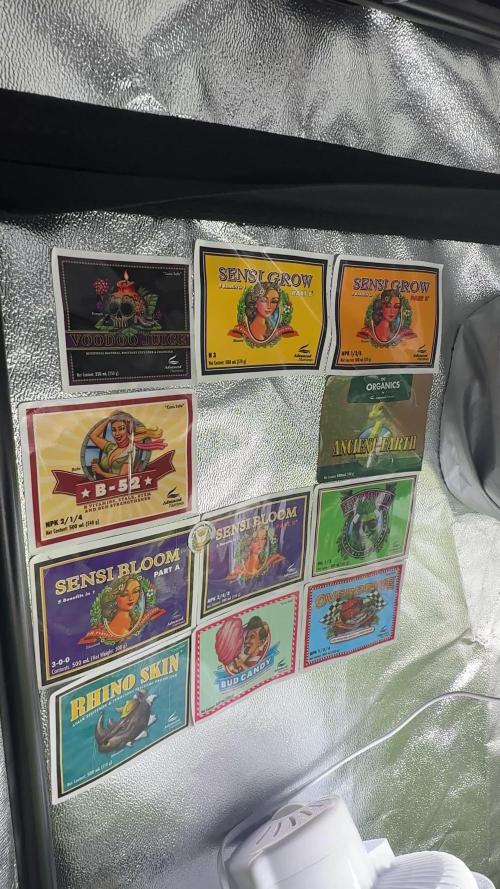
Ta fialka v prvom rade už dostáva overdrive , v tom budem pokračovať ešte týždeň a potom flowless finish s čistou vodou ako flushing . Zvyšné tri dostávajú ešte stále big bud a chuti im ? sú nádherne zacukrovane , už sa teším na harvest
@MedicGrow
@Fast_Buds
Likes
1
Share


@BroTanicGrow
Follow
Overall for now I'm already pretty smashed by the outcome for my first indoor grow attempt so far! 😎


Likes
7
Share

@Xipsiomega1
Follow
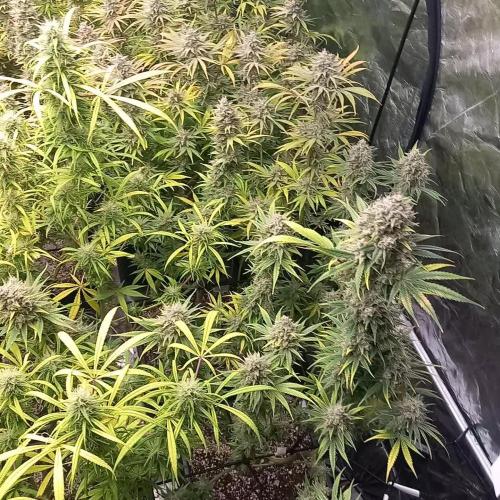
End of week 9 in bloom (day 62), so far so good. Buds starting to mature (except one Malawi plant), leaves are yellowing, trichomes are getting milky so i am waiting... Just 3 liters of water every 4 days. I think i have 1-2 weeks before harvest the first one. Will see

Likes
12
Share


@DeepRootsGrowTrees
Follow
MIMOSA by ROYAL QUEEN SEEDS
Week #14 Overall
Week #13 Veg
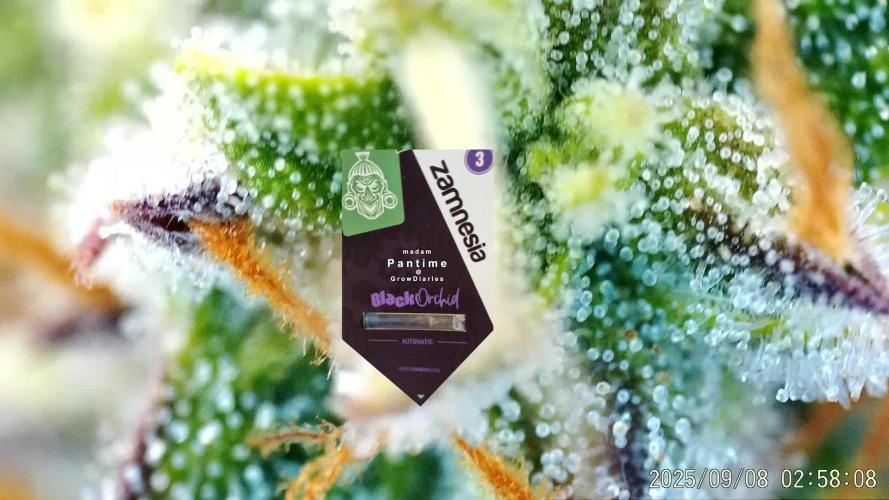
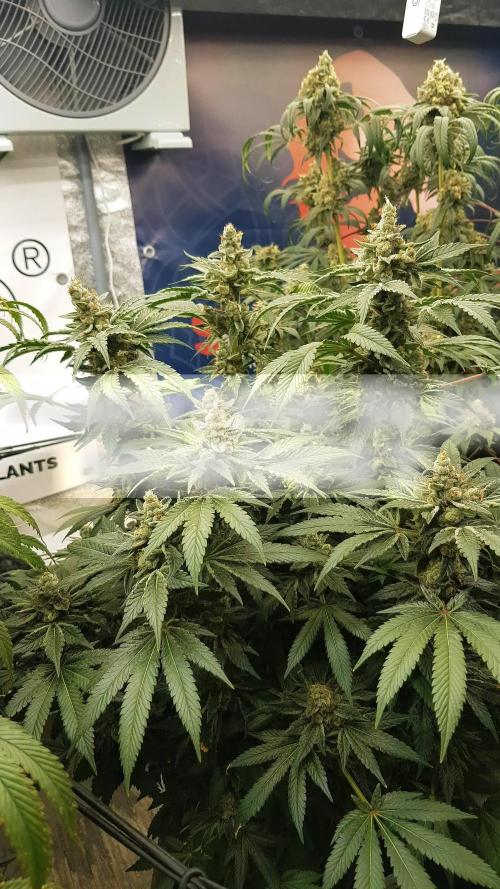
This week no real issues to report the sun did get to her a little bit had to move her to a new location other than that she's a strong plant to grow she's one that can take some heat.
Stay Growing!!




Likes
15
Share


@420TouristguideDWC
Follow
10/5 Day 31.
I've added a dehumidifier now that the plants are starting to show signs of pre-flower or flower. Maybe one of the expert growers can let me know. :o)
10/6 Day 32.
I did some more defoliation to open up the air flow at the base of the stem (mini lollipoping). I also re-arranged the pots and lifted the air pumps so that I could have more room for training them. This should also improve air flow. I moved the rotating fan so that it is pulling air from the lower tent intake. Move the 6'' hurricane fan so that it is blowing down at the center of the tent. More LST training after giving everyone some more "elbow" room! I will allow them to recovery for a few days after the defoliation, but will keep adjusting the LST wires.
- Added 1 gallon of purified H2O to each plant. No signs of any deficiencies on the leaves. Nice and Green with new nodes popping up (I think).
Red - PH 5.54 TDS 703 EC 1.459
Blue - PH 5.77 TDS 735 EC 1503
Yellow - PH 5.6 TDS 693 EC 1.482
Blue (runt) is finally showing a growth spurt and has almost caught up to Red who seems to have healed from the partial stem tear. Yellow seems to still be the front runner in size and horizontal stretching. I will continue to train them until they definitely show signs of vertical growth and bud formation. At that time I will switch over their feeding to decrease N and increase P & K. SO far the GHE products are doing well, I might switch over to advanced nutrients for the next grow.
Roots in all 3 pots are filling up and are still nice and white. Thankfully I am able to keep the water temp around 74-75 F. The UC Roots product is doing it's job as well.
As of right now I'm not using any type of extra CO2 generator, but have watched some videos on You Tube on making a DIY.
I wish there was more community involvement on questions and the need help section of this site. Also a lot of the You Tube sites that claim to cater to the "beginner grower" seem more interested in their "hip" music selection, video shots of their plants, and talking a lot of nothingness just to get viewers, verses providing quality content to really help the newbie growers. Ok off my soap box. I am really enjoying this grow and today after spending about an hour in the tent it was quite relaxing and therapeutic tending to the plants. 😊
10/7 Day 33.
Rest in Peace Eddie Van Halen! Your influence in rock and roll will always be remembered!
Feeding day! I am liking the 4 day schedule giving them 1/2 of the weekly recommended amounts per a consensus of growers who all say it's better to feed a little less, and make any additional increases as needed. The extra day helps to spread it out too. Also the importance of looking at the plants daily to see if there are any issues. Yellow is drinking more water that the other 2 and is still the front runner in overall growth and size. To think Yellow almost didn't make it past the seedling stage due to a "stretching bend" injury during week 1.
- Amounts total in 4 gallons. UC Roots 8ml, CalMag 5ml, Micro 6ml, Gro 2ml, Bloom 6ml. These amounts are overall as the pots have 4 gallons of water in them. I adjusted to pot size in the description above. I made some small adjustments to the LST wires. All of the plants are now competing to who will become "Top Cola." I've also decided to name the plants per their growing pot color. Ruby, Bertha, Yuki. I picked Bertha as she was the runt, hopefully the name with inspire a great weigh in on dried flowers!
10/8 Day 34.
Plants showing some signs of heat stress. I raised the lights up 2 inches. Now that I'm in flowering, heat and humidity reduction will get more of a focus. Tested the PH and it dropped to 5.2. I re-calibrated the pen just to make sure. Since they are starting to really drink more water I added 1/2 gallon of regular tap water that had been de-chlorinated. Checked PH 3 hours later and it is back up to 5.8. I have some PH up solution that I use for the aquarium, so will decided if I should adjust PH with watering using purified store water to lower PH and tap water to raise it since I anticipate them needing a gallon of water added every other day. Or I could just PH up the store bought water.
10/9 Day 35.
Heat stress seems to be subsiding, but have noticed a few of the leaf tips are showing signs of nute burn. Overall they are looking great. I will monitor the leaf's for any additional issues. I know autoflowers like to be under feed compared to what the fertilizer companies recommend. I might look at going to a feed every 5 days using 1/2 of the recommended feeding amounts, along with seeing what the plant leaf's, water chemistry is telling me. As this is my first Cannabis grow it feels like I'm trying to "learn how to fly this particular model while I'm building it!" Anyone else feel like that on their 1st grow?
10/11 Day 37.
All is growing well. Added a mixture of store water and tap to make adjustments to PH dropping. Each girl needed 1 gallon of water. Flowers are starting to grow :O)
Ruby - PH 5.0 TDS 786 EC 1.651 (added PH up water to correct and an extra dose of 5ml UC Roots)
Bertha - PH 5.96 TDS 858 EC 1.831
Yuki - PH 6.09 TDS 753 EC 1.725
Week 5 Lessons Learned:
1. Bought some Botanicare Silica Blast for the next grow.
2. Need to ensure the lid holes for adding water, and the air stone line is placed correctly with the water level sight guage. Yuki (Yellow) will need a new lid for the next grow.
3. More and a bit larger bore drill holes for the LST tie down points on the edges of the lids.


Likes
4
Share

@Black_Widow
Follow
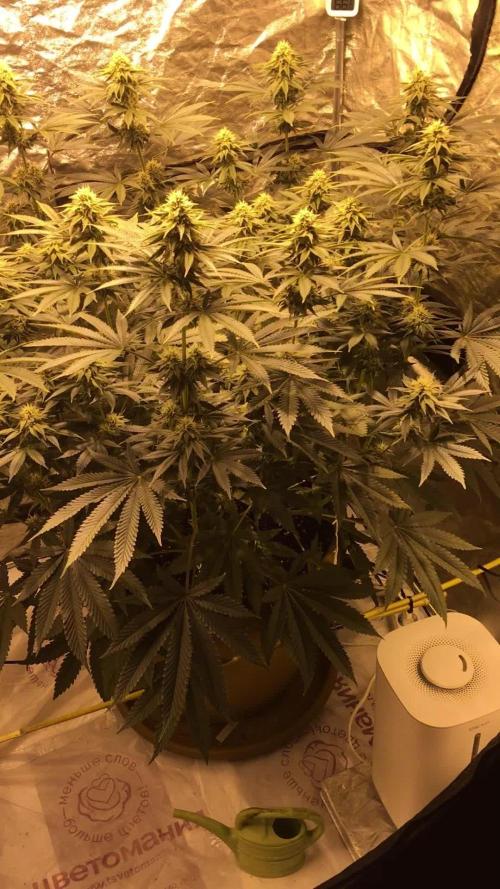
Привет садоводы !!!
Началась новая неделя
Растение чувствует себя хорошо
сегодня я полил ее чистой водой из скважины
поливать я стал ее чаще ,примерно 1 раз в 3 дня по 5 литров
эта красавица источает сильный запах во время цветения
Likes
3
Share


Likes
21
Share


@Staffedition
Follow
Привет друзья. Моей растихе сегодня 88 дней.
Растение почти пришло в себя.
20.10 буду переводить на цвет.
Начал применять LST технику на 19 дне и продалжаю применять её через день, а 18 августа добавил ДЕФОЛИЗАЦИЮ
С 20.08 ДЕФОЛИЗАЦИЮ делаю каждые 3,4 дня
С 20.08 LST технику делаю каждые 4.6 дней
На сегодняшний день влажность 54%
5.09.2023 заметил высокий Ph 7.9
С 48 дня Ph не ниже 5.8
На сегодняшний день Ph 6.0
Начал кормить с 60 дня Canna Terra Vega
PPM 450
Всем мира и добра!
Не забудь поставить лайк❤️, если понравилась как прошла неделя
И читайте наш TELEGRAM: https://t.me/smail_seeds
#Smail_Seeds 😀

Likes
2
Share


@Ultraviolet_
Follow
18 hours in seconds, 60x60x18 = 64,800 seconds, now multiply by the 833μMol/s reading off the PAR metre. μMol/s (micromol) is the unit in which P.A.R. is expressed.
64,800x833=53,784,000μMol
53,784,000μMol = 54 Mol
54 DLI @ 800ppm, powerful combination. Pushing photosynthesis to peak capacity, accelerated growth and increased biomass. Applied net, stretching her around for a week. Maintaining a minimum air velocity of 0.3m/s within the inner canopy.
E=MC2 looks like a simple multiplication problem; it describes a fundamental physical truth: mass and energy are the same thing. The equation doesn't just calculate a value; it reveals that mass is effectively "congealed" energy. Energy is just numbers. Energy isn't a physical "substance" you can hold or touch. It is essentially an abstract, calculated number that we assign to a system to predict how it will change, interact, or move. A numerical label we attach to matter to track how it behaves. Because the universe runs on laws of symmetry (specifically, that the laws of physics don't change over time), a single global number must be conserved. We call that number "energy".
How well a seedling grows is down to how much knowledge one can acquire to increase the level of conversion to occur. Applying knowledge effectively requires intuition, which comes from hands-on experience. A seasoned stoner learns to read subtle signs—like a slight change in leaf turgor (stiffness), subtle color shifts, or the specific texture of the soil—before a textbook diagnosis can be made. Ultimately, growing is the application of botanical science blended with active observation. Knowledge dictates your potential, but adaptability and attentiveness to the plant's immediate environment determine your results. The human eye is capable of distinguishing more shades of green than any other color in the visible spectrum.
1.618
Nature mathematically optimizes quantum energy transfer and light absorption efficiency within the photosynthetic machinery, as it naturally dictates energy scaling hierarchies and resonance dynamics. External vibration or electromagnetic wave that perfectly matches a plant's natural frequency directly influences plant growth. Low-frequency sound waves and targeted electromagnetic fields stimulate cellular processes and boost photosynthetic efficiency. An angular frequency aligned with the Golden Ratio is often used in wave mechanics and quantum physics to optimize energy transfer.
Does it produce better yields? All I know is the IVM loves being aligned with it. Here is how I "think" of it to simplify it for myself when I give it thought. Quantum is the firmware, DNA is the software read/write expression.
Alignment with that of which already exists.
Law of nature, not my opinion: Constructive interference occurs when two or more overlapping waves meet in phase, meaning their crests and troughs perfectly align. Their amplitudes add together, creating a new, amplified wave with greater intensity than the individual components.
Constructive interference is the foundational mechanism that establishes a resonance hierarchy across physical, structural, and acoustic systems.
"Frequencies utilizing this ratio naturally minimize resistance (or impedance) and allow for highly efficient resonance, which can facilitate an increase in Electron Transfer Reactions (ETR) or energy pathways in molecular structures."
Quantum coherence in photosynthesis occurs when a photon of sunlight strikes a leaf; the energy it carries must travel to a reaction center to be converted into chemical energy. This process operates at nearly 100% efficiency. If the energy moved in a traditional "bunching" or random hopping manner, a large portion of it would be lost as heat. Instead, plants utilize quantum superposition. The energy particle (exciton) doesn't just take one path; it exists in a wave state and explores multiple pathways simultaneously. It essentially "chooses" the most efficient route to the reaction center simultaneously.
Research shows that molecular vibrations and the specific network arrangements of chlorophyll molecules (like the naturally evolved Chlorophyll A & B ratios) actively protect against energy overflow, optimizing light capture across different light intensities. Enzymes are the biological catalysts that speed up chemical reactions within a plant's cells, allowing them to grow, metabolize, and repair. Rather than relying solely on the classical kinetic energy of molecules colliding, plants use quantum tunneling. Subatomic particles like electrons and protons (hydrogen ions) can literally "teleport" through energy barriers that they normally wouldn’t have the energy to climb over. This makes vital metabolic reactions happen far faster than classical physics could ever explain!
Chloryphyll b has peak absorption at 460nm (Blue) and at 647nm(Red). If we take the blue peak wavelength 460nm and a UV-B, UVR8 peak absorption wavelength 285nm, Tryptophan-285 (W285) Sensing protein. 460/285=1.618 Φ If we take chlorypyhll b's Red absorption peak 647nm and a UV-A of 400nm, we get 647/400=1.618 Φ. "Structure of light". The cryptochrome photoreceptor (CRY) is a UV-A/blue light receptor that shares this dual sensitivity with several other biological structures and functions, including significant sequence similarity and a common evolutionary ancestor with DNA photolyase enzymes. These are light-activated enzymes that use blue/UV-A light to repair DNA damage caused by UV-B radiation in plants. Synergistic.
Effective quantum efficiency of photosystem II, often denoted as ΦPSII, represents the proportion of light absorbed by Photosystem II (ΦPSII) that is actually used in photosynthetic electron transport. It is a key indicator of how efficiently a plant is using light for photosynthesis, as opposed to losing it as heat or fluorescence. ΦPSII (effective quantum yield of photosystem II) functions primarily as a "multiplier" (a coefficient of efficiency) rather than an additive factor when estimating the overall photosynthetic electron transport rate (ETR). Multipliers are considered far more beneficial than additions because they generate exponential growth, leverage existing resources to their full potential, and create sustainable, self-multiplying capacity, rather than just incremental, linear increases. This fascinating observation is rooted in the intersection of subatomic geometry, fractal scaling, and quantum dynamics. In specific molecular arrangements—such as in conjugated polymer networks or biomolecular architectures—the Golden Ratio (PHI) naturally dictates energy scaling hierarchies and resonance dynamics. Mathematically tied to the fine-structure constant, which defines the strength of the electromagnetic interaction. The Golden Ratio can be mapped geometrically as the Golden Angle (137.5 degrees) in atomic structures, linking the charge of the electron to fundamental quantum constants like Planck's constant.
An electromagnetic wave is neither electric nor magnetic, but a combination of both. 137.5
The Golden Angle (137.5) This angle is derived from the Golden Ratio (1.618). It is the smaller of two angles created when a circle is divided such that the ratio of the arcs equals the Golden Ratio.
An electromagnetic wave (like light or radio waves) is not a static electric field or a static magnetic field, it is a self-propagating combination of both. An oscillating electric field creates an oscillating magnetic field, which then regenerates the electric field. They feed off each other and travel together through space at the speed of light, carrying energy without needing a material medium.
The Fine-Structure Constant Alpha (Α/α): In quantum physics, is the approximate denominator of the fine-structure constant (often represented by the Greek letter Alpha (Α/α). It is a fundamental, dimensionless number that dictates how strongly charged particles (like electrons) interact with the electromagnetic field. Its value has puzzled physicists for over a century, as it bridges quantum mechanics, electromagnetism, and relativity.
In quantum mechanics, Omega (Ω/ω) usually represents angular frequency. When applied to "quantum coherence"—the ability of particles to exist in overlapping states without immediately degrading—is key to calculating how long these states last.
The Golden Angle, the value 137.5° is the geometric Golden Angle. It is derived from the Golden Ratio (1.618) and is famously responsible for the beautiful, mathematically optimized spiral patterns found in nature (such as sunflower seeds, pinecones, and leaf arrangements). Because of this, theoretical physicists and mathematicians have long speculated about why nature relies so heavily on the number 137 and the golden angle to govern everything from subatomic light interactions to the macroscopic geometry of the universe.
Quantum coherence allows particles to maintain superposition and entanglement. In realistic, open environments, interactions with a noisy background typically cause decoherence, destroying the system's quantum information. A major challenge in quantum physics and quantum computing is preventing this decoherence at large scales. In quantum optics and driven systems, the Greek letter Omega (Ω/ω) often represents the Rabi frequency, which dictates the strength of the coherent driving laser or electromagnetic field interacting with the quantum system.
The interaction of light and water generates specific Coherent Domains. Trapped electromagnetic fields cause water molecules to vibrate in unison at a coherent frequency, separating the liquid into structured quantum areas and an unstructured phase. When water interacts with hydrophilic (water-attracting) surfaces, the energy from UV and Infrared light can drive the formation of larger, structured layers known as Exclusion Zone (EZ) water. Exclusion Zone (EZ) water represents a structured, negatively charged phase of water critical to cellular biology. Driven by light energy and hydrophilic surfaces, this ordered state acts as a natural biological battery, with far-reaching implications for cell function and human health. In this domain, water molecules arrange themselves into a highly ordered, negatively charged lattice that excludes solutes and particles. At higher energy levels, UV light acts as a catalyst for photochemical reactions. Photons can provide enough energy to break the hydrogen and oxygen bonds in molecules, resulting in free radicals and a plasma of quasi-free electrons. This transfer of electrons forms the fundamental basis for redox reactions and energy metabolism in ALL biological systems.
Input: The energy, time, and focus you dedicate.
Process: Continuous growing, refining, and learning.
Output: A superior, highly polished final product.


Likes
146
Share


@Natrona
Follow
Apollo is coming along nicely and enjoying new friends, zkittles, gorilla cookies and granddaddy purple. All autos. Godzilla cookies is the runt.
Apollos schedule : Water & feed Tues, Thurs, and Sunday.
Increased TPS to early bloom at 9ml/g and Signal to 3ml/g. I think she could use more fertilizer but I'm gun shy on feeding too much.
I noticed the new leafs are thinner than veg leaves indicating early flower.
No pics on 10/12. My special day.
10/13 pics and video outside before first defoliation. And after defoliation.
Note to reduce impact of stress, I ground up 1 of my B vitamins and dispersed in water after feeding on Friday 13th.
Apollo is strong. Once I did definition you can really see her.
1)Very thick strong stem.
2) Very tight node structure. There was no space between the first and 2nd leaf group.
3) Side shoots almost as thick as the mail stem
4) roots at the soil top. I used MycoBliss in the soil and planting hole.
Friends, Royal Queen Seeds Is offering a discount on purchases
👉**GROWERS20** for 20% 👈
Https://www.royalqueenseeds.com
Link to Apollo
https://www.royalqueenseeds.com/us/56-f1-hybrid-cannabis-seeds
Variety: F1 Hybrid auto
Genetic Background: Lemon x Black Domina x Sugar Mangolia
THC: Very high
Yield: XXL
Height: 55 - 75 cm
Flowering time: 45 - 50 days
Harvest: 75 - 80 days after sprouting
Effect: Calming, Creative, Motivating , Physically Relaxing
Flavor: Citrus, Herbal, Lavender, Pine, Vanilla
Major terpenes: Caryophyllene, Farnesene, Myrcene, Terpinolene
Climate: Short Summers
====================================
Equipment: AC Infinity
CLOUDLAB 844 – Advance Grow Tent 48”x48”x80”
CONTROLLER 69 PRO – Grow Tent Controller
CLOUDLINE LITE 6 - Inline Fan 6"
IONBOARD S44 – LED Grow Light Board 400W
CLOUDRAY S6 – Oscillating Circulation Clip Fan
Carbon Filter 6”
Pots: 5 gallon Air pots
Soil Fox Farm Happy Frog amended with worm castings, dolomite lime and mycorrhiza.
Seeds provided by Royal Queen Seeds Check them out 😎
Https://www.royalqueenseeds.com
Link to the seeds
https://www.royalqueenseeds.com/us/56-f1-hybrid-cannabis-seeds
use Discount Code
👉 **GROWERS20** for 20% discount 👈
Nutrients: Total Plant Solution
>TPS1
>Canopy
>Signal
Amended soil recipe #2 used for soil prep.
https://www.paramountseedfarms.com/super-soil-recipes/

